Education is a major investment for anyone. But the investment looks different when you have to factor in travel to another country.
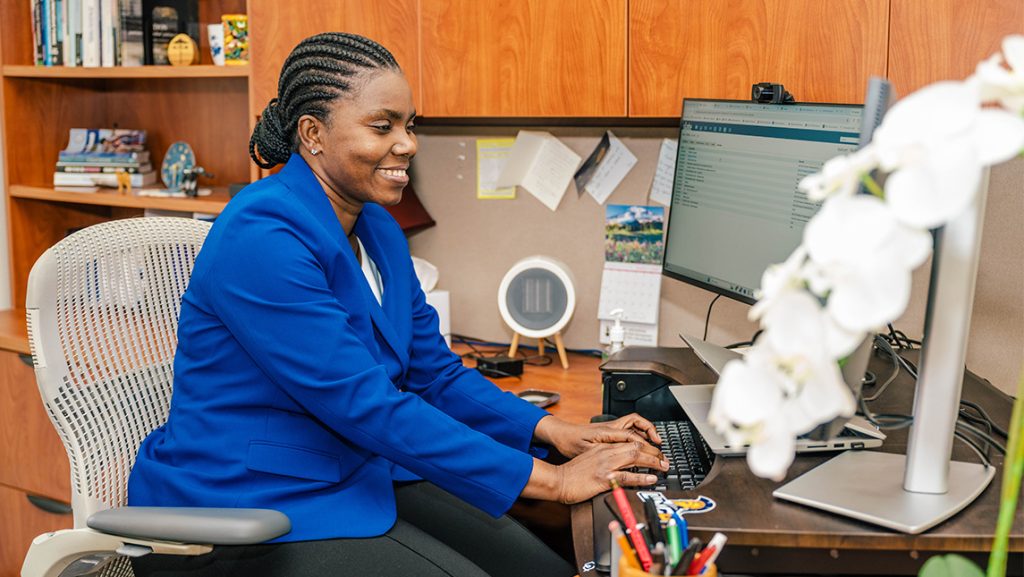
Adwoa Arhin ’24 M.S., with UNC Greensboro’s Global Engagement Office (GEO), knows this firsthand. She went through the complex, sometimes nail-biting process of traveling from Ghana to Greensboro, playing the waiting game until she secured her seat in the Bryan School of Business and Economics.
She’s put her degree and her new job as a business analyst to use improving the workflow for incoming international students, work that has earned the praise of her colleagues in GEO as well as ITS.
Processing student applications in fewer steps
Arhin came to the U.S. for her master’s in information technology and management with a concentration in business analytics. She began working for GEO while she was still a graduate student.
“And once I became a business analyst, I was put in a position to change things,” says Arhin. “I was so happy that I could change so many manual steps in all these processes.”
After graduation, she proposed redesigning the international admission workflow. Before the redesign, processing applications depended on multiple handoffs across Slate, Banner, and the Terra Dotta System (TDS). Students would upload their documents in Slate, and their visa data would be updated in Banner. Synchronizing visa data in Banner with TDS could take up to 24 hours, and only then could staff proceed with student profile creation. GEO staff — primarily graduate student assistants — often had to download the documents and upload them into TDS.
“For each student, there were about five documents moving through the process,” Arhin adds for context. Teams messages signaled colleagues to begin the next step while spreadsheets tracked each student’s status. The designated school official (DSO) reviewed the documents, issued the I-20 form necessary for students to travel to the U.S. to study, and then graduate assistants downloaded and sent the I-20s to students
Even when everything went smoothly, the process typically took 7–10 days — and if a student missed the submit-to-enroll step, the workflow could stall.
Identifying Workflow improvements
Arhin worked directly with Terra Dotta to automate many of those steps and with ITS to implement changes. Since there are fewer undergraduate international students, Undergraduate Admissions agreed to run a pilot program.
In the new process, admitted students are loaded into TDS and profiles can be created in bulk rather than one at a time. Students submit their financial documents directly in the system, and once documents are submitted, the case moves through a structured review flow — first to graduate assistants for completeness checks and then to the DSO for I-20 issuance.
With fewer downloads and uploads and less back-and-forth messaging, staff can track each student’s status more easily. “Now the graduate assistants have a lot more time to do other meaningful tasks,” says Arhin. “The system also gives us built-in reporting. We no longer have to rely on spreadsheets for reporting — the data lives in one place, and Terra Dotta can generate weekly updates for leadership on students’ I-20 status and related milestones.”
Time makes the difference in college choice and funding
Arhin says international students will see the difference. It cuts the wait time for an I-20 from 7–10 days to 1–3 days. And time matters, she says, because they can’t make visa appointments and travel plans without an I-20. A delay may also cost them funding not guaranteed for a later term, and those students may defer enrollment or just go to another institution.
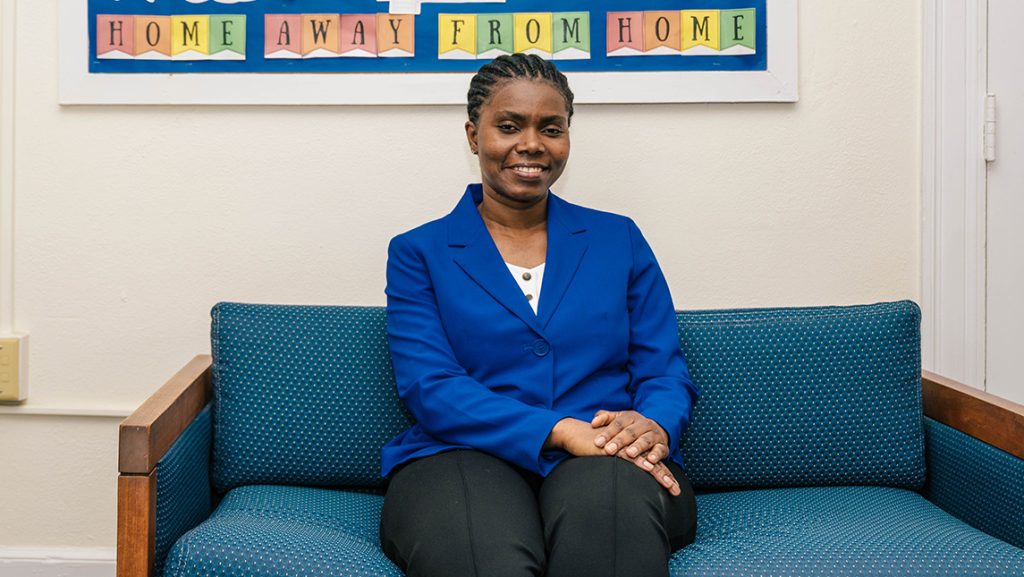
She speaks from personal experience. She applied for Fall 2022 and submitted her documents in March. She did not get feedback until July, and with no visa appointment available, she had to defer to Spring 2023. As a result, she lost her graduate assistantship.
Micah Chartier, ERP Developer student lead in ITS, says Arhin deserves to be congratulated by the University as a whole. “Her work helped remove delays, reduce manual handling, and improve consistency across systems,” he says.
Mark Silverthorn, lead business analyst for ITS, says, “Adwoa has been pivotal in implementing efficiency and data quality improvements for international student admissions processes.” He adds, “Not only have I seen an unprecedented level of dedication to the work, but she has displayed incredibly high levels of strategic thinking and kindness towards others.”
Arhin appreciates that her colleagues noticed the difference. “I’m just thankful for the recognition,” she said. “I value the work that improves services for students, that makes daily operations more effective for staff. It makes me happy and fulfilled that the work I’m doing is noticed by others.”
Arhin represents the passion and motivation of UNCG students. When confronted with a challenge, they immediately harness their skills to make the journey easier for those who come after them.