

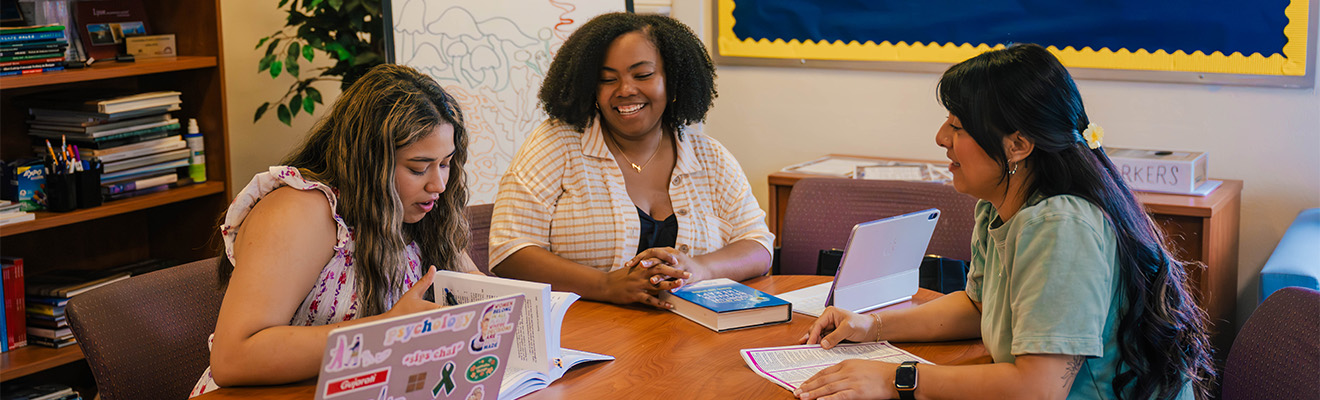
UNC Greensboro’s Master’s in Counseling prepares compassionate, skilled counselors to make a meaningful difference in the lives of individuals, families, and communities. Nationally recognized for excellence and accredited by CACREP, the program combines rigorous academic preparation with extensive supervised clinical experience, including hands-on training in UNCG’s Nicholas Vacc Counseling and Consulting Clinic. Whether pursuing the Clinical Mental Health Counseling, Couple and Family Counseling, or School Counseling concentration, students graduate ready to pursue professional licensure and provide ethical, evidence-based, and culturally responsive care in a wide range of counseling settings.
the master’s in counseling Program Distinctions
UNCG’s Department of Counseling and Educational Development (CED) has earned a longstanding reputation for excellence in counselor preparation and consistently ranks among the nation’s top graduate counseling programs. The department’s Ph.D. program reflects decades of leadership in preparing counselor educators and advancing the counseling profession. Within North Carolina, CED is rated as the top graduate counseling program and comes in fourth nationally in U.S. News & World Report rankings. The program has been rated among the top 15 in the country for more than three decades.
All three Master’s in Counseling concentrations are CACREP-accredited, the gold standard in counselor education:
*Visit the specific concentration page for more details on specific application requirements*
UNCG intentionally limits each incoming class to approximately 32–38 master’s students, creating opportunities for close faculty mentorship, personalized supervision, strong peer connections, and collaborative learning. The full-time program offers its courses during the day, between 9:00 a.m. and 5:00 p.m., allowing students to engage fully in coursework, clinical training, and faculty mentoring.
More About the Clinical Mental Health Concentration
Master’s in Clinical Mental Health students receive extensive clinical supervision throughout practicum and internship experiences. Rather than simply completing required clinical hours, students receive ongoing guidance and feedback from nationally recognized counselor educators who help them strengthen their assessment, diagnosis, treatment planning, and counseling skills.
Graduates of the program meet the educational requirements for professional licensure, gain extensive supervised clinical experience, and are ready to provide high-quality mental health services in community agencies, hospitals, private practice, college counseling centers, and other behavioral health settings.
More About the Couple and Family Counseling Concentration
Students in the Couple and Family Counseling track move beyond learning counseling theories by applying them in real-world settings. Through coursework, clinical practice, and supervision, students develop skills in relationship counseling, family systems approaches, assessment, diagnosis, treatment planning, and evidence-based interventions. The program’s focus on hands-on learning helps graduates enter the counseling profession prepared to support clients navigating relationships, family transitions, and mental health challenges.
Graduates leave the Couple and Family Counseling concentration ready to work as counselors. They may work with children, parents, couples, and families in outpatient mental health settings and in-home counseling settings. They can also work in the foster care system or with clients impacted by domestic violence and other forms of family violence.
More About the School Counseling Concentration
Students in the School Counseling concentration spend much of the program applying what they learn through supervised counseling experiences rather than only studying theory. Coursework includes counseling children and adolescents, trauma and crisis counseling, career counseling, multicultural counseling, and program evaluation, while field experiences help students build confidence working with K–12 students, families, teachers, and administrators.
Graduates of the program are prepared to serve as school counselors in elementary, middle, and high schools, where they support students’ mental health, behavioral, and academic success. They also pursue careers in alternative schools and group home settings, helping diverse student populations thrive.
The Master’s of Science counseling Student Experience
Students complete clinical experiences in a wide variety of settings, including:
- Community mental health agencies
- Hospitals and integrated healthcare systems
- K–12 schools
- College counseling centers
- Inpatient and outpatient treatment facilities
- Private practices
- In-home counseling programs
Among the clients Master’s in Counseling students work with are children, couples and families, immigrants and refugees, trauma survivors, sexual minorities, individuals with addictions, individuals with chronic illnesses, and underserved populations.
Students gain hands-on experience in UNCG’s Nicholas Vacc Counseling and Consulting Clinic, an on-campus training clinic. Beginning early in the program, students counsel real clients under close faculty supervision before moving into community internships. This integrated clinical experience allows students to build confidence and competence before graduation.
Participants in the Master’s in Counseling program will find that the curriculum emphasizes:
- Evidence-based counseling interventions
- Ethical decision-making
- Multicultural competence
- Social justice and advocacy
- Trauma-informed care
- Research-informed clinical practice
““UNCG was one of the best beginnings that a counseling professional and educator could ever ask for. With my UNCG degree, I have been able to become amazing and have influence on others so they can also become amazing. Without the interactive and challenging work that was placed on me at UNCG, always with supports of course, I would not have emerged as a strong counselor and grown into a strong counselor leader.””
– Sweety Patel, ’06

After Graduating with your master’s in counseling
Graduates of the master’s program are well-prepared for success in careers in areas including:
- Outpatient mental health
- Private counselor
- Hospital or medical setting
- College counseling center
- Elementary, middle or high school counselors
- Group homes
- Couples and family counselor
- Foster care system
- Integrated behavioral health settings
The U.S. Department of Education requires that all higher education institutions advise students as to whether their curriculum provides them with the eligibility to apply for a professional license and/or certification in the state for which they plan to practice. The U.S. Department of Education requires that all higher education institutions advise students as to whether their curriculum provides them with the eligibility to apply for a professional license and/or certification in the state for which they plan to practice. As such, please review UNC Greensboro’s status by state. You should note whether the program either “meets”, “does not meet”, or if there “has not been a determination” of the program’s status in the state for which you plan to practice. Licensure Reciprocity Information
Program Details
Degree Type: Master's
College/School: School of Education
Program Type: Majors & Concentrations
Class Type: In Person
Catalog Name: Counseling, M.S.
Similar Degree Offerings
Contact Us
CED Admissions Staff
ced@uncg.edu
336.334.3434

Scott Young
Chair of the Master’s Admissions Committee
jsyoung3@uncg.edu