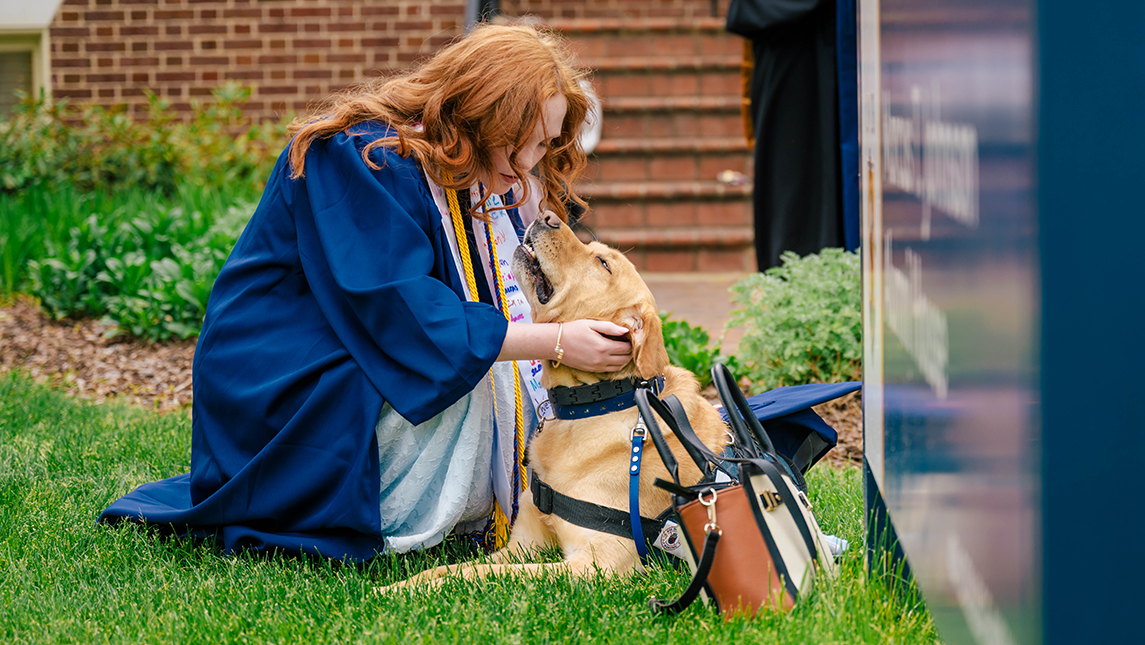
AnnaGrace Berry did not expect to find her calling in a classroom. But now, she cannot imagine being anywhere else.
Set to graduate this year with a bachelor’s degree in dual elementary and special education from UNC Greensboro’s School of Education, Berry is already doing the work she once only imagined: leading her own classroom as a long-term substitute while completing her student teaching. It is a role that may be overwhelming for many, but for Berry, it feels natural.
“I look forward to coming to work,” she says. “Teaching just fills my cup.”
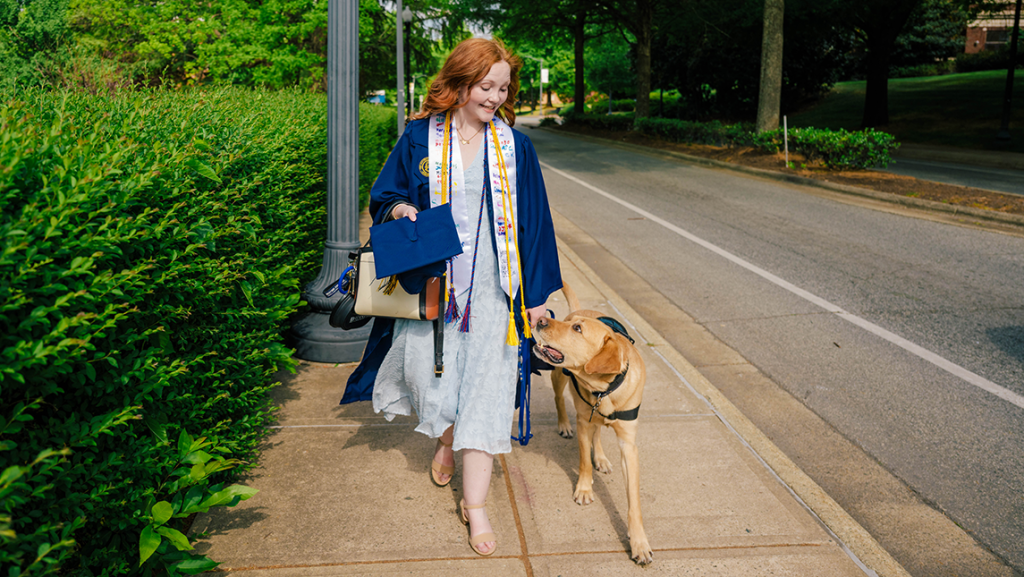
That sense of purpose didn’t come overnight. From her early experiences volunteering with Special Olympics to navigating life with Type 1 diabetes alongside her service dog, Lake, Berry has built for herself a path defined by resilience, empathy, and a desire to make a difference.
FINDING HER WAY TO UNCG
Though her parents are originally from Winston-Salem, N.C., Berry grew up in a military family in Calvert County, Md. She graduated from high school and attended community college where she pursued nursing before realizing the field was not a fit for her.
After relocating to North Carolina and attending Forsyth Tech Community College, Berry decided she wanted to become a teacher. She enrolled at UNCG in 2023, choosing the School of Education after meeting both students and faculty members in the program.
“I remember talking to education students, and they spoke very highly about the program,” she says. “When a student is speaking highly of something, that speaks volumes.”
WHY EDUCATION
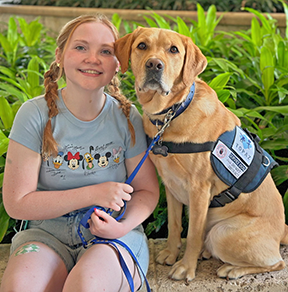

Berry was diagnosed with Type 1 Diabetes when she was 4 years old and often found herself being the child left out. Things changed for her when she began volunteering with Special Olympics. It was in this role that she found her love of working with children.
She says, “Working with kids with special needs, teaching them, working one-on-one with them evolved into becoming a teacher. I love teaching kids. I love fostering their knowledge.”
After having loving, supportive elementary teachers, Berry met a high school math teacher who noticed her difficulties with the subject. This teacher dedicated extra time to help Berry grasp the concepts in a manner tailored to her needs, even if it differed from the approach used for other students.
Berry wants to pay that forward, to be that teacher who works to make a difference in the life of a student. She says, “I want to be that person they can come to and say, ‘I don’t understand,’ and I know that their brain works differently, so I can say, ‘Let’s figure out what works for your brain.’”
While she entered the UNCG program intending to teach elementary special education, Berry has found joy in working with older students in her current role as a long-term substitute at Western Guilford High School. The position allows her to teach a variety of subjects, including English, math, and economics.
“This program is an occupational course of study,” she says. “We’re helping kids with special needs develop life skills and work skills. I do it because I love the kids and I love the topic, too.”
OVERCOMING CHALLENGES
In her first year at UNCG, Berry commuted daily from Winston-Salem before moving on campus the following year. Now, she lives in an off-campus apartment.
Berry was anxious about moving on campus due to her diabetes, but having Lake eased that transition. Her service dog alleviated her fears of sleeping through her medical alarms in the middle of the night or experiencing a diabetic emergency. If Berry’s blood sugar is off, Lake is trained to smell it and alert her early to avoid an emergency.
She says, “He’s always ahead of the machine. Having him makes me more confident and helps me trust myself. He played a huge part in me moving on campus.”
When living on campus, Berry lived in an ADA accessible room with her service dog. She found that being in a single room forced her to get outside of her comfort zone to connect with other people on campus. That is where her participation in student organizations like the Student Council for Exceptional Children was beneficial.
TEACHING EXPERIENCE
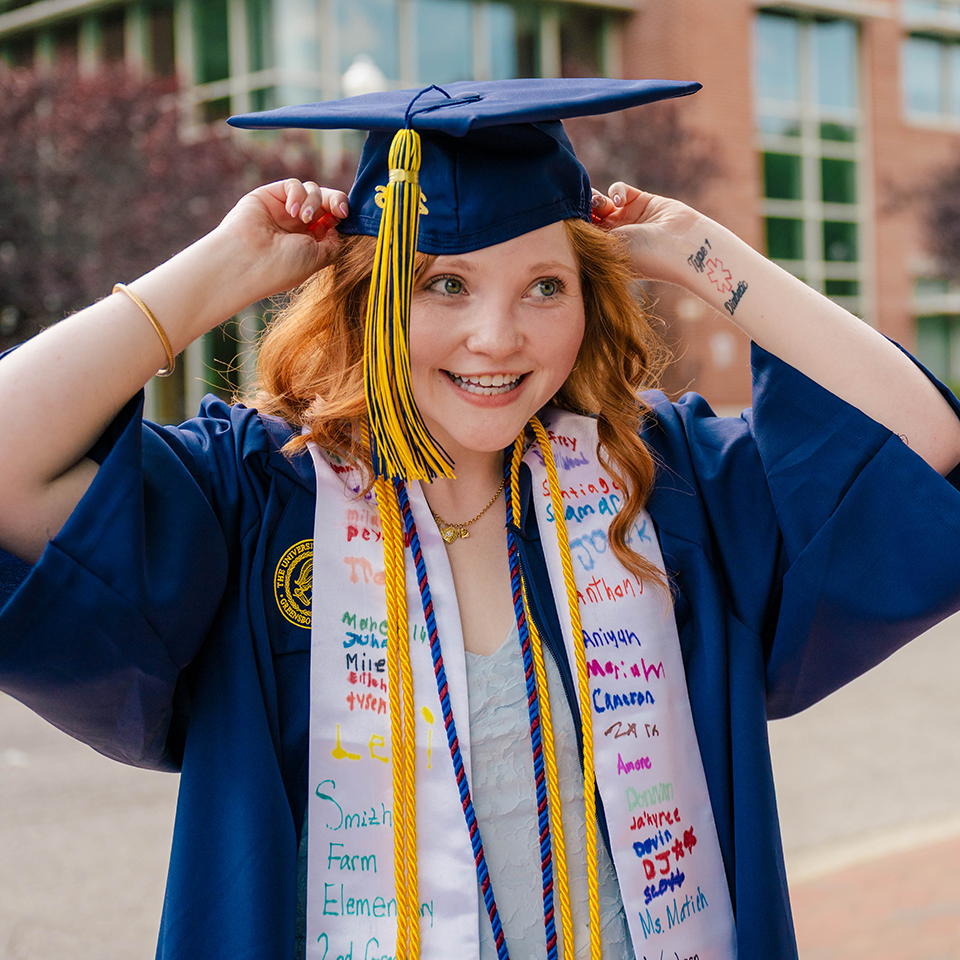
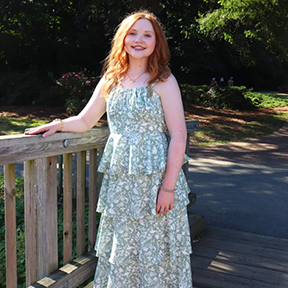
While at Western Guilford completing her student teaching requirement this year, Berry received a call from her cooperating teacher at the school over winter break. She learned that the program’s co-teacher had left the school, and a long-term sub was needed.
After speaking with school leadership and Dr. Julie Bost, Berry’s student-teaching supervisor and mentor at UNCG, she was able to step in to become the classroom’s long-term substitute in February.
Despite being younger than the faculty and not much older than some of her students, Berry has felt welcomed, respected, and supported from the beginning.
“They talk to me like an adult,” she says. “Sometimes as an intern or student teacher, other staff members might talk to you like a college student. But they’re asking me about what I want to do after college and if there is anything I need. I can go to my cooperating teacher if I don’t know how to teach something to the students.”
While Berry is teaching, Lake has a mat where he lays nearby. If he needs to alert, he will come to her. Her students understand that Lake is a service dog, and she uses his presence as a teaching opportunity — presenting a small lesson about his work. She will also allow students to occasionally pet him, but only after they have completed their assignments.
LOOKING TO THE FUTURE
Berry hopes to remain at Western Guilford in a full-time capacity next year. But wherever she goes, she just wants to be teaching.
“I can honestly and truly say, that as long as I’m teaching, I would be happy,” says Berry.
Looking ahead, she is planning for her career after being in the classroom. She wants to pursue a master’s degree in curriculum and instruction while working. That degree would allow her to help design and implement curriculum, possibly at the state level.
But until then, she wants her students to know that she is always a place that students can turn if they need a break, someone who always greets them with a smile.
Story by Chris Rash, School of Education
Photography by Sean Norona, University Communications; and courtesy by AnnaGrace Berry, School of Education
CELEBRATE OUR GRADS!
Graduates and their families are encouraged to share their accomplishments on social media by tagging the University accounts and using the hashtag #UNCGGrad. Visit UNCG’s digital swag page for Commencement-themed graphics and templates.
Mention @UNCG in celebratory posts on Instagram and X and @uncgreensboro on TikTok.