UNCG’s two greenhouses elevate research opportunities for NC scholars
Did you know UNC Greensboro has a desert? And its own tropics? Four stories up in the Sullivan Science Building, research is growing.
“Watch your step,” April Harris cautions as she opens the door to the tropical room of the teaching greenhouse. Even on a cool and dry morning, its floor is very slick.
The difference between the greenhouse’s three chambers is palpable. When you first step inside, the weather closely matches what’s outside, a prime environment for native North Carolina plants. But take a dozen steps to the right into the desert, and you’ll feel the hot sun beating down on your shoulders. Take care not to brush your arm against a cactus plant. Move a dozen steps to the left, and you’ll feel like you’ve been transplanted into a rainforest.
Putting the ‘green’ in UNC Greensboro
For Harris, greenhouses provide something textbooks and slides cannot. “It’s one thing to look at a diagram or a picture on a PowerPoint,” she says, “but to actually pick up that plant and look at the structure and things like that, it’s beneficial to have hands-on learning.”
UNCG students and faculty, primarily in the Biology Department, study how plants thrive in different climates. Harris, the greenhouse manager, came to UNCG with a bachelor’s in biology and a master’s in plant physiological ecology. She is a vital player in keeping their plants in peak form.
Her daily tasks include following each plant’s watering schedule, removing dead leaves, and spraying for harmful pests. Harris says she does a lot of “reading plants,” i.e., watching how they respond to daily care. “I know it sounds funny, but I can just look at plants and know, ‘You need this or that today,'” she says.
She has also added to the teaching greenhouse’s inventory over time, adding and phasing out plants to align with the needs of professors. For example, this past semester, they used the unique shape of the Chinese money plant to teach undergraduate students about leaf structure.
Growing Solutions through Research
Alongside the teaching greenhouse at Sullivan, which serves more foundational classes for undergraduates, Harris manages a larger research warehouse two miles down the road.
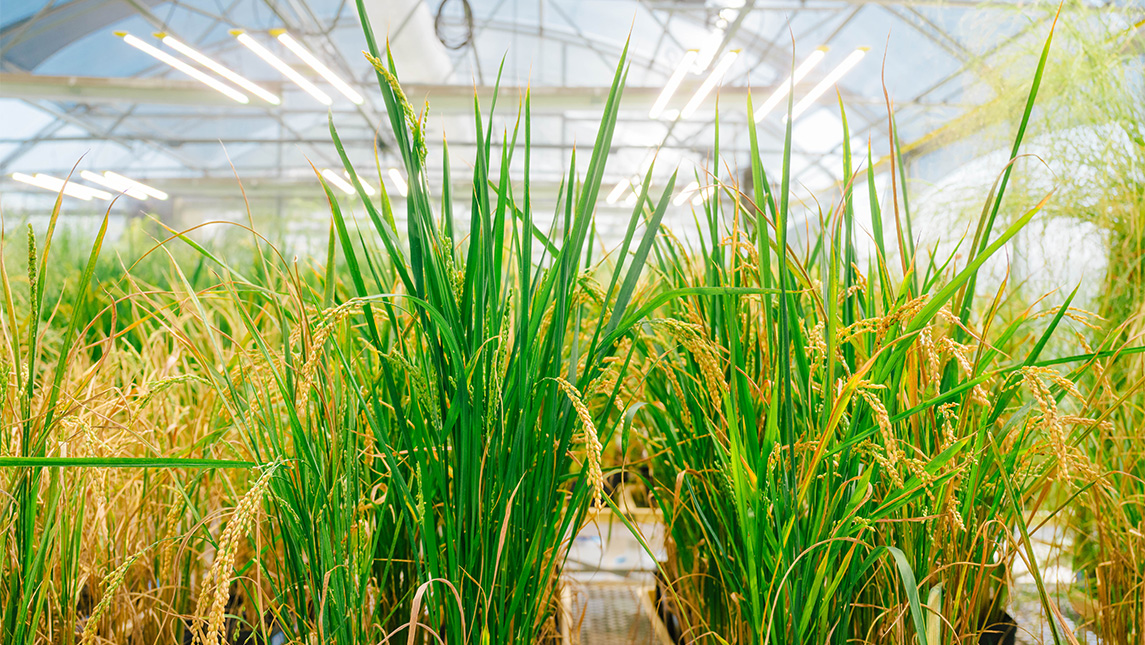
There, faculty and graduate students grow the samples they need for their projects. Rows of tef stalks, a grass crop native to Ethiopia, tower overhead from upraised beds so Dr. Ayalew Osena can study ways to increase its yield. In another section, doctoral student Jordan Winter has watering rigs dripping water through a layer of longleaf pine into soil cups to simulate how rain reaches the understory of forests.
Their findings will ultimately go toward creating solutions to real-world issues like food insecurity, disease, forest restoration, and effective sustainable practices.
Story by Janet Imrick, University Communications
Video by David Lee Row, University Communications
Video editing by Jeff Castillo, University Communications