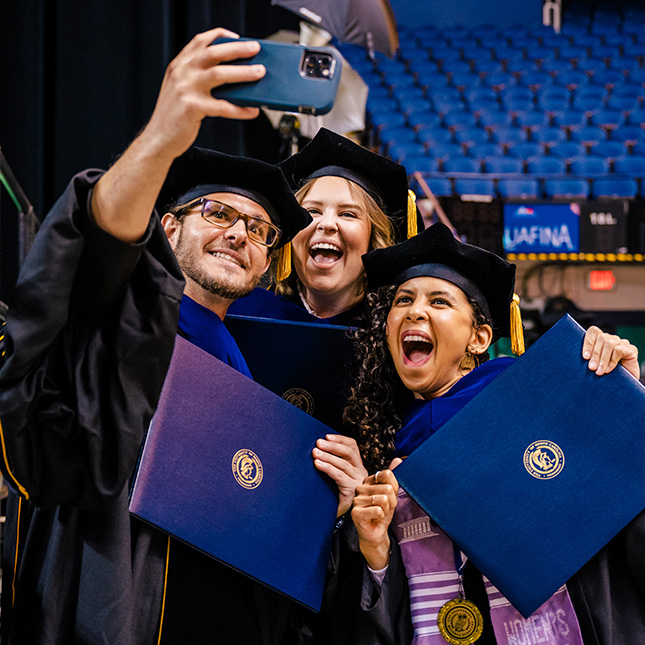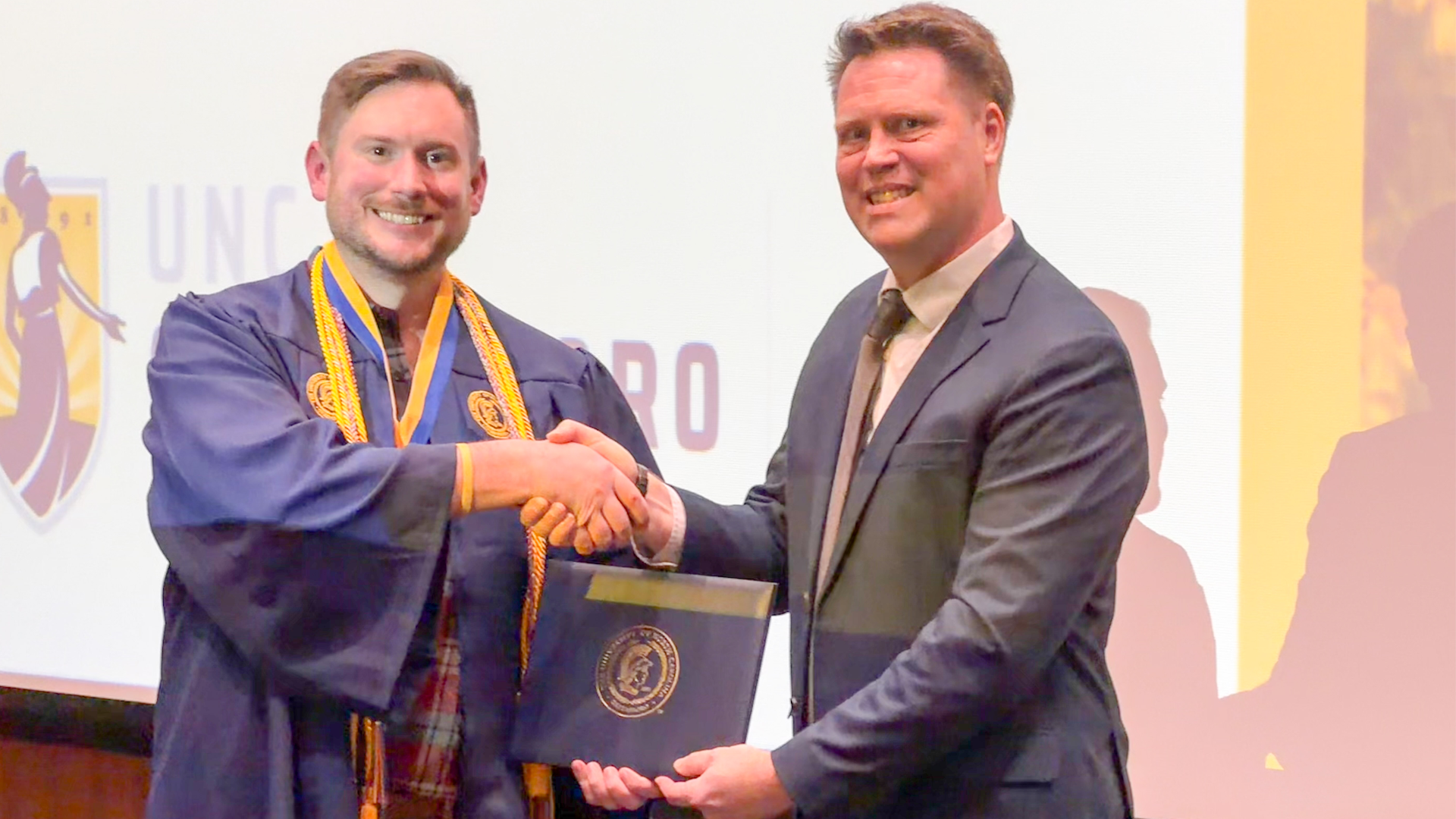
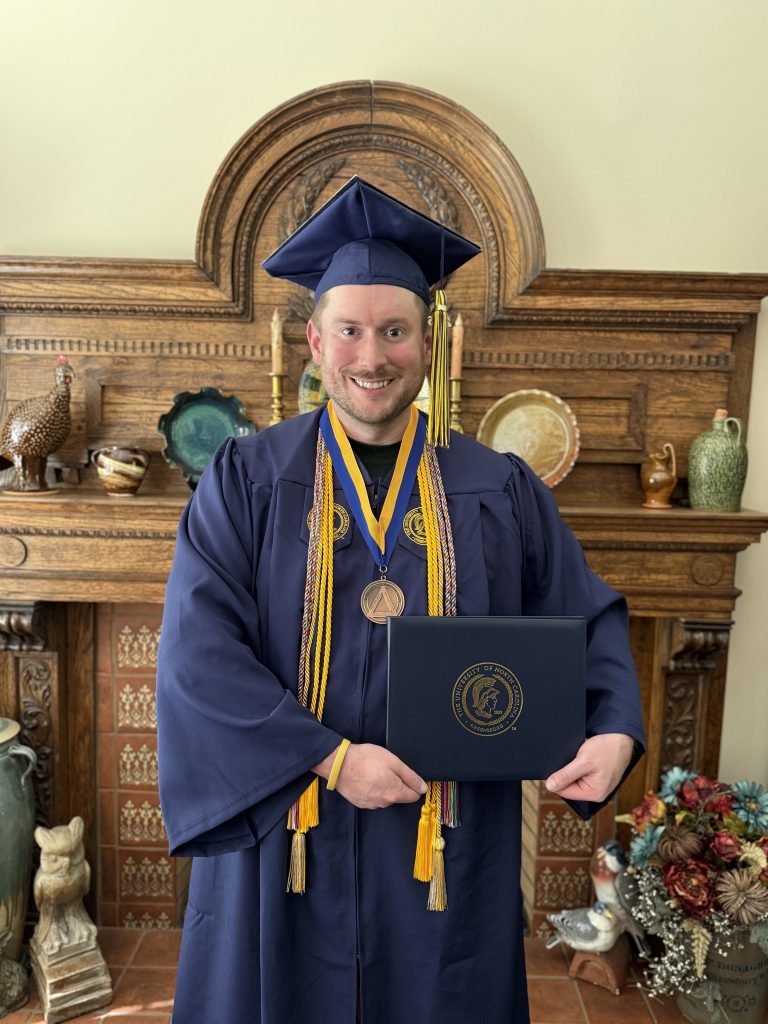
When Jason Rich ’26 walked across the Commencement stage last week, it marked the culmination of a journey that began more than two decades ago — one shaped by work, self-discovery, and a deliberate return to education. That path ultimately led him to a renewed sense of creativity and community in UNCG’s Department of Interior Architecture (IARc).
A Nonlinear Journey Back to the Classroom
Rich grew up in Asheboro, N.C. After graduating high school, he studied dance for a year at UNC School of the Arts and then moved to New York to attend the University of Buffalo. Before completing his degree, he returned home to work in his family’s antique business.
For 12 years, he managed the shop. But turning 30 prompted him to reassess what he wanted to do. “Around the time that I turned 30, I realized I didn’t want to take over the family business,” Rich says. “I was like, ‘What am I going to do?’”
Friends, who recognized his creativity and eye for space, encouraged him to pursue interior design at Randolph Community College (RCC). Growing up surrounded by furniture and history — and occasionally decorating the store’s front window — had planted early seeds of design interest.
“It was a little scary, kind of blindly going in,” Rich says. “But as I learned, I realized I enjoy doing this. I enjoy building these kind of spaces.”
Rich graduated from RCC in 2020. His internship with SUNPAN Modern, a Toronto‑based furniture company with its main showroom in High Point, N.C., quickly became a full‑time role. He worked as a showroom designer and showroom manager, creating displays for the High Point Furniture Market and for shows in Las Vegas. He helped redesign showrooms in both cities and contributed to a new showroom in Toronto. Though he describes the job as “a wonderful experience,” the desire to finish his bachelor’s degree never faded. After three years, he felt ready to return to school.
Finding Belonging in Studio Culture
Choosing UNCG was easy. Rich lived only minutes from campus, and several RCC instructors who had graduated from the IARc program spoke highly of it. What felt harder was returning to a university environment after so many years away.
“Preparing myself emotionally for going back to school, especially at the university level, was nerve‑wracking,” he says.
Being 20 years older than most classmates added another layer of uncertainty. He kept mostly to himself during his first semester. But as finals approached, classmates began reaching out, offering help and feedback on his designs. From there, collaboration came naturally.
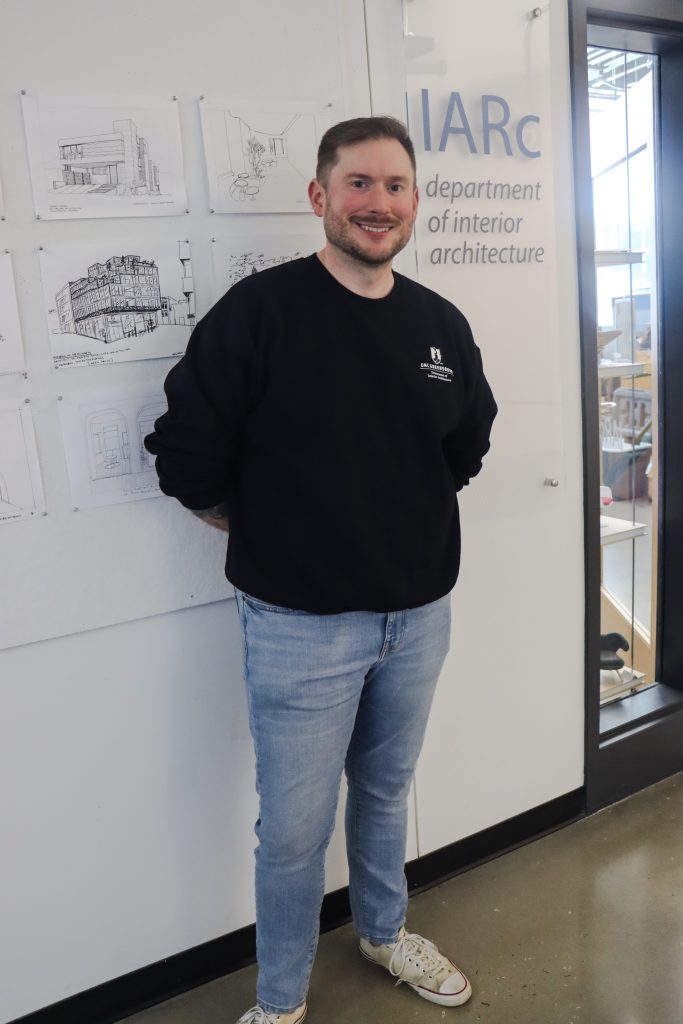
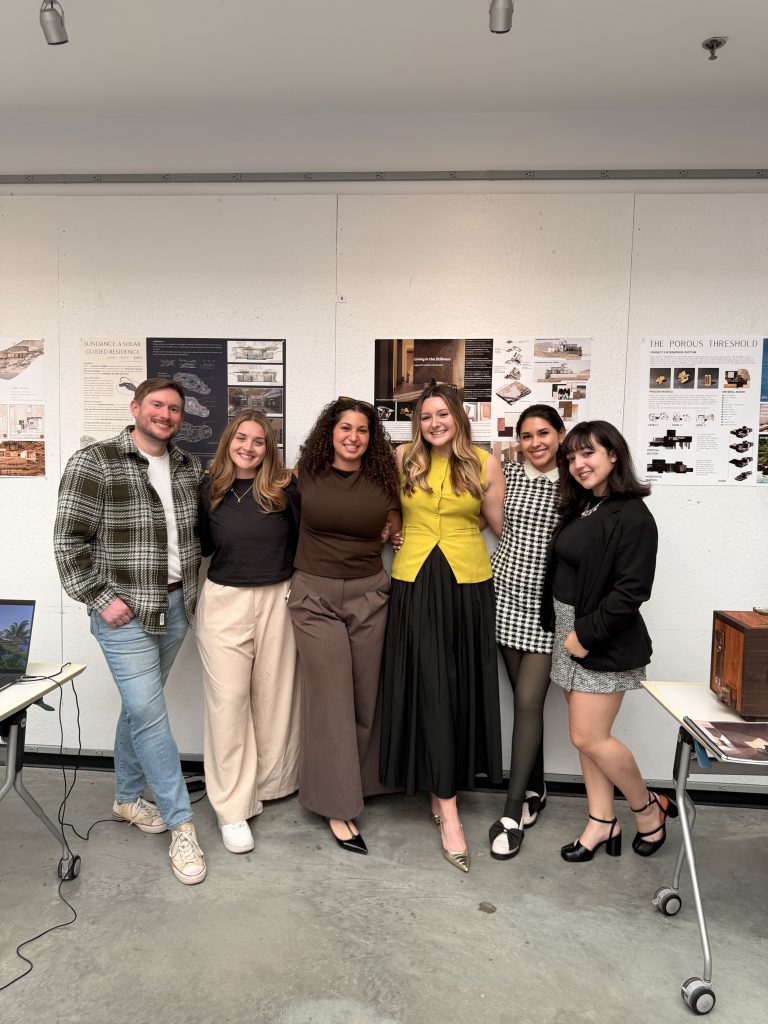
Gatewood Studios, home to the IARc program, has an open layout intentionally designed to foster community. Each cohort has its own studio space, and every student has a dedicated desk.
“There’s a beautiful thing about student culture, how open it is, and how you can wander and look at projects that are pinned up from space to space,” Rich explains. “We’re always encouraged to walk around, to talk, to meet other people, to look at other projects. And having that dedicated desk that’s always yours that you come back to provides a sense of safety.”
That sense of belonging, paired with the program’s emphasis on both collaboration and independence, helped Rich refine his technical skills and deepen his personal design philosophy.
Feeling and Function: Designing with a Purpose
Rich has always been drawn to the structural essence of a space. “I am drawn to how spaces are laid out, the uses of walls, openings, windows, apertures, and how people who will use spaces will move through them and feel in them,” he says.
His time in the IARc program both nurtured and challenged that perspective, especially through two major senior year projects.
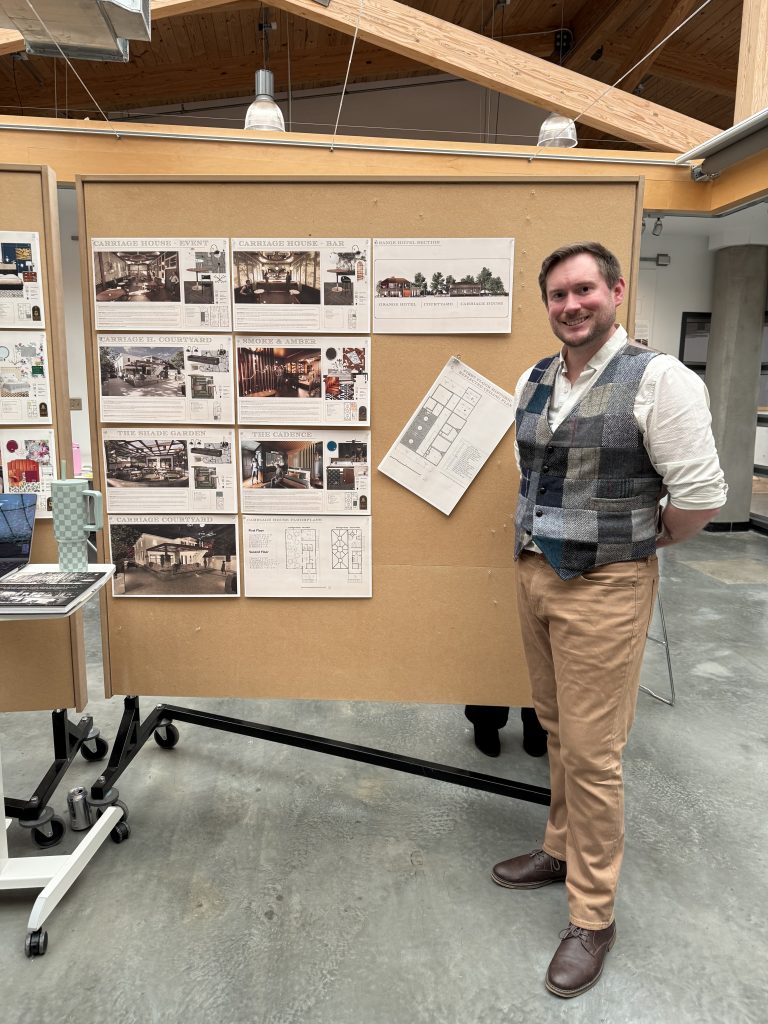
The first was a historic preservation collaboration with Natalie Miller, CEO and founder of The Historic Magnolia House, who had recently acquired the old Orange Hotel. Rich designed a flexible event space that emphasized community gathering while honoring strict preservation requirements.
“Magnolia House is a historically Black-owned and -operated business here in Greensboro, part of the Green Book for Black travelers throughout the 1930s, 40s, and 50s,” he says. “And Orange Hotel, while not appearing in the Green Book, was absolutely a part of that. That project was a great one because it was very community, culturally, and emotionally driven.”
His spring studio centered on the Home of Shadows, a worldwide competition from Bildner, where students designed a residence using no artificial light, only the sun, moon, and stars. Associate Professor Stephen Skorski pushed students to think deeply about atmosphere and emotional experience.
“I’ve never thought to design that way,” Rich says. “I might do it instinctually, but to be intentional with it takes a lot of energy, and a lot of trying and failing, guessing and seeing how it looks.” Despite the challenge, he describes the final outcome as “a beautiful process.”


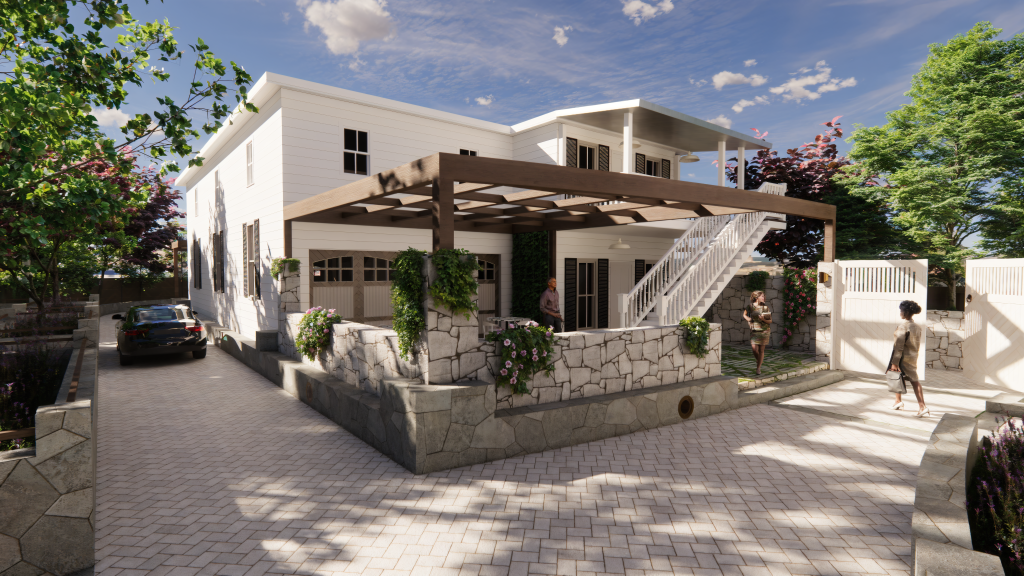
Growing in Leadership and Confidence
Beyond the studio, Rich embraced opportunities that helped him recognize his strengths. He served on the department’s student council, completed the Spartan Bronze Leadership Challenge, spoke at the Dean’s Convocation, presented at the Carolyn & Norwood Thomas Undergraduate Research and Creativity Expo, and worked as a teaching assistant.
Serving as a teacher’s assistant proved especially meaningful. As a transfer student, Rich appreciated the chance to revisit foundational concepts alongside first‑year students. “It’s been so re-educational because they’re learning the basics of everything that I learned at a different school almost 10 years ago,” Rich says. “Hearing them again and rethinking about them again re-energizes my thought process.”
He has enjoyed being a mentor to first-years in the program. Watching them give presentations with more confidence and with correct terminology and seeing how they described spaces and forms with more eloquence, he says, has been as rewarding as his own progress.
Designing His Next Chapter
Now Rich prepares for another transition: returning to the workforce. He hopes to stay in Greensboro and pursue commercial or hospitality design, ideally with a firm that works across multiple project types. He knows his years of professional experience, combined with the depth of his UNCG training, have prepared him well.
“IARc has given me everything I need. Now I just need to believe in myself,” Rich says. “I am proud of the education, proud of opportunities I’ve gotten, and proud of the chance to represent UNCG in the workforce.”
Story by Amanda Kennison, College of Arts & Sciences
Photography by Amanda Kennison and courtesy of Jason Rich, College of Arts & Sciences
CELEBRATE OUR GRADS!
Graduates and their families are encouraged to share their accomplishments on social media by tagging the University accounts and using the hashtag #UNCGGrad. Visit UNCG’s digital swag page for Commencement-themed graphics and templates.
Mention @UNCG in celebratory posts on Instagram and X and @uncgreensboro on TikTok.