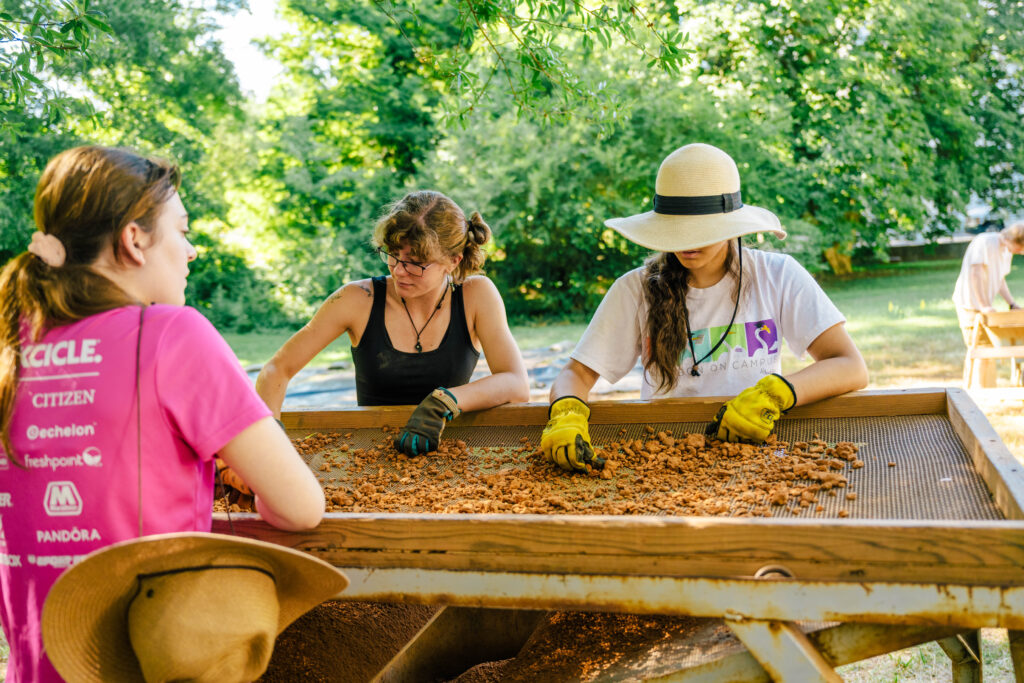
This summer, on the Greek Island of Kea, five UNC Greensboro students joined an archeological expedition to study cultural artifacts on the northwest surface of the island. The artifacts – pieces of pottery, stone tools, and metal slag — were collected between 2012 and 2014 build on a study that began in 1983. For 13 years, students from UNCG and other universities, along with archeologists, have mapped the artifacts for distribution, catalogued them and used them to recreate a view of the ancient landscape of Kea.
Their leader is Bronze Age archeologist and UNCG Department Head and Professor of Ancient Mediterranean Studies and Archeology Joanne Murphy, who has led the field school program in Greece since 2012. Her goal, beyond archeological discovery, is to expose her students to experiences and people that will inevitably inform their choices.
“I want them to make their worlds as big as they can make it,” Murphy says. “If you don’t work on that perspective, you don’t get that perspective.”
Unearthing History
The program starts with a three-day tour in Athens. There, students stay at the Irish Institute of Hellenic Studies, which serves as home base for the summer field program. The institute’s new headquarters, which opened in 2025, is located in the neighborhood adjacent to the Panathenaic Stadium, and includes a research library, lecture and seminar rooms, and accommodations for visiting scholars.
Murphy is the director of the Irish Institute of Hellenic Studies, and highly connected to the international archeological community, Irish and Greek governments, and experts. Her network in the field and in the country enable her to offer students an eye-opening experience.
“Many of our students haven’t traveled much before, and they definitely haven’t traveled with specialist archeologists, so we have them meet us in Athens for touring,” Murphy says. “Then we go to the northern Peloponnese to see famous sites like Mycenae and Corinth.”

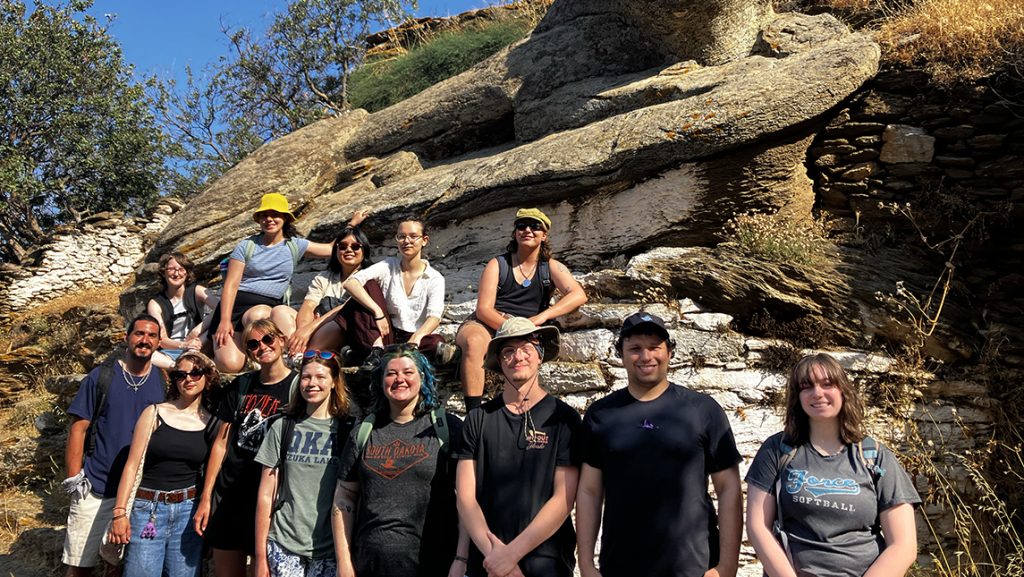

Following their tour, students travel to the Island of Kea for archeological work in the lab. The island is the earliest production location of copper and bronze in Europe. The students participate in the ongoing Kea Archaeological Research Survey (KARS), a multi-period and multi-disciplinary project.
“Lab is a very posh word for a dirty, dusty storeroom of artifacts,” Murphy says. “We have so many pieces of sherds, slag left over from metal production, and stone tools, like these tiny pieces of obsidian that are arrowheads or blades. The students process all of that: cataloging them, weighing them, measuring them, working with their experts. This is the hard part of archeology.”
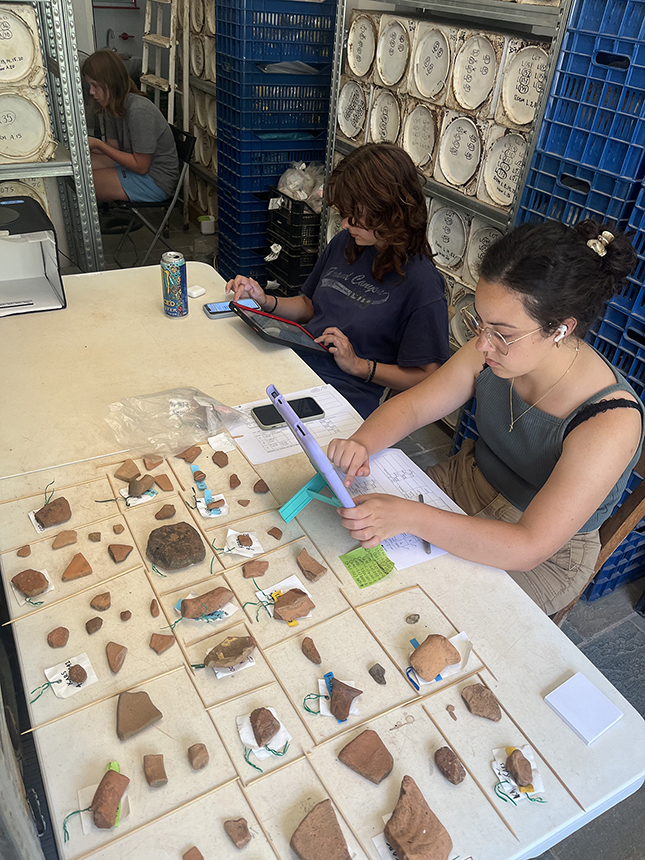

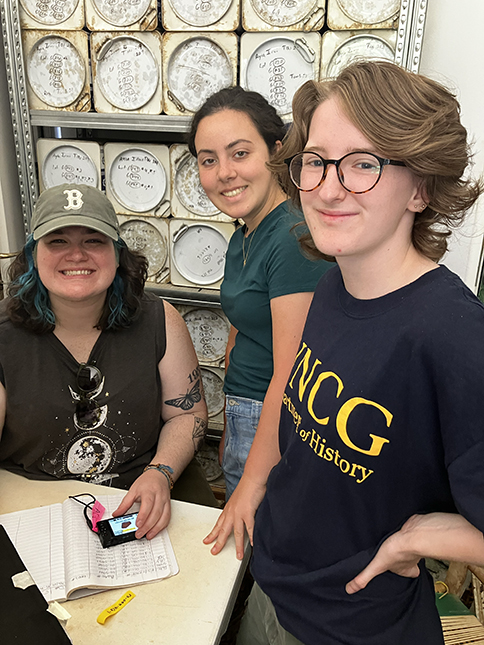
This survey methodology is both process and research. The students’ results will be compared to those documented in the earlier survey of the island.
Working alongside the students are experts in the Bronze Age, Neolithic pottery, the Ministry of Culture in Athens, and the University of Crete, among others. The field school program attracts students from UNCG, the University of Massachusetts Amherst, and Trinity College Dublin, with a mix of majors including classics, archaeology, history, and other disciplines.
The experts and students from around the globe all eat, work, and live together.
“It normalizes the sense of social access,” Murphy says. “It levels the playing field, which is not what happens when you’re going nine to five with people where you’ve got the suits and a huge gap between the students.”
Transformative experience
The month-long program’s offering of hands-on experience in archaeology and exposure to distinct cultures and ways of living leaves an impression that should benefit them in their future careers.
“Our program gives them confidence, and when they come home, they are different,” Murphy says. “Their familiarity with the international world vastly shifts their perspectives academically and personally.”
An estimated 100 students have traveled to Greece through UNCG, gaining a perspective that teaches them to maintain their identity within a global landscape.
“Some students manage a field team, understanding what it really means to implement data management and lead a team of international students and experts,” Murphy says. “All of them grow their own identity and when they go for job interviews and apply for graduate school, they are more capable, more responsible, and a breath of fresh air for people looking for an individual who has done something different and has something to say.”
Written by Alice Manning Touchette
Photography Courtesy of Joanne Murphy