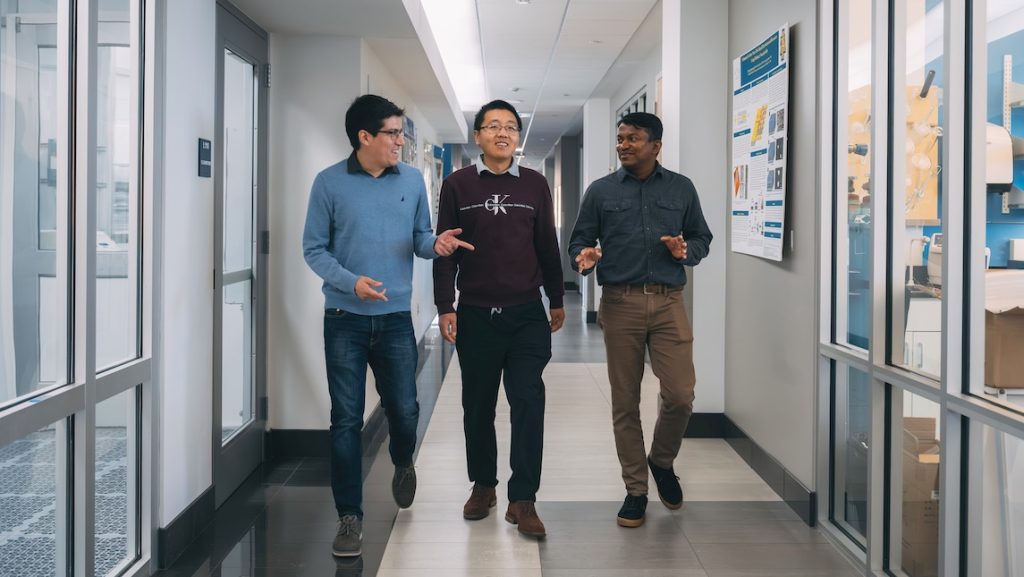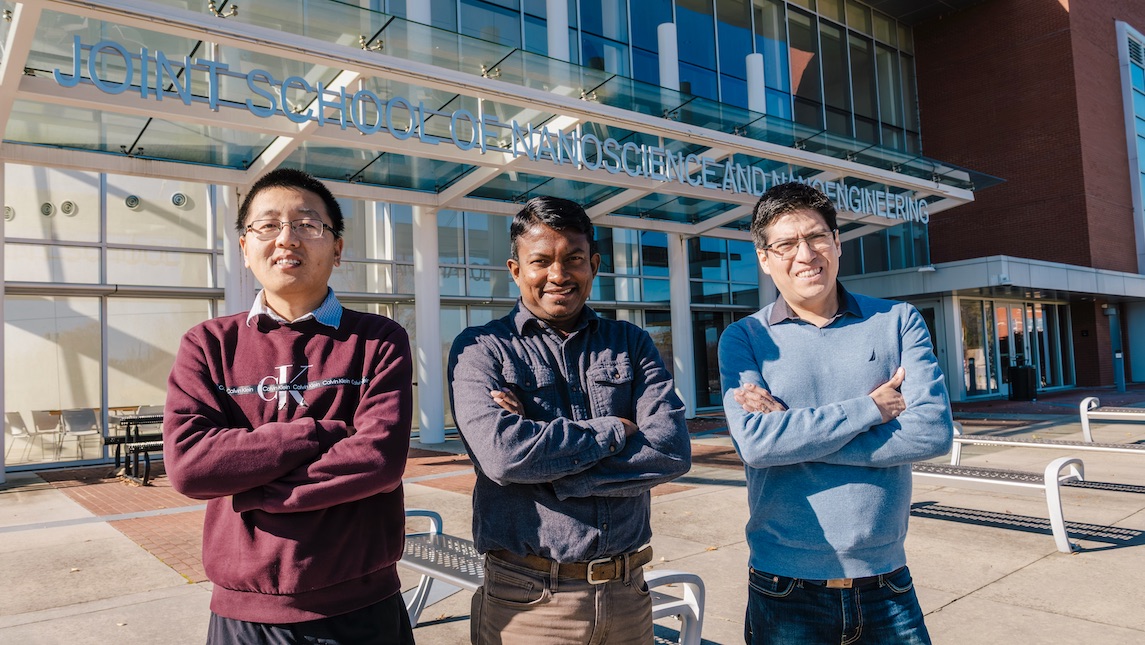
The Joint School of Nanoscience and Nanoengineering at UNC Greensboro welcomed three new nanoscience faculty this fall, all of whom are first-time professors with unique research expertise.
Whether building biological computers to progress medical diagnosis, creating computational devices to better fight cancer, or improving materials to make AI more efficient, Tianqi Song, Sampath Gamage, and Oscar Avalos-Ovando will impact the science that happens here and the students who excel here.
Although pursuing different nanotechnology research objectives, they all appreciate JSNN’s interdisciplinary nature, state-of-the-art equipment, and active collaboration of faculty, staff, and students.
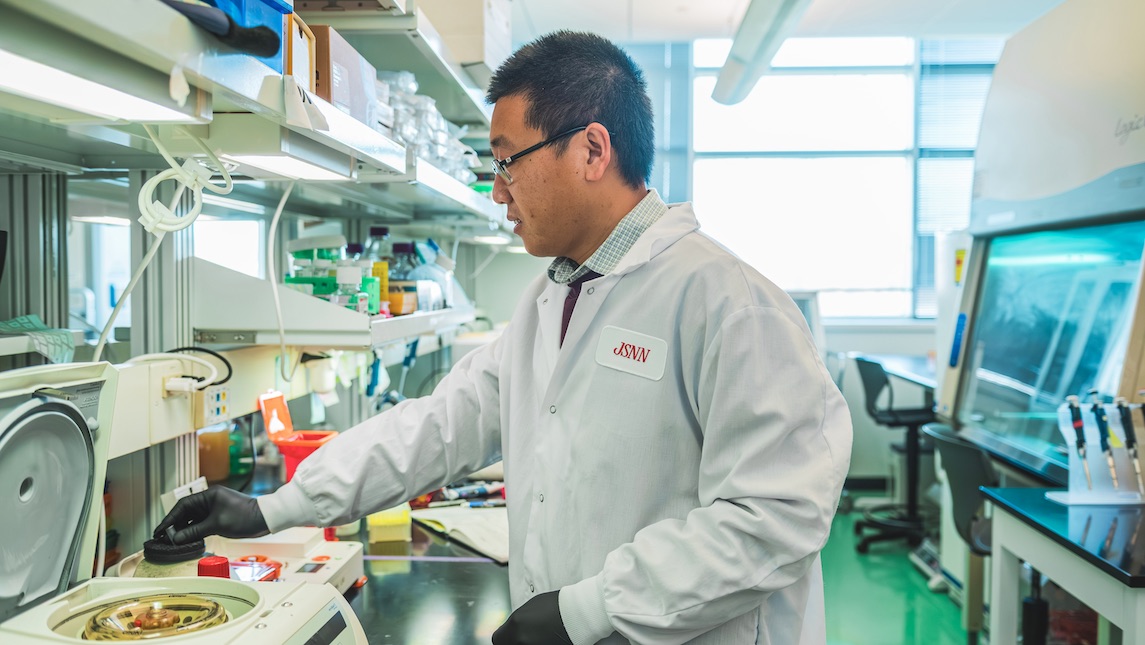
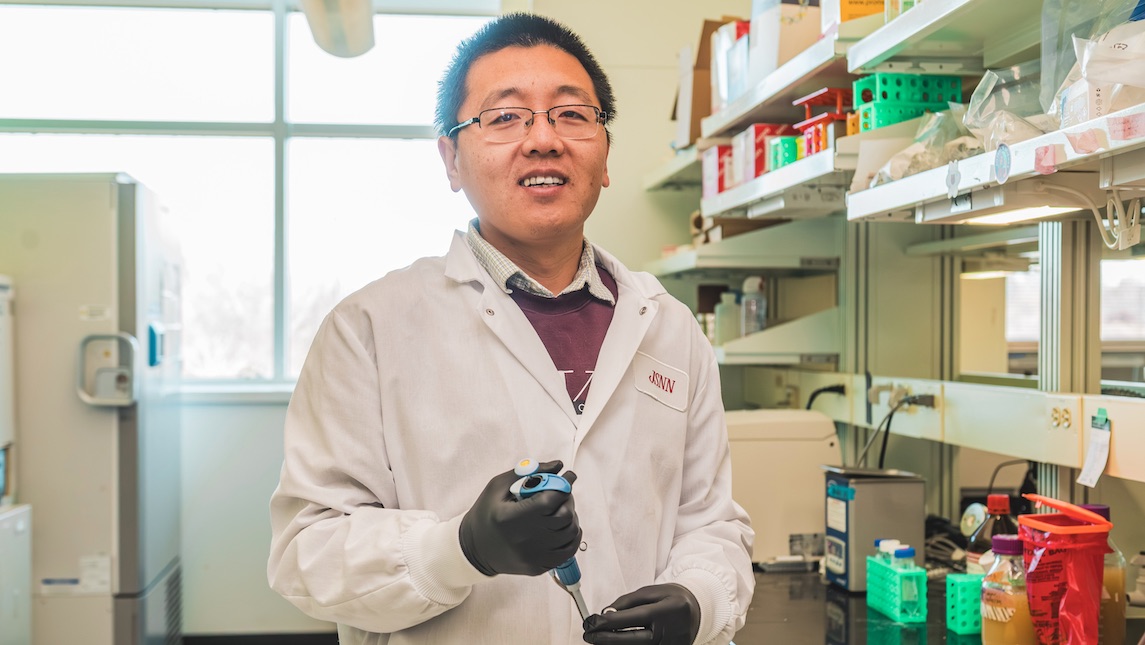
Tianqi Song: Building Biological Computers
Song’s arrival at UNCG was a homecoming of sorts as he lived in Durham, NC for eight years, while pursuing his master’s and doctoral degrees at Duke University.
He was happy to come to the “beautiful UNCG campus” and start collaborating with the JSNN scientists.
Song brings a background in computational science. In his research, he uses biological material, like DNA molecules, to build a biological computer, with the goal of one day implementing this computer type into human cells or even a human body to improve medical diagnosis and treatment.
“My research is like a toolbox; it can be used in many scenarios,” says Song.
Song published a paper in the weekly international journal Nature in October, entitled “Heat-rechargeable computation in DNA logic circuits and neural networks.”
Song shares that other JSNN scientists are interested in his research; collaborations have already begun since his arrival at the start of the semester.
“I am excited to have my own lab and pursue my own ideas,” he says. “I have found the diversity of the equipment at JSNN particularly helpful for my research, specifically microscopy.”
Song likes counseling students and appreciates having more opportunities to do so as a professor.
Sampath Gamage: Innovating Sustainable Energy
Gamage landed at JSNN because he saw a huge opportunity for his career and his family.
“I saw inclusiveness here,” he says. “I saw a diverse student and faculty community as well as a strong emphasis on mentoring and community engagement that I really liked.”
Gamage believes ideas from the lab and academia should be applicable to society. He witnessed JSNN making that meaningful real-world contribution and wanted to be a part of it.
Combating the energy problem drives this scientist’s research. Currently, there’s a never-ending demand for energy to support AI infrastructure. Gamage seeks novel methods to generate and supply energy in more sustainable ways.
“We need to discover how to make AI more energy efficient and how to generate energy sustainably to quench the escalating energy demands of AI,” he says.
Therefore, his research focuses on developing technology on the nanoscale, specifically creating materials to deposit on a thin film that can be incorporated into energy-efficient electronic devices.
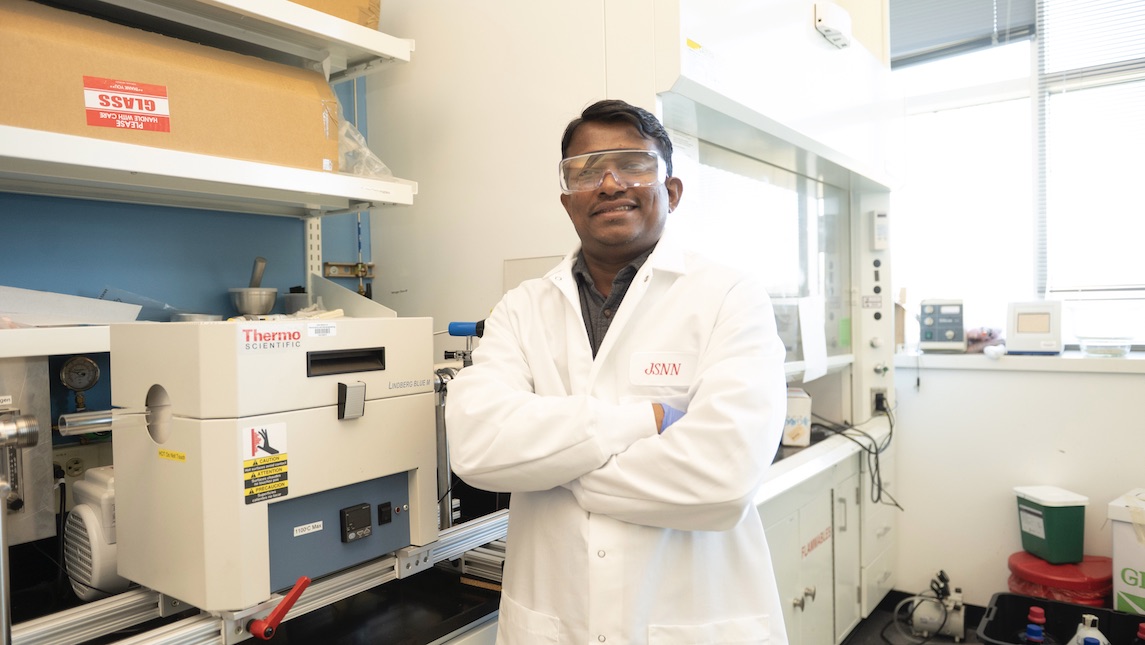
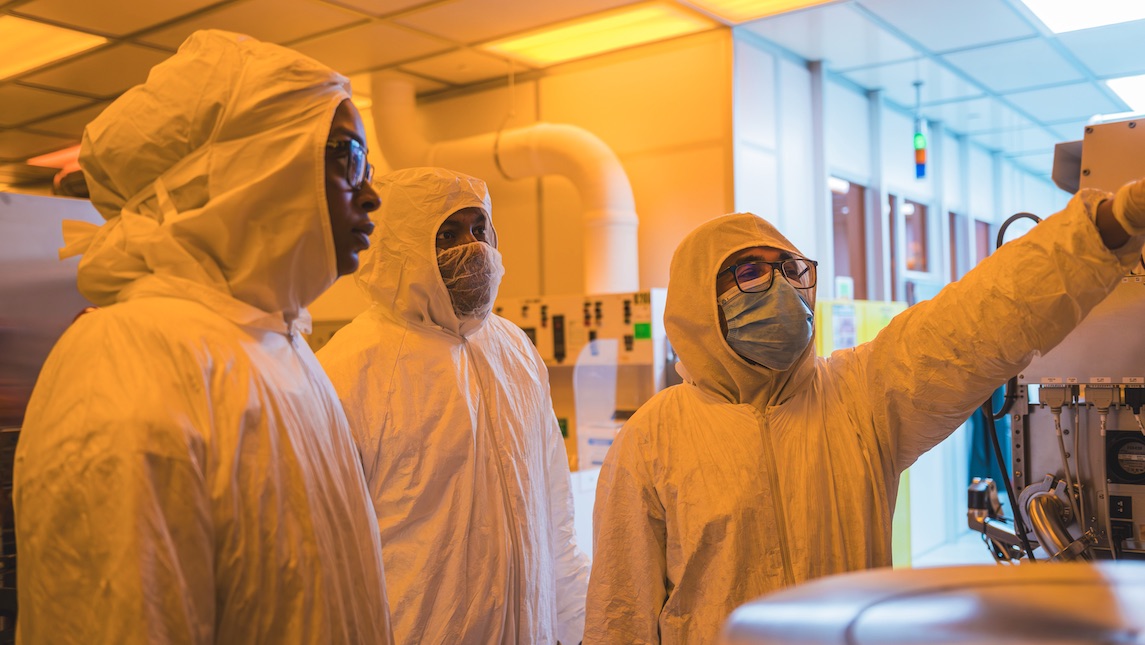

“The challenge is how to deposit these novel advanced materials onto the film surface and make a device. I’m focused on improving the quality of the material and the deposition techniques,” Gamage says.
Gamage reports a smooth transition into his new professorship at JSNN.
“In addition to the tools and facilities, I love the interdisciplinary nature here: We have chemists, physicists, biologists, computer scientists, and engineers,” he says. “It’s a very dynamic environment in which to support one another’s research.”
He also appreciates the committed and curious JSNN students and looks to guide them.
“My plan is to establish a research group and program that benefits their professional goals as well as impacts the school and society,” Gamage says.
Oscar Avalos-Ovando: Advancing Nanoparticle Research
Avalos-Ovando started as a theoretical physicist, then became a computational physicist, and now is a material science physicist. The good news? He can be any of these things at JSNN.
“I was attracted to how JSNN brings together nanoscience and nanoengineering fields,” he says. “I appreciate having the equipment, scientists, and talent all under one roof.”
Avalos-Ovando studies how electrons behave in plasmonic nanoparticles, which can lead to building systems that could one day fight cancer or produce faster computers.
When building at the nanoscale, things like light, temperature, and energy behave in different ways that cannot yet be anticipated, he explains. For every system built, that behavior needs to be studied, which can be conducted computationally or experimentally.
“My research aims to design future computational devices to be more useful and efficient, plus smaller,” he says. This could eventually enable certain applications, like identifying diseases medical testing cannot identify, seeing bacteria or a virus too small to be seen with today’s methods, and using solar harvesting to recover the environment’s energy, among many others.

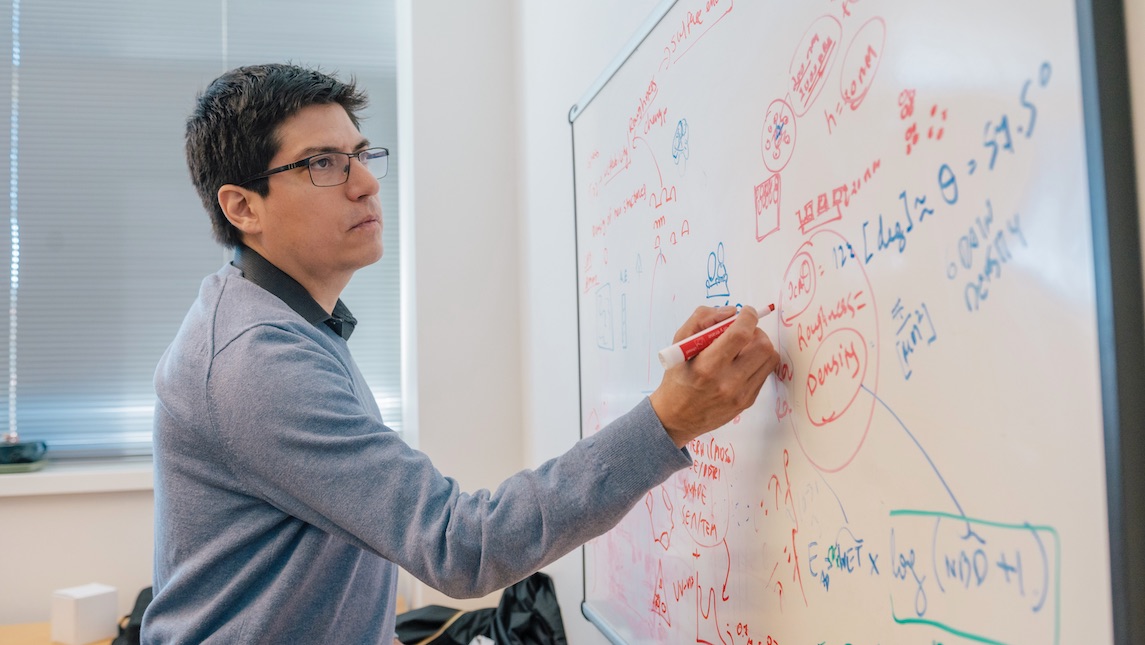
“The ideas that I develop, imagine, or simulate can be achieved here at JSNN – someone here will be able to build those things experimentally, which is really exciting,” Avalos-Ovando explains.
While this is his first professorship, he was ready to make this change. He appreciates the diversity of his students, enjoys helping them uncover their strengths and weaknesses, and supports their efforts to make an impact with their research.
Story by Amy Burtch, AMBCopy
Photography by Chase Cofield, University Communications