When it comes to using artificial intelligence tools, UNC Greensboro faculty and staff are like many Americans. Some put AI to work every day. Others are curious but don’t know where to start. And some have questions they want answered before deciding where AI fits into their work.
Campus employees with varying levels of AI experience brought their questions and ideas to UNCG Information Technology Services’ first AI Showcase.
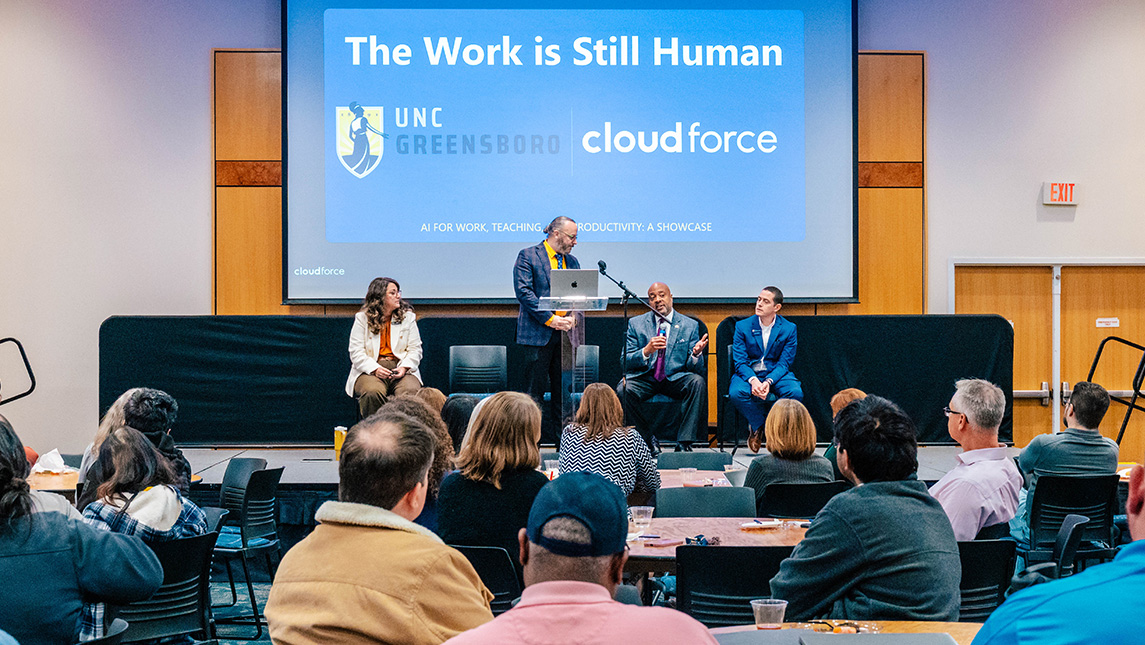
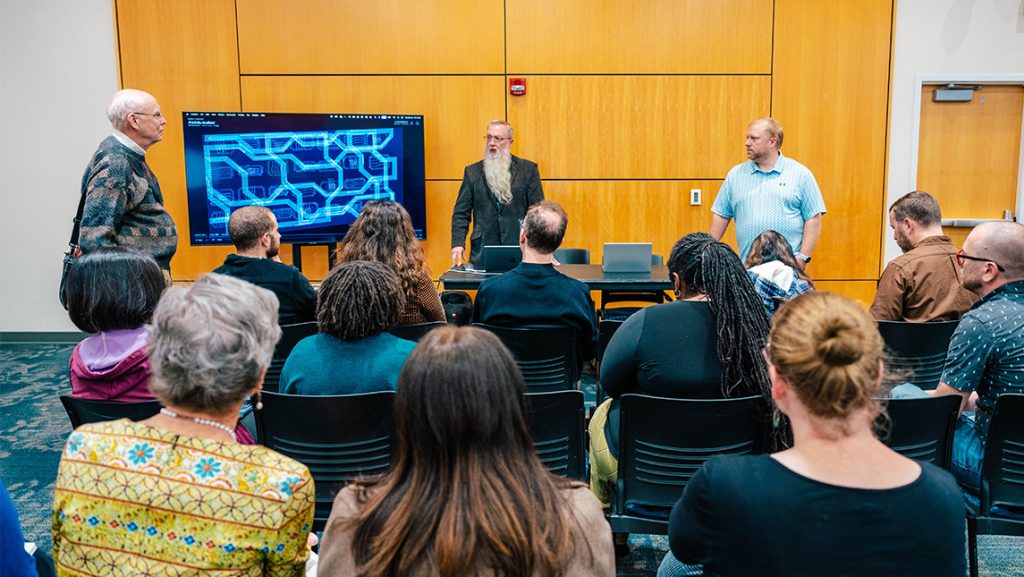
On Oct. 20, they met in Elliott University Center’s Cone Ballroom to hear directly from ITS staff and from Cloudforce, a Microsoft partner that supports SpartanAI. Users watched live demos, which began every half hour so they could move on to the next AI station and compare the models.
“The energy at the AI Showcase came from our people,” said Wade Maki, Senior Advisor to the Chancellor for Strategic Initiatives. “More than 200 faculty and staff came together to share innovations and explore UNCG’s AI pilot tools with a clear purpose: improving students’ education and serving North Carolina more efficiently. This work is about using technology thoughtfully to strengthen teaching, support student success, and make the most of the resources entrusted to us.”
Showcase Looks at General and Specific Uses of AI
The showcase followed the rollout of SpartanAI, which joins ChatGPT Edu and Microsoft Copilot among AI tools being evaluated during UNCG’s pilot year. Faculty and staff can explore how the tools might support teaching, research, and day-to-day work.

Participants’ interest, combined with uncertainties, was reflected in the many questions they brought to the presenters. They asked how agents are different from a chatbot, how to build prompts, how to choose the best model for a specific job, and how to look up records of previous questions asked of an AI. Other questions explored the accessibility, data security, and environmental impacts of AI.
RK Harris, senior director of revenue operations and data strategy, already uses Copilot and SpartanAI for coding, process automation, and data analysis. The showcase introduced her to other possibilities.
“I was surprised to learn that I wasn’t even scratching the surface of all of the fantastic things that Spartan AI and Copilot could do,” she said. “From creating agents trained to be the experts on various topics or to prioritize my day and save time by summarizing emails and preparing meeting briefs to creating artifacts like flashcards and quizzes that can be used to train staff on processes, policy and procedures.”
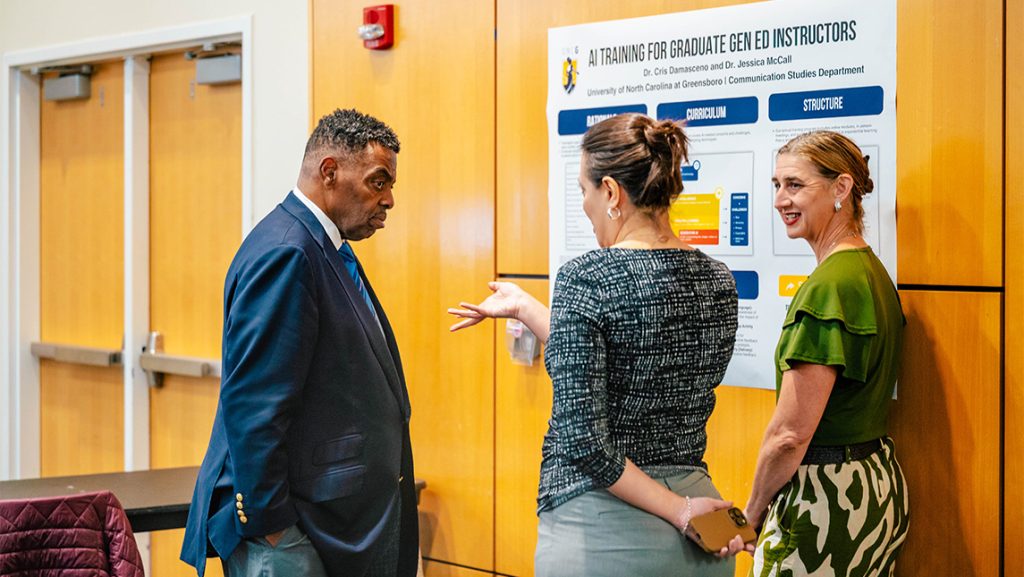
Faculty and staff already using AI tools had tables with specific examples of how it supports tasks in their departments and units. On one side of the room, Drs. Cristiane Damasceno and Jessica McCall showed off a training module they created for graduate students who teach the Department of Communication Studies’ Introduction to Communication course. On the other side, Thomas Payne from the Division of Student Success showed off his chat tool to help schedule peer tutoring sessions.
Designing AI to Work for Humans
The keynote speech during lunch was delivered by Anna Harding, director of customer success for Cloudforce. She focused on what she considered one of the most important features of AI: keeping the human component.
She said, “If we do this well, AI does not replace the teacher or the researcher. It helps us spend less time doing things that can be automated and more time spent doing the things that are solely meant for us.”
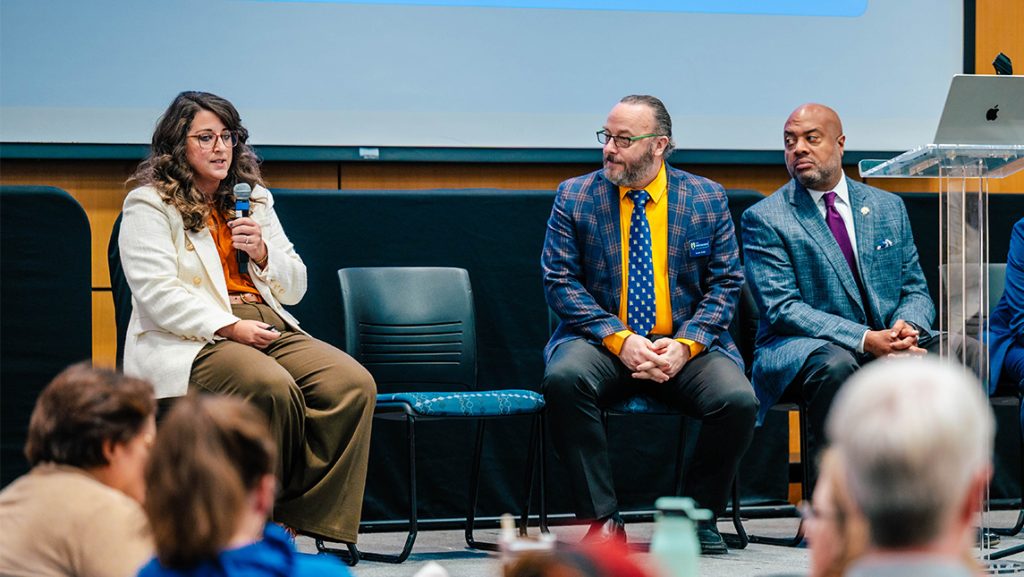
Harding looked back on her own experiences as an educator incorporating new technology into schools. She said part of rolling out AI is teaching people how to use it with intelligence and integrity.
“I know the daily realities of students, staff, and faculty,” she said. “I know how much time is consumed by searching and translating and aggregating things from 12 different systems. It is my aspiration to make it more efficient and make your job a little bit easier.”
After her speech, Maki read questions that had been submitted earlier. They covered issues that directly impact higher education, such as implementing AI tools into a curriculum and protecting confidential information.
One question addressed the preservation of academic integrity. Harding answered that faculty can create a scaffold of appropriate use. They can add guardrails within AI agents to keep them from directly giving students the answers. They can create activities or instructions to encourage responsible use of AI, such as requiring students to attach their chatlogs to assignments.
AI Pilot Period Prepares UNCG for Long-term Implementation
During this pilot phase, ITS is gathering data on how many campus members use AI, how faculty and staff want to use it, and which models they prefer. All these will help the University make an informed decision for future purchases and capacity.
Associate Vice Chancellor for Enterprise Technology Infrastructure and Chief Technology Officer Casey Forrest said, “Our goal with the showcase was to give faculty and staff an opportunity to explore the AI tools available at UNCG, learn from colleagues, and ask questions about how these tools might fit their work. We encourage colleagues across campus to continue exploring through the pilot programs and workshops, try a practical use case, and share what they learn. That feedback helps us understand where AI can be useful and where additional guidance is needed.”

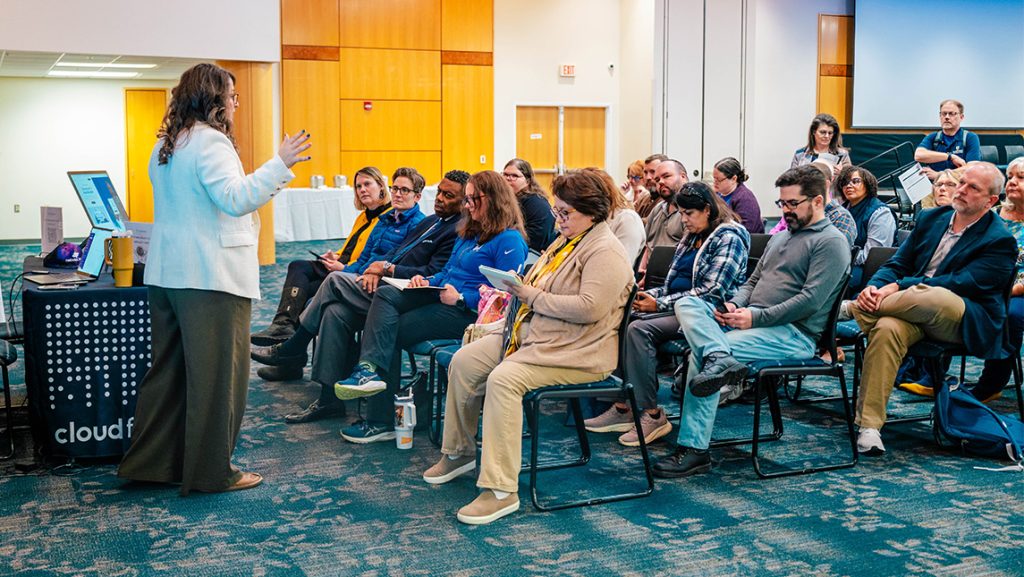
Regardless of their comfort level around AI, participants reacted positively as they found room to explore its uses. Dr. Nihal Raees, energy management engineer for UNCG Facilities, called it engaging and informative. “I really enjoyed attending the UNCG AI Pilot Program Showcase,” she said. “It was great to hear how faculty and staff are already using AI in their work and to see the many possibilities it can bring to our campus.”
Those who participated in the October showcase can send more feedback to help plan future events and identify other useful AI topics and resources.
Harding encouraged the attendees to keep on studying AI and listen to their colleagues. When using AI, she said they can integrate their expertise to refine its capabilities. “It’s not about handing over the work; it’s about expanding your capacity,” she urged.
Story by Janet Imrick, University Communications
Photography by Jefferson Castillo, University Communications