When Jonah Tatsapaugh walked into the UNCG Human Diversity Lab in the Sullivan Building, he wasn’t just logging hours toward graduation. He was stepping into what he calls the highlight of his day — a space where he could ask questions, build solutions, and contribute to a project that is pushing the boundaries of what scientists know about human bone development.
A biology major with a minor in chemistry, Jonah spent the last three semesters developing an innovative method to analyze the microstructural growth of thigh bones of individuals aged 3 months to 18 years.
His project, titled “Filling in the Holes: An In-Depth Look at Microstructural Variation in Subadult Femurs,” uses cutting-edge imaging technology to build the first comprehensive 3D model of normal bone growth patterns in children and adolescents.
“Studying biology in the classroom is one thing, but researching — finding problems and looking for solutions — that’s what really excites me,” he says.
Jonah’s work uses fragile, historically-sourced bone samples from Jordan. Many of these samples come from archaeological contexts such as church ossuaries or burial pits, where they’ve been preserved long enough for detailed study.
Cutting-edge Tech
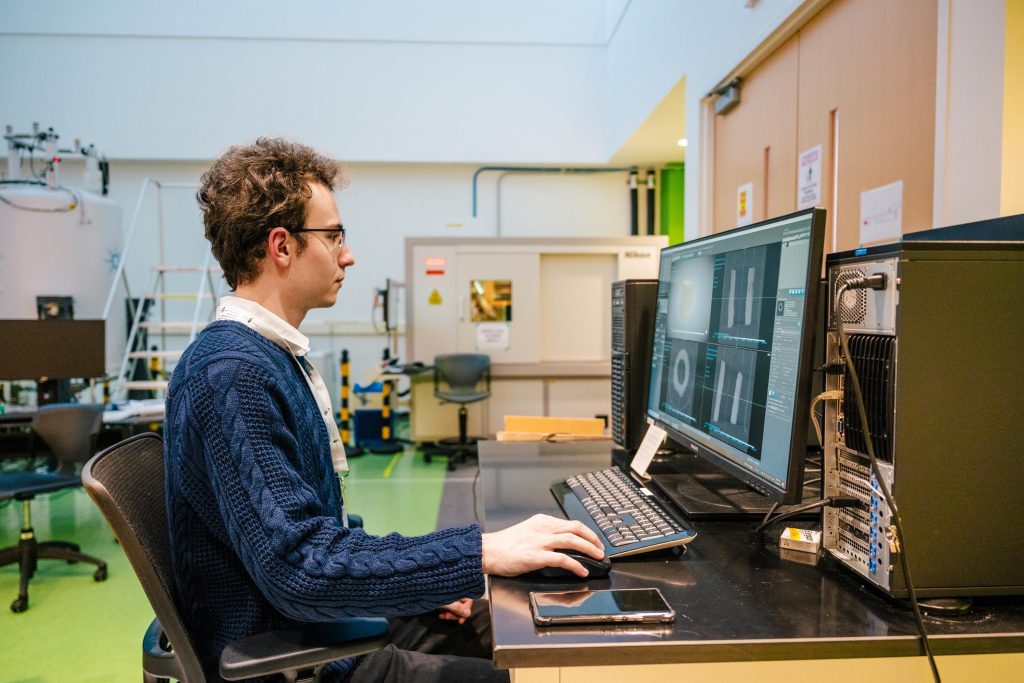
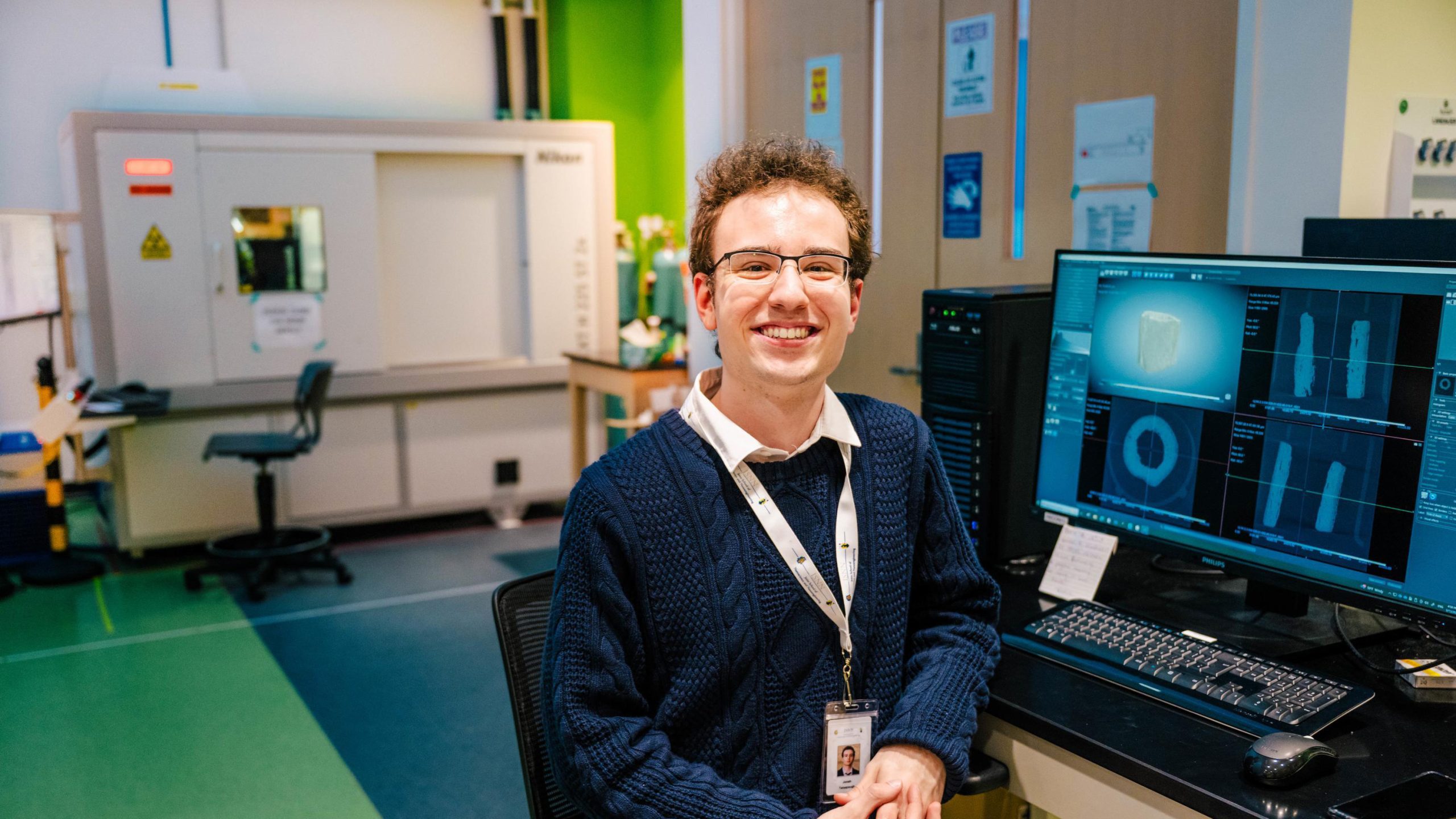
At UNCG, Jonah scanned these samples with the University’s high-resolution micro-CT machine, a sophisticated imaging tool that produces detailed 3D renderings at a level impossible to see on living humans due to radiation limitations.
UNCG acquired this machine only a few years ago, and Jonah is part of the first generation of researchers to build protocols around it.
Using the software program Dragonfly, Jonah analyzes porosity, thickness, and microstructural patterns within the bones — data that forms the foundation for understanding how healthy bones grow over time.
Baselines for Healthy Bones
While 2D bone histology has existed for decades, this is among the first attempts to establish a fully 3D developmental standard for subadult bone microstructure.
“We’re developing a baseline for what normal bone growth should look like,” Jonah explains.

“Once we have that standard, we can compare it to bones affected by things like vitamin deficiencies, mineral deficiencies, or diseases that alter bone growth.”
One disease Jonah is particularly interested in is leprosy, a chronic infection that still exists today in South America, Asia, and Africa. The lab has access to one of the oldest physical specimens of leprosy in the world — an invaluable sample for studying how the disease has changed over centuries.
Jonah’s fascination with bone biology unfolded somewhat unexpectedly.
“I’m pre-dental, so I wanted something biological, something related to the body,” he says. “This project stood out because I could actually learn to use micro-CT technology and do the scans myself.”
What began as a technical curiosity quickly deepened into a passion. Working hands-on with specimens, refining imaging techniques, and troubleshooting complex questions in bone biology reshaped the way Jonah approaches science.
“It’s so exciting to come across something we don’t have an explanation for yet and then get to go find that explanation,” he says.
That excitement has been nurtured by his mentor, Dr. Gwen Robbins Schug.
“Working with Dr. Robbins Schug has been great!” he says. “She loves teaching and cultivating students’ interests. She guides me when needed but also gives me room to explore questions on my own. Having the freedom to ask my own questions and find their answers is extremely fulfilling.”
Inspiring Curiosity
When asked what he would tell other UNCG students who are considering getting involved in research, Jonah doesn’t hesitate.
“Get in there,” he says. “Look up professors and the research they’re doing, then go talk to them in person. It shows you’re interested and professors love talking about their research.”
He emphasizes that curiosity is one of the most important qualities an undergraduate researcher can have.
“If something doesn’t seem right or you have a question, look for answers,” he says. “A lot of the work I’m doing in this lab came from noticing things that didn’t have explanations. Now those answers are what I’m planning to publish at the end of the semester.”
He will carry his research experience into his next steps, whether in dental school or a future scientific career.
But for now, he is proud to have contributed something new to the field of bone biology, and to have done it as an undergraduate researcher at UNCG.
“This experience has shaped the way I think about biology,” he says. “Being in the lab, learning how to ask questions, and being part of something that hasn’t been done before — it’s been an incredible opportunity.”
by Sierra Collins, Division of Research and Engagement
photography by Sean Norona, University Communications