Threaded narratives will come alive for guests of the Weatherspoon Art Museum’s new exhibitions celebrating the history and creativity of Southern Black quilters.
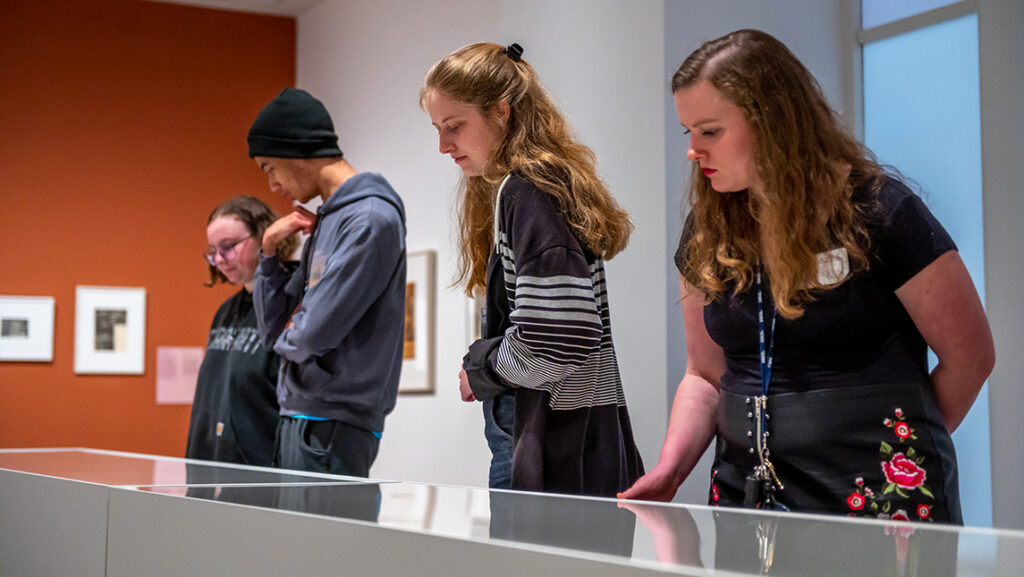
On view now, the museum is delighted to present Of Salt and Spirit: Black Quilters in the American South, organized by the Mississippi Museum of Art, and a companion installation commissioned by the Weatherspoon, Harriet’s Powers, by Raleigh-based artist Precious D. Lovell. Together, these shows offer a chance to explore the incredible artistry of quilting, the many roles this art form has played for Black communities in the South, and the important cultural contributions of quiltmakers, both collectively and individually.
Of Salt and Spirit
Of Salt and Spirit, curated by quilt scholar Dr. Sharbreon Plummer, features 24 quilts crafted between 1968 and 2010 in a range of styles and techniques, patterns and subjects.
The quilts were originally collected by Black folklorist Roland L. Freeman, who spent decades meeting with Black quilters to document their stories, making sure their lives were not separated from their craft.
“Dr. Plummer and the Mississippi Museum of Art have done a remarkable job of extending Freeman’s legacy,” says Weatherspoon Director Juliette Bianco, “and it’s a privilege for us to not only present these stunning quilts but also recognize and honor the women who made them.”
Among those women, and of particular note for UNC Greensboro audiences, is Gwendolyn Magee. A native of High Point, North Carolina, she graduated from the University with a sociology degree in 1963 and decades later took up quilting while living in Jackson, Miss.
“It’s always exciting to be able to feature the work of alumni artists,” says Emily Stamey, Weatherspoon Head of Exhibitions.
Harriet’s Powers
Visitors can continue their exploration of quilting history in an immersive installation on the other side of the hall commissioned specifically for the Weatherspoon. Before they even step inside the gallery for Harriet’s Powers, they might pick up the sound of cicadas or a woman’s voice sharing stories of sewing. Soon they will realize they are in for a breathtaking trip back in time to meet one of the most influential women of American quilting history.
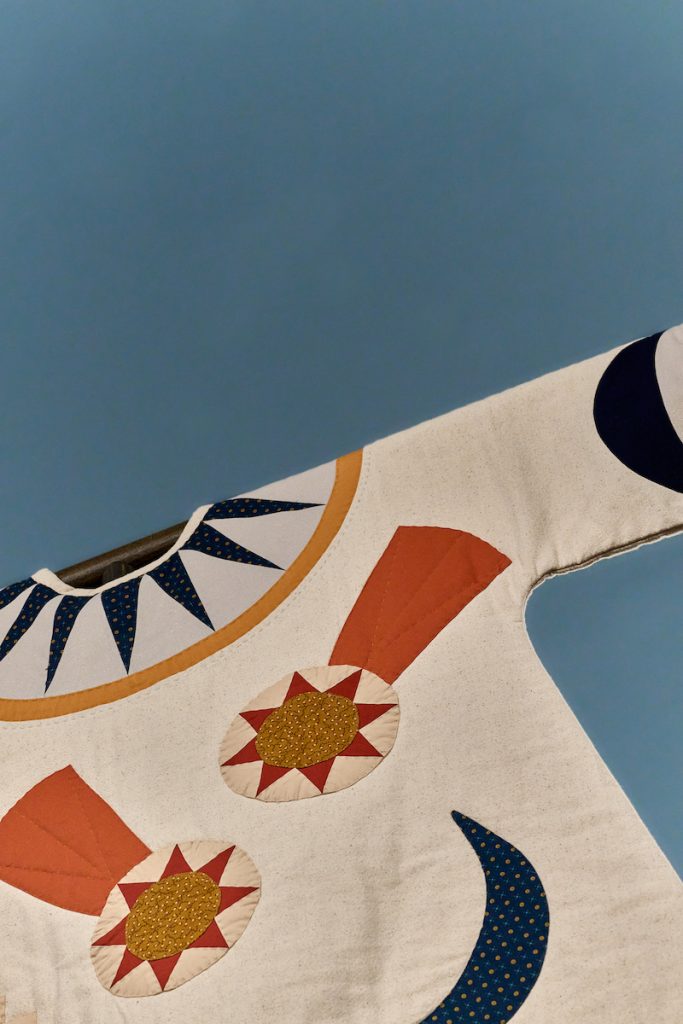
Image courtesy of the Artist. Photographer Sally Van Gorder.
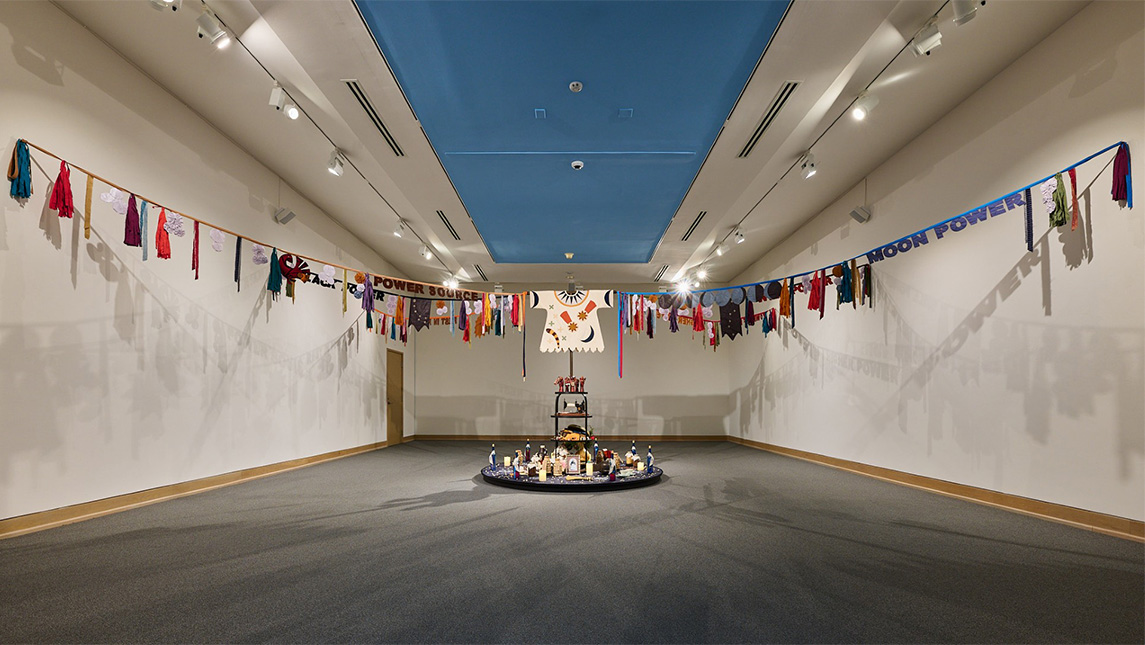
Artist Precious D. Lovell’s site-specific artwork honors Harriet Powers, often referred to as the mother of African American quilting. In the center of the room stands a three-part sculpture described by the artist as “an altar-totem-tree of life for Powers and all Black female quilters.” Surrounding the sculpture, a soundscape fills the space and amplifies the work’s message.
Powers, born enslaved in Georgia in the 1830s, was freed at the end of the U.S. Civil War and owned a farm with her husband. In addition to her work on the farm, Powers showed her quilts at local fairs. When the farm fell on hard times, she chose to sell at least one of those quilts and accept a commission for the sale of another. Today, those quilts are in the collections of the Smithsonian Institution in Washington, D.C., and the Museum of Fine Arts, Boston.
Using carefully selected imagery, objects, and symbols, Lovell evokes Powers’s life, work, and legacy. The exhibition reflects African American history and the ways in which Black women across time have created lives for their families, their communities, and themselves. Her installation begins with an altar-like base covered in a blue fabric evocative of the Atlantic Ocean and presenting artifacts of enslavement and resistance. It includes examples of the cash crops raised on plantations and farm tools that doubled as weapons. Also included are later objects from Greensboro’s contributions to the Civil Rights Movement, such as a Green Book listing the historic Magnolia House and a menu from the Woolworth’s lunch counter.
At the center of the altar, a totem extends upward, filled with quilting tools, including an antique sewing machine that closely matches the one Powers used. At its top, a quilted shirt includes symbols from Powers’s two surviving quilts. Above that garment, celebratory bunting with stars, streamers, and phrases that include the word “power” extends up into the gallery’s ceiling, which has been painted a brilliant blue.
While visitors take in these visual elements, they will be surrounded by a soundscape inspired by Powers’s life. The rush of ocean waves and click-clack of an antique sewing machine mingle with regional bird calls and stories of sewing told to Lovell by her Aunt Elizabeth. Layered throughout the composition, female vocalists sing Nina Simone’s “I Wish I Knew How It Would Feel to Be Free.”
In Conversation and Community
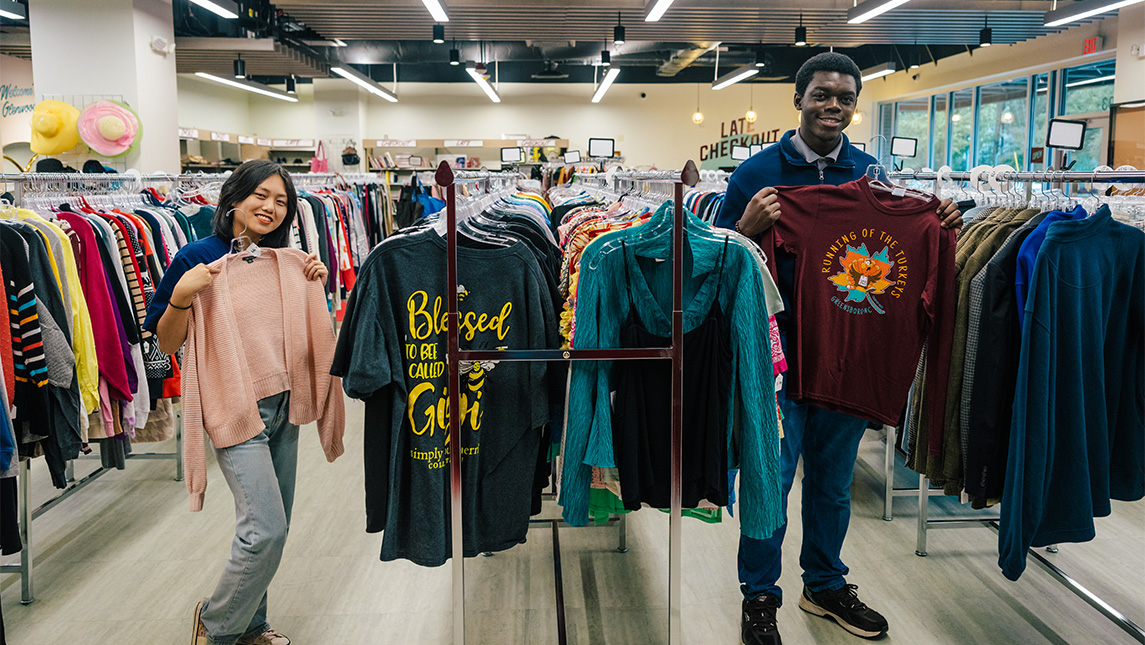
As a project, Harriet’s Powers embodies community. Lovell began her research with a visit to see Of Salt and Spirit at the Mississippi Museum of Art and talk with its curator and exhibiting artists. She then created Harriet’s Powers with elements sewn by students in UNCG’s Consumer Apparel and Retail Studies program, and she developed its soundscape with Grammy-nominated sound designer Bill Toles and singing recorded by UNCG’s PopTech students.
“Projects like Harriet’s Powers are one of the many things that make university art museums such special places,” says Weatherspoon Associate Curator for Academic Programming Raechel Cook. “This installation was made possible by Lovell’s deep artistic research and disciplinary expertise, enhanced by student collaboration.”
Of Salt and Spirit is on view through August 1, and Harriet’s Powers through July 25.
Story by Janet Imrick, University Communications
Photography by Sally Van Gorder