MLIS Researcher Designs AI-Themed Games for Academic Libraries
Libraries have always been the place to go when you have questions. Right now, people have lots of questions about artificial intelligence (AI) and its place in the workforce, recreation, the arts, research, commerce, and more.
But AI, primarily generative AI, has moved so quickly that many librarians are trying to catch up. Although they’ve made strides in learning more, they may not be comfortable using the technology themselves, let alone explaining how it works to a student who wants to use it for a project.
H. Blake-Lee ’19 ’22 MA, a graduate student at UNC Greensboro, wants to move that needle. “I started my master’s of information and library science (MLIS), not specifically to work as a librarian, but to work with the community within libraries,” she explains. “My work focuses on bridging different perspectives, and I think that it’s really important to start those connections internally.”
While researching her IRB-approved capstone, “Understanding Generative AI in Academic Libraries,” a few statistics stood out:
While the majority are aware of AI-related concerns, “librarians’ comfort and confidence level in using, teaching, or talking about AI is only in the 30-35 percent range,” she says. “About 70 percent want to learn about AI, but not from a computer. They want to learn from engaging with others.”
Bridging Gap Between ‘I Want to Know’ and ‘What I Know’
Blake-Lee saw that open discussion of AI in academic settings has become more difficult due to librarians’ divergent perspectives and expressed emotional conflict.
Her proposal centers not only on sharing her capstone research findings in lectures and conferences, but in facilitating conversation and social connection using hands-on gameplay.
But first: How does someone without a computer science degree visualize the process, results, and long-term implications of a computer communicating high-speed responses to a human?
Fortunately, Blake-Lee’s previous studies at UNCG, starting with a bachelor’s degree in studio art and master’s degree in sociology, helped her connect this new challenge to something people have done for generations.
From Family Photos to Generative AI Perceptions
If you’ve ever looked at an old family photo, you know you do more than reflect on that fraction of a second captured. Your mind cycles through memories and emotions — positive, negative, or mixed — related to the event and the people involved.
When you show that photo to another family member, they may have a different reaction based on their own perspective of that experience or their life afterward. “I fell in love with that type of research method, using a visual object and seeing how it creates something to talk about,” says Blake-Lee.
She saw this in play during her Terra Foundation for American Art grant-funded sociology internship at UNCG’s Weatherspoon Art Museum. Weatherspoon staff had created a card game with artworks in its collection to facilitate responsive learning and interaction. Blake-Lee facilitated game sessions with students and museum visitors, studying how people reacted to the art based on their values and lived experiences.


She took that approach to UNCG’s Department of Information, Library, and Research Sciences. It all coalesced around her capstone research, with a goal to design AI-themed activities.
Blake-Lee also built on her background in game design and community-centered research. For example, she has helped develop programs focused on art and music at the McGirt-Horton Public Library and a board game for people with intellectual and developmental disabilities for the nonprofit InFocus Advocacy.
To strengthen the educational foundation of her AI-focused game, she conducted additional data gathering in libraries and art museums in Greensboro and globally. Thanks to the MLIS study-abroad experience led by Department Chair Lisa O’Connor, she got to see art spaces in Ireland. That, with her own independent trips to London, Prague, and Italy, let her watch how different pieces of artwork triggered different discussions and interpretations.
“From all my experiences,” says Blake-Lee, “I thought it would be best to introduce visuals around a theme, specifically AI, that people might have different perspectives of. I found a card game is a really great way to connect people.”
Putting All Her Cards on the Table
She came up with the card game “Caution!” for academic library staff and student workers, earning a $2,000 stipend from Impact Through Innovation (ITI), a research-funding program in the School of Education, to move it into development.
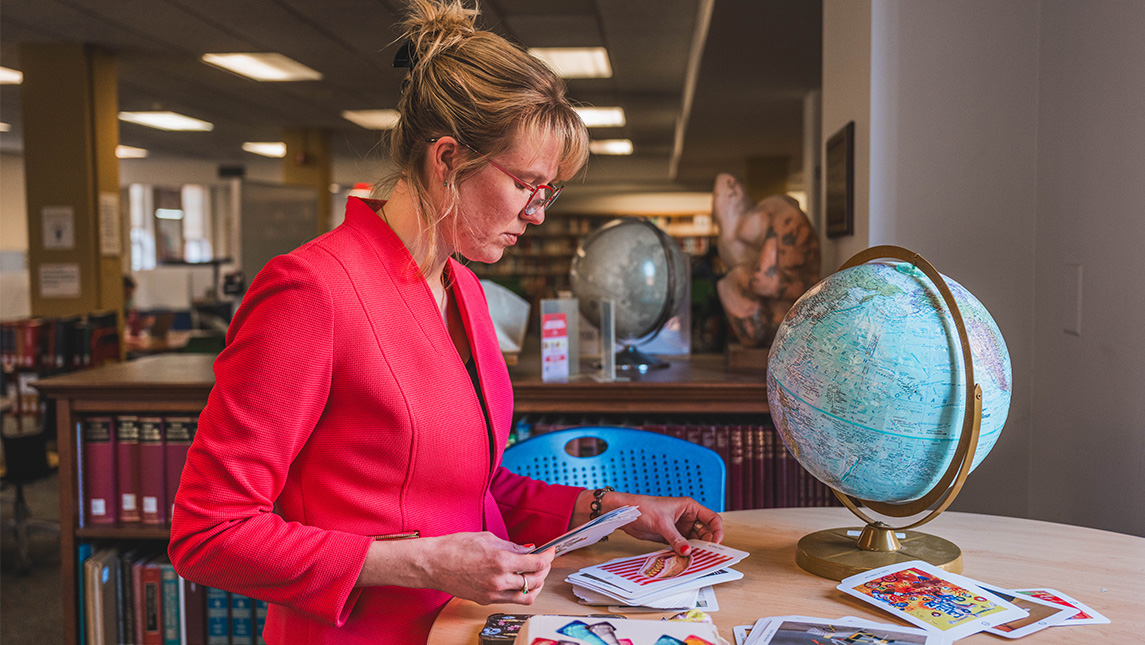
The cards will have 200 illustrations, some generated by AI and some contributed by local artists and UNCG alumni. Players are asked to think up words or ideas about AI based on the images they draw.
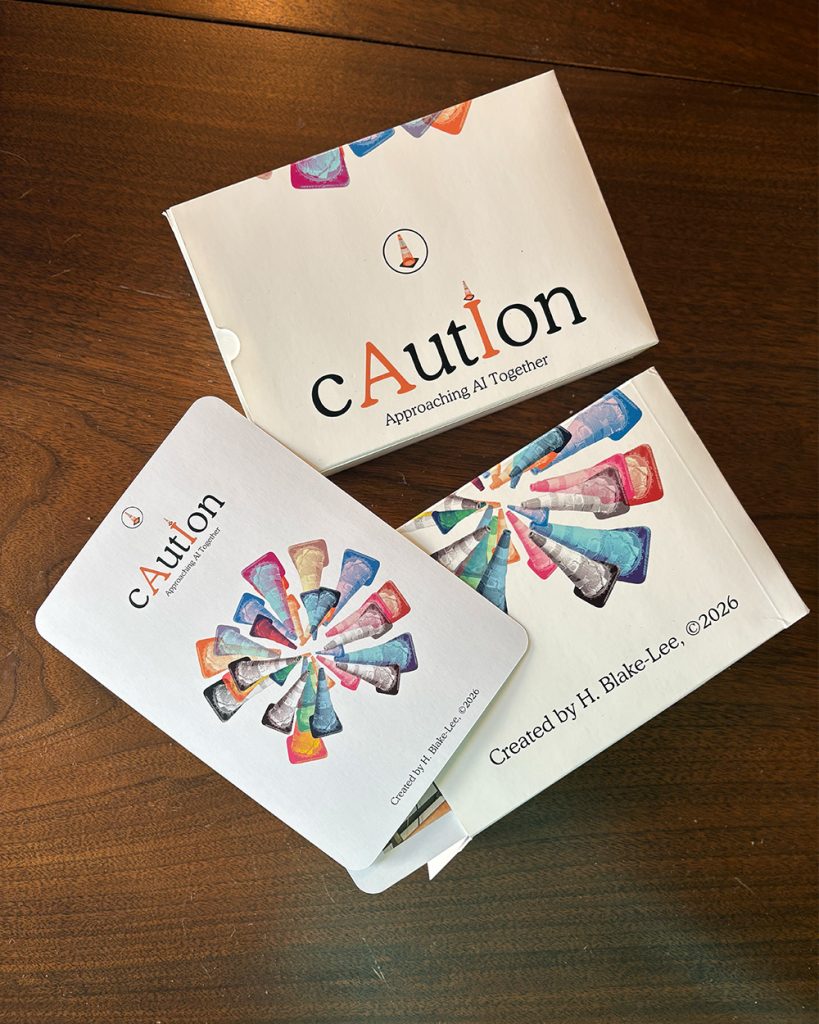
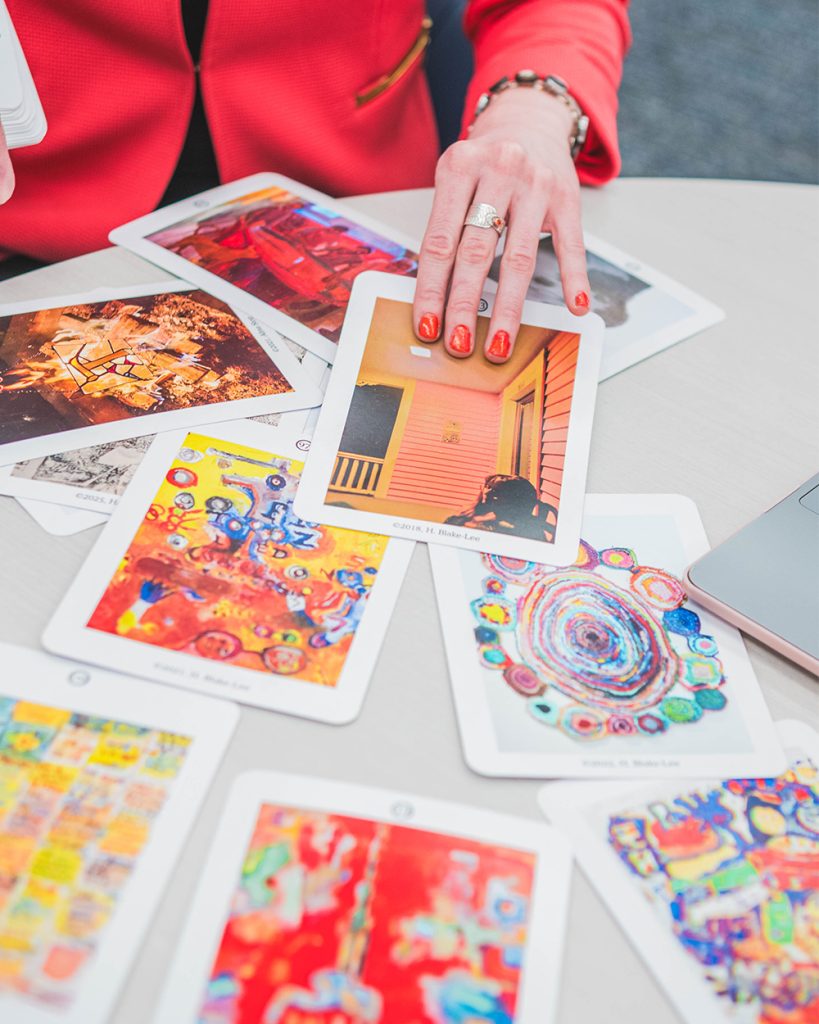
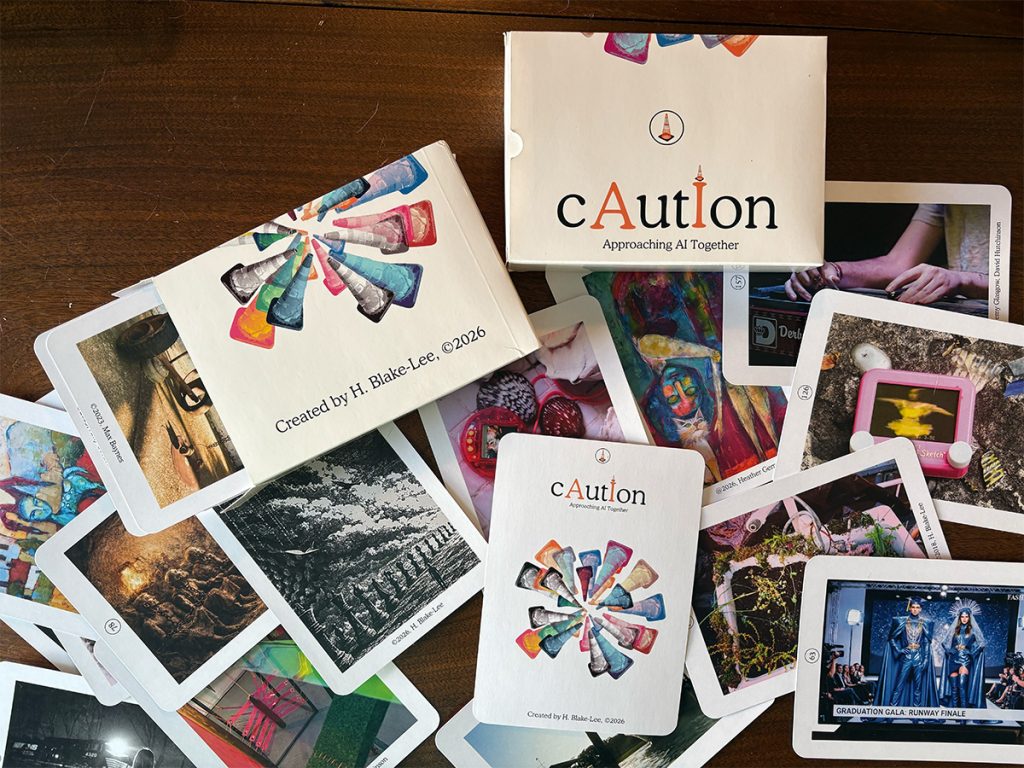
Artwork by Heather Gerni, Max Baynes, Kate Robinson, Robert Benson, Maggie Murphy, Jeremy Glasgow, and David Hutchinson
The point, Blake-Lee says, is not to figure out which one is AI, but to diversify the deck, let librarians absorb different types of digital art, and facilitate even more discussion by people with different perspectives on AI.
“During group gameplay, everyone passes around a card and thinks of one word to describe it,” she says. “They all say their word out loud at the same time, so not to influence one another’s perspective.”
From there, players then search for an image they think best represents one of the other players’ words. Then they can talk about why they connected that particular image to that word.
The conversation for each round of “Caution!” can be as long or as short as they want. She says, “The point is that they’re all listening to one another, using cards to connect with others’ perspectives, creating a welcoming space to approach AI together.”
Faculty and staff were critical to helping her create this, particularly her faculty mentor, Dr. Sonia Archer-Capuzzo. “Sonia is a great resource to turn to,” says Blake-Lee. “I could always ask if we could meet for a few minutes. Her help with proposal and conference writing helped lead to my success in many educational endeavors.”
She also worked closely with Steve Cramer, MLS — a business librarian and professor in University Libraries who researches how AI is being incorporated into his field.
Read more stories about AI implementation at UNCG
AI@Work in Business: Learn about the new Executive Education: AI for Impact workshop designed by Bryan School for business leaders
AI@Work in Nursing: Meet the School of Nursing AI champions exploring how to safely and ethically integrate it into health care.
Next Step, Expanding her Global Footprint
With the support of ITI, Blake-Lee hopes to adapt the game to different types of libraries, and perhaps other professions one day. She will collect feedback from early players on their interpretations of the visuals and the discussions the game sparked.
“We’ve even talked about introducing it in counseling groups for people who are so connected to AI that they distance themselves from human relationships,” she says. “There’s lots of social, emotional, and educational scenarios left to investigate.”
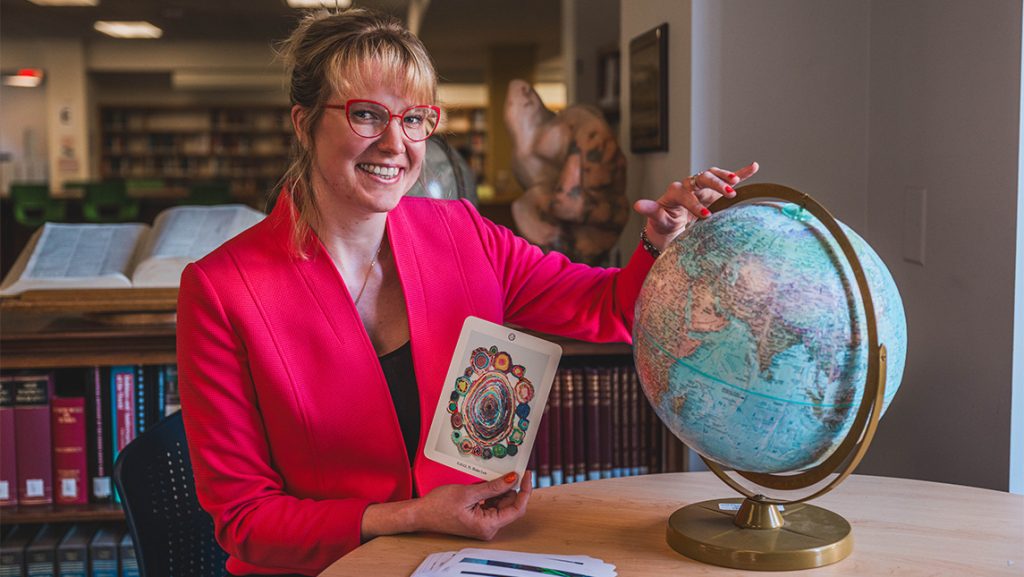
Her work also piqued the interest of people outside UNCG. While studying abroad, she got to talk with staff at the National Library of Ireland. They thought her visual card-game approach could be a viable art research tool and talked about inviting her back to their side of the Atlantic Ocean for future collaborations, using their art collections for similar games and community-centered research.
It’s exciting for Blake-Lee to see her work become part of the worldwide conversation about AI and ultimately help librarians feel they’ve got a handle on the rapidly evolving technology.
“What I’ve learned from my research,” she says, “is just because every person has a different interpretation, connection, understanding, or perception of AI, that doesn’t mean they can’t join together to provide students the resources they need to be successful.”
Story by Janet Imrick, University Communications
Photography by Sean Norona, University Communications; and courtesy of H. Blake-Lee, Department of Information, Library, and Research Sciences
You Choose! A Curatorial Card Game Developed by the Weatherspoon Art Museum © 2023 by UNC Greensboro is licensed under Attribution-NonCommercial 4.0 International