An old, unused building on a busy street can mean something different to each person who passes by. Where some might experience a burst of nostalgia, others might see a dilapidated relic from a fading point in time.
Students in UNC Greensboro’s Department of Interior Architecture (IARc) see the potential to give these old buildings new purpose.
And thanks to that mindset, they also saw a clean sweep. Three proposals by IARc students to revitalize historic properties snagged every student category in the 2025 AIA Winston-Salem Design Awards.


Merit Award winner Maya Monteverde with interior architecture faculty, Dr. Asha Kutty and Matt Jones.
Aaron Solar ’25 had recently moved to Baltimore, Md., for a job with the Patrick Sutton design firm. After the awards ceremony on Dec. 4, a UNCG friend called with the news that his proposed redesign of Greensboro’s historic Fordham’s Drug Store won the Honors Award, the highest student category. He also shared the Citations Award won by a group that worked on another locale: the Douglas J. Galyon Train Depot.
“What really took these projects to the next level were the real-world implications,” says Solar. “It was cool to see my design fit into an existing space, to work with constraints I don’t always have when working on a hypothetical.”
Restaurant design mixes new and old flavors

Old buildings pose unique challenges. Students must work around structural limitations while making the spaces suitable for new business needs. AP Assistant Professor Matt Jones, MFA challenged Solar’s class to turn Fordham’s, a century-old drugstore on South Elm Street, into a mixed-use project with apartments, retail, and a restaurant.
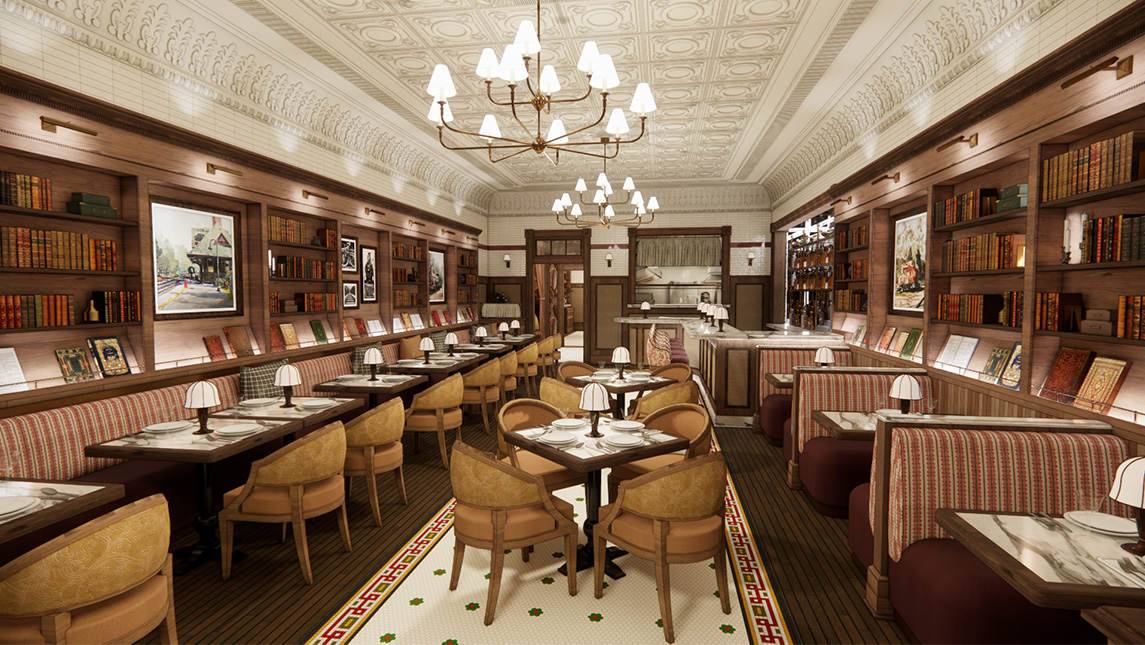
Solar came up with an English-themed restaurant for the ground floor, but he wanted the building to maintain its 19th century downtown character.
“It had these really old bookshelves along the walls, this beautiful mosaic tile floor, these tin ceilings that were sort of falling apart at this point,” he describes. “It’s amazing. When you walk in there, you get the feeling there are so many stories that you really want to keep alive.”
One limitation he learned to work around was Fordham’s narrow layout. Jones and Solar practiced with smaller projects called charettes to help him allocate space for seating and the kitchen. “I took heavy influence on old-world train cars,” Solar says. “The building is located very close to the train tracks, and so I wanted to bring in the details of what you might find in an old train car.”‘
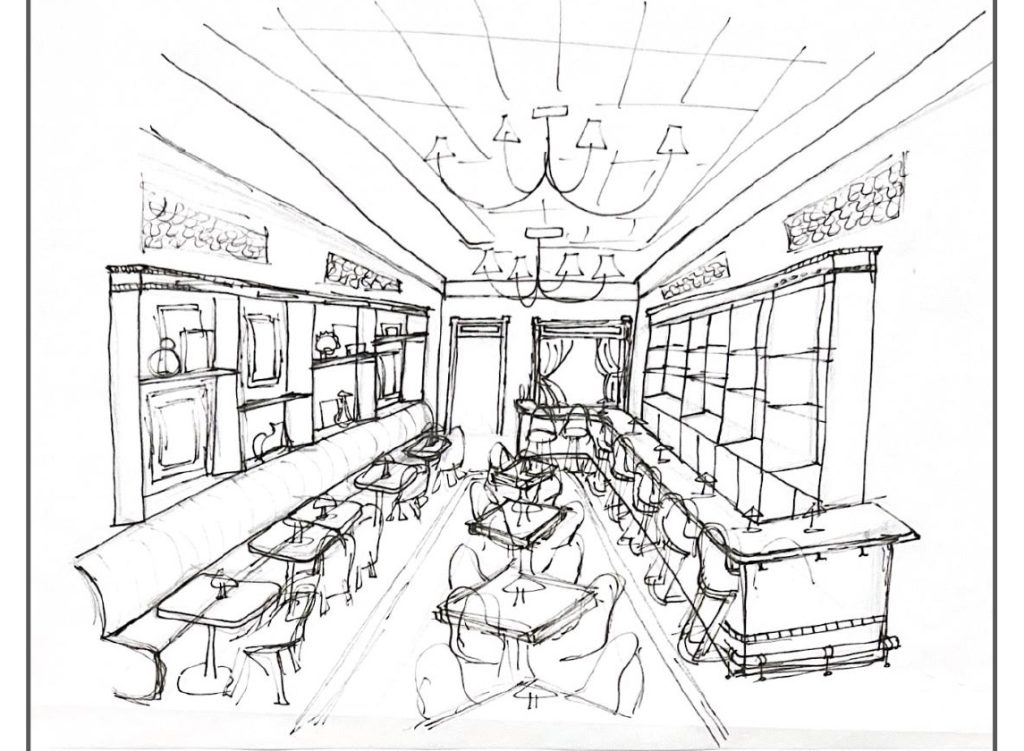
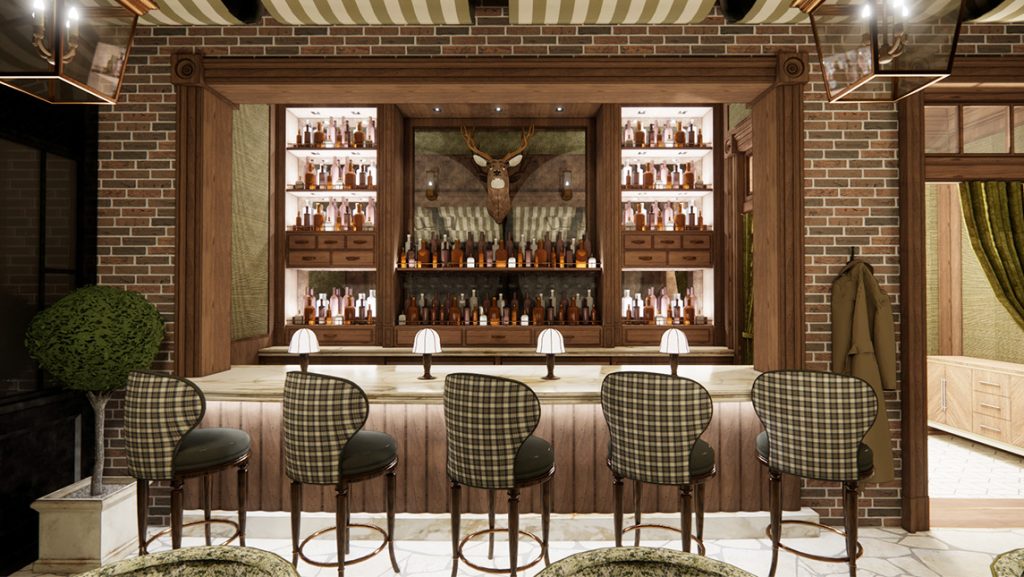
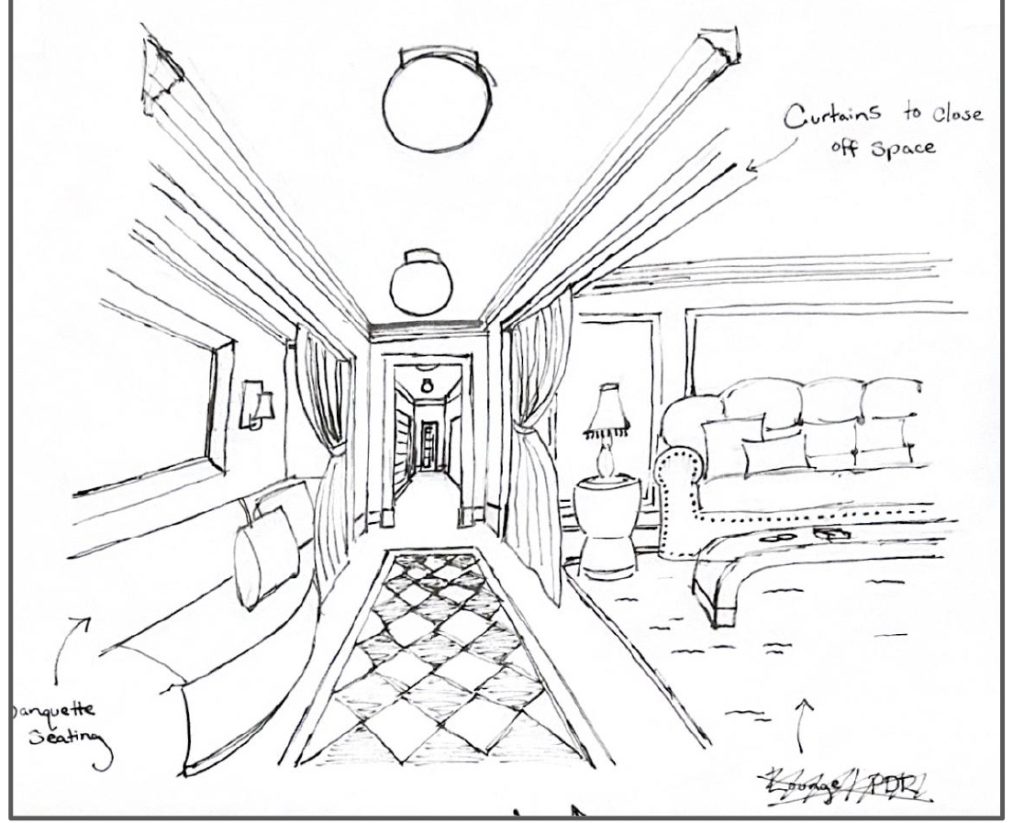
Solar’s sketches and renderings.
It came as no surprise to Jones that Solar’s design won, especially after seeing him present the project at an event for Creative Greensboro.
“That was a huge success,” Jones says. “They weren’t just presenting to their peers, but hundreds of people from the community were coming through, and we got a lot of great feedback.”
Style meets comfort in maternity-minded makeover

Historic significance and emotional well-being inspired Maya Monteverde, who won the Merit Award for her Nia and Vida Birthing Center concept. She was tasked with designing a property of MAAME, Inc. in Durham’s Hayti District, a neighborhood deeply connected to its African American history.
Its health care purpose posed additional challenges. “The building is very small, and a lot of medical equipment is very large,” she explains.
She designed built-ins to maximize floor space in the reception area and birthing units. She added birthing tubs and other relaxing spaces for families separate from the beds, while leaving room to maneuver a wheelchair or stretcher.
Monteverde also spoke with parents and doulas about what to avoid. Many people she surveyed described hospital interiors as feeling too cold and sterile.
“I drew a lot of material selections and colors from traditional African patterns, as well as earth tones,” says Monteverde. “I tried to use a lot of stone, wood, and glass to help open up its spaces. Soft color palettes, a lot of relaxing tones, so as not to overwhelm families.”
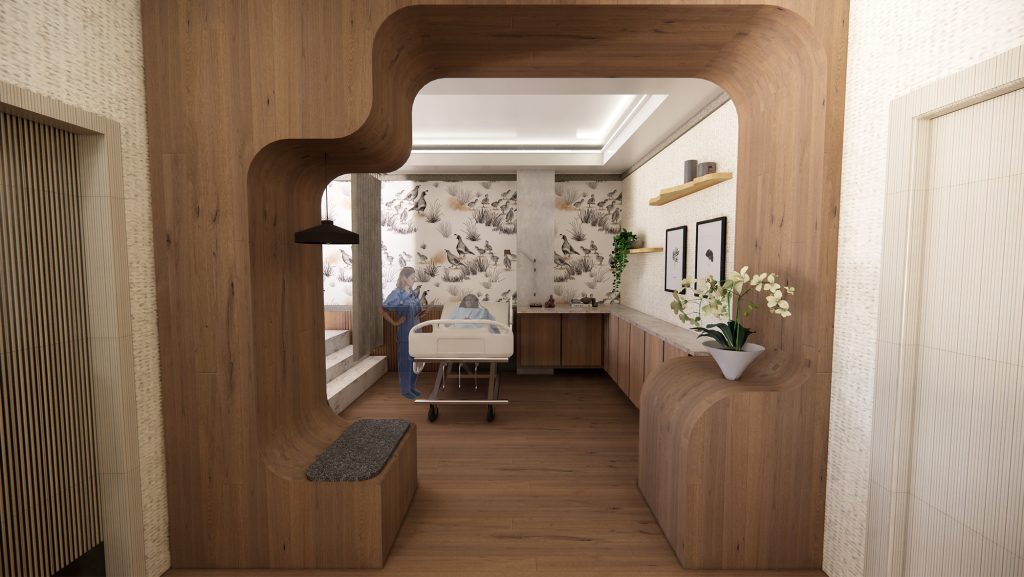
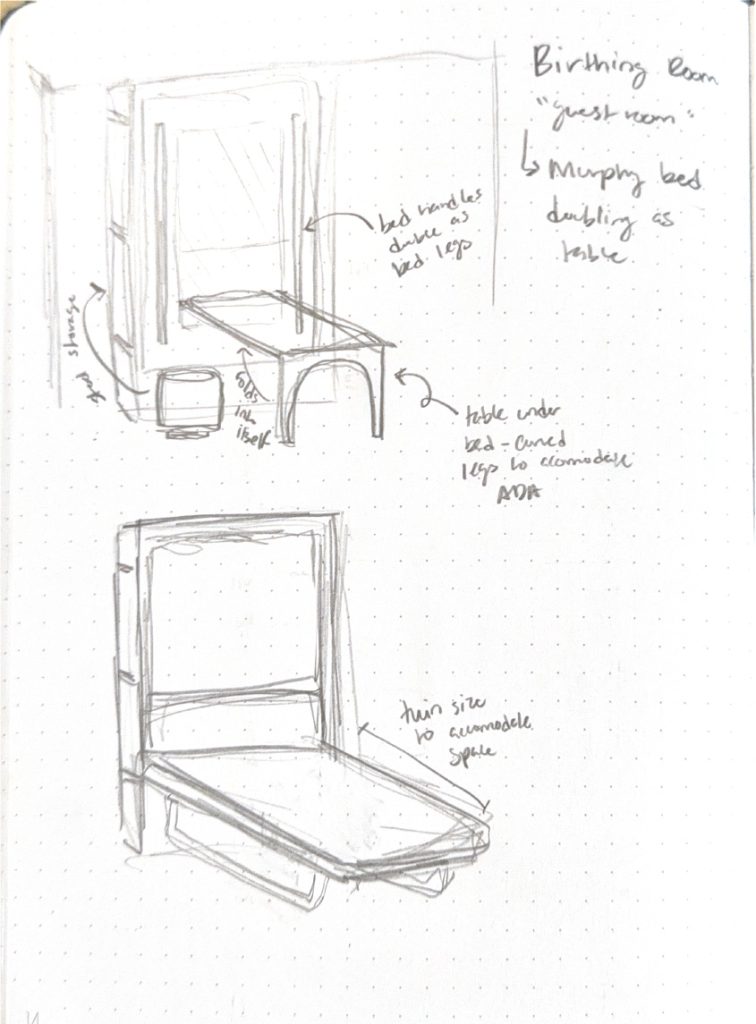

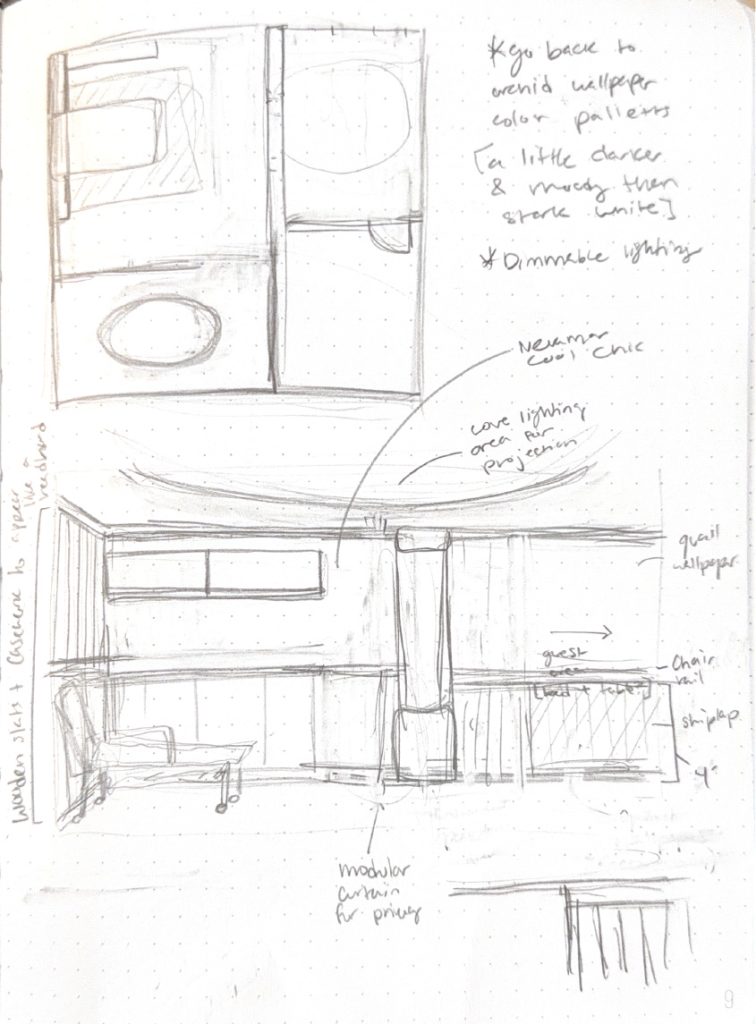
Monteverde’s sketches and renderings.
Monteverde enjoyed developing a design connected to one of the clients of her faculty mentor, Dr. Asha Kutty. “She’s probably one of the most involved professors I’ve ever had,” she says. “All the projects I’ve done in her studio involved real clients. We can talk to them face to face and figure out their needs.”
Kutty says Monteverde’s designs stood out because of how well she researched and prioritized mental health needs. “Working with real community sites fosters a sense of ethical responsibility, as students understand their designs represent real people and lived experiences,” says Kutty. “She demonstrated a strong understanding of how interior environments influence emotional safety, dignity, and agency during childbirth.”
Award-winning work with real-world application
The AIA awards sweep means a great deal to the IARc department, one of the few programs of its kind in North Carolina. Department Head Travis Hicks, who mentored the winning Gaylon Depot group project, says “Our department has a deep and rich history of community-engaged design, following principles and practices that connect our talented faculty and students with community partners in impactful, real-world projects. It’s encouraging to have professional architects and designers validate this engaged way of teaching and learning with AIA design awards.”
Monteverde, who graduates this May, says UNCG gave her the place to develop interests she’s had since childhood. “My mom studied art curation and pushed me to be creative,” she says. “Her influence made me realize how much deeper we can go into designing a space, and how it can bring people together, especially communal and public spaces.”


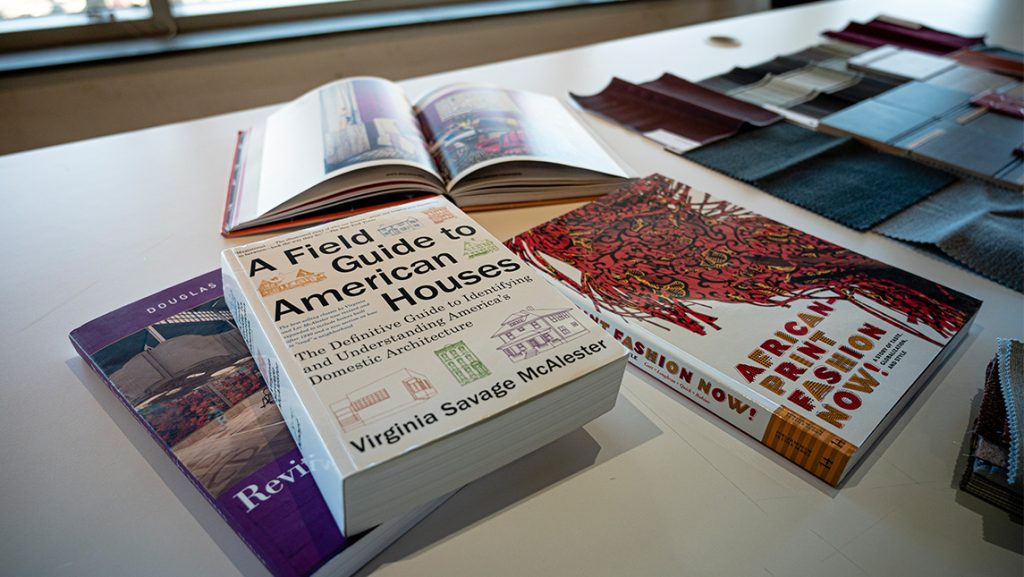
Jones says the work of Spartans made such an impact that it might create new opportunities for students outside North Carolina.
“The jurors for this were from northern Alabama,” he explains. “They told us that their chapter currently does not have student awards categories, but because of the quality of these, they want to start having student designs as part of their show. That’s a win-win for everyone.”
For the awardees, these accolades go beyond a wall plaque or a point for a résumé. Solar says his concepts became great practice for the work he takes on in his full-time career. “The Fordham project was a great precursor for jumping into the real world and working on high-level restaurant projects,” he says. “I see so many restaurants that are like this, that make you think, ‘How do I fit a restaurant in a 15,000 square foot, 100-year-old building?'”
Monteverde says older buildings are full of life, and it’s great to have projects about keeping them in use. “It’s a very powerful feeling, to stand somewhere that’s old, to think about how someone made this wall by hand, carved out details like on a door frame. I think it’s essential to keep that life in them while moving forward.”
Story by Janet Imrick, University Communications
Photography by David Lee Row, University Communications
Additional images courtesy of Aaron Solar, Patrick Sutton; and Maya Monteverde, Department of Interior Architecture