

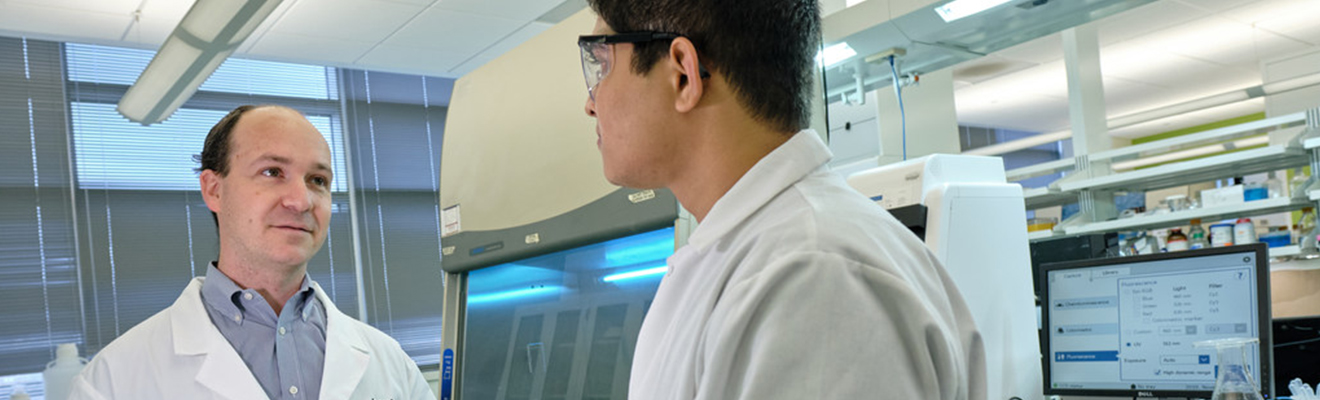
UNC Greensboro’s Post-Baccalaureate Certificate in Medical Science and Nanomedicine provides graduate-level training at the intersection of human health, biomedical science, and nanotechnology. Offered through the Joint School of Nanoscience and Nanoengineering (JSNN), the 12-credit program explores how nanoscale science can contribute to new approaches in diagnostics, drug delivery, biomaterials, medical technologies, and the study of biological systems. Students build foundational knowledge in analytical and computational nanoscience while selecting advanced coursework in areas such as immunology, nanosafety, synthetic biology, nanomechanics, and biomaterials.
The certificate is designed for students and professionals with backgrounds in biology, chemistry, physics, engineering, or related STEM fields who want specialized graduate training in biomedical and health-related applications of nanoscience.
Why Study Medical Science and Nanomedicine at UNCG?
Nanomedicine requires scientists to understand both biological systems and the nanoscale technologies used to study or influence them. At JSNN, students learn in an interdisciplinary environment where biology, chemistry, materials science, engineering, computation, and nanoscience come together.
JSNN research includes bio-nanotechnology, biosensing, bioelectronics, nanomedicine, nanomaterials, and computational nanoscience. This environment allows students to explore medical and biological applications while developing a broader understanding of the analytical methods, materials, and nanoscale processes that support biomedical innovation.
The 12-credit certificate provides focused graduate training for students who want to expand their scientific expertise without immediately committing to a full master’s or doctoral program.
The Medical Science and Nanomedicine Student Experience
Students study medical science and nanomedicine within JSNN’s interdisciplinary research environment, where biological questions can be explored alongside materials science, nanotechnology, engineering, and computational approaches. The flexible certificate curriculum allows students to emphasize topics that complement their existing STEM background or professional goals, including immunology, biomaterials, synthetic biology, nanosafety, and nanomechanics.
- Students may complete the certificate full-time or part-time
- Specialized expertise in a growing field
- Extensive hands-on research experience
- Access to advanced technology and facilities
- Strong faculty mentorship
- Diverse career pathways in industry, government, and academia
Career Outcomes and Opportunities
Graduate training in medical science and nanomedicine can strengthen preparation for research and technical work involving healthcare, biotechnology, biomedical materials, and nanoscale technologies.
Relevant career areas can include:
- Biomedical research
- Biotechnology research and development
- Pharmaceutical research
- Nanomedicine and drug-delivery research
- Biomaterials
- Biosensors and diagnostics
- Medical-device research and development
- Laboratory and analytical science
- Regulatory and safety-related work
- Government and academic research
The certificate can also provide additional preparation for graduate study in nanoscience, biomedical science, biotechnology, materials science, bioengineering, or other health-related STEM fields.
Program Details
Degree Type: Graduate Certificate
College/School: Joint School of Nanoscience and Nanoengineering
Program Type: Graduate Certificate
Class Type: In Person,Online
Catalog Name: Medical Science and Nanomedicine, P.B.C.
Similar Degree Offerings
Contact Us
Joint School of Nanoscience and Nanoengineering
336.285.2800
jsnninfo@ncat.uncg.edu