

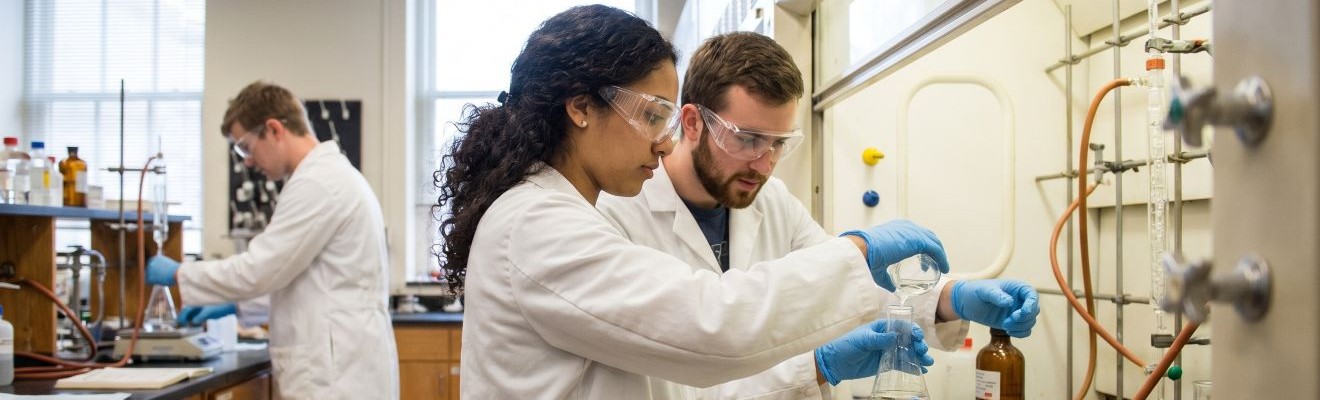
UNC Greensboro’s Post-Baccalaureate Certificate in Analytical Instrumentation provides graduate-level training in the scientific tools and techniques used to measure, image, analyze, and characterize materials and biological systems. Offered through the Joint School of Nanoscience and Nanoengineering (JSNN), the 12-credit certificate allows students to develop specialized knowledge in areas such as microscopy, spectroscopy, nanoscale characterization, biosensors, laboratory techniques, and process control.
The program is designed for students and professionals with backgrounds in chemistry, physics, engineering, biology, or related STEM fields who want additional expertise in scientific instrumentation for research, laboratory, manufacturing, or technology-focused environments.
Why Study Analytical Instrumentation at UNCG?
Analytical science is best understood in an environment where advanced instruments are actively used for research and materials analysis. At JSNN, students study within an interdisciplinary research facility that supports microscopy, analytical chemistry, materials testing, fabrication, and nanoscale characterization. JSNN’s Institute for Research Technologies provides access to advanced imaging and analytical resources used by academic, government, and industry researchers. Its facilities include technologies for electron and optical microscopy, spectroscopy, chemical analysis, materials testing, and other forms of scientific measurement. The certificate provides a focused way to strengthen technical knowledge of analytical methods without immediately committing to a full master’s or doctoral program.
Available areas of study include:
- Nanoscience laboratory and characterization techniques
- Spectroscopy methods
- Optical microscopy
- Particle beam and electron microscopy
- Molecular biology techniques
- Nano-biosensors
- Equipment and process control
Coursework helps students understand both the scientific principles behind analytical methods and how those methods are used to collect, interpret, and evaluate experimental data.
The Analytical Instrumentation Student Experience
Students learn in an interdisciplinary environment where advanced analytical methods are used to investigate scientific and engineering problems.
Because the certificate allows students to select four graduate courses, they can emphasize techniques that complement their existing STEM background or develop expertise in new areas such as microscopy, spectroscopy, biosensors, materials characterization, or process control.
The program may be completed on a full-time or part-time basis, making it an option for recent STEM graduates as well as professionals seeking focused graduate-level technical training.
Career Outcomes and Opportunities
Graduate training in analytical instrumentation can strengthen preparation for research and technical roles that rely on scientific measurement, materials analysis, laboratory instrumentation, and process monitoring.
Relevant career areas can include:
- Analytical chemistry
- Materials characterization
- Microscopy and imaging
- Laboratory analysis
- Quality control and quality assurance
- Scientific instrumentation
- Research and development
- Environmental analysis
- Process control
- Field applications and technical support
- Biotechnology and biomedical laboratories
- Government and academic research laboratories
The certificate can also provide additional preparation for graduate study in nanoscience, materials science, chemistry, physics, engineering, biology, or related STEM disciplines.
Program Details
Degree Type: Graduate Certificate
College/School: Joint School of Nanoscience and Nanoengineering
Program Type: Graduate Certificate
Class Type: In Person,Online
Catalog Name: Analytical Instrumentation, P.B.C.