

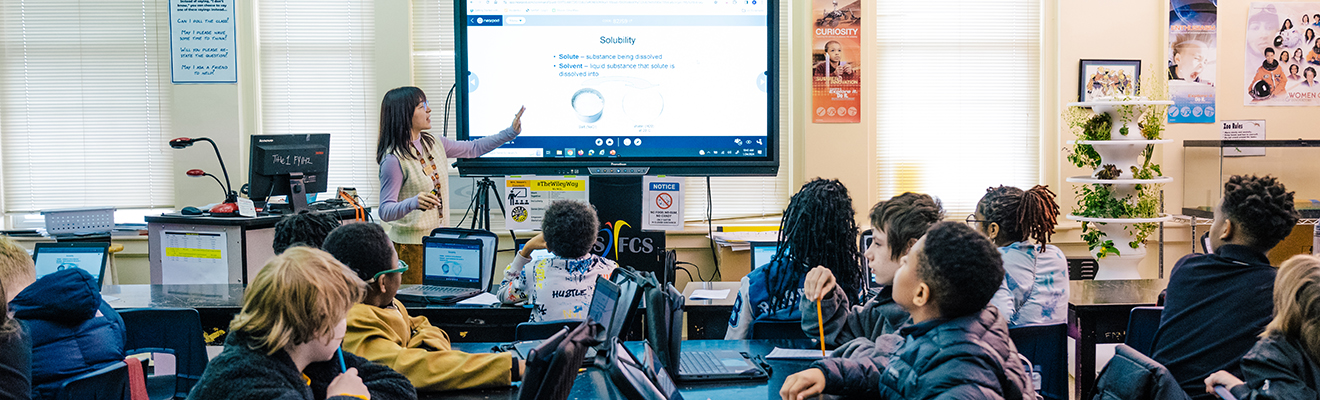
Prepare to inspire the next generation of scientists with UNC Greensboro’s Bachelor’s in Middle Grades Science Education. Designed for future educators who want to teach grades 6–9, this program combines rigorous science coursework with hands-on classroom experience from the start. Students will learn how to create engaging, inquiry-based lessons, integrate innovative instructional technology, and help middle school students develop the critical thinking and problem-solving skills they need to succeed. Graduates leave prepared to earn North Carolina teacher licensure and make an immediate impact in today’s science classrooms.
Bachelor’s in Middle Grades Science Education Program Distinctions
The Middle Grades Science Education program holds accreditations and affiliations from the Council for the Accreditation of Educator Preparation (CAEP) and the North Carolina Department of Public Instruction (NCDPI).
This concentration focuses specifically on teaching science to students in grades 6–9. Students in this program are able to develop a deep understanding of both middle school learners and science pedagogy while completing coursework in biology, chemistry, Earth science, and physics alongside discipline-specific teaching methods.
UNCG’s program emphasizes close collaboration with local public schools, giving students repeated opportunities to translate educational theory into effective classroom practice while working alongside experienced mentor teachers and university faculty.
Your Experience as a Middle Grades Science Education Student
Rather than limiting classroom experience to a final-semester internship, the program integrates multiple supervised field placements throughout the curriculum. These experiences allow students to apply instructional strategies in diverse middle school settings and build confidence before full-time student teaching. There are opportunities for service in programs and centers serving local middle grades students, as well as workshops designed to strengthen each candidate’s understanding and skill.
Students can collaborate with faculty on research related to topics such as:
- Equity in science education
- Student culture and learning
- Educational psychology
- Online education
- Teaching and learning practices
These opportunities help future teachers connect educational research with classroom practice.
School of Education students have access to two unique resources – the Michel Family Teaching Resources Center (TRC) and the Student Educator Learning Factory (SELF) Design Studio. The TRC is a model school library media center that offers a large collection of picture books, young adult fiction, nonfiction, board books, kits, and manipulatives. The TRC also offers professional resources that can be useful in creating lesson plans and study guides for North Carolina teacher exams. The SELF Design Studio is a dynamic makerspace where students engage in hands-on learning and creative exploration. You will find 3D printers, robotics, art supplies, and circuitry kits in the SELF Design Center.
Be sure to meet with your academic advisor each semester for more details pertaining to your program of study.
“Starting out with an internship your first semester is rare anywhere, but week seven in college? I was already in the classroom, interacting with kids and getting to know them, taking on leadership.”
– Grady Dupree-Isaac ’27

School of Education Academic Support Hub
Middle Grades Education majors have access to the School of Education’s Academic Support Hub services. The Hub provides no-cost tutoring and licensure exam preparation to our undergraduate students.
Services include:
- Praxis Core Preparation
- Praxis Math CKT Preparation
- Pearson Reading Exam Preparation
- American Sign Language Lab
UNCG School of Education Scholarships
Each year, the School of Education awards over $1 million in scholarships and graduate assistantships to students.
The Spartan Education Scholars program includes scholarships of up to $28,000. Scholarship funds for tuition are distributed incrementally, with $4,500 distributed in the first year, $5,500 distributed in the second year, and $9,000 distributed in each of the last two years, as long as eligibility requirements are maintained. Participation is open to incoming freshmen (first-year students), current UNCG students, and transfer students majoring in Elementary Education, Deaf Education, Middle Grades Education, Special Education, and Dual (Elementary and Special) Education.
The Haggai Academy is a scholarship program that provides scholarships of up to $8,000 per year, as well as a wide range of additional enrichment opportunities, for non-traditional students (24 years of age or older) pursuing an undergraduate degree in teacher preparation.
Once You Graduate with a Bachelor’s in Middle Grades Science Education
Students who complete UNCG’s Bachelor’s in Middle Grades Science Education program develop the knowledge, skills, and practical experience needed to effectively teach science in grades 6–9. Key program outcomes include:
- Demonstrate strong science content knowledge across multiple scientific disciplines and apply that knowledge to middle grades curriculum and instruction.
- Design and deliver engaging, inquiry-based science lessons that promote critical thinking, problem-solving, and scientific literacy.
- Understand the developmental needs of young adolescents and create learning environments that support their academic, social, and emotional growth.
- Apply research-based instructional practices to meet the needs of diverse learners and foster equitable learning opportunities.
- Integrate educational technology and innovative teaching tools into science instruction to enhance student engagement and learning.
- Translate educational theory into effective classroom practice through extensive field experiences, internships, and student teaching placements in diverse school settings.
- Collaborate with students, families, colleagues, and community partners to support student success.
- Meet the requirements for North Carolina licensure in Middle Grades Science (Grades 6–9) and enter the profession as confident, competent educators.
UNCG graduates are sought after by employers because of the close supervision and extensive field experience they received in their major and often assume leadership positions in their schools and state.
The U.S. Department of Education requires that all higher education institutions advise students as to whether their curriculum provides them with the eligibility to apply for a professional license and/or certification in the state for which they plan to practice. As such, please review UNC Greensboro’s status by state for the initial teaching license. You should note whether the program either “meets”, “does not meet”, or if there “has not been a determination” of the program’s status in the state for which you plan to practice. Licensure Reciprocity Information
Program Details
Degree Type: Bachelor's
College/School: School of Education
Program Type: Majors & Concentrations
Class Type: In Person
Catalog Name: Middle Grades Education, B.S. Science with Grade 6-9 Teacher Licensure Concentration
Similar Degree Offerings
Contact Us

Dr. Nick Kochmanski
Program Coordinator
nmkochmansk@uncg.edu