

A Master’s in Nutrition at UNC Greensboro can prepare students for more advanced skills and positions in the nutrition field depending on the option they choose in the program. Students can choose between the 37-hour thesis, the 38-hour M.S./D.I. combined or the 40-hour non-thesis.
The M.S. thesis involves training in research skills and prepares students for teaching, research, administrative, and consulting positions or for progression to a Ph.D. degree program.
The M.S./D.I. program combines the M.S. degree with the Dietetic Internship Post-Baccalaureate Certificate Program. Students complete a plan of study that includes M.S. courses in year one and D.I. courses in year two.
The M.S. non-thesis track prepares students for consulting, administrative, and practitioner positions in nutrition. The registered dietitian (R.D.) credential must be obtained for a career in dietetics. Successful completion of didactic coursework qualifies students to apply for our post-baccalaureate certificate (PBC-DI) supervised practice program. Following completion of supervised practice and a Master’s degree, students will take a national registration exam to earn the registered dietitian nutritionist (RDN) credential.
the master’s in nutrition Program Distinctions
The Master’s in Nutrition Program at UNCG is led by faculty with a wide range of research interests. This varies from cellular to population level, related to nutrition and health and involves use of diverse methodological approaches. Students in the thesis track will conduct basic or applied research with faculty.
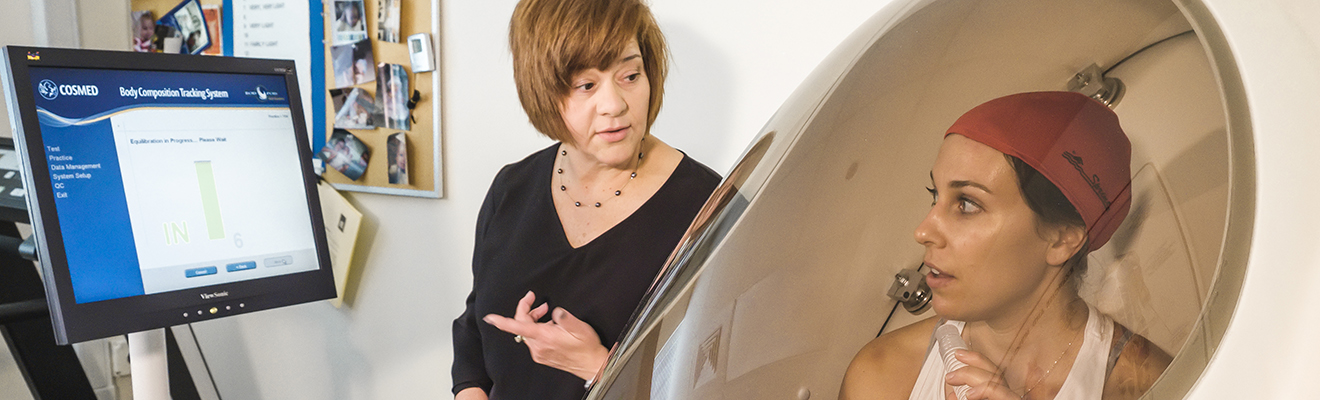
Students in the program will use state-of-the-art laboratories. Research laboratories contain modern equipment for the study of:
- Cellular and molecular nutrition
- Nutritional and clinical biochemistry
- Physical fitness and body composition
- Dietary intake
UNCG Nutrition students also frequently receive national awards and funding for their research, or other opportunities. This includes:
- The Emerging Leader in Nutrition Science and Obesity Research Interest Section Award in the American Society of Nutrition (ASN) Poster Competition
- Society for Nutrition Education and Behavior (SNEB) Foundation Scholarship
- UNCG School of Health and Human Sciences Scholarships
- Dietetic interns often receive grant funding to attend the Food & Nutrition Conference & Expo (FNCE)

“There is so much that goes on in a food service operation, from the janitors to the chefs to the supervisors. Everyone plays such a vital role.”
– Tamika Watts ’23 MS, RD, LD, Nutrition
The Master’s in nutrition Student Experience
The program is research-based, which allows students to work alongside faculty members, clinicians, and community partners inside and outside of the classroom. Regardless of whether students are in the thesis, M.S./DI or non-thesis option, they will have the opportunity to:
- Present at professional conferences.
- Become involved in the Nutrition Graduate Student Association or the UNCG Graduate Student Association.
- Learn about contemporary subjects, such as sports nutrition and culinary medicine.
After Graduating with your master’s in nutrition
Upon graduating, students may find jobs such as:
- Clinical dietitian
- Clinical research associate
- Extension nutrition specialist
- Food production manager
- Nutritional scientist
- Physician/physician assistant
Applying to the Master’s in nutrition Program
- GRE IS WAIVED.
- Applications for admission to M.S./M.S.N. must be submitted on-line by the following dates:
- February 1 for assistantship consideration for fall semester admission,
- May 1 for fall semester admission without assistantship consideration, and
- Nov. 15 for spring semester admission.
- Applications for admission to the M.S./DI program must be submitted on-line by February 15th for the following fall semester admission. UNCG participates in the Dietetic Internship Centralized Application Services (DICAS) application system and applicants should consult the DICAS website to confirm dates and deadlines for the computer matching process.
- The DI program at UNCG also has a preselection process for current UNCG DPD students and UNCG Graduate Students.
The following are required for evaluation by the Graduate School:
- A completed on-line application form and payment of the application fee;
- Three letters of recommendation;
- A letter of intent that includes whether the applicant is applying for the M.S. (thesis-option); M.S./DI combined or M.S. (non-thesis option), indicates the applicant’s professional goals, and indicates the applicant’s general area of research interest (for M.S. thesis option) (indicate applied research or basic research, or no preference);
- And official transcripts of all previous college course work.
FOREIGN STUDENTS
Additionally, foreign students are required to
- Submit TOEFL or IELTS scores and
- Detailed NACES (course-by-course) evaluations of transcripts.
All application materials must be sent to the Graduate School. Once complete, application materials are then forwarded to the Department of Nutrition for review. Questions regarding application status should be directed to the Graduate School.
All students entering the master’s and doctoral degree programs must have background-supporting courses in:
- General and Organic Chemistry
- General Biology
- Biochemistry
- Human Physiology
- Basic Nutrition
At UNCG these course numbers are: CHE 103, CHE 104, CHE 110L, CHE 205, CHE 206, NTR 531, BIO 111, BIO 277, NTR 213 (see Transfer Credits)
Program Details
Degree Type: Master's
College/School: School of Health and Human Sciences
Program Type: Majors & Concentrations
Class Type: In Person
Catalog Name: Nutrition, M.S.
Similar Degree Offerings
Contact Us
Steve Fordahl, Ph.D.
Director of Graduate Studies
Department of Nutrition, 318 Stone Building
319 College Avenue
Greensboro, NC 27412
336-256-0325
scfordah@uncg.edu