


Graduates of UNCG education programs work in over 75% of North Carolina’s public-school districts.
Whether your goal is to work in elementary schools, secondary schools, or higher education, the Department of Teacher Education and Higher Education (TEHE) provides the best possible preparation and support. It develops leaders who want to make a difference in the lives of learners. Its in-person and online options ensure flexibility for working teachers.
Students may enhance their Masters of Education experience with one of six concentrations. Each focuses on teaching mathematics, literacy, science, and social studies for elementary, middle, and secondary grades.
the master’s of education Program Distinctions
The UNC Greensboro School of Education was named one of the “Top Graduate Schools of Education” by the U.S. News & World Report.
TEHE is structured for practicing teachers and freshman who have just begun pursuing their college degree. Outside of their classwork, students gain access to internships, field-based projects, and more opportunities to work within the local community.
The department faculty have advanced research in teacher support, teacher licensure, inquiry learning, engaged reading communities, learning assessments, social-cultural academic socialization, dual language/immersion, informal science learning, family engagement, professional development, and other applicable fields of expertise.
Its advanced degree programs move beyond practice and delve into theory and research. These allow practicing teachers to earn their advanced (M-Level) licensure. UNC Greensboro’s School of Education research initiatives include:
- The Coalition for Global Languages and Cultures (CGLC): Promotes innovative, relevant, and collaborative work in the areas of community-engaged research, outreach and advocacy, policy work, and professional development.
- Impact Through Innovation (ITI): Empowers educators, students, and communities to turn ideas into transformative programs that overcome challenges and create measurable change.
Master’s students may specialize by adding any of these six concentrations:
- Elementary Mathematics
- Middle Grade/High School Mathematics
- Middle Grade/High School Social Studies
- Kindergarten–High School Science
- Kindergarten–High School Literacy
- Teaching English as a Second Language
The graduate teacher education Student Experience
Students in the Teacher Education M.Ed. program learn applied skills in the design, production, application, and evaluation of a broad range of media and technology for innovative teaching, instruction, training, and development.
The master’s level offers the option of initial licensure, Master of Arts; or advanced licensure, Master of Education.
Over 100 assistantship roles — many paid — offer hands-on experience in faculty-led research projects and local tutoring. Students will have access to conference presentations nationwide and international.
Sample courses include:
- Humanizing Pedagogies in Elementary Education
- Child and Adolescent Development and Learning
- Student Engagement in the Classroom
- Dual Language Instructional Practice
- Emergent Literacy and Literature
- Institutes in Education
Student learning goals are consistent with standards set forth by the Council for the Accreditation of Educator Preparation, the Interstate New Teacher Assessment and Support Consortium (INTASC) at CCSSO, the National Educational Technology Standards at the International Society for Technology in Education, and the North Carolina Department of Public Instruction.
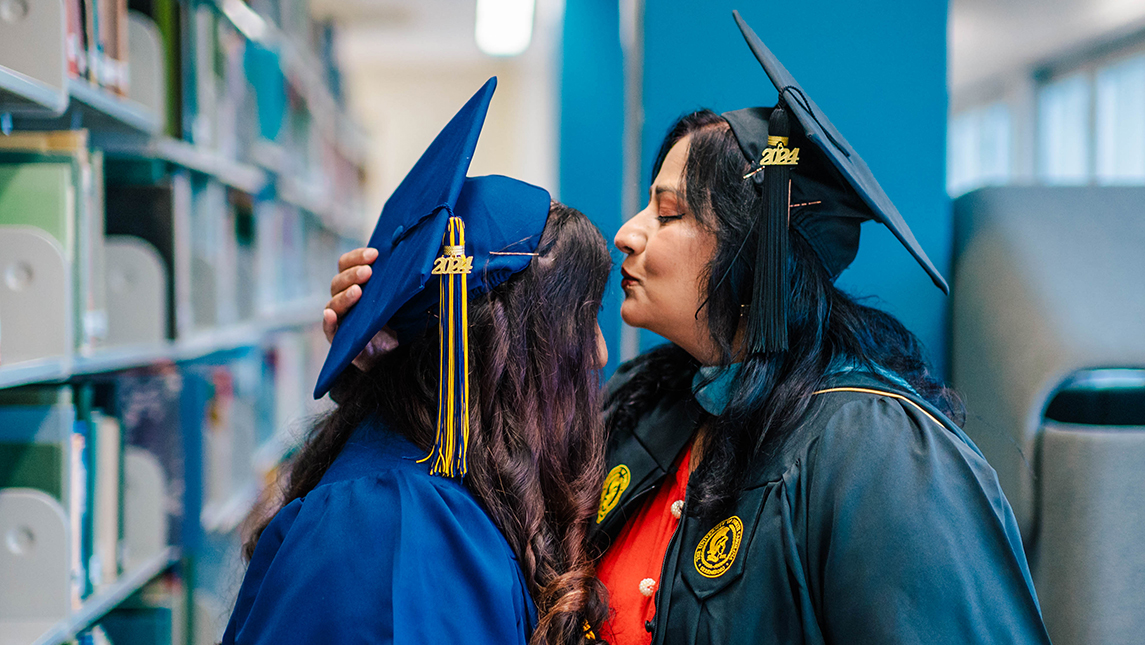
“Math and physics are my passion, so I was excited to teach high school math…I enrolled to help motivate my daughter, but I have learned so much.”
–Dr. Rabia Qindeel ’24, M.Ed. in Teacher Education, Middle/Secondary Mathematics Education Concentration
After Graduating with your master’s of education
Graduates of the program are well-prepared for successful careers as:
- K-12 teachers
- Community college instructors
- School district administrators
- Curriculum developers, specialists, and facilitators
Program Details
Degree Type: Master's
College/School: School of Education
Program Type: Majors & Concentrations
Class Type: Online
Catalog Name: Teacher Education, M.Ed.
Similar Degree Offerings
Contact Us

Dr. Kerri Richardson
kdricha2@uncg.edu