IDEAS alumnus and freelance ASL interpreter on his time with UNCG
Alumnus Mark Lineberger grew up fluent in English and American Sign Language (ASL). His mother, who had deaf siblings, taught at the North Carolina School for the Deaf in his hometown of Morganton, where his father served as a minister for a deaf congregation. ASL was the family’s second language.
Knowing he wanted a career working with the deaf and hard of hearing, Lineberger enrolled in UNC Greensboro School of Education which offered the only undergraduate deaf education program in North Carolina. During his time at UNCG in the late 1990s, he would help create the program’s concentrations in interpreting and advocacy services and help lay the groundwork for the Interpreting, Deaf Education and Advocacy Services (IDEAS) program the School of Education offers today.
Deaf education beyond the classroom
Committed to using his ASL skills, Lineberger chose to major in deaf education, but unlike his classmates, he did not plan to teach. While on campus, he interpreted for other students in their classes and expanded his experience working with people with hearing disabilities..
He earned a certificate to interpret in the community but was not sure how he would put it to use. “I had a base of fluency,” he says. “But I had to learn how to adapt it to different situations.”
In the late 1970s, the early years of the deaf education program, most of the world’s deaf individuals were taught to speak and read lips. Research later showed that oral language is not the only effective way to communicate, which uncovered a need for those who can interpret.
“If you wanted an interpreter at your doctor’s appointment or other things, you asked a family member or friend,” recalls Lineberger. He wanted to see that change.
So did UNCG faculty members Edgar Schroyer, Glenda Torres, and Mary V. Compton, who were considering creating a concentration in Deaf Advocacy for people like Lineberger, who wanted to work in various contexts besides teaching.
Today, Lineberger says lightheartedly that he was the “guinea pig” as faculty designed a curriculum that included general education courses that led to more advanced coursework in psychology, sociology, social work, and other subjects to prepare interpreters for various settings.
They knew that being a successful and versatile interpreter requires more than just knowing ASL.
“Their guidance of my academic path laid the groundwork for the IDEAS program,” Lineberger says. “You need content knowledge to work in a legal setting, social services setting, religious settings and others. You have to know a little about a lot, so you can interpret not just words, but concepts for an equivalent message in ASL.”
A Quest for Understanding
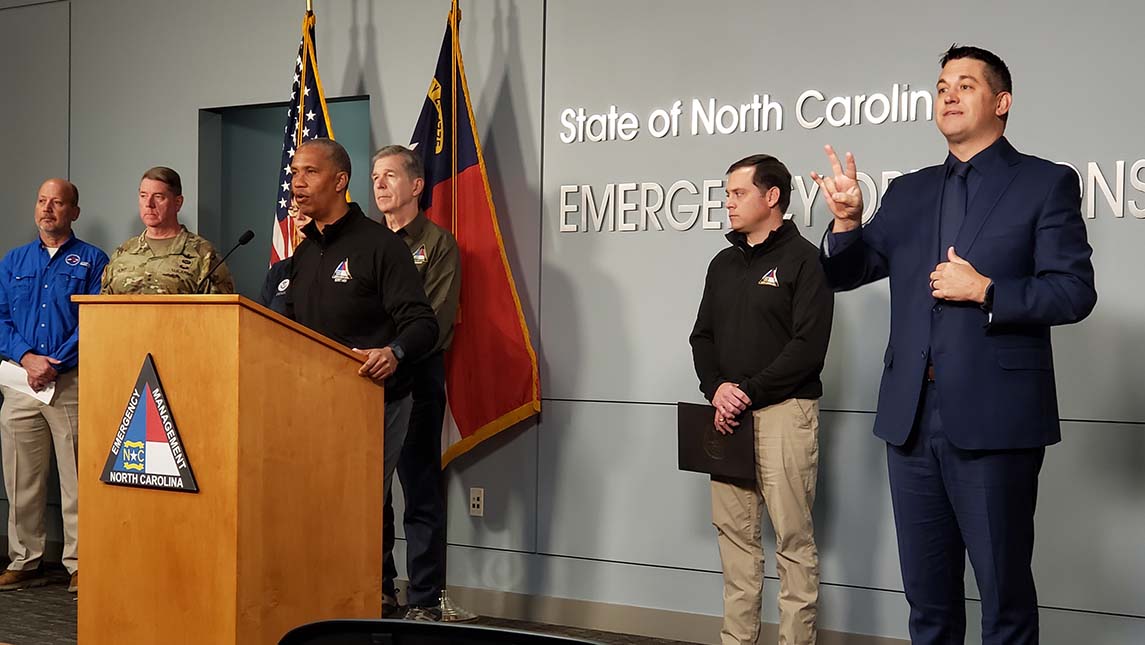
Now, 25 years after graduation, Lineberger is a busy freelance interpreter. He works wherever he is called to go: courtrooms, doctors’ offices, press conferences and anywhere interpreting is needed. The Americans with Disabilities Act, passed in 1990, requires that an interpreter be provided upon request in a variety of situations.
Lineberger gets some of his work through interpreting agencies, while some clients call him directly. He is in great demand. He might go from a courtroom to a physical therapist’s office to a public official’s press conference, all within a day.
“I enjoy the variety of the work I get to do,” he says.
When he does his best work, people hardly notice he’s in the room. They just know they can communicate.
It’s critical to recognize, he says, that in each situation interpreters are not “helping deaf people.” Rather, they provide communication, language equity, and equal access to the world through interpretation.
His goal at each job is to ensure that both deaf people and hearing people leave the appointment or event with the same knowledge of what was said. Both need interpretation to communicate. In facilitating that process, Lineberger is also breaking barriers and building community.
“It’s a big responsibility and should be treated as such,” Lineberger says.
UNCG’s Interpreting, Deaf Education and Advocacy Services (IDEAS) Program in the School of Education is celebrating its 50th year. Begun in 1975, offering only a bachelor’s degree in Deaf Education, it now also includes concentrations in Interpreting and Advocacy Services.
Story by Mary Daily
Photography by NCDHHS Division of Services for the Deaf and Hard of Hearing