The United States recognizes environmentally friendly practices this week with America Recycles Day. But students, faculty, and staff at UNC Greensboro are making it happen every day.
“Sustainability at UNCG is a campus-wide effort,” says Sustainability Specialist Sean MacInnes. “I’m thankful to all of the staff, faculty, and students who serve on various sustainability-focused committees and who work behind the scenes to help us achieve our goals.”
UNCG made The Princeton Review’s 2026 Guide to Green Colleges and earned a Silver rating from the Association for the Advancement of Sustainability in Higher Education. These awards reflect an all-encompassing dedication to sustainability in academic course offerings, buildings and infrastructure, and community outreach and partnerships.
“It’s really easy to get involved,” says Tanner Lyons ’25, a graduate student who was president of the Garden Club while earning their bachelor of science in biology. “The club inspired me to focus on sustainability initiatives. But you can also attend events like the Peabody Park ivy pull this Friday. There’s so many opportunities within departments and on campus as a whole.”
What does sustainability look like for UNCG students? Here are four ways to put it into practice:


Live the ‘Green’ Life
UNCG students take great pride in the look of their dorms. Thanks to the Office of Sustainability, students feel empowered to lead the way by participating in the Green Room certification program.
The program provides a simple checklist for students to make their dorm rooms more sustainable. Each participant earns a certificate they can display and a chance to win a gift bag each semester.
The Office also lists resources for commuter students and employees so they can enact green practices at home or in their office. For example, they can learn about reusable alternatives to single-use kitchen items and locate cleaning products free of harmful chemicals.
Spartans will find links to sign up for local programs that help them save energy, reduce water usage (and costs), shop smarter, and find drop-off spots for materials that can’t be picked up by the routine garbage collection.
Stainless steel solutions
This semester, Spartan Dining rolled out an alternative to one-use disposable takeout boxes and reusable plastic containers. It partnered with USEFULL, which makes stainless steel containers for students who want a little something for the road from Fountain View Dining.
Students can request a container at the register and keep them for 48 hours. A QR code tracks when they return them. In just the month of October, students checked them out more than 2,500 times.

The resources also show them how to get involved in citizen science projects like Merlin and iNaturalist. This way, they can connect with nature and contribute to ongoing research.
A link to the program can be found in the sustainability section of the UNCG Mobile app.
Grab it by the root
Students can discover their green thumbs while providing for the community through the student Garden Club. The group promotes sustainable gardening while also growing and harvesting produce for Spartan Open Pantry.

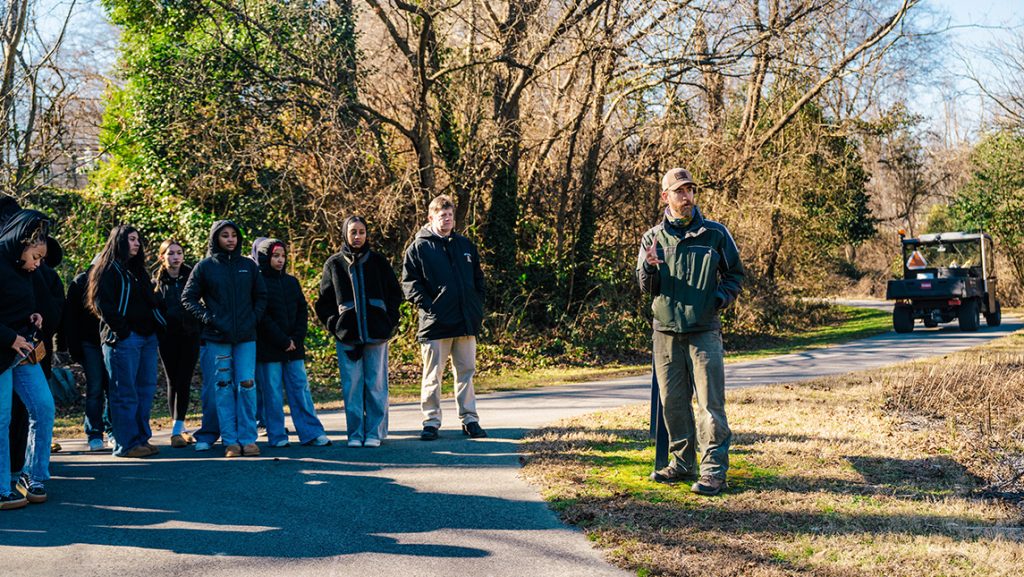
Ivy is a problem across the South, and that includes UNCG. The invasive plant grows fast, choking out native undergrowth and trees we wish to cultivate in Peabody Park.
For years, UNCG faculty, staff, and students have committed time, work, and research to preserve the 34 acres of woodland and prairie. As part of that work, they invite everyone to help with their routine ivy pulls.
The next ivy pull is Nov. 14, from noon to 2 p.m. Registration is not required. Just show up at the pedestrian bridge that links College Ave. to the Music Building.
Meanwhile, faculty have made planting into an art form, as seen in the pollinator garden near the basketball courts. That project sprung from the minds of Assistant Professor of Photography Leah Sobsey, M.F.A., and Costume Technology Lecturer Tara Webb, M.A., who wanted a garden art space on campus. Students keep busy there, diversifying the plant life and infrastructure while sowing seeds of creativity for future projects.
And off campus, members of the College of Arts and Sciences opened the Plant and Pollinator Center at Gateway Research Park North. Since then, it’s become a valuable place for students to find solutions to shrinking bee populations. (In 2023, UNCG became an affiliate of Bee Campus USA.)

Get course credit

Many students become experts of earth-saving habits by making sustainability their major, minor, bachelor’s, or graduate degree.
Classes are delivered by the aptly named Department of Geography, Environment, and Sustainability (GES). “GES has a variety of classes for sustainability learners, from urban studies to dendrochronology and from political ecology to climate science,” says Aaron Allen, Ph.D., director of the environment and sustainability program.
Introduction to Environment and Sustainability (GES 162) is a popular gateway class, according to Allen. He says, “Our advanced topics include climate economics, sustainable buildings, food systems, and environmental humanities.”
Other areas of study have courses about the environment and sustainability. When registering—now open for Spring 2026—simply type “SUS” in the “General Education Attribute” field to find all sustainability-marked classes available for the semester, or ask an instructor or advisor for recommendations.
Other Popular Courses
- The Biosphere 3 (BIO 431): A study of environmental issues in biology, specifically ecosystems, population dynamics, biodiversity, and extinction.
- Chemistry and the Human Environment 3 (CHE 252): Study of chemical problems central to current technological, biomedical, and environmental issues, including energy alternatives, food chemicals, environmental chemistry, molecular basis of drug action, and consumer products.
- Environmental Communication 3 (CST 420): Explores environmental communication including current issues, theoretical frameworks, ethical frameworks, and the symbolic relationship between humans and nature.
- Green Criminology 3 (SOC 373): Study of harms and crimes against the natural environment and the related impacts on humans.
- Literature and the Environment 3 (ENG 380): Exploration of some important post-1800 literary texts about “nature,” ecocritical theories, and affiliated social movements.


What’s your project?
Each month, the office accepts proposals for the Green Fund. This fund supports professional development and educational opportunities with an environmentally conscious focus. Projects submitted by campus members are sure to leave a lasting impact, to be enjoyed by Spartans for years to come.
Lyons just received funding to advance their thesis for their master of science in biology, comparing remnant Piedmont prairies with restorative Piedmont prairies.
With the award from the Green Fund, they can purchase phenology cameras and other equipment that track the growth trends of plants over time, including those in Peabody.
“Phenology is essentially the biology of timing,” they explain. “In plants, for example, it’s when they flower, when they fruit, and when they die. Phenocams are a really powerful tool to look at the foliage of a plot of land. They track the greenness in the image over time, taking many pictures every single day.”
With the rest of the money, Lyons can buy insect traps to catalogue what kind of insects visit the region. They hope this data will help people restore prairieland and grassland.
“Sean has done a lot for me as a student,” says Lyons. “I wouldn’t be able to do my thesis project without this money. It’s monumental, and I’m enormously thankful to the Green Fund Committee.”
Other students used the Green Fund to prevent birds from colliding with building windows and to add solar-panel picnic tables in Moran Commons.
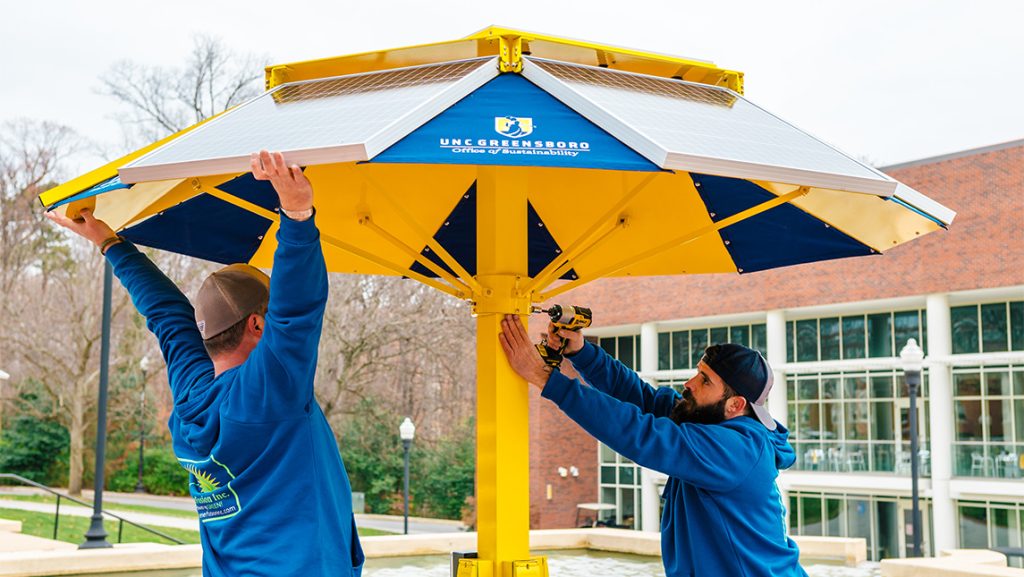

Applying is easy, with a proposal form available on the Sustainability website. Maybe your idea will spark the next new and enduring feature at UNCG.
Story by Janet Imrick, University Communications
Photography by Sean Norona and David Lee Row, University Communications