Four cosmic events converge within 24 hours, giving one UNC Greensboro astrophysicist a chance to explain how they’re all connected.
A solar eclipse, a meteor shower, a new moon, and a parade of planets might seem like four random events. But according to Dr. Anatoly Miroshnichenko, director of the UNC Greensboro Planetarium and the Three College Observatory, they’re more connected than they appear.
On Aug. 12, all four will happen within roughly 24 hours of each other. It’s a convergence that astronomers don’t get to point out very often. What links them isn’t coincidence, but the orbital motions of the Earth, moon, planets, and other objects throughout the solar system.
The new moon is key to two of the week’s biggest celestial events, Miroshnichenko says. Its position between the Earth and the sun causes the solar eclipse, while the darker sky it creates makes the Perseid meteor shower easier to see.

“The Perseid meteor shower will be visually accessible in the evenings starting at about 11 p.m. and for a few more hours after that,” Miroshnichenko says. “You could expect to see up to several dozen meteors, but it’s unpredictable.”
No single place on Earth, including Greensboro, will get a perfect view of everything. Miroshnichenko notes the path of totality for the solar eclipse will pass across parts of Spain, Portugal, Greenland, and Iceland, but leave North Carolina with only a partial eclipse. As seen from Greensboro, up to 12% of the surface of the sun will be covered by the moon.
Luckily,& skywatchers here will still have plenty to look for: a pre-dawn lineup of six planets, a partial solar eclipse, and one of the year’s best meteor showers under a moonless sky.
The planetary alignment and the meteor shower are best viewed, Miroshnichenko says, from dark, rural areas free of light pollution from the cities. He adds that eye protection is a must for observing the solar eclipse.
The peak is Aug. 12, but Miroshnichenko says there’s no reason to stop watching after that. The Perseids will remain active for several nights, and the planetary alignment will remain visible for weeks. He hopes the unusual timing of the four events encourages more people to look up — and ask questions about what’s happening overhead.
Inside the UNCG Planetarium

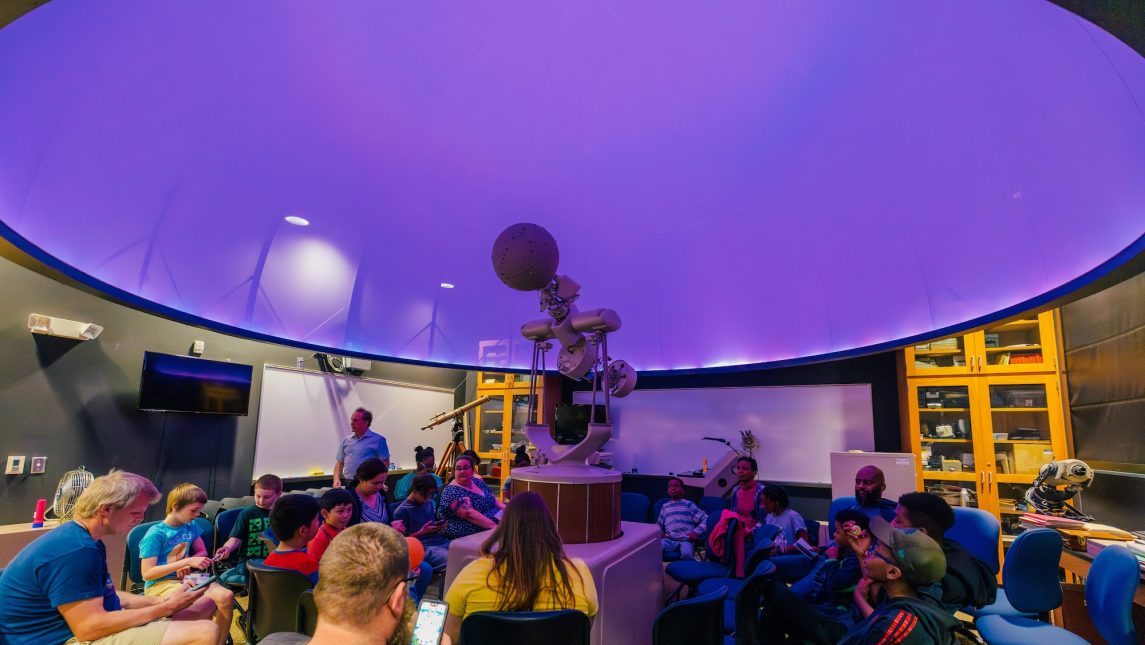
Those questions don’t have to end when the sky grows cloudy or the celestial events pass. At the UNCG Planetarium, Miroshnichenko can recreate the night sky from anywhere in the Northern Hemisphere and at any point in time, giving visitors a chance to explore astronomical events that may be difficult — or impossible — to fully experience from Greensboro. Miroshnichenko brings his classes here regularly to demonstrate celestial phenomena; it is also open to the public about once a month, free of charge.
“We’ll talk about what the sky is going to be like that night,” he says. “We’ll show them all of the things they could see in a really dark sky — darker than the Greensboro sky.”
The UNCG Planetarium came about when the remodeling of Petty Science Building was finished in 2009, and the Greensboro Science Center was refurbishing its own planetarium with a new digital projector.
Dr. Steve Danford, UNCG professor emeritus of physics and astronomy, says that after he made some inquiries, the Science Center agreed to donate its analog projector, a Spitz 512, as a gift to the University.
The UNCG Planetarium will next be open to the public on Saturday, Sept. 25 at 7:30 p.m. Reservations can be made at the Planetarium home page.
Story by Brian Clarey, University Communications
Photos by Sean Norona, University Communications ;