Artifacts from the archives haunt and thrill
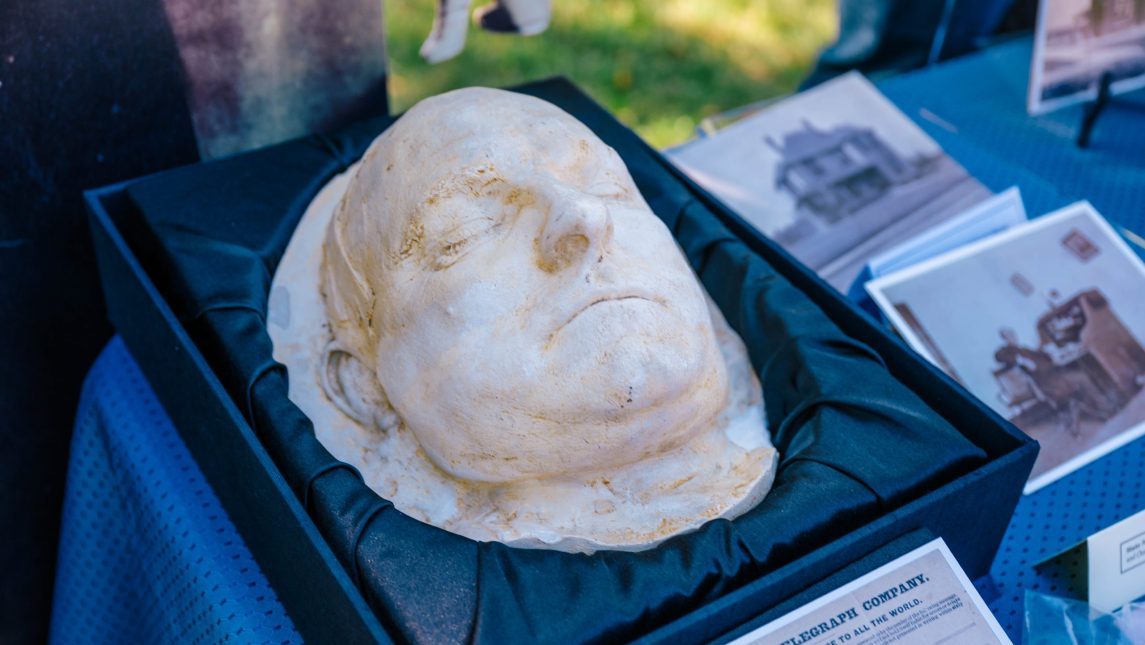
The death mask of Charles McIver, the founder and first president of the State Normal and Industrial School, now UNC Greensboro, holds a place of honor in the Hodges Reading Room at the Main Library this week. It’s part of the second annual “Hodges Halloween Hijinks” exhibit, a chance for archives staff to unearth some of the collection’s spookiest treasures.
There’s a copy of Mary Shelley’s “Frankenstein” from 1832, a book she wrote when she was just 18 years old. The first draft of the novel was written during a particularly stormy evening at a house party with her eventual husband Percy Bysshe Shelley, Lord Byron, her sister Claire Clairemont, and Dr. John Polidori in attendance. At that retreat, held in 1816 at a villa near Lake Geneva in Switzerland, Lord Byron challenged everyone to write a ghost story. Mary Shelley, then known as Mary Godwin, planted the seeds for “Frankenstein” that week. Polidori’s efforts eventually became “The Vampyre,” published mistakenly under Lord Byron’s name in 1819, an early printing of which is also part of this display. The printing of “Daemonologie” by King James I of England dates to 1616. There is the first American edition of “Dracula” by Bram Stoker, 1899. And there are two works of a ghostly nature by Sir Arthur Conan Doyle, best known for creating Sherlock Holmes but who also had a keen interest in the supernatural.
“His wife was a medium,” says Kathelene Smith, associate professor and head of the Martha Blakeney Hodges Special Collections and University Archives, “and Conan Doyle was a devout spiritualist.” She points out Doyle’s “The Case for Spirit Photography,” first published in 1922, and his two-volume work from 1926, “The History of Spiritualism.” “It was really an interesting aspect of his personality that he was writing these mysteries based on a character who was all about logic. And then he was also very interested in all of these supernatural things,” Smith says.
On display until Halloween, the exhibit also features other rare books and artifacts from the collection, including a family of papier-mâché Jack-o-lanterns made by the home economics department in 1930.
But the McIver death mask may be the spookiest item of them all.
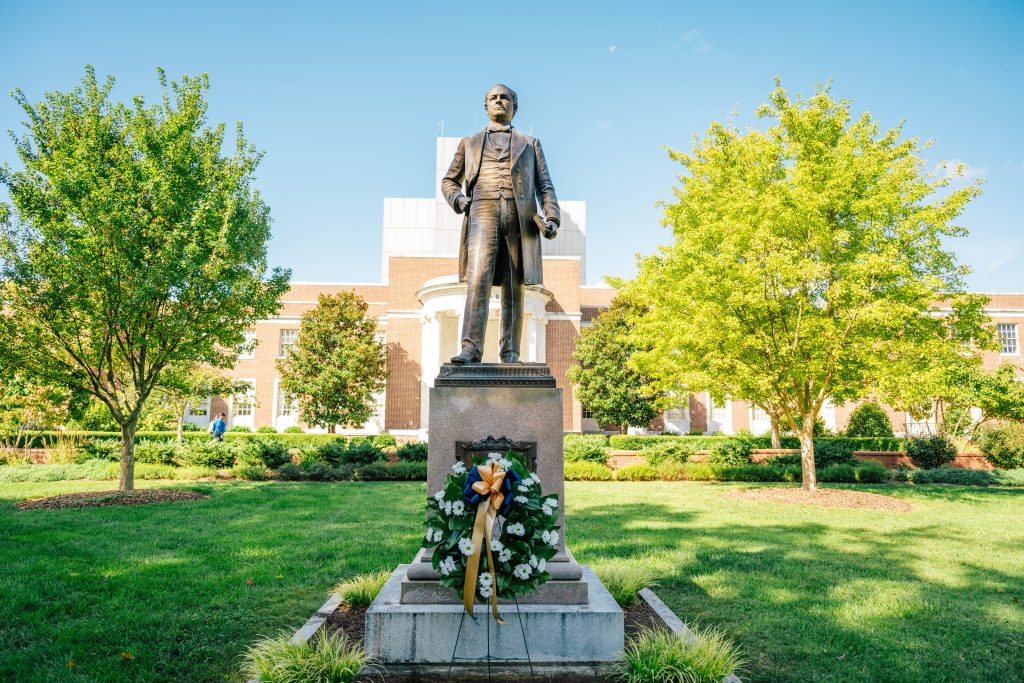
Wells L. Brewer, a prominent Greensboro architect, cast the mask within hours of McIver’s death in 1906. Sculptor Frederick W. Ruckstuhl later used it to create McIver’s memorial statue, which has stood near the Main Library’s College Avenue entrance since 1912.
Ruckstuhl held onto the mask until 1915, when he donated it to UNC-Chapel Hill President Edward K. Graham. There, it was displayed at the Peabody Educational Building for years before being relegated to the archives, where it remained until 1962. That year, Woman’s College Librarian Charles M. Adams drove to Chapel Hill with McIver’s daughter, Lula, to retrieve the honored visage and return it to its spiritual home.
.
“Hodges Halloween Hijinks” won’t be back until next year’s spooky season, but University Libraries keeps a “ghost file” containing all of the macabre artifacts and stories from UNCG’s long history.
Students can also book a campus ghost tour featuring the Grey Lady of UNCG Auditorium; the spirit of Clara Booth Byrd, said to inhabit the Marcus T. Johnson Alumni House; the ghost of Mary Foust; and spirits associated with the Faculty Center. The Faculty Center originally served as an infirmary, where victims of the 1899 typhoid epidemic were treated.
Smith says ghost tours can be booked through University Archives and Special Collections.
Story by Brian Clarey, University Communications
Photos by Sean Norona, University Communications
Video by David Row, University Communications