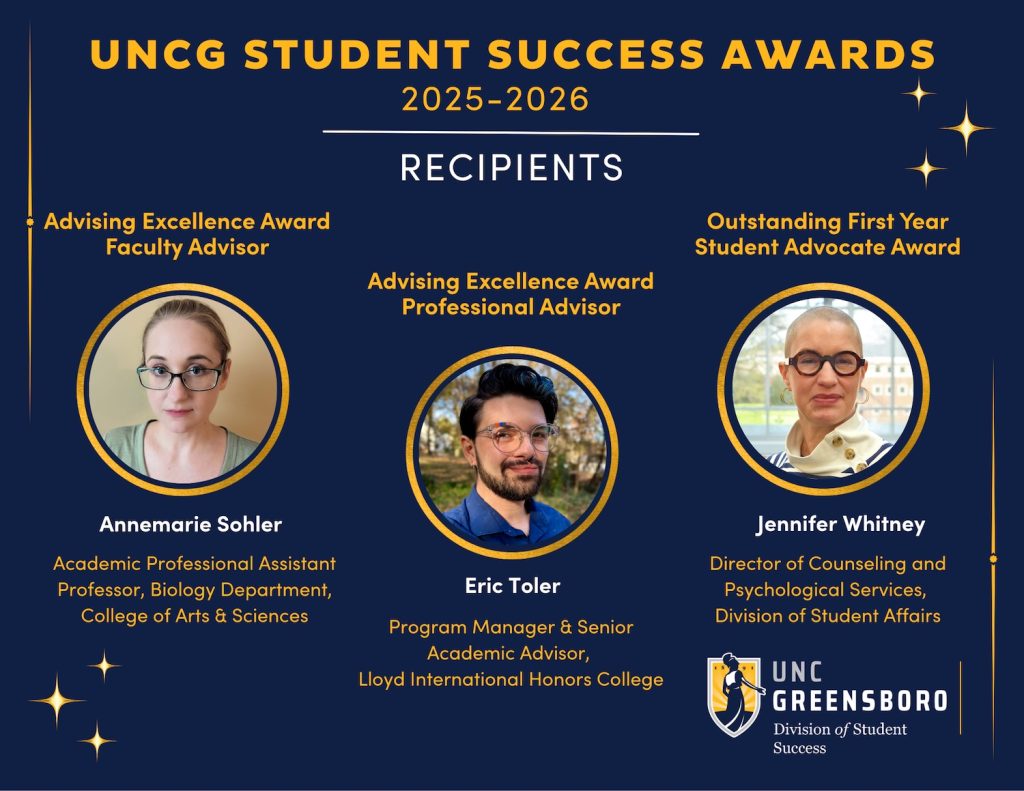
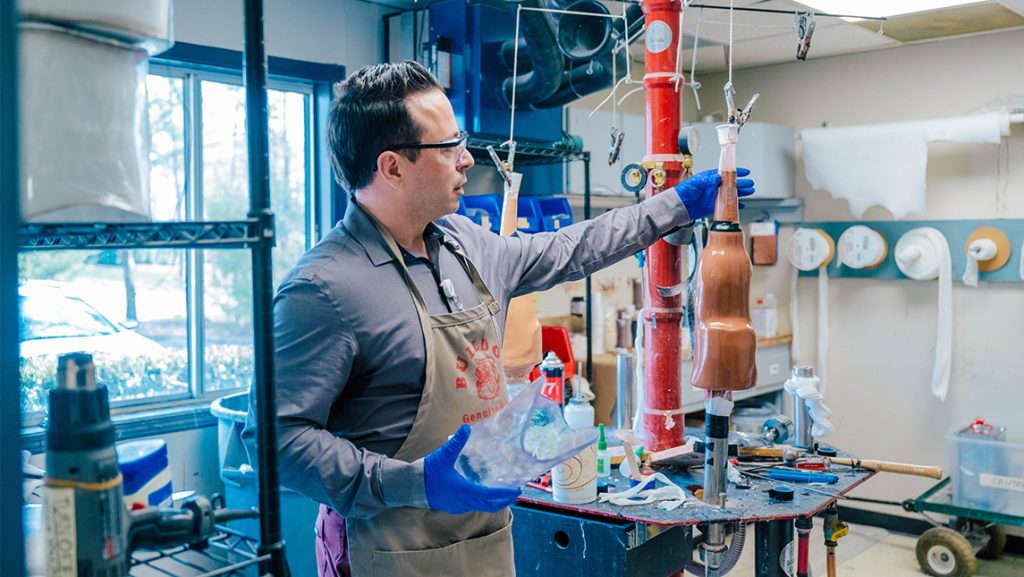
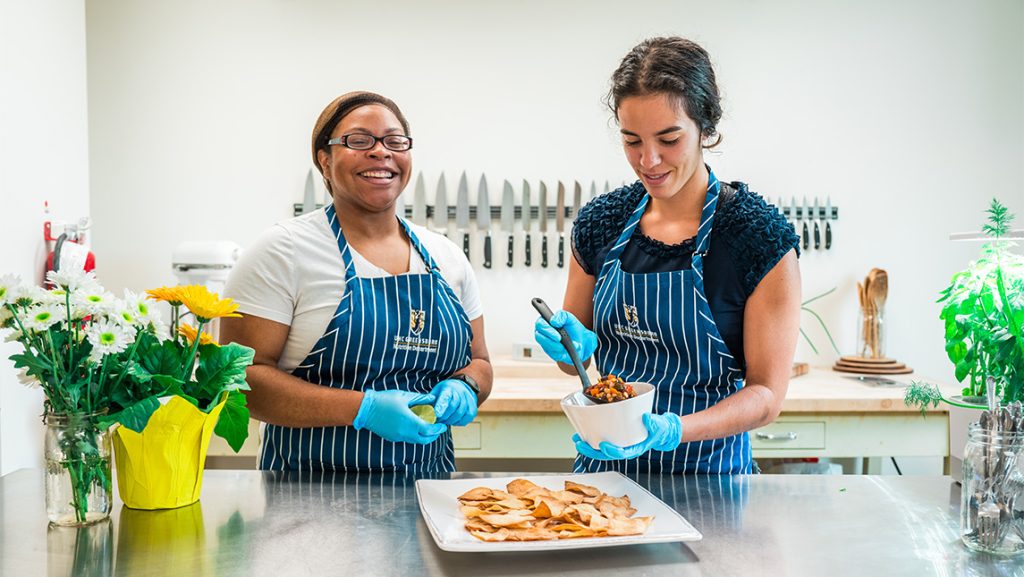
The three recipients of the academic year’s UNCG Student Success Awards, sponsored by the Division of Student Success, have been announced.
The UNCG Advising Excellence Awards recognize the commitments of faculty and staff who make significant contributions to student success through the delivery of exemplary academic advising. Two UNCG Advising Excellence Awards are presented each spring term honoring a faculty advisor and a professional academic advisor. Both awards and the selection criteria have been modeled to reflect the regional and national advising awards established by the National Academic Advising Association (NACADA).
The Outstanding First-Year Student Advocate Award recognizes and celebrates the efforts and significant contributions of UNCG faculty and staff who provide leadership in creating a positive transition to college and a successful learning environment for first-year students.
The recipients this year are:
Academic Advising Excellence, Faculty Advisor Annemarie Sohler, Academic Professional Assistant Professor Department of Biology, College of Arts & Sciences
Academic Advising Excellence, Professional Advisor Eric Toler, Program Manager and Senior Academic Advisor Lloyd International Honors College
Outstanding First-Year Student Advocate Jennifer Whitney, Director of Counseling and Psychology Services Student Health Services, Division of Student Affairs
New International Poetry Review Issue ‘The Work of Staying’ Elevates Perspectives on Meaning
Posted on April 01, 2026
The poems gathered by the Department of Languages, Literature, and Culture for this issue confront a struggle over meaning: who assigns it and what meaning is imposed on experience. These diverse voices speak of memory, loss, and endurance, insisting on the right to speak plainly when language proves unstable or inadequate.
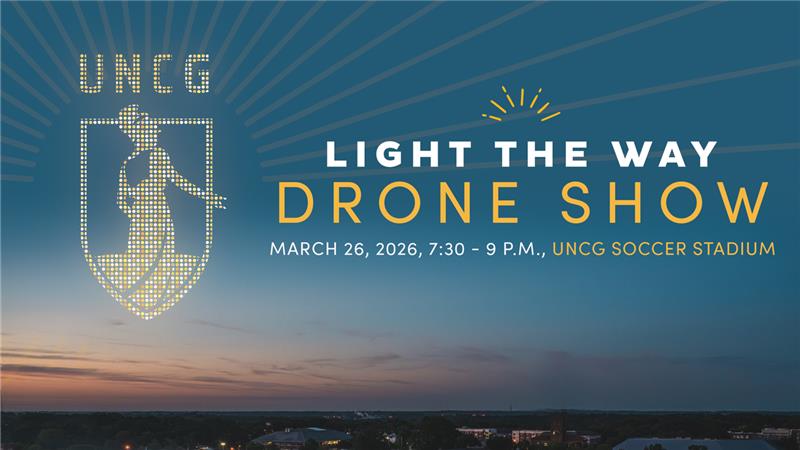
On March 26, UNCG is celebrating the success of its historic givingcampaign with Greensboro’s first-ever drone show. Students, faculty and staff, and the community are all invited to come see the show at the soccer stadium and to enjoy music, performances, food, and giveaways.
Undergrad Researcher Maps New Pathways in Bone Biology at UNCG
Posted on March 23, 2026
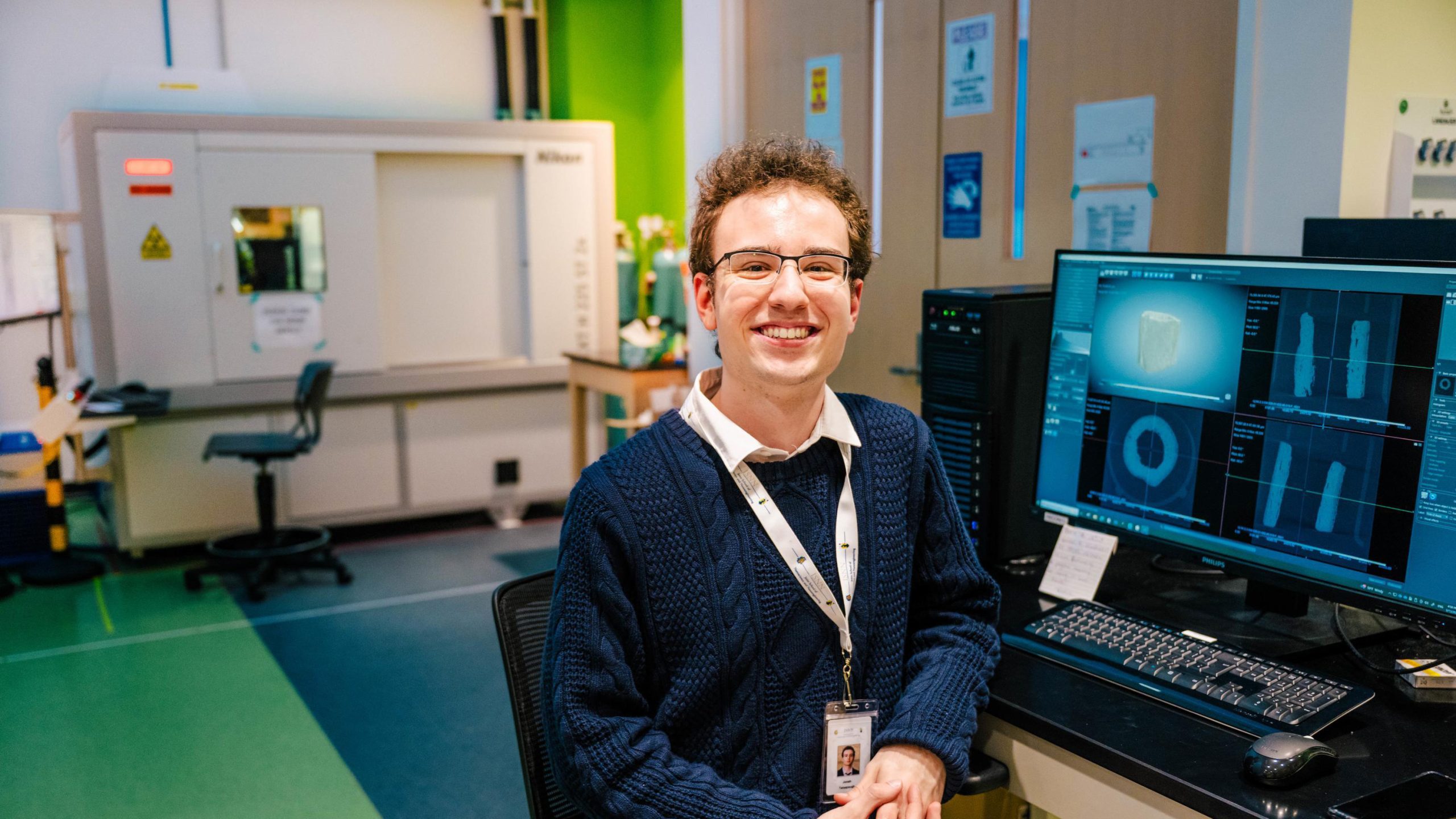
When Jonah Tatsapaugh walked into the UNCG Human Diversity Lab in the Sullivan Building, he wasn’t just logging hours toward graduation. He was stepping into what he calls the highlight of his day — a space where he could ask questions, build solutions, and contribute to a project that is pushing the boundaries of what scientists know about human bone development.
A biology major with a minor in chemistry, Jonah spent the last three semesters developing an innovative method to analyze the microstructural growth of thigh bones of individuals aged 3 months to 18 years.
His project, titled “Filling in the Holes: An In-Depth Look at Microstructural Variation in Subadult Femurs,” uses cutting-edge imaging technology to build the first comprehensive 3D model of normal bone growth patterns in children and adolescents.
“Studying biology in the classroom is one thing, but researching — finding problems and looking for solutions — that’s what really excites me,” he says.
Jonah’s work uses fragile, historically-sourced bone samples from Jordan. Many of these samples come from archaeological contexts such as church ossuaries or burial pits, where they’ve been preserved long enough for detailed study.
Cutting-edge Tech
At UNCG, Jonah scanned these samples with the University’s high-resolution micro-CT machine, a sophisticated imaging tool that produces detailed 3D renderings at a level impossible to see on living humans due to radiation limitations.
UNCG acquired this machine only a few years ago, and Jonah is part of the first generation of researchers to build protocols around it.
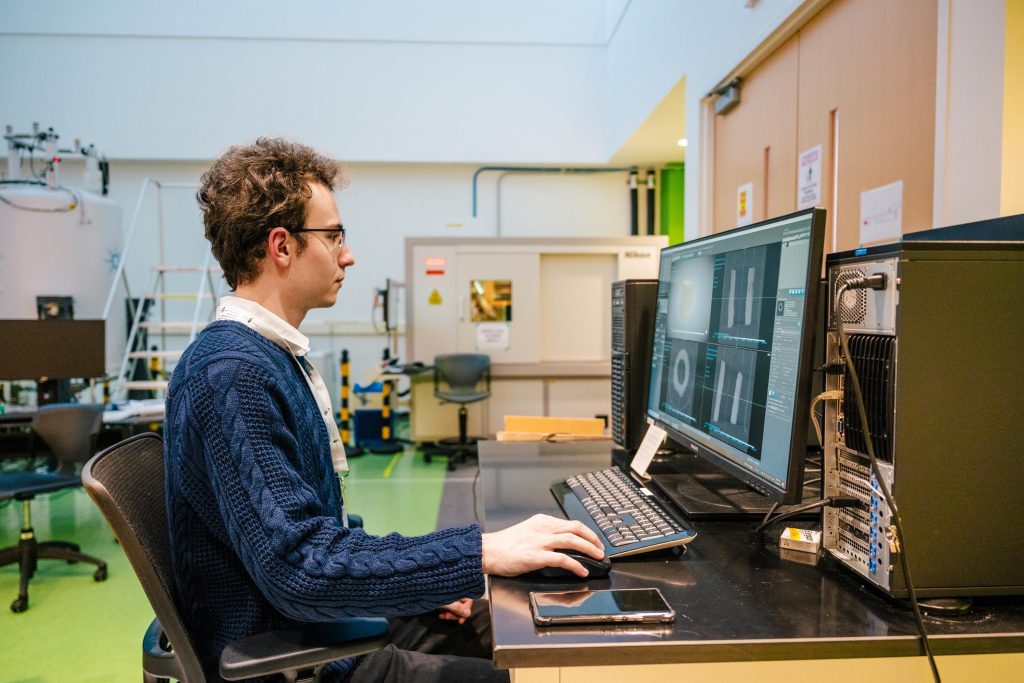
Using the software program Dragonfly, Jonah analyzes porosity, thickness, and microstructural patterns within the bones — data that forms the foundation for understanding how healthy bones grow over time.
Baselines for Healthy Bones
While 2D bone histology has existed for decades, this is among the first attempts to establish a fully 3D developmental standard for subadult bone microstructure.
“We’re developing a baseline for what normal bone growth should look like,” Jonah explains.
“Once we have that standard, we can compare it to bones affected by things like vitamin deficiencies, mineral deficiencies, or diseases that alter bone growth.”
One disease Jonah is particularly interested in is leprosy, a chronic infection that still exists today in South America, Asia, and Africa. The lab has access to one of the oldest physical specimens of leprosy in the world — an invaluable sample for studying how the disease has changed over centuries.
Jonah’s fascination with bone biology unfolded somewhat unexpectedly.
“I’m pre-dental, so I wanted something biological, something related to the body,” he says. “This project stood out because I could actually learn to use micro-CT technology and do the scans myself.”
What began as a technical curiosity quickly deepened into a passion. Working hands-on with specimens, refining imaging techniques, and troubleshooting complex questions in bone biology reshaped the way Jonah approaches science.
“It’s so exciting to come across something we don’t have an explanation for yet and then get to go find that explanation,” he says.
That excitement has been nurtured by his mentor, Dr. Gwen Robbins Schug.
“Working with Dr. Robbins Schug has been great!” he says. “She loves teaching and cultivating students’ interests. She guides me when needed but also gives me room to explore questions on my own. Having the freedom to ask my own questions and find their answers is extremely fulfilling.”
Inspiring Curiosity
When asked what he would tell other UNCG students who are considering getting involved in research, Jonah doesn’t hesitate.
“Get in there,” he says. “Look up professors and the research they’re doing, then go talk to them in person. It shows you’re interested and professors love talking about their research.”
He emphasizes that curiosity is one of the most important qualities an undergraduate researcher can have.
“If something doesn’t seem right or you have a question, look for answers,” he says. “A lot of the work I’m doing in this lab came from noticing things that didn’t have explanations. Now those answers are what I’m planning to publish at the end of the semester.”
He will carry his research experience into his next steps, whether in dental school or a future scientific career.
But for now, he is proud to have contributed something new to the field of bone biology, and to have done it as an undergraduate researcher at UNCG.
“This experience has shaped the way I think about biology,” he says. “Being in the lab, learning how to ask questions, and being part of something that hasn’t been done before — it’s been an incredible opportunity.”
by Sierra Collins, Division of Research and Engagement photography by Sean Norona, University Communications
It’s March in North Carolina, which means daffodils are blooming, days are warmer and longer, and all eyes are on college basketball. Even though our Spartans are not competing in national tournaments this year, UNC Greensboro is still relevant in basketball conversations with the announcement of Jerod Haase as our new basketball coach.
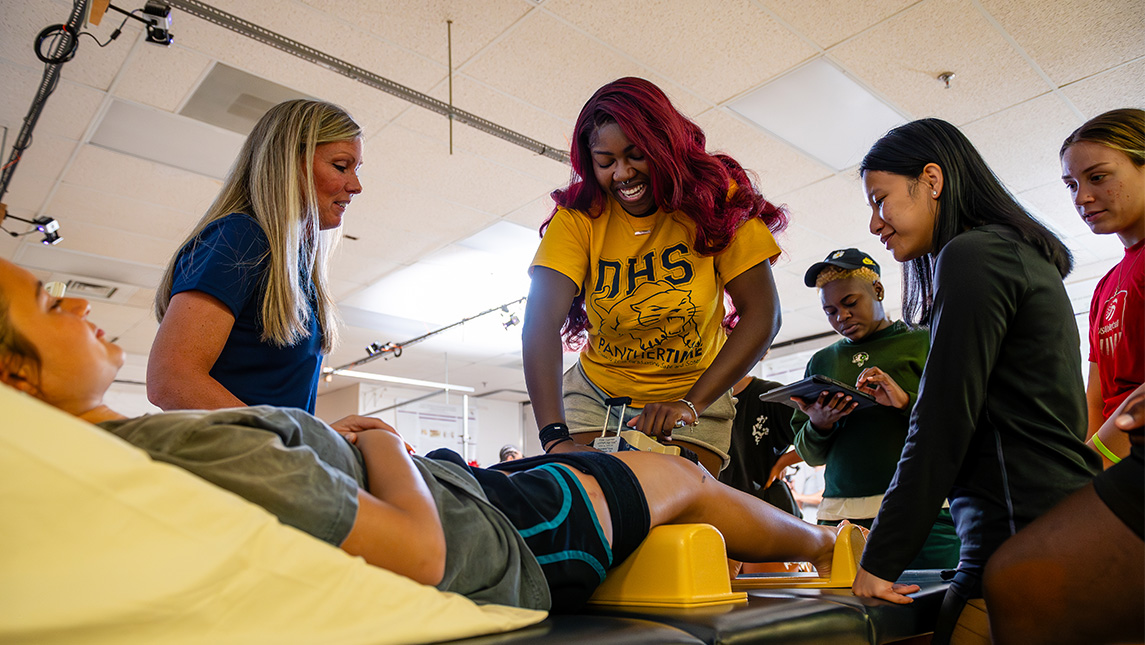
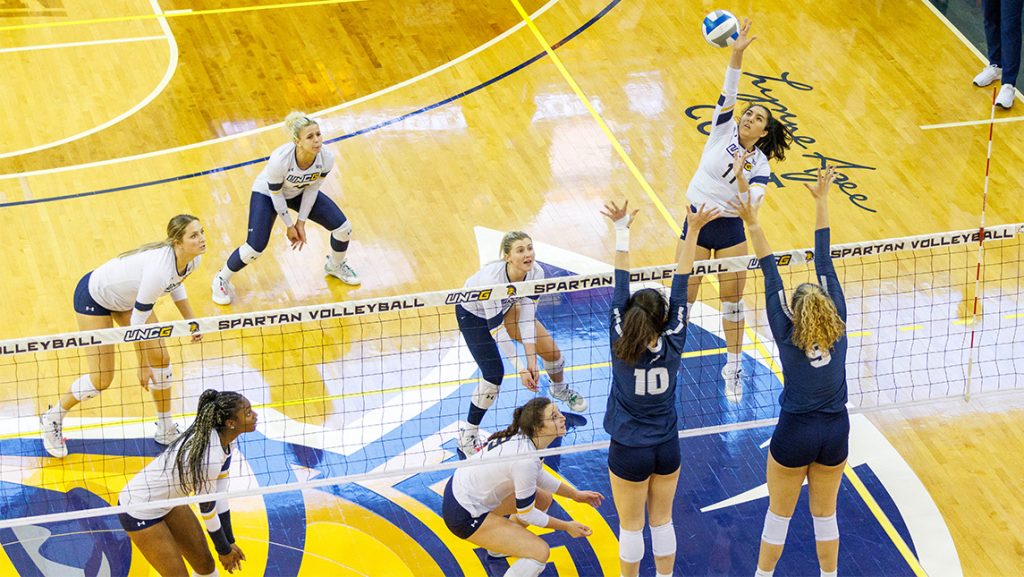
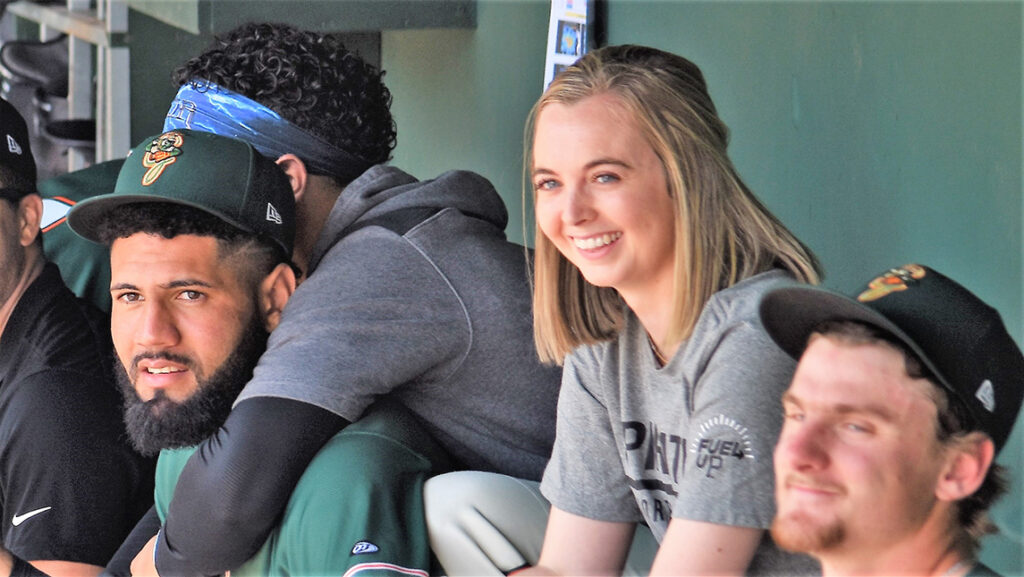
It’s a reminder that sports teams are much bigger than their players, and only as strong as the supportive staff who keep them physically and mentally fit. Beyond coaches, professionals like trainers, advisors, physical therapists, and nutritionists make up the “team behind the team.”
Career fields in sports and health sciences are growing to serve athletes of all ages, from children on recreational teams to collegiate and professional athletes. Building those workforces in our state is the mission of UNCG’s School of Health and Human Sciences (HHS).
Here are a few examples of how HHS’s programs in kinesiology, public health education, nutrition, and athletic training give students hands-on experience for in-demand careers and develop research that improves the experience of sports teams at every level.
Athletes and Fans Find Their Way Here
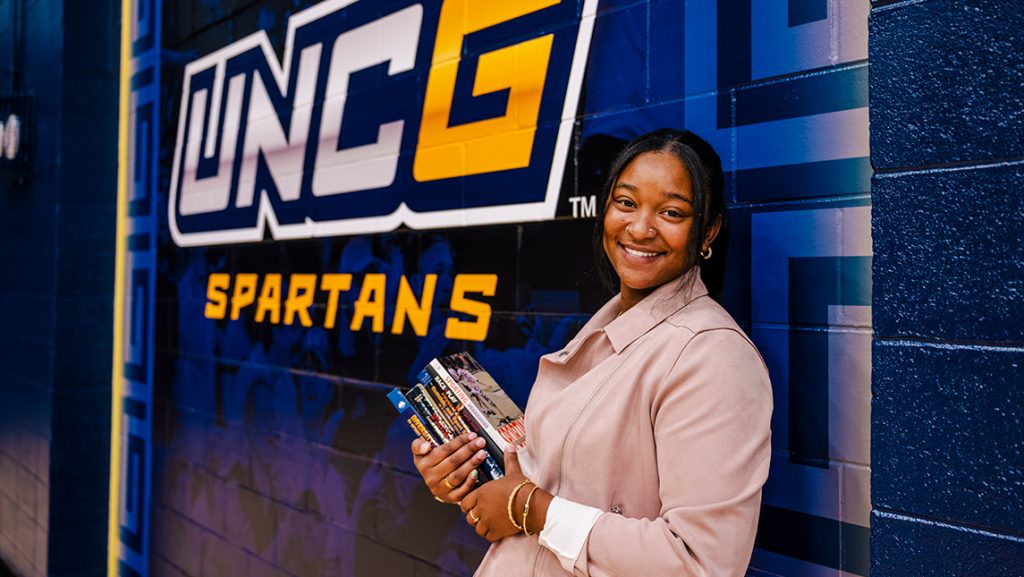
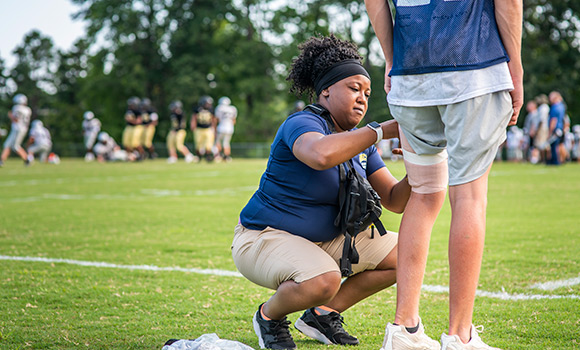
Former athlete turns her love of sports into a passion for athletic training.
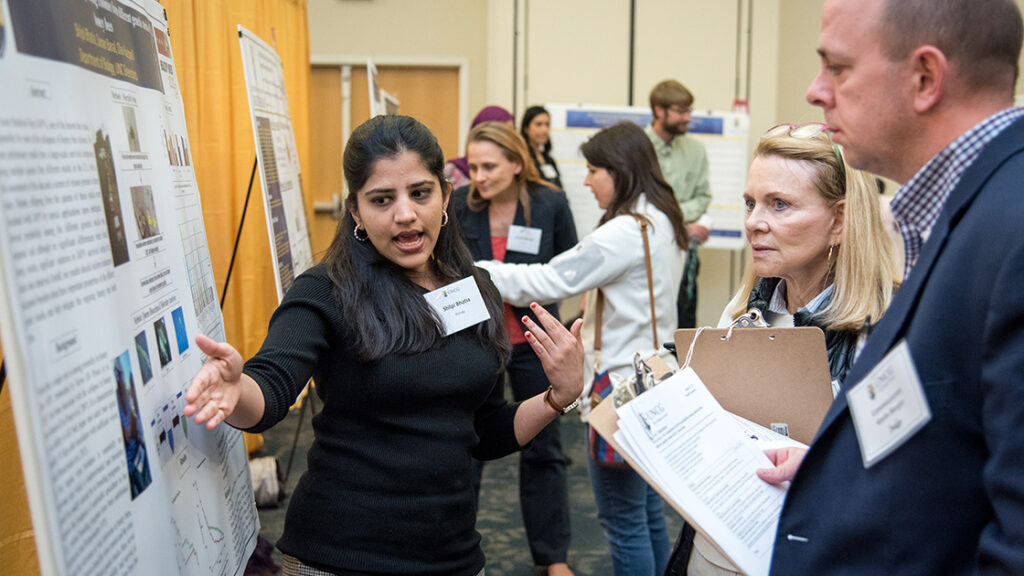
UNCG Graduate Students Compete to Quickly (and Clearly) Present Research
Posted on April 01, 2026
“Do you want the long version or the short version?”
The “elevator pitch” is a staple of business, entertainment, and other industries. In a fast-paced world, professionals should learn how to introduce themselves and their big ideas in a minute or two — about the time you might share with someone in an elevator — to an executive who could give them their big break.
But graduate research is often measured in years: years of coursework, experiments, drafting a thesis, revising the thesis, and defending it. It’s difficult to compress such vast work into a “short version.”
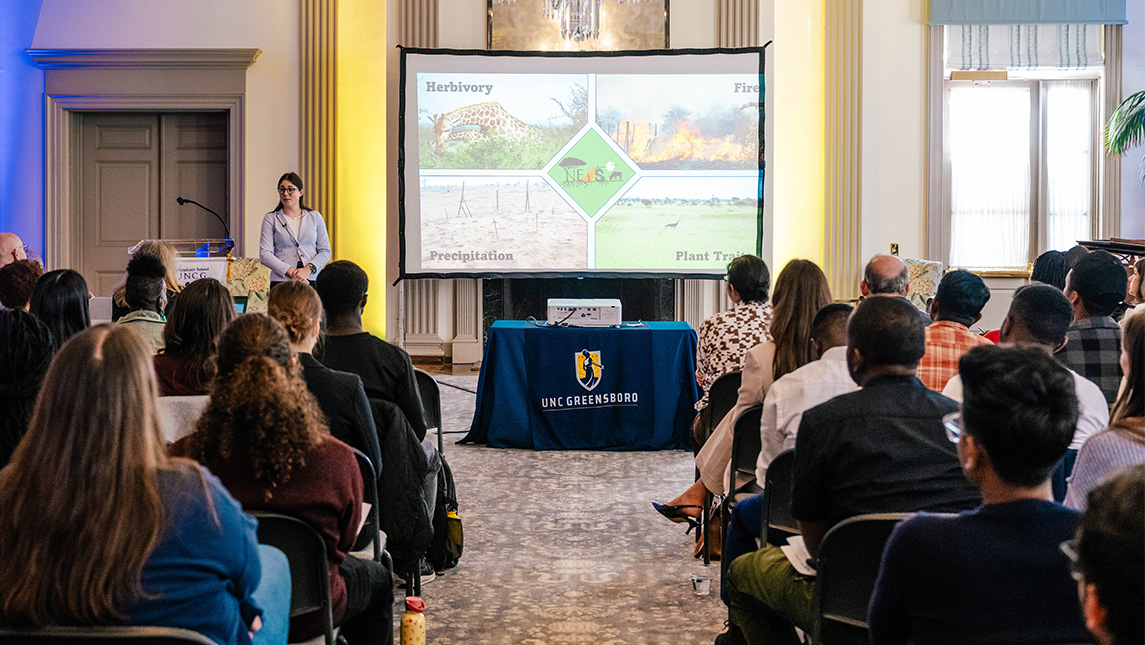
Laura Drew, student support lead at UNC Greensboro’s Graduate School, wants researchers to consider their “elevator pitch,” so they can deliver it with clarity and confidence. “Relevance is what transforms good work into meaningful impact,” says Drew. “You can have the greatest project in the world, but if your audience doesn’t feel its relevance, then it loses its power.”
After the data is collected and the paper is written, UNCG students must be able to describe their work, whether it’s in formal proposals or to someone stopping them at a moment’s notice to ask, “What does all this mean?”
Communication, adaptability, and knowing your audience are essential soft skills for any academic or aspiring professional. Drew says 3MT helps students get to the heart of their research: what it is and why others should care.
“If you can’t keep me engaged and interested in your work for three minutes, I’m probably not going to be interested for 20-30 minutes,” she points out. “I always think back to my marketing days: Think up three to five takeaways. What do you want people to leave the conversation understanding?”
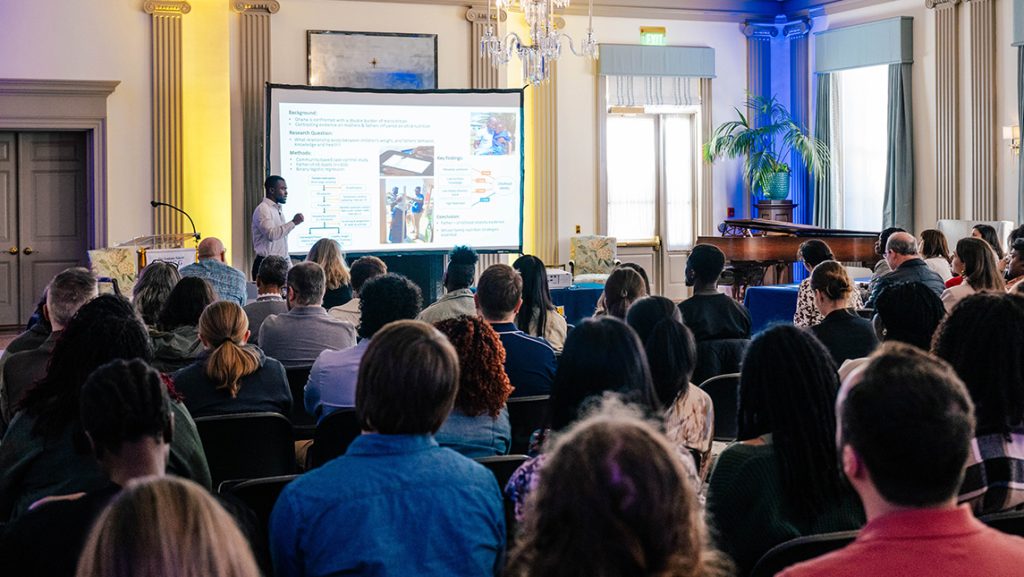
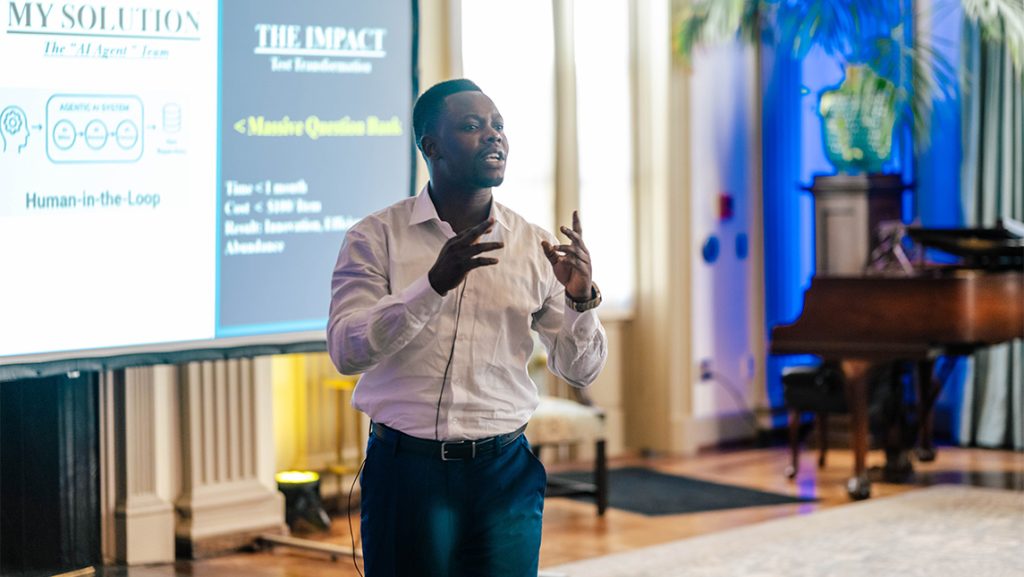
2025 3MT winners from left to right: Praveen Pasupathi, first place; Victoria Fonville, second place; Samuel Adegoke, people’s choice.
Students get three minutes and one PowerPoint slide to win over judges intentionally selected from outside their disciplines. Drew says it teaches them to strip out the jargon and focus on meaning and impact. “We ask them, ‘Why does your work matter to others? Can your mom understand it?'” she says. “Sometimes, they get so caught up in the terminology and acronyms of their degree that they forget the audience doesn’t understand them.”
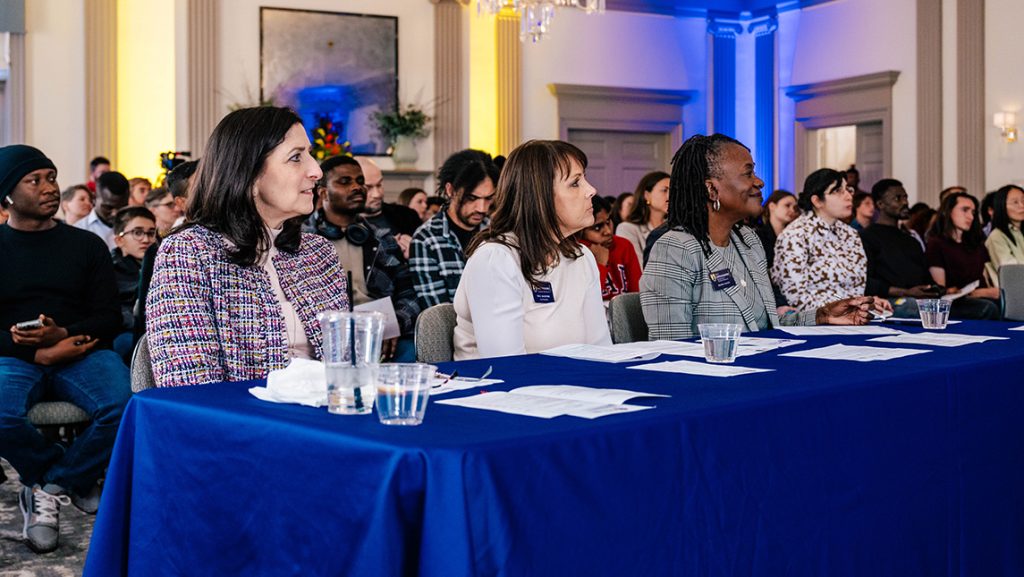
Drs. Jodi Pettazzoni, Tina McEntire, and Regina McCoy judged the 2025 3MT competition. As members of UNCG’s senior leadership, they provided the perspective of someone outside students’ field of expertise.
Proving the Community Impact
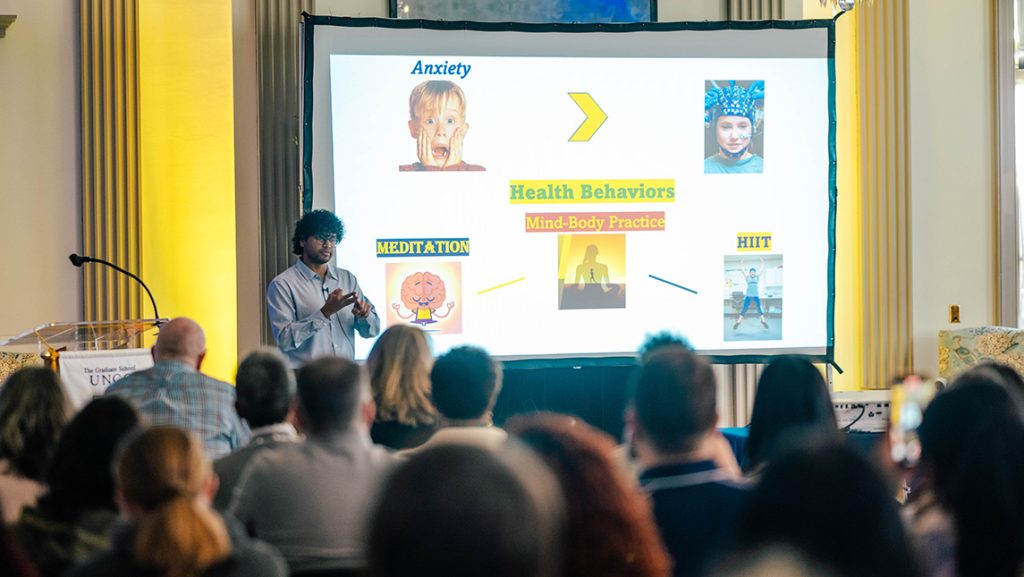
Praveen Pasupathi took first place in the 2025 3MT. A doctoral student in the kinesiology lab of Dr. Eric Drollette, he is measuring the link between short bursts of physical or mindfulness activity and lowered anxiety in children. He wants his research to guide mental health programs in schools and communities.
He says 3MT helped him push his limits. “Experiences like this challenge you to step outside your comfort zone and trust that your research and your voice belong out there,” he says.
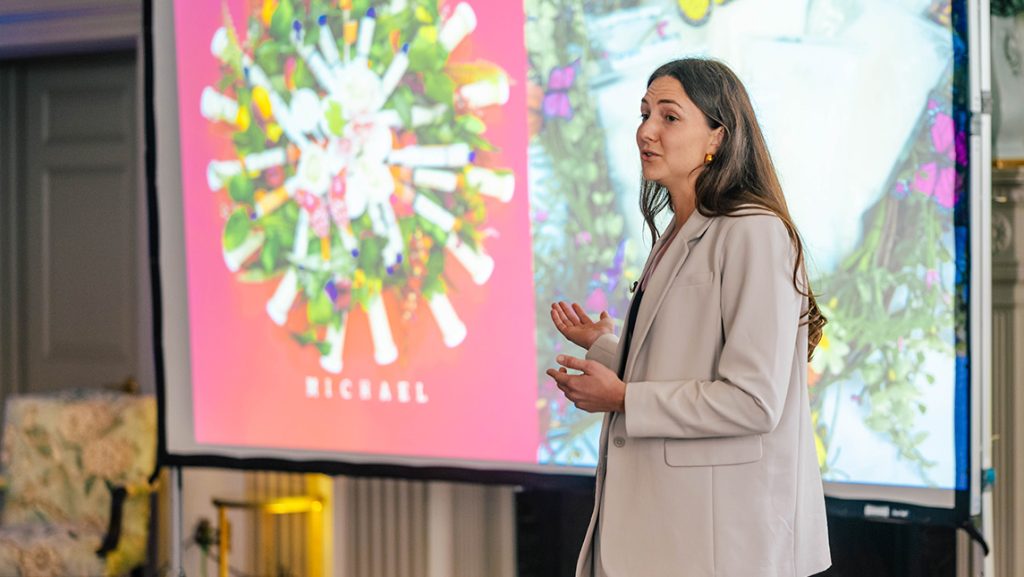
Mental wellness was also front and center for the second-place winner Victoria Fonville, who studies nutrition. She presented her study of best lactation and pumping practices for mothers who suffered a stillbirth or neonatal death, building upon research that shows donating breastmilk helps those parents on their healing journey.
Condensing all her data was more difficult than she expected, she says, but immensely rewarding. “Learning how to share my research with people outside of my discipline was the most valuable skill I gained from the 3MT competition, and I am so thankful I had the opportunity to participate,” says Fonville.
Free Showcase of Scholarship
The Graduate Research and Creativity Showcase is another opportunity to present research for the whole community. Using poster presentations and in-person conversations, they share their work and develop speaking skills that will serve them well in the future, whether that be interviewing for a job, pitching a grant, or engaging with a community partner.
Dive into students’ latest discoveries at the Spring 2026 showcase:
Thursday, April 9 1–3 p.m. Elliott University Center Cone Ballroom
Students present for the following categories: Arts and Humanities; Health Sciences; Natural, Physical and Mathematical Sciences; and Social Sciences, Education, and Business.
Virtual Adaptations
University Libraries approaches the same challenge with Webinars Worth Watching. In the live online competition, modeled in part after 3MT, graduate students present original research in a compressed format for virtual audiences. They are judged on content, clarity, engagement, and design.
“A big part of the competition is taking your research and making it absorbable by a regular audience,” says online learning librarian Sam Harlow.
She says the requirements reflect the scenarios students will face when they leave graduate school. Job interviews, national conference presentations, and even dissertation defenses increasingly happen online. Harlow does not want a technical hiccup or a rambling explanation to spell the difference between acceptance and rejection.
“We want them to feel more comfortable presenting their research in an online environment,” Harlow says. “We also want them to get comfortable with breaking down their research for everyday audiences, thinking about grants and pitching, and seeing the value of their research for the everyday world.”
Glitches happen
Before the competition, University Libraries holds optional workshops on presentation and online delivery. Contestants can also schedule one-on-one practice sessions to time their presentations and hear targeted feedback. They learn about accessibility and visual design.
“We play a ‘true or false’ game,” Harlow explains. “For example, ‘Should you wear a headset?’ And they say ‘true or false’ in the chat, and then we talk about why. That used to be a huge issue, say, if someone else in the house was watching Netflix while you were presenting.”
Just as important as polish is flexibility. Because the competition is live, the risk of technical difficulties is a real one. Students must adapt to the unexpected in real time.
“I hope it teaches students how to roll with things that can go wrong,” Harlow says. “We’ve had winners whose internet cut out, and they had to come back and finish the presentation. And they still won.”
Publishing skills
Academic writing poses its own set of presentation challenges. That’s what drew graduate students, primarily from the School of Health and Human Sciences, to take a “paper chase” workshop. Read about what they learned while turning around a paper worthy of an academic journal in just three days.
Everyone’s a winner
Each of these may choose winners at the end, but ultimately, all the students benefit from a low-stakes environment where they can make mistakes and grow. Drew remembers one student who froze during his first 3MT presentation.
“He totally lost his train of thought, tried to start again, and ended up walking out of the room,” she says. “The next year, he came back and he won. I always tell students, ‘Even if you didn’t place or do well, each time you do it, you get better and more confident.'”
And Pasupathi says there’s another winner. “Strong presentation skills help ensure that research reaches the people it is meant to benefit,” he says. “Clear communication helps communities understand why the work matters and how it can support healthier lives.”
Story by Janet Imrick, University Communications Photograpy by Sean Norona, University Communications
Bring innovative ideas into the public conversation.
How UNCG’s School of Nursing Is Leading in AI Integration
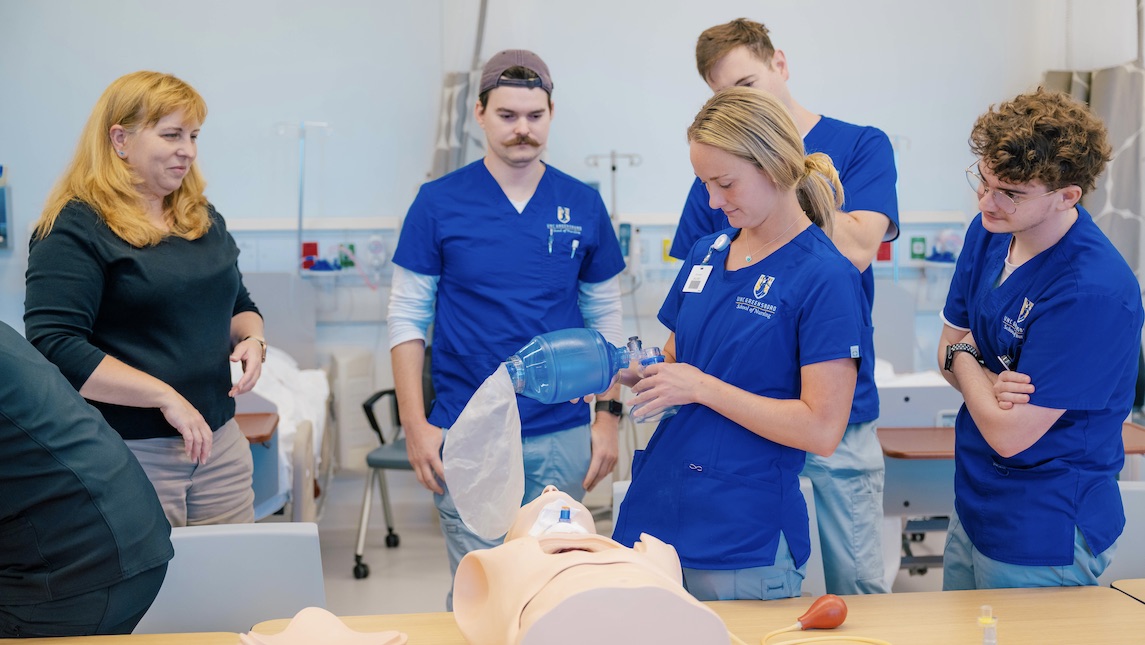
Artificial intelligence (AI) is no longer on the horizon for UNC Greensboro’s School of Nursing. It is already woven into the fabric of how the school teaches, trains, and prepares the next generation of nurses.
AI tools enhance instructional design, accelerate content development, improve faculty efficiency, and deepen student engagement.
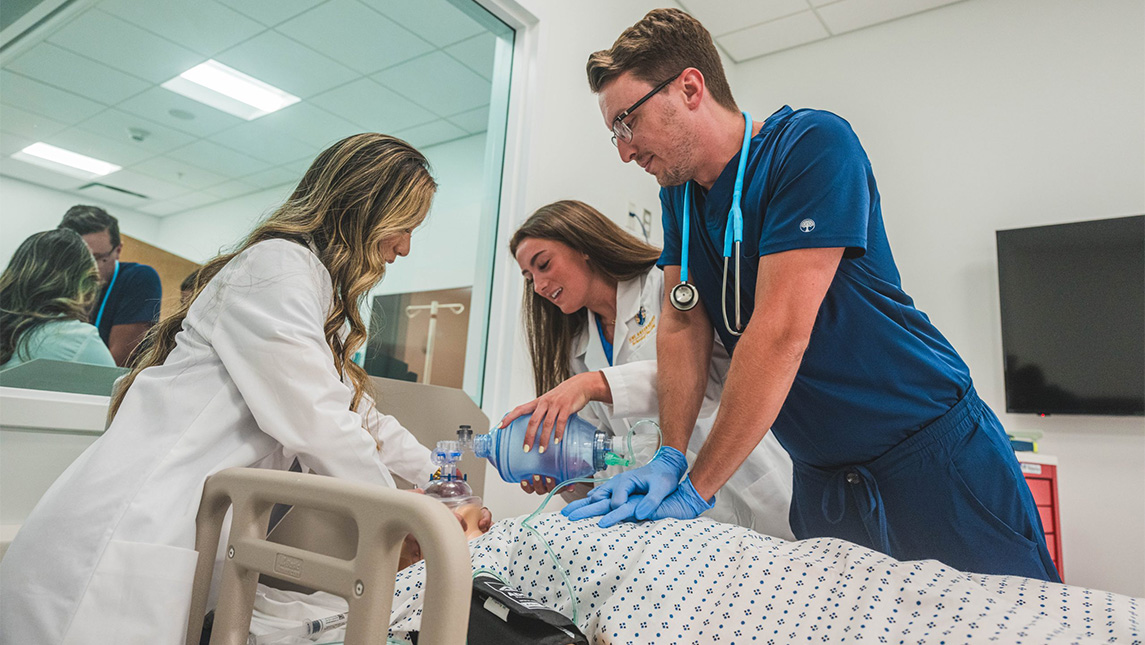
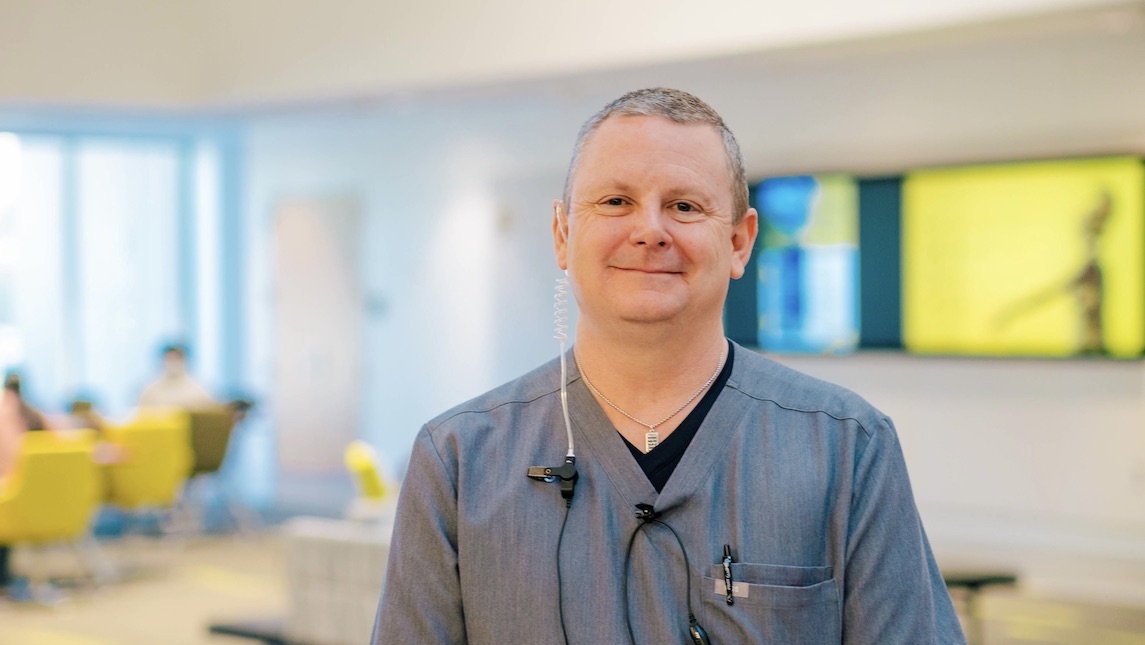
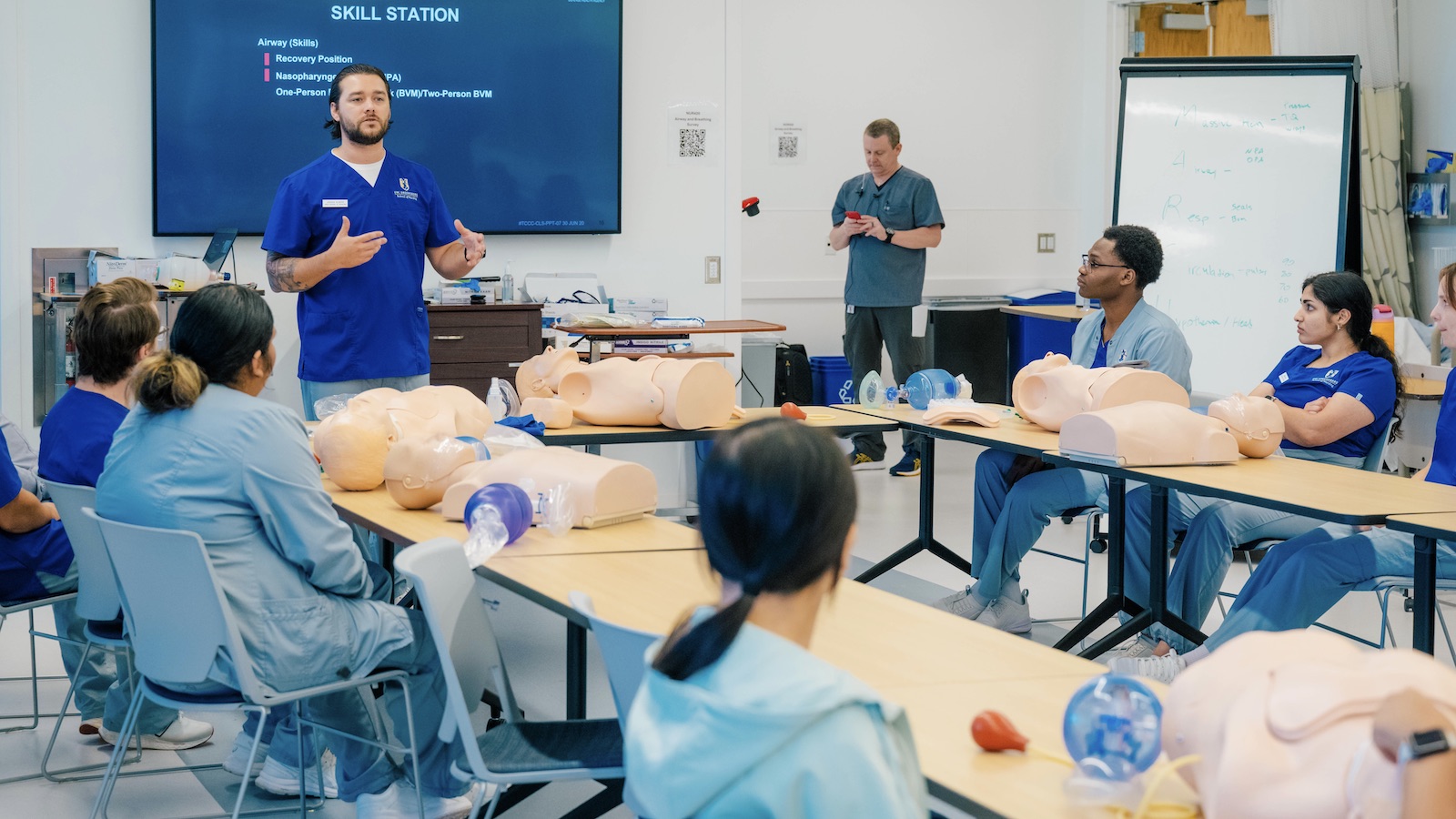
Tommy Mann is one of the School of Nursing’s AI Champions, a formal group of Dean-appointed faculty and staff dedicated to integrating AI into the teaching of nursing. Mann serves as assistant professor and director of the Simulation Center for Experiential Nursing Education (SCENE), a state-of-the-art facility offering hands-on experiences that bridge theory and practice.
Dean Debra Barksdale knows the School of Nursing (SON) needs to be on the “bleeding edge” of AI — and therefore drives her faculty and the AI Champions to achieve this goal.
A self-proclaimed “technology enthusiast,” Mann recognized early that AI was advancing rapidly and believed it could do so much for academia, particularly within curriculum and simulation development.
“This is a large passion of mine,” he says. “We continually seek to understand what’s new in AI and how we can use it, to question whether it has value, and to consider how it fits in our workflow.”
Using AI to Support Student Learning
From talking with Mann, it appears AI is all about new ways of thinking, recognizing that the way something has always been done is not necessarily the best way to do it now.
The SON AI Champions use AI in curriculum development, Student Learning Outcomes (SLO) creation, and content generation. In fact, 70% of SON faculty are actively using AI in some fashion.
“By using AI, faculty can engage different student learning styles simultaneously in one classroom,” says Mann, “thus meeting students where they are and enhancing student engagement with the content.”
There is a common assumption that today’s college students, because of their age and generational fluency with technology, are natural AI users. Mann pushes back on that.
“Once they get in the classroom, students are not using AI as much as people believe,” he says.
But Mann knows they could use it to improve their academic performance.
For example, if a student’s schedule demands they need to listen to class material to study, they can use NotebookLM to convert a PowerPoint into a podcast, producing content in a way that meets their needs.
Therefore, the SON is working to support faculty in becoming AI leaders, so they can educate students on helpful AI platforms — pointing them in the right direction and demonstrating effective usage.
Read more: AI implementation at UNCG
AI@Work Stories
AI@Work in Libraries: MLIS Researcher Designs AI-Themed Games for Academic Libraries AI@Work in Business: Bryan School Introduces AI Workshop for Business Leaders
The four-person simulation team, consisting of Merry Prior, Brittany Norman, Derrick Owsley, and Mann, conduct ongoing research to identify the latest generative AI models that meet the Simulation Center’s and faculty’s needs.
The team deliberately seeks free, easy-to-use platforms for faculty use, prioritizing tools that lower barriers rather than create them.
Mann provides one example scenario for content generation: A faculty member could use Microsoft Copilot to develop a video script based on research or lecture notes. Then, they could use the video production platform HeyGen to create a video for students.
All of this SON faculty AI training directly benefits nursing students, according to Mann.
“The more we train and integrate AI within the faculty community, the better prepared they are to deliver that content to the students,” he says.
Mann’s team hosts faculty AI training and discovery sessions to better understand the ways faculty experience AI use in the classroom.
The session curriculum explores questions like: How are faculty using AI? What was the outcome for the faculty member? For the students? Was using AI less or more work for the faculty member? Understanding what is working and what is not shapes the team’s next steps.
AI Nursing Education Resources
AI Integration in Simulation-Based Education ChatGPTserves as the core engine for simulation development. Claude supports long-form scenario branching, multi-patient logic, faculty guides, manuals, and extended narratives.
Improving Student Learning Materials NotebookLM creates podcasts, flashcards, infographics, mind maps, and video overviews. Canva generates visually professional infographics, clinical guides, student handouts, and simulation prebrief slide decks.
Faculty Support and Workflow Efficiency ChatGPT drafts prebriefing language aligned with psychological safety guidelines. Claudereorganizes large curriculum documents, strengthens their structure, and supports the creation of policies and manuals. Copy.aihelps craft student announcements, reminders, and supportive messaging. NotebookLM summarizes long reference materials, clinical guidelines, and simulation documents into quick-reference formats for faculty use.
Embracing AI in Nursing Education
AI is not going away, and academia cannot afford to ignore it, Mann says. UNCG’s School of Nursing is leading the way.
The AAN “supports the responsible and ethical use of artificial intelligence (AI) as a transformative force in health care…,” states AAN. “The rapid and expansive growth in AI technology presents a remarkable opportunity for advancing innovations in person-centered care and health care delivery.”
The school will continue educating its faculty on what AI platforms students can use, how to use them ethically and effectively, and how AI helps students grow and succeed in the classroom.
“The integration of AI across simulation, skills labs, and didactic courses has significantly strengthened our ability to deliver innovative, efficient, and student-centered nursing education at UNCG,” says Mann.
Written by Amy Burtch, AMBCopy Photography by Sean Norona, University Communications
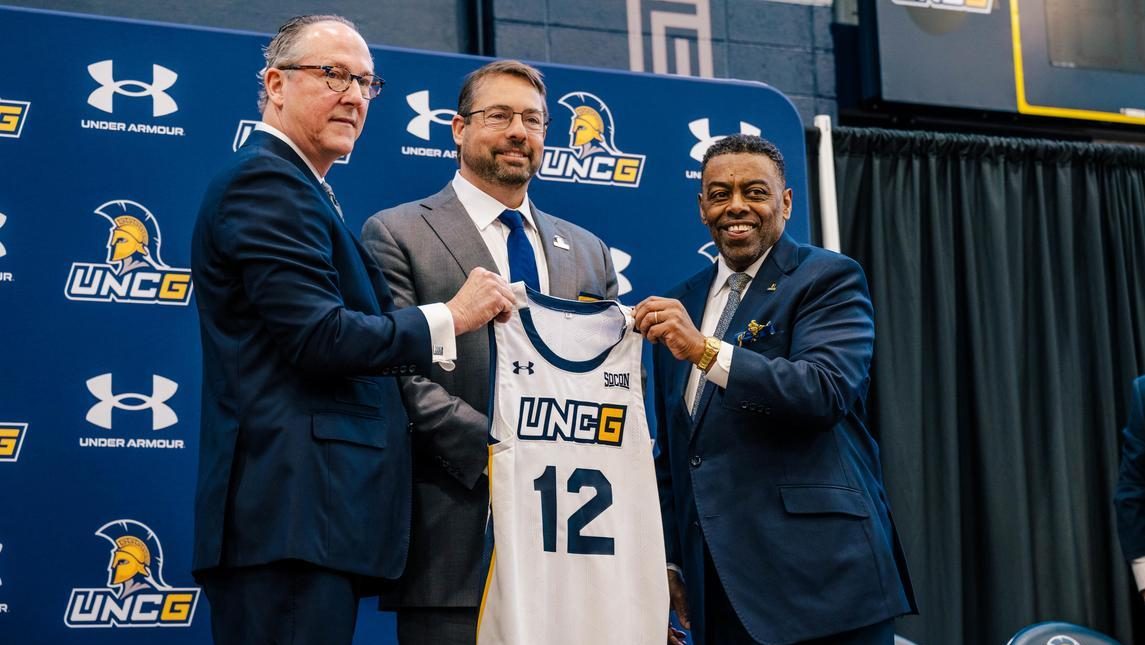
UNCG announced Jerod Haase as its new Men's Basketball coach at a press conference at Bodford Arena on March 18th, 2026.
GREENSBORO, N.C. – UNC Greensboro (UNCG) today announced Jerod Haase as the new head coach for the men’s basketball program. He is the 12th head coach in UNCG men’s basketball history.
It’s decision time for high school students and transfers who are considering UNC Greensboro. Early spring is an introspective season not only for prospects, but also for current students who are taking inventory of their college experience with a “how it started and how it’s going” critical eye.
University accolades and alumni success support what prospective students are deciding and what current students are realizing. Here are a few reasons why UNCG is the right place for you.
Bang for Your Buck
As a UNC System university, we are an affordable institution for North Carolina residents seeking the academics and resources expected of a system university. And when tuition is out of reach, UNCG financial aid steps in with customized options such as grants, scholarships, and flexible payment plans. It’s a system with proven results that currently serves the Pell-eligible students who account for 57% of our undergraduate student body.
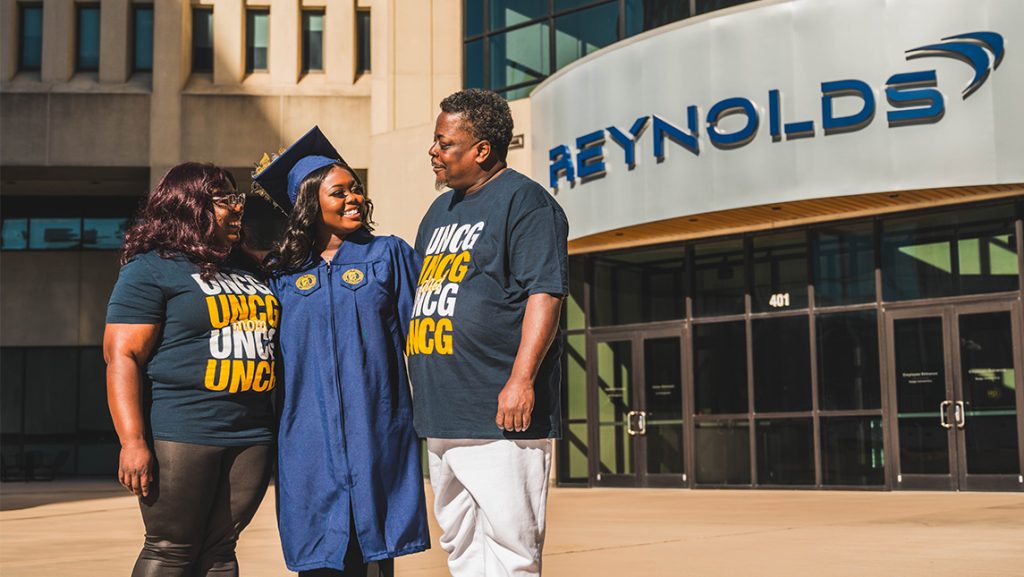
A UNCG degree is a life-changer, especially for half of our students who self-identify as first generation. When these students graduate to earn more than their parents did before them, their careers serve as ladders for future generations. This effect of higher education, which improves the futures of families and communities, is called social mobility. UNCG ranks first in the state for social mobility, with alumni who are testaments to the value of their educational investment.
“Because of UNCG, not only am I able to give a better life to my wife and my children, but to my mom who sacrificed for me,” Dr. Trey Bateman ’08. “It’s hard to measure the value of the way UNCG promotes social mobility for people, but it is something they are doing better than so many universities out there.”
No matter your financial circumstances, UNCG works to put you in a better one
This year, UNCG was named the top performer of all the UNC system universities. The accolade was based on graduation rates, credits earned, degree efficiency, cumulative student debt at graduation, university expenses per degree granted, and external funding.
Our performance is a direct result of our culture of care. Rather than being just a number, Spartans are supported in every step of their academic journey. Advisors work with students who need tutoring, advice on majors, and ways they can augment their studies with service and leadership opportunities. It’s support that drives them to graduation and beyond.
“My one word to describe UNCG is ‘opportunity,’” says Janae Wofford, biology student and Goldwater Scholar. “No matter where you are, there are people looking out for you and pushing you forward.”
Alumni often credit advisors for helping them turn their passions into careers. At UNCG, faculty and staff help students consider majors that fit their interests and strengths, and then give them the tools to succeed.
In today’s competitive job market, UNCG students have an advantage. They not only graduate with degrees, but most also have hands-on experience in their fields thanks to internships, leadership in student organizations, and service-learning opportunities.
Advisors and faculty are always thinking about career preparation for their students. All Bryan School students take professional development classes to polish their résumé and presentation skills. And Career & Professional Development (CPD) connects employers like Reynolds American Inc. with students like Ashanti Evans.
“I went in with nothing because they tell you that you don’t need a résumé draft to meet with their advisors,” Evans says. “They set me up for success. Without the CPD office, I would not have a full-time position prior to graduation.”
When students are asked what they like most about UNCG, the typical answer is the welcome they find here. Some arrive straight out of high school, and some come to us after other life experiences. Among honors students, commuter or online students, and student-athletes are learners who identify as:
They arrive from various backgrounds to thrive in a community that celebrates their differences and encourages how they can learn from each other. Although many colleges claim to do this, UNCG does it without leaving families behind.
From the first tour at UNCG, families of prospective students are engaged. Tours are conducted in English and in Spanish. Later, families discover that Spartan orientation isn’t just for students. Special sessions with language translation services are designed for guardians from around the globe to learn what to expect when their student goes off to college. And homecoming is always a family affair at UNCG with alumni, current students, and families of both joining in the fun together.
Angela McNair joined her daughter for homecoming festivities and raved about the support she found at UNCG: “Those first few weeks of school, there were challenges adapting to living on her own, but she has overcome all of that. I’m grateful that UNCG has been here to meet her needs along the way.”
First-generation family members particularly appreciate UNCG’s efforts to keep them informed and included. A new connection tool for families is the guest access portal for student accounts. It gives supporting family members protected access to their student’s records so they can keep tabs on tuition balances, credit hours, class schedules, and grades.
Residence hall drop-off and commencement shouldn’t be the only times families can share in their loved one’s college journey. At UNCG, they are a crucial part of the ride.
Facts aside, most students base their college decision on the feeling they get when they step on campus. It’s a feeling that has as much to do with the aesthetics of the campus as it does with the staff they meet and resources they find along the way.
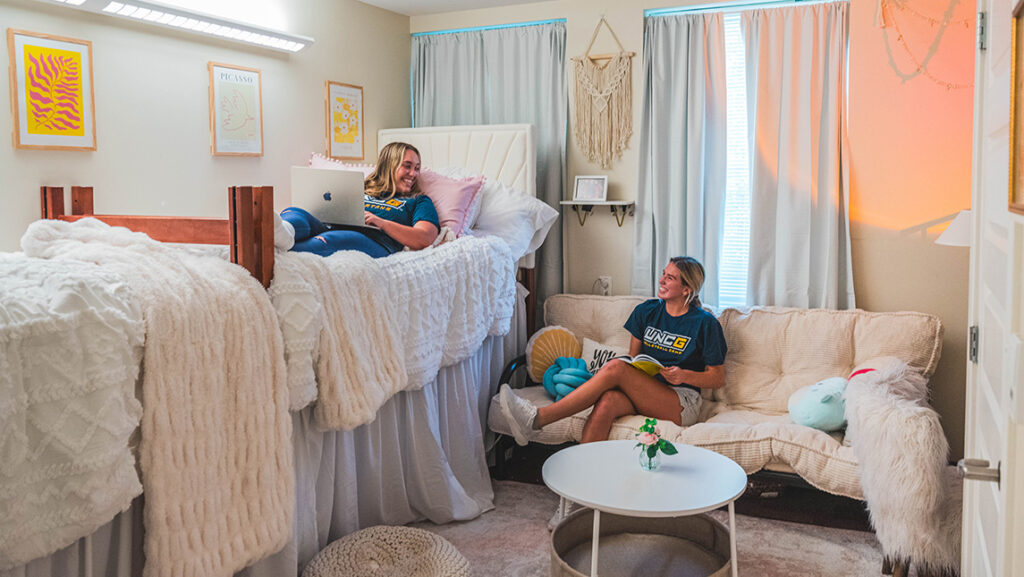
The wide green quads, stately arbors, and brick sidewalks exude classic higher education. A walk through campus makes students feel worthy of the academic expectations they find here. Residence halls can be found in historic buildings and updated mid-rises, giving students a range of room types that appeal to our diverse students. Eighty percent of our first-years live on campus, and unlike some of our sister universities, there’s space for Juniors and Seniors to live on campus too!
The city of Greensboro also offers reasonably priced off-campus housing in a community that gives students opportunities for internships, part-time jobs, and career networking. It’s a city that isn’t too large but isn’t too small, conveniently located right in the middle of the state.
Within the comfort of campus facilities, students find an active student life with over 250 organizations representing a range of service, social, professional, and cultural groups.
“We’ve got 17 Division I sports teams, an esports arena, and an award-winning dining hall, but UNCG has a personalized feel,” says Joel Lee, Associate Vice Chancellor of Enrollment Management. “As students walk across the campus, it’s easy for them to find a community and feel like they’re part of something.”
Opportunities can be found everywhere, but staff prioritize students’ mental health and lists like Princeton Review’s Mental Health Honor Roll are taking notice. Whether students are looking for a cozy, Zen, or inspirational environment, it’s all within reach at UNCG.
Young alumni, current students, and committed prospects agree: there are many numerous answers to the “Why UNCG?” question. Take a visit to our campus, ask questions, feel the vibes, and join the ranks of UNCG’s Spartan nation.
Story by Becky Deakins, University Communications. Photos by Sean Norona, University Communications.
A sample of UNCG branded wallpaper made available in Canto.
Creating flyers, digital invitations and event signage at UNCG just got easier! In the past, campus communicators and graphic designers needed to submit a request to download unit logos, colors and fonts to create promotional materials. But now there’s a one-stop shop for all your graphics needs in Canto.
We already use Canto to download photos, but now all graphic assets can be found there including the following:
Logos: Find official University marks as well as departmental or unit logos.
Colors: Blue and gold and beyond. Be sure to check out our secondary colors.
Fonts: Stay on brand with headlines and descriptive text.
Digital templates: From Power Point presentations to social wallpapers.
Faculty, staff, students — absolutely anyone with a UNCG email address — can access Canto. Bookmark the brand guide and photo library in Canto to keep University assets at your fingertips.