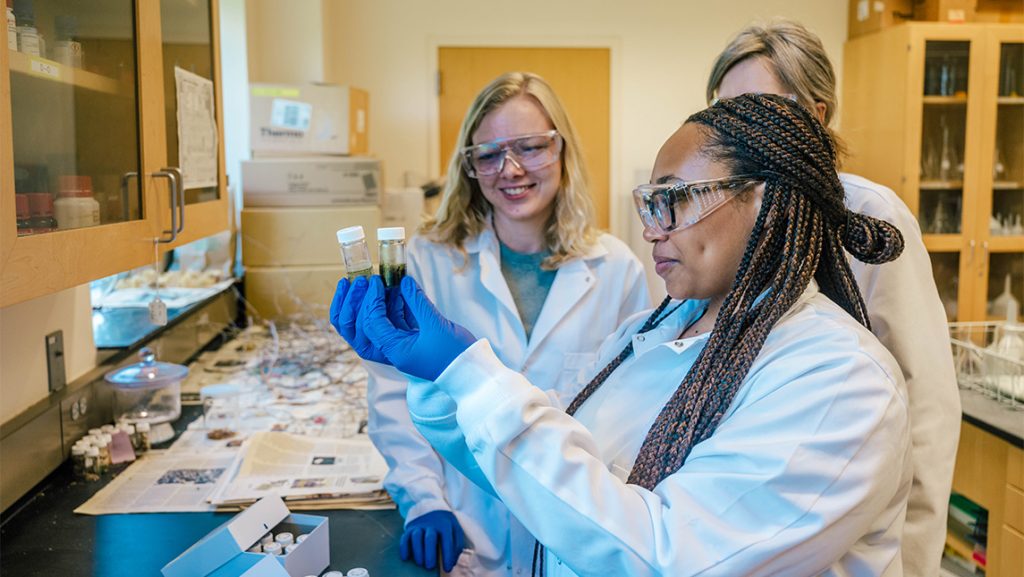
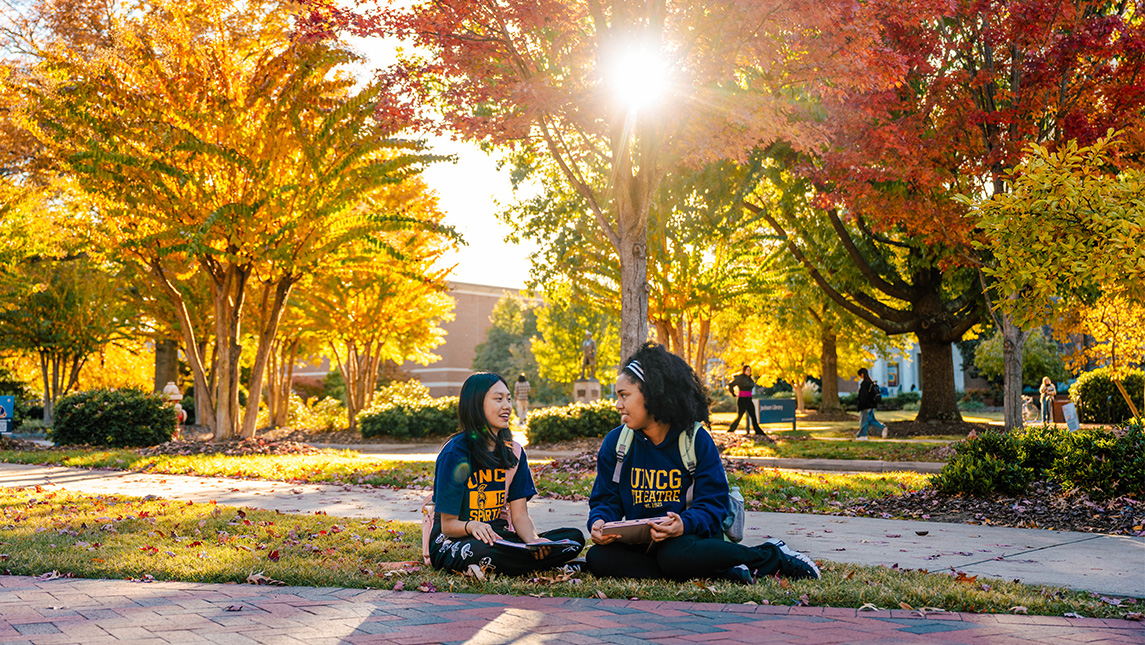
For burgeoning researchers at UNC Greensboro, summer is no time to take a break.
And the University, which values the time for undergraduates to do their own independent research, guides them in prioritizing this work without creating a financial burden.
Summer stipends from the Undergraduate Research and Scholarship Creativity Office (URSCO) make it all possible. Thanks to those – and strong relationships with their faculty – students can spend their breaks from classes engaged in high-impact experiences known to correlate to higher grades, a greater likelihood of graduation, and readiness for graduate or professional schools and careers.
“Undergraduate research is one of the most impactful and life-changing activities for a student,” says Marie Foscue Rourk Distinguished Professor Mitch Croatt, Ph.D., who serves as director of URSCO. “Similar to most faculty, I can personally attest to undergraduate research opening doors that I didn’t even know existed.”
“This is a paid opportunity,” says biochemistry major Jasmin Grillo, “A chance for you to get some savings under your belt. I would tell a freshman, ‘If you think this is something you want to do in your future, put as much time into it as you can. Get that background so you can put yourself ahead.'”
“It’s a good push for us to make a difference in the world,” says Ryan Hargrove, a biology senior studying the medicinal properties of ginger plants.
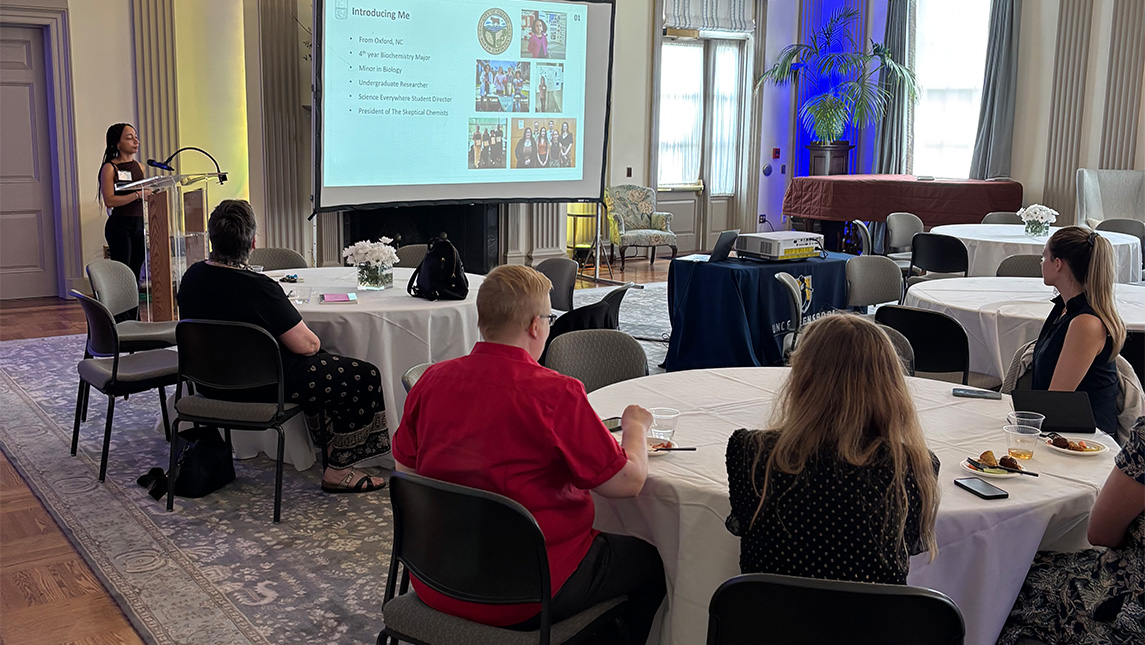
On Aug. 20, the participants celebrated with a dinner in the Alumni House, catching up with friends from Lloyd international Honors College and sharing their summer research experiences.
At the Crossroad of Art and Nature: Aminah Coppage and Mallory Cox
Major: Art, painting concentration
Hometown: Winterville, NC
Mentors: Leah Sobsey, M.F.A. and Tara Webb, M.A.
Aminah Coppage’s hard work will leave her with something that lasts long after she graduates. For the last two years, she has participated in URSCO’s summer research program, working in the pollination garden created by College of Visual and Performing Arts faculty members Tara Webb and Leah Sobsey.
This year, with fellow art student Mallory Cox, they catalogued the current plants and added new ones in Peabody Park. They also worked on the first steps to install a bee fountain, using clay from a nearby stream as a locally-sourced construction material.
“Hopefully many more pollinators will have access to the area, a place to rest and nest,” says Coppage.
What does garden research have to do with an art degree? For Coppage and Cox it allowed them to use their talents in conjunction with the natural world. Coppage plans to use plant materials like mulberries to make paint dyes. “We’ll be incorporating our art styles into it to enhance the outer part of the fountain and attract more people to the garden, while also making a space mainly for pollinators and animals,” she explains.
Coppage learned about the garden through Sobsey, an associate professor of photography who spoke to her art history seminar class. That discussion connected with Coppage on a deeply personal level.
“My mom got me into herbalism and nature,” she explains. “Her name was Astria Coppage, and she passed in 2023. She taught me about teas. A lot of plants in the garden, like the yarrow, I’ve used to make teas.”
Support from the campus has been strong. Along with Sobsey and Webb, Kaira Wagoner, Ph.D., a research scientist in biology, set them up with the Bee Campus team. Even Cox’s dog Pip pitched in and helped dig holes.
Coppage lives in Durham now, but she says the opportunity was worth the hour-long commute to Greensboro during the summer. Coppage hopes their work will inspire other students to take initiative in campus sustainability projects and contribute to UNCG’s legacy of environmental stewardship.
“Being in nature, getting the chance and support to learn more about plants, that’s something that brings me joy,” says Coppage.

Aspiring for Greener Labs: Jasmin Grillo
Major: Biochemistry, biology minor
Hometown: Oxford, NC
Mentor: Jason Reddick, Ph.D.
Grillo wants to be part of the effort to make labs more environmentally sustainable. Some scientists believe enzymes could move green chemistry forward because they are renewable and biodegradable.
“It could be great for medicinal chemistry and organic chemistry,” Grillo explains. “We’d be able to introduce catalysts, using enzymes instead of completely organic solvents. The catalysts could be reused and reused.”
This summer, she focused on the spd7 gene, which encodes the protein that methylates at least one of the oxygens found on sporidesmin’s structure. This summer, she purified her target protein via nickel-affinity chromatography column to purify the protein and get it ready for additional research this semester. This toxin, produced by the fungus Pseudopithomyces chartarum, is known to impact pastures located in the Southern Hemisphere, which impacts the health of livestock.
Grillo’s introduction to her biochemistry lab was a tad unorthodox. The Skeptical Chemistry Club, of which she is president this year, held a “shadow night” in the fall to introduce students to different labs. That night, Grillo had a conflict. But later, one of her friends excitedly told her about going to the lab of Chemistry and Biochemistry Department Head Jason Reddick.
“She was like, ‘It was super cool. He has all this really cool machinery, and he works with bacteria and fungi and all these projects,'” she reflects.
Intrigued, Grillo asked Reddick how to join the lab. He was interested but told her as a first-year student, she would have to wait. Then, in her second semester, she asked again while taking his general chemistry course and was accepted.
She has worked closely with graduate students to learn the ins and outs of the lab and the procedures, and she was excited to dedicate the summer to her own project. Between this research and her teaching assistant job, she feels more confident in her knowledge of organic chemistry, which she will need to excel in her senior year and, eventually, as a graduate student. “I was able to put these skills – with all the opportunities I got in the past – to work this summer. It made me realize what I was capable of.”
And she’s happy to work on something new that could also improve chemistry practice. “Working toward something that could benefit others is really important to me. That’s what keeps me going into the lab even if I’m having a hard day. I’m doing meaningful work every day.”
Rooting for Good Health: Ryan Hargrove
Major: Biology
Hometown: Garner, NC
Mentor: Kim Komatsu, Ph.D.
Lots of people use ginger to treat aches and pains. Ryan Hargrove, a senior majoring in biology, saw it as a perfect launching pad to leap into biomedical research. “I was always interested in looking into how gingerol or ginger roots had healing properties to treat stomach aches, headaches,” he says.
Gingerol, the compound in ginger believed to alleviate those pains, has been researched before. However, many of those findings and data, Hargrove says, are not concrete. One issue is that ginger plants don’t all produce the same amount of gingerol, so the impact of ginger on humans varies also. “I wanted to see how my data will compare to the rest.”
The Komatsu lab was the perfect place for him to explore this interest. She researches how ecosystems adapt to change, including due to competition, consumers, availability of resources, and climate change. Komatsu was the one who recommended the summer undergrad research program to Hargrove. “She told me, ‘This is a great opportunity to join disciplinary honors and do your own research, then present it and get honors credit,'” he says.
During the spring semester, Hargrove planted his ginger specimens. Then he spent the summer monitoring how different factors – shade, drought, and herbivores – affected their growth. He planted four sets: one control, and others manipulated to receive less sunlight, water, or herbivore control. Then he measured the amount of gingerol the different specimens were producing using high-performance liquid chromatography.
Some of the results from the summer surprised him, with plants that he thought would have been negatively impacted thriving more than he expected. With these findings and the positive feedback of URSCO staff and his lab team, he feels motivated to take his research to the next level in his final semester at UNCG.
He says Komatsu and her lab team created a great environment for research as an undergrad, and he’s grateful that they pushed him to go the extra mile, especially since he wants to lay a foundation for applying to medical school one day. “I know that those schools love students who have already done research,” he says.
And he’s happy to study something that could matter to many people, given gingerol’s use for headaches, stomach aches, and other ailments. “URSCO definitely has given us the opportunity to grow within society,” he says.
Story by Janet Imrick, University Communications
Photography by Mitch Croatt, Ph.D., URSCO