Most of us don’t appreciate the thousands of steps we take each day without stumbling or falling. Maybe we should.
“You’re within an inch of tripping every time you take a step,” says Associate Professor of Kinesiology Chris Rhea. “Yet, most of the time we don’t.”
Since his doctoral studies, which focused on how people use vision to navigate their environment, Rhea has looked for ways to help those whose walking is impaired due to injury or illness.
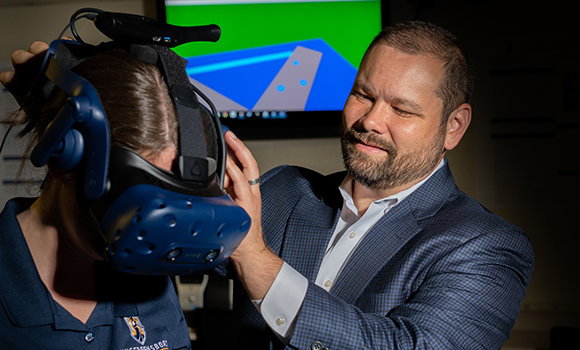
“We’ve been studying how we use vision to walk around in the world,” he says. “What if we can control someone’s vision and use that to control how they walk?” Virtual reality technology – which has been getting more compact, cheaper, and more user friendly – is allowing Rhea to do just that.
When he joined UNCG in 2011, he started the Virtual Environment for Assessment and Rehabilitation Laboratory, or VEAR Lab. Since then, a string of projects, applications, and research by Rhea and his colleagues has begun to unlock the technology’s potential.
One application, which netted Rhea a patent in 2018, uses virtual reality – or VR – to retrain people who have trouble walking.
In the VEAR Lab, subjects – wearing goggle-like VR headsets or watching a video monitor – are told to match their steps to those of a virtual avatar as they walk on a treadmill.
“You’re just playing a game we all played in kindergarten – follow the leader,” Rhea says. But concealed within the avatar’s virtual steps are subtle cues designed to shift the patient’s movement.
“It’s the small hidden patterns that we embed in there,” he says, “that we think can build up a person’s adaptive capacity, lost due to injury, aging, or disease.”
Rhea’s new patent is for the technology that embeds these adaptive patterns into the software driving the digital avatar.
There are many ways VR could improve rehabilitation.
Rhea’s doctoral student Chanel LoJacono is currently working on a VR headset program to bring a virtual obstacle course to life at a patient’s location, rather than having a patient travel to a special facility. This could make cutting-edge therapies less expensive and more accessible.
“We’re a ways from this, but imagine if you could check out a VR rehab headset. You’re with a human therapist every Monday, but you get to take one of these home,” Rhea says. “I get to play a game, and the game is fun. The game gets harder as I get better.”
This post originally appeared in UNCG Research Magazine. To read other stories about research, scholarship, and creative activity, visit researchmagazine.uncg.edu.
Story by Mark Tosczak
Photography by Jiyoung Park, University Communications