


A dungeon master (or “DM”) might introduce a group of Dungeons & Dragons (D&D) players to the imagination of Dr. Rick Barton this way:
“Once you move to the other side of the waterfall, you see a statue carved into the cliffside — a woman in armor towering over you. Beside her, a second statue of a man in a long, flowing robe. These are the legendary Arden and Vul. Their stern, stone eyes seem to direct you to a staircase winding up the 1,500-foot cliffside. It will lead you into the Halls of Arden Vul.”
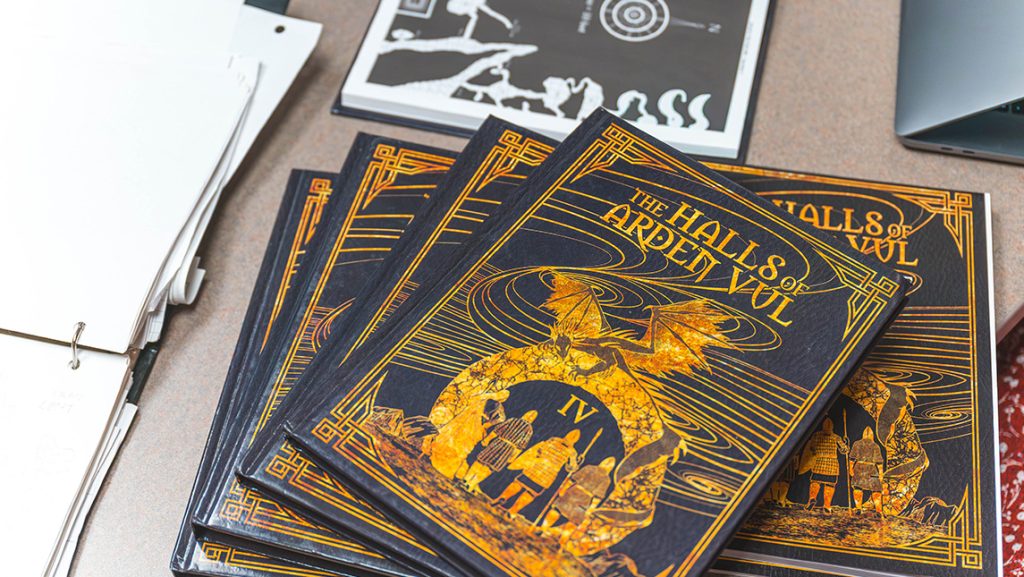
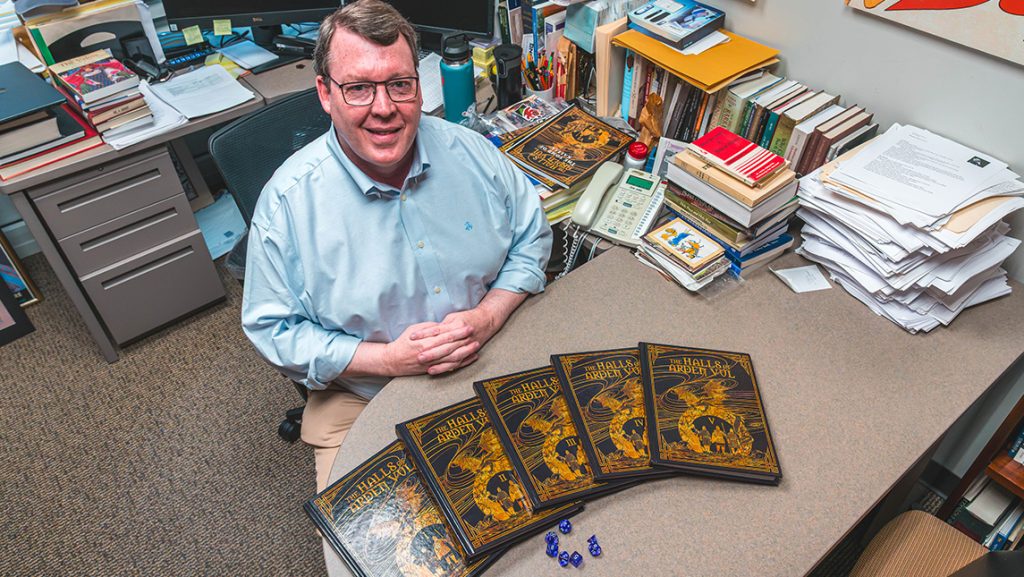
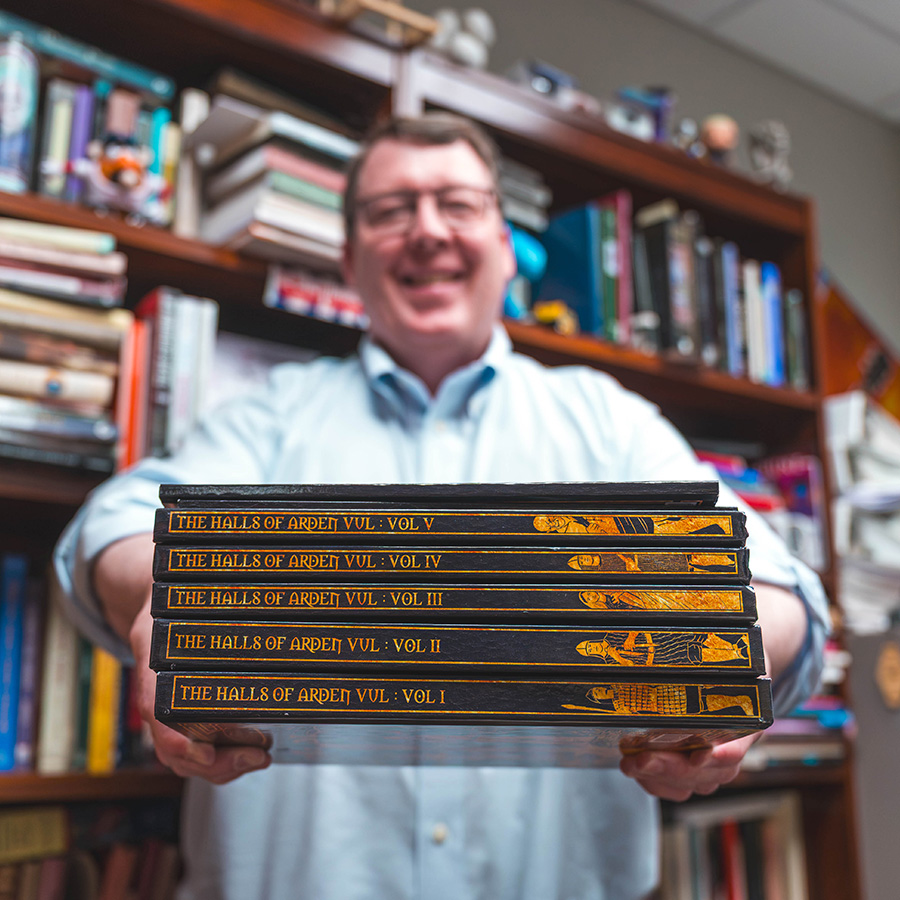
“The Halls of Arden Vul” is an enormous underground “megadungeon” designed by Barton, a professor in the UNC Greensboro Department of History, and avid D&D player. With a prestigious career researching real-life societies, he’s accumulated plenty of intelligence points for creating an immersive fantasy realm.
“It’s one of the biggest D&D products that’s ever been published,” says Barton. Sales of the hardback volume number in the hundreds, and the PDFs have been downloaded more than 5,000 times.
The Idea that Inspired Volumes of Adventure
Before Barton dedicated himself to the study of medieval European aristocracies, he was a D&D player. He got into the role-playing game in the 1970s, not long after it was first created by Gary Gygax and Dave Arneson.
As he advanced deeper into the field of history, Barton remained interested in something that rarely left the conceptual stage for D&D enthusiasts.
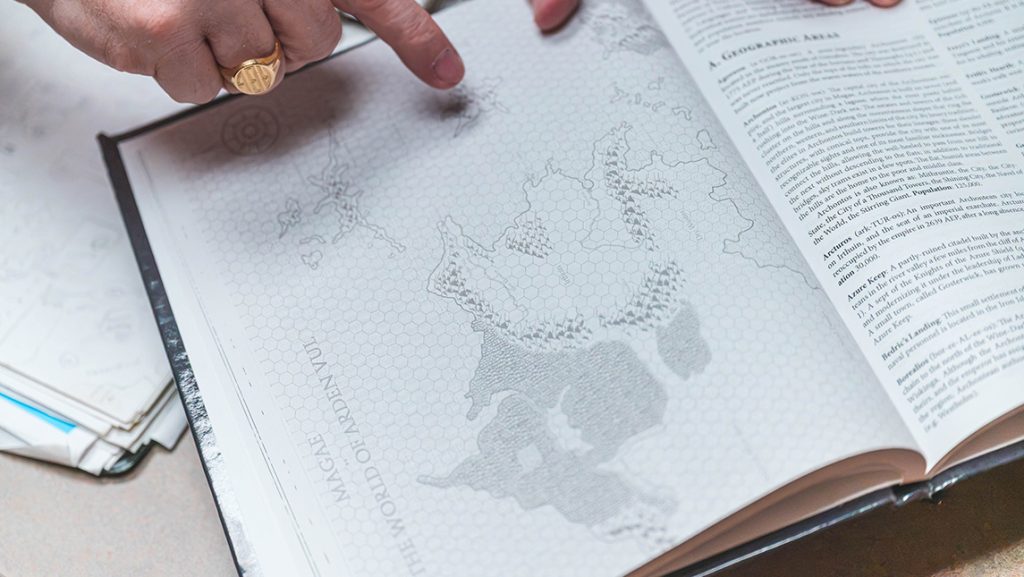
“There had always been this unicorn in D&D history of a true megadungeon,” he explains. A megadungeon is a sprawling, multilevel D&D setting designed for extended exploration. “Most adventures are shorter; your group completes them, then you’re done, and you move on to the next one. So, this was one of those things that everyone talked about, but no one ever did it.”
In the early 2000s, he connected online with Andreas Claren, a D&D player in Germany. He told him about his idea for an elaborate underground ruin in a city called Arden Vul. “He told me, ‘You’ve got to get this published,'” Barton says. “And I thought, ‘Who’s going to buy one professor’s labor of love?’ He said, ‘No, we’ll do it.'”
Claren and Barton pitched it to Expeditious Retreat Press. Claren rendered the digital versions of the maps while his son Lucas drew some of the illustrations based on Barton’s sketches.
Next, he had to organize all those ideas so that individual DMs could tailor campaigns for their groups. “Some players like overcoming challenges or finding treasure. Others like investigating,” he says.
Since that first conversation with Claren, he’s published five hardback guides and additional softcover volumes. He’s created 10 levels, 17 sublevels, and more than 2,000 encounters, traps, spells, magical items, puzzles, and shocking discoveries for “The Halls of Arden Vul.”
Layers of Real-World History Form Backbone of Megadungeon’s Lore
Players who would rather be archaeologists or scribes than monster slayers will find plenty to investigate in Arden Vul, including artifacts left by ancient civilizations.
The years of research into real-world history served Barton’s storytelling. Drawing primarily from the fall of the Roman Empire and the transition to the Byzantine Empire, he came up with the fictional Archontean Empire. During a disastrous civil war, the empire lost control of the city of Arden Vul. This left an opening for new civilizations and monsters to take up residence in the ruins. Barton set his world a millennium later as expeditioners return to the valley to recover the empire’s riches and magical artifacts.
“What makes this one different from a lot of other D&D publications is its internal logic,” Barton says. “My world is tightly logical; it all has to make sense within this invented world.”

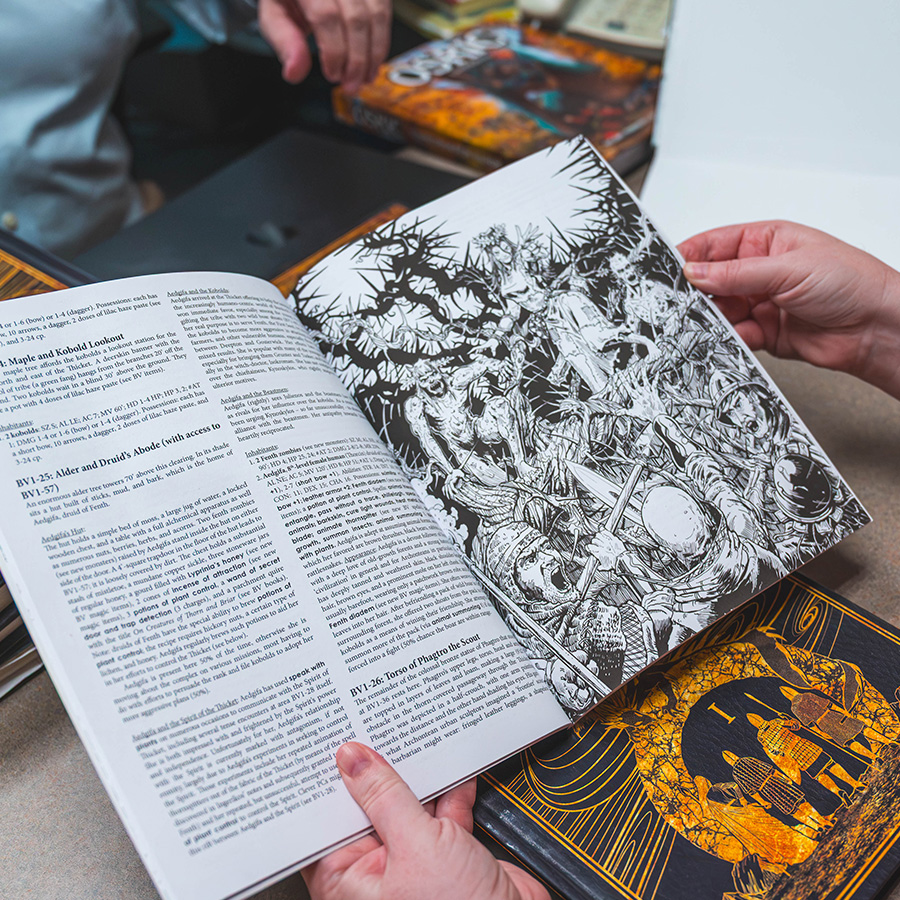
He based some characters on historic figures or famous legends, such as the Roman Republic general Marius. The backstory for the legionary Arden reflects the Twelve Labors of Hercules. His expertise in languages helped him create a cultural progression, giving modern Archonteans a language different from the one spoken by the empire in its golden age, much like how the Byzantines spoke Greek instead of Latin.
“I also decided that it was important to have a systematic artistic program for different eras of construction over time,” he says. “The old empire is all modeled on Roman portrait busts I’d seen in the British Museum.”
Arden Vul Finds Its Delvers
After years of developing Arden Vul, Barton now gets to see firsthand how players respond to his creation. He is a DM for his own D&D group, which includes UNCG faculty and staff. There is also a Facebook group called “Survivors of Arden Vul.” It has hundreds of followers who love to pick his brain about the work.

“People will ask me these questions that I’ve never thought of,” he says. “I think I’m kind of geeky, but these are people who really want to know this stuff.” The questions he hears from players show how an imagined world can encourage curiosity about history, language, and the development of civilizations, extending Barton’s work as an educator at UNCG.
Their interest may soon be sated. Barton is finishing the sixth volume now. Next he plans to flesh out the world around Arden Vul and introduce other cultures; he has one in mind that will draw from African history.
“There’s also deep lore about dragons and why they are rarer in the present,” he says. “That’s our next step: to take that simple world map and zoom in, to an even larger scale.”
For Barton, history is not a collection of isolated dates. It is a way to understand how societies, languages, and cultures develop, and a foundation for imagining convincing new worlds. His work shows how historical study can inform careers and creative pursuits extending far beyond the classroom, from research and writing to worldbuilding, game design, storytelling, as well as making real-world connections within a community of enthusiasts.
Story by Janet Imrick, University Communications
Photography by Jefferson Castillo, University Communications