Posted on February 17, 2026

UNCG MLIS student H. Blake-Lee looks at cards in a library.
H. Blake-Lee studies artwork by Pat Healy and Emily Furr.

MLIS Researcher Designs AI-Themed Games for Academic Libraries

Libraries have always been the place to go when you have questions. Right now, people have lots of questions about artificial intelligence (AI) and its place in the workforce, recreation, the arts, research, commerce, and more.

But AI, primarily generative AI, has moved so quickly that many librarians are trying to catch up. Although they’ve made strides in learning more, they may not be comfortable using the technology themselves, let alone explaining how it works to a student who wants to use it for a project.

H. Blake-Lee ’19 ’22 MA, a graduate student at UNC Greensboro, wants to move that needle. “I started my master’s of information and library science (MLIS), not specifically to work as a librarian, but to work with the community within libraries,” she explains. “My work focuses on bridging different perspectives, and I think that it’s really important to start those connections internally.”

While researching her IRB-approved capstone, “Understanding Generative AI in Academic Libraries,” a few statistics stood out:

While the majority are aware of AI-related concerns, “librarians’ comfort and confidence level in using, teaching, or talking about AI is only in the 30-35 percent range,” she says. “About 70 percent want to learn about AI, but not from a computer. They want to learn from engaging with others.”

Bridging Gap Between ‘I Want to Know’ and ‘What I Know’

Blake-Lee saw that open discussion of AI in academic settings has become more difficult due to librarians’ divergent perspectives and expressed emotional conflict.

Her proposal centers not only on sharing her capstone research findings in lectures and conferences, but in facilitating conversation and social connection using hands-on gameplay.

But first: How does someone without a computer science degree visualize the process, results, and long-term implications of a computer communicating high-speed responses to a human?

Fortunately, Blake-Lee’s previous studies at UNCG, starting with a bachelor’s degree in studio art and master’s degree in sociology, helped her connect this new challenge to something people have done for generations.

From Family Photos to Generative AI Perceptions

If you’ve ever looked at an old family photo, you know you do more than reflect on that fraction of a second captured. Your mind cycles through memories and emotions — positive, negative, or mixed — related to the event and the people involved.

When you show that photo to another family member, they may have a different reaction based on their own perspective of that experience or their life afterward. “I fell in love with that type of research method, using a visual object and seeing how it creates something to talk about,” says Blake-Lee.

She saw this in play during her Terra Foundation for American Art grant-funded sociology internship at UNCG’s Weatherspoon Art Museum. Weatherspoon staff had created a card game with artworks in its collection to facilitate responsive learning and interaction. Blake-Lee facilitated game sessions with students and museum visitors, studying how people reacted to the art based on their values and lived experiences.

She took that approach to UNCG’s Department of Information, Library, and Research Sciences. It all coalesced around her capstone research, with a goal to design AI-themed activities.

Blake-Lee also built on her background in game design and community-centered research. For example, she has helped develop programs focused on art and music at the McGirt-Horton Public Library and a board game for people with intellectual and developmental disabilities for the nonprofit InFocus Advocacy.

To strengthen the educational foundation of her AI-focused game, she conducted additional data gathering in libraries and art museums in Greensboro and globally. Thanks to the MLIS study-abroad experience led by Department Chair Lisa O’Connor, she got to see art spaces in Ireland. That, with her own independent trips to London, Prague, and Italy, let her watch how different pieces of artwork triggered different discussions and interpretations.

“From all my experiences,” says Blake-Lee, “I thought it would be best to introduce visuals around a theme, specifically AI, that people might have different perspectives of. I found a card game is a really great way to connect people.”

Putting All Her Cards on the Table

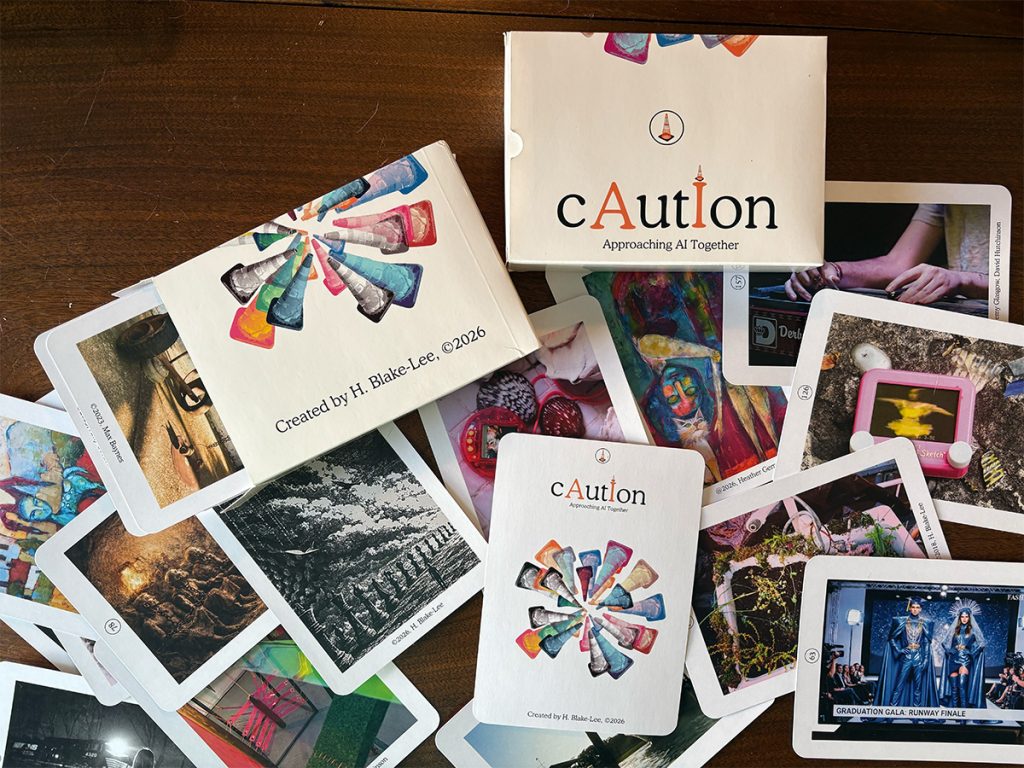
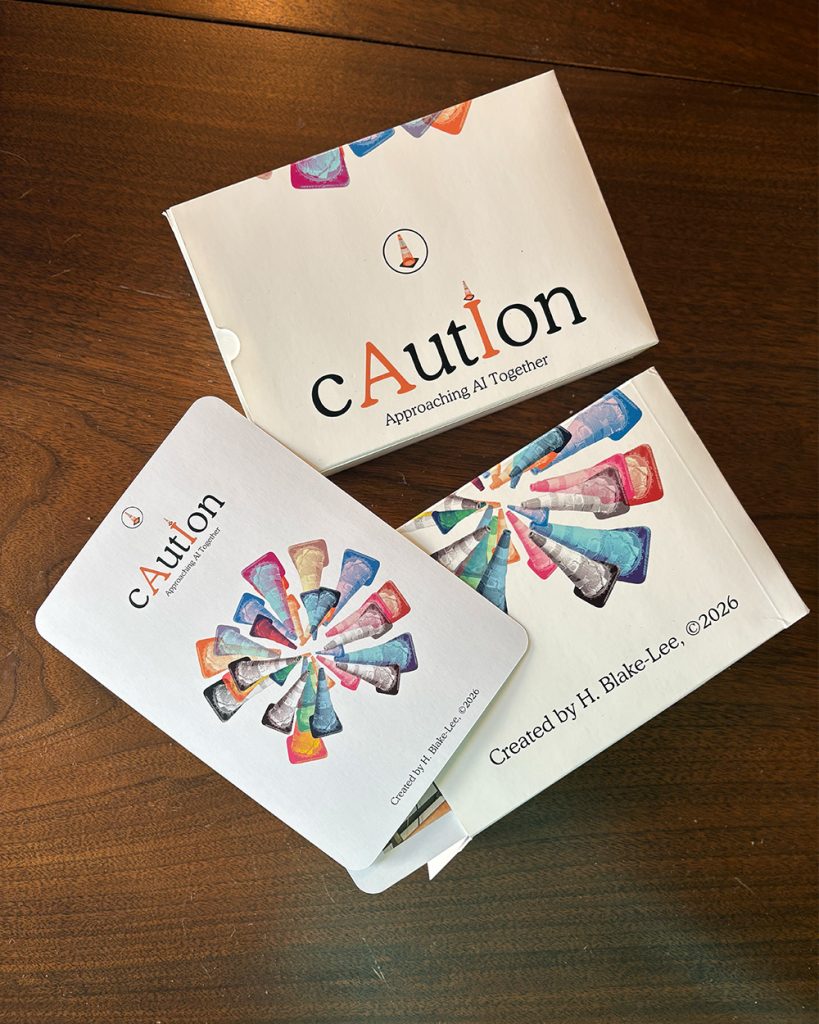
She came up with the card game “Caution!” for academic library staff and student workers, earning a $2,000 stipend from Impact Through Innovation (ITI), a research-funding program in the School of Education, to move it into development.

The cards will have 200 illustrations, some generated by AI and some contributed by local artists and UNCG alumni. Players are asked to think up words or ideas about AI based on the images they draw.

The point, Blake-Lee says, is not to figure out which one is AI, but to diversify the deck, let librarians absorb different types of digital art, and facilitate even more discussion by people with different perspectives on AI.

“During group gameplay, everyone passes around a card and thinks of one word to describe it,” she says. “They all say their word out loud at the same time, so not to influence one another’s perspective.”

From there, players then search for an image they think best represents one of the other players’ words. Then they can talk about why they connected that particular image to that word.

The conversation for each round of “Caution!” can be as long or as short as they want. She says, “The point is that they’re all listening to one another, using cards to connect with others’ perspectives, creating a welcoming space to approach AI together.”

Faculty and staff were critical to helping her create this, particularly her faculty mentor, Dr. Sonia Archer-Capuzzo. “Sonia is a great resource to turn to,” says Blake-Lee. “I could always ask if we could meet for a few minutes. Her help with proposal and conference writing helped lead to my success in many educational endeavors.”

She also worked closely with Steve Cramer, MLS — a business librarian and professor in University Libraries who researches how AI is being incorporated into his field.

Image used to convey AI.

Next Step, Expanding her Global Footprint

With the support of ITI, Blake-Lee hopes to adapt the game to different types of libraries, and perhaps other professions one day. She will collect feedback from early players on their interpretations of the visuals and the discussions the game sparked.

“We’ve even talked about introducing it in counseling groups for people who are so connected to AI that they distance themselves from human relationships,” she says. “There’s lots of social, emotional, and educational scenarios left to investigate.”
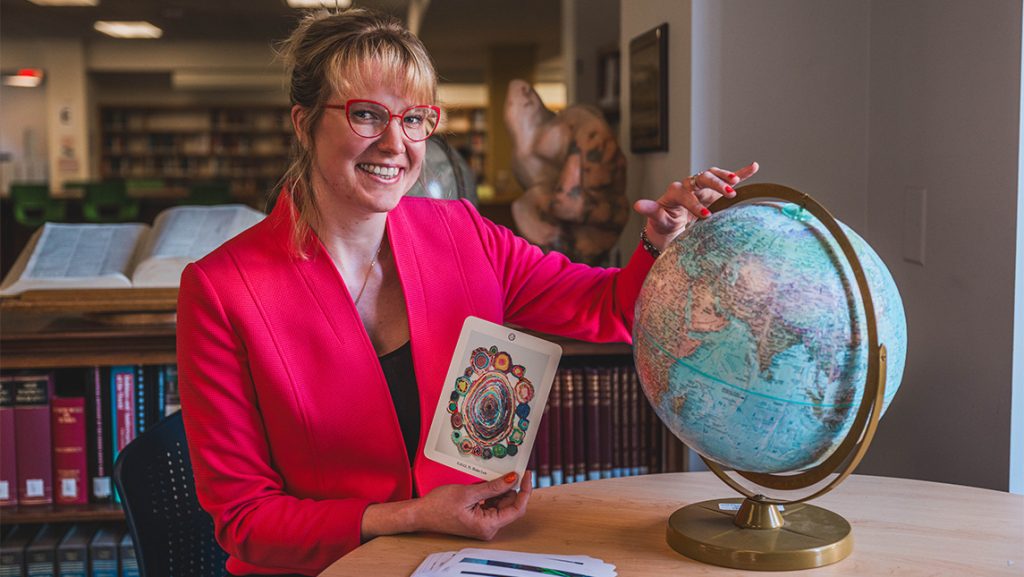
UNCG MLIS student H. Blake-Lee points at a globe.

Her work also piqued the interest of people outside UNCG. While studying abroad, she got to talk with staff at the National Library of Ireland. They thought her visual card-game approach could be a viable art research tool and talked about inviting her back to their side of the Atlantic Ocean for future collaborations, using their art collections for similar games and community-centered research.

It’s exciting for Blake-Lee to see her work become part of the worldwide conversation about AI and ultimately help librarians feel they’ve got a handle on the rapidly evolving technology.

“What I’ve learned from my research,” she says, “is just because every person has a different interpretation, connection, understanding, or perception of AI, that doesn’t mean they can’t join together to provide students the resources they need to be successful.”

Story by Janet Imrick, University Communications
Photography by Sean Norona, University Communications; and courtesy of H. Blake-Lee, Department of Information, Library, and Research Sciences
You Choose! A Curatorial Card Game Developed by the Weatherspoon Art Museum © 2023 by UNC Greensboro is licensed under Attribution-NonCommercial 4.0 International

Two middle school students shelve library books.

Build knowledge and knowledge centers.

Latest News

June 10, 2026

The 2026 National Principal of the Year is a Spartan

Before becoming the 2026 National Principal of the Year, Spartan Jason Johnson was a high school kid in Durham watching the way his ...

June 9, 2026

Sage Continues UNCG’s Passion for Poetry

Sage Short ’26 MFA was named poetry editor of "The Greensboro Review" in her second year at UNCG. She's another link in the long c...

June 4, 2026

Countdown to 250: Director of the Raleigh Museums

Ernest Dollar ’93, director of museums for the City of Raleigh, believes in making history feel relevant to people’s lives. As t...

What's Trending

Connect with Us

Subscribe to our Top 5

Subscribe today to our Top 5 Weekly email

This field is for validation purposes and should be left unchanged.

Share Your Story

For the Media

Posted on March 03, 2026

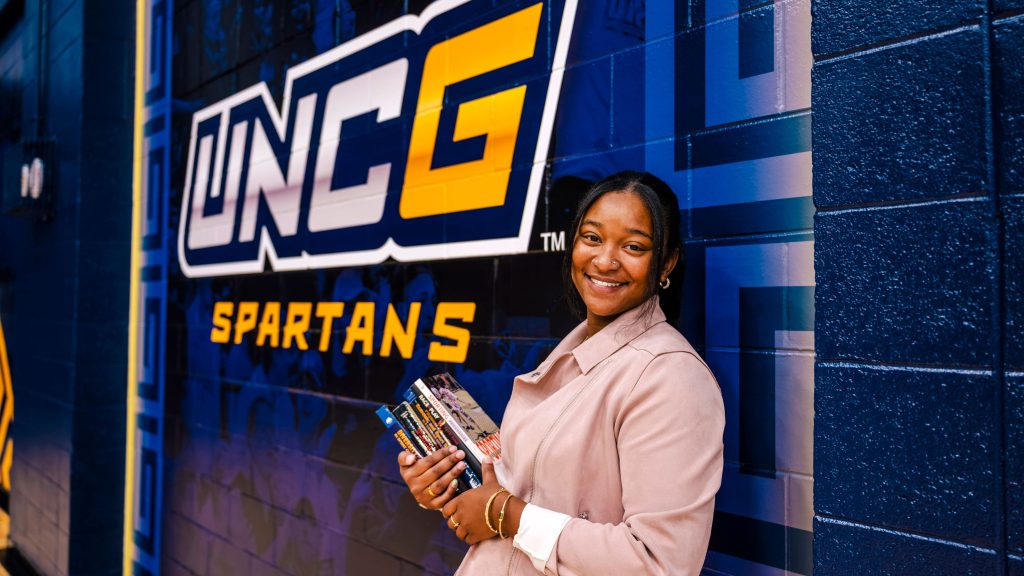
Kier holds books related to her research while standing in UNCG Basketball's Bodford Arena.

For Lexi Kier, sport has always been more than competition — it’s an intersection of joy and loss, community and pressure, and resilience and vulnerability. As a doctoral student in public health education at UNC Greensboro, she is building a research agenda that challenges how institutions understand athletes, particularly Black athletes.

“I come from an athletic background,” Kier says. “And I’ve seen these challenges firsthand.”

Kier grew up in Winchester, Va., in a family deeply rooted in athletics. She played competitive basketball in high school and dreamed of continuing at the collegiate level until her two knee surgeries—one a total reconstruction — ended her playing career.

At the same time, she watched her brothers navigate the intense demands of elite sport.

One brother played football at the University of Virginia. There, he experienced a concussion that, Kier says, changed his demeanor and mental health. Another rose from walk-on status at Marshall University to the NFL, where he now plays for the Kansas City Chiefs, bringing both extraordinary success and ongoing injury-related challenges.

“Seeing athletes, especially Black athletes, go through what they go through, and not being able to do anything about it, really motivated me,” says Kier, who also worked with the Virginia Tech women’s basketball team for several years. “I couldn’t just keep watching.”

That motivation led her first to a master’s in kinesiology at UNCG, concentrating in sport and exercise psychology, and eventually to a Ph.D. in public health education. There she found a disciplinary home that allowed her to examine not just behavior, but the broader systems shaping athlete health.

Broadening the definition of athlete health

Since beginning her doctorate in the School of Health and Human Sciences, Kier’s research portfolio has expanded rapidly. Recent work examines multiple dimensions of athlete health and transitions.

One recently accepted commentary in the Journal of Physical Activity and Health, critiques what Kier and her mentors, Drs. DeAnne Brooks and Erin Reifsteck, describe as the “miseducation” of athletes. The paper argues that sport culture prioritizes winning at the expense of long-term physical and mental health, leaving athletes unprepared for life after sport.

“There’s this sport ethic of ‘win at all costs,’ even over your body and your health,” Kier says. “Then when athletes transition out, they don’t know how to sustain physical activity, and mental health often declines.”

In another article in Journal of Clinical Sport Psychology, Kier, Reifsteck, and Kier’s doctoral advisor Dr. Jeff Milroy examine how pain intensity and pain interference affect symptoms of depression and anxiety in athletes across different sport types.

Their findings suggest that even when athletes can still perform daily activities, pain alone can significantly impact mental health. This insight carries important implications for injury management and psychological support.

Kier is also interested in the research tools used to study athlete health. During her master’s work at UNCG, she initially planned to examine concussions using electroencephalography (EEG) but encountered racial limitations embedded in the technology related to Black hair types and styles.

With support from an internal grant, she evaluated how open Black athletes are to participating in research with current EEG caps. The resulting publication in the International Journal of Kinesiology in Higher Education reinforced a principle that continues to guide her work: inclusion must be built into research from the start, not added later.

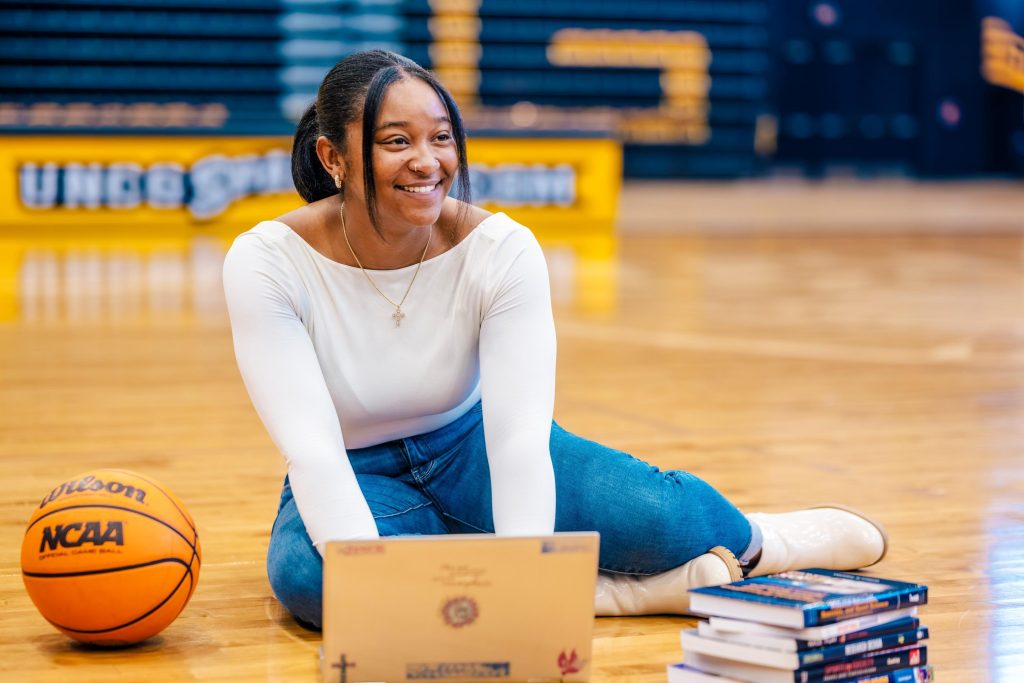
Kier holds books related to her research while standing in UNCG Basketball's Bodford Arena.

Research in community, research with purpose

Kier currently serves as a mental-skills trainer for Karenni youth soccer players in Winston-Salem. Her work with the community originally from Myanmar is part of a randomized controlled study focused on emotional regulation, cognitive restructuring, problem-solving, and teamwork.

Working with a refugee community required humility and adaptability, Kier says. “Black culture and Southeast Asian cultures are very different. I had to learn how to build trust, how to listen, and what leadership looks like in that context.”

The experience reflects her evolving interest in blending sport psychology, public health, and community engagement — an approach that aligns closely with her work as a Robert Wood Johnson Health Policy Research Scholar.

The prestigious program is designed for researchers whose work has clear policy relevance, even if they do not come from traditional policy backgrounds. The highly competitive program provides $124,000 in funding.

Kier was encouraged to apply to the program by mentors — including faculty members Drs. Michelle Martin Romero, Amanda Tanner and Tamar Goldenburg — who recognized the implications of her work before she herself fully did.

“I was like, ‘Policy? I didn’t do any policy,’” she said. But she discovered the program is intentionally designed for scholars whose research already intersects with policy questions, even if they have not been formally trained in policy analysis.

“I don’t want to be a policymaker,” she said. “But I want to know what to say, how to say it, and when to say it when I’m in the room with policymakers.”

As a scholar, Kier is learning how to frame athlete-health research in ways that resonate beyond academia, translating evidence into conversations that can influence systems, institutions, and decision-making.

“I’m learning how to communicate my work in ways that matter beyond academia,” Kier said. “It’s about making sure research reaches the people and systems that can change things.”

Looking ahead

Kier credits much of her growth at UNCG to strong mentorship, including from Milroy.

“He’s incredibly supportive,” she said. “He reminds us that we’re doing well, even when it feels overwhelming.”

As she continues her doctoral work, Kier remains open to where her research will ultimately land, whether that be in sport psychology, public health policy, or a space that bridges both.

What remains constant is her commitment to athlete health, equity, and accountability.

“I just want to get this figured out,” she said. “Because athletes deserve better.”


by Sierra Collins, Division of Research and Engagement
photography by Sean Norona, University Communications

Latest News

June 10, 2026

The 2026 National Principal of the Year is a Spartan
Before becoming the 2026 National Principal of the Year, Spartan Jason Johnson was a high school kid in Durham watching the way his ...

June 9, 2026

Sage Continues UNCG’s Passion for Poetry

Sage Short ’26 MFA was named poetry editor of "The Greensboro Review" in her second year at UNCG. She's another link in the long c...

June 4, 2026

Countdown to 250: Director of the Raleigh Museums

Ernest Dollar ’93, director of museums for the City of Raleigh, believes in making history feel relevant to people’s lives. As t...

What's Trending

Connect with Us

Subscribe to our Top 5

Subscribe today to our Top 5 Weekly email

This field is for validation purposes and should be left unchanged.

Share Your Story

For the Media

Posted on March 03, 2026

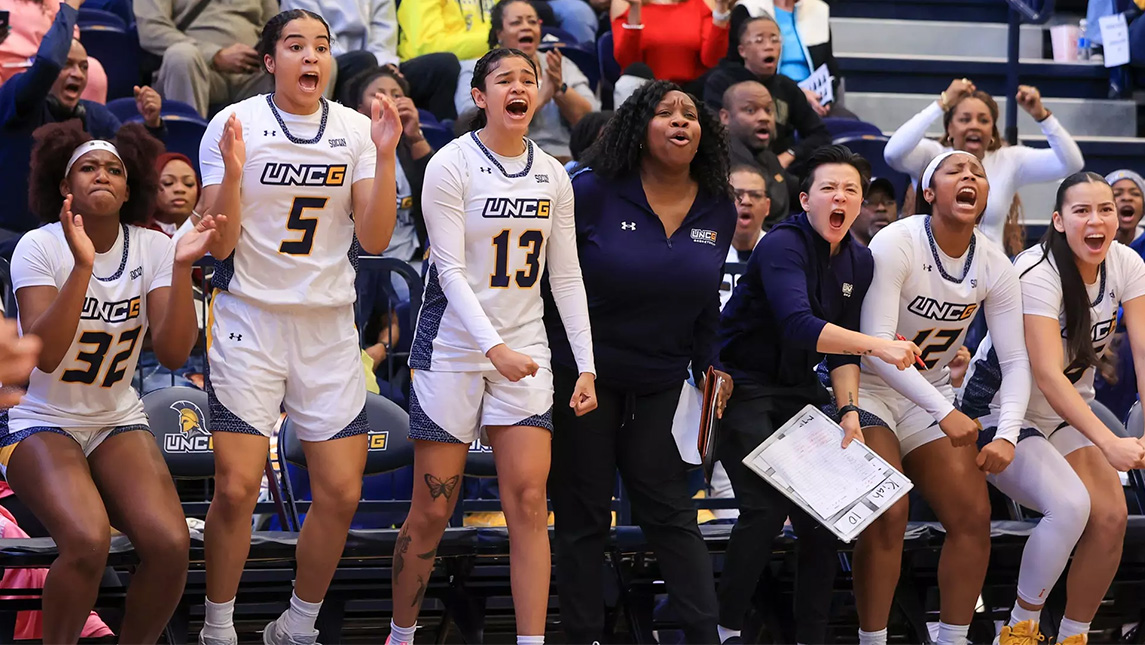
UNCG women's basketball players cheer from the sidelines.

The countdown to the 2026 Southern Conference (SoCon) basketball championship is on. UNCG men’s and women’s basketball both headed to Asheville for their first tournament games this week.

In the Men’s SoCon basketball tournament in Harrah’s Cherokee Center, the Spartans will face No. 10 VMI on Friday, March 6, in a first-round game at 7:30 p.m. The men’s team received a No. 7 seed. They hope for a victory so they can face the defending champions, Wofford, on Saturday, March 7.

Men’s first-round games will air on ESPN+ and select Nexstar stations.

No. 7 seed women’s basketball hit the court first on March 5 for the quarterfinals. However, their dreams of repeating last year’s SoCon championship win were dashed in the first round against ETSU, even a 12-0 start thanks to from Rylan Moffitt, Jaila Lee, and Kristina Rakotobe; and a valiant effort by Leyla Minor with a fastbreak layup to close out the first half and cut UNCG’s deficit.

Story by Janet Imrick, University Communications

Latest News

June 10, 2026

The 2026 National Principal of the Year is a Spartan
Before becoming the 2026 National Principal of the Year, Spartan Jason Johnson was a high school kid in Durham watching the way his ...

June 9, 2026

Sage Continues UNCG’s Passion for Poetry

Sage Short ’26 MFA was named poetry editor of "The Greensboro Review" in her second year at UNCG. She's another link in the long c...

June 4, 2026

Countdown to 250: Director of the Raleigh Museums

Ernest Dollar ’93, director of museums for the City of Raleigh, believes in making history feel relevant to people’s lives. As t...

What's Trending

Connect with Us

Subscribe to our Top 5

Subscribe today to our Top 5 Weekly email

This field is for validation purposes and should be left unchanged.

Share Your Story

For the Media

Posted on March 17, 2026

Promotional photo of author Casey McQuiston.

Acclaimed author Casey McQuiston will visit UNCG on April 9 for an event co-sponsored by University Libraries and the Greensboro Bound Book Festival. Their moderated discussion, Q&A, and book signing are free and open to the public, but RSVPs are required. McQuiston’s works include Red, White, and Royal Blue, One Last Stop, I Kissed Shara Wheeler, and The Pairing.
Latest News

June 10, 2026

The 2026 National Principal of the Year is a Spartan

Before becoming the 2026 National Principal of the Year, Spartan Jason Johnson was a high school kid in Durham watching the way his ...

June 9, 2026

Sage Continues UNCG’s Passion for Poetry

Sage Short ’26 MFA was named poetry editor of "The Greensboro Review" in her second year at UNCG. She's another link in the long c...

June 4, 2026

Countdown to 250: Director of the Raleigh Museums

Ernest Dollar ’93, director of museums for the City of Raleigh, believes in making history feel relevant to people’s lives. As t...

What's Trending

Connect with Us

Subscribe to our Top 5

Subscribe today to our Top 5 Weekly email

This field is for validation purposes and should be left unchanged.

Share Your Story

For the Media

Posted on March 05, 2026

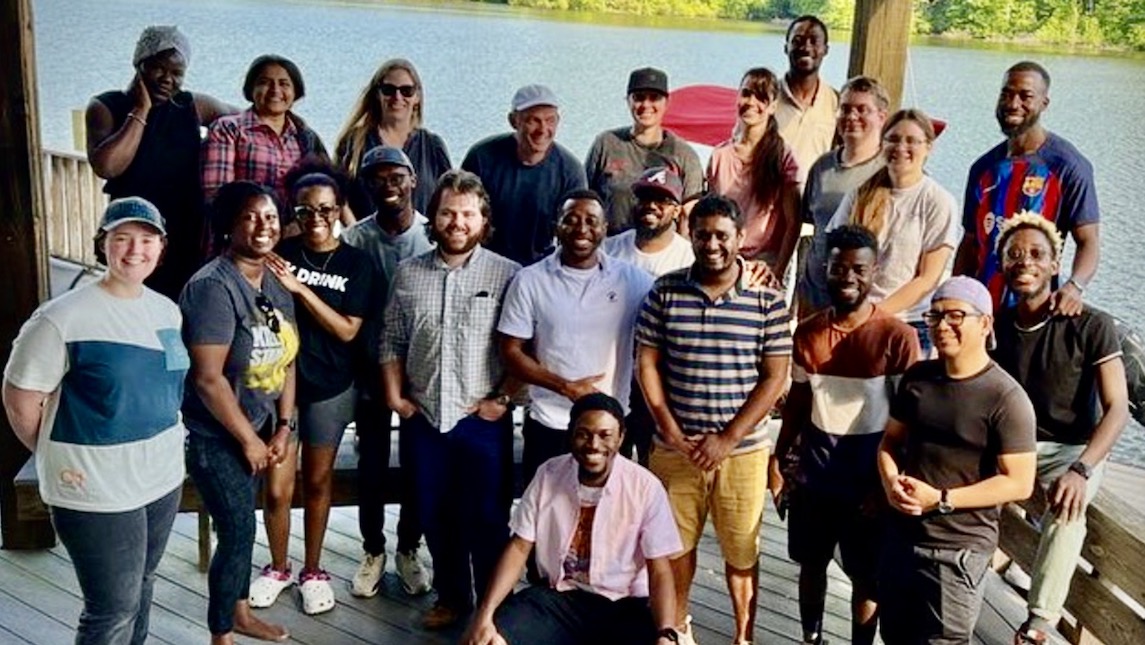
UNCG JSSN students at an outdoor retreat.

Joy, enthusiasm, energy — this is what emanates from even a brief interaction with Dennis LaJeunesse, longtime nanoscience professor at UNC Greensboro’s Joint School of Nanoscience and Nanoengineering (JSNN).

As he concludes a 26-year career at the University, he seems thrilled to mentor JSNN graduate students, support innovative research, and collaborate with colleagues as if it were his first year of teaching.

“The past year has been so exciting,” he says. “There have been so many papers published, so many graduations, and so many students defending. I want to get students excited about their achievements.”

LaJeunesse identifies graduate school as the “most favorite time in my life,” and he has gone to great lengths throughout his career to ensure JSNN students experience the same.

Pathway to Nanoscience  

Talking to LaJeunesse quickly reveals he is a man of many passions.

His undergraduate experience included majors in both classics and biology, with the hopes of being an archaeologist, as well as wrestling and fencing.

Following graduation, odd jobs — like being a fencing coach, an asbestos abatement technician, and a waiter — kept him busy, but he could not ignore his curiosity about science, so he applied for graduate school at Johns Hopkins University.

“Being in graduate school was freeing, so full of possibility and potential,” says LaJeunesse. “I had the opportunity to glean information from many different sources, allowing me to better understand what was happening in the world around me.”

After completing his doctoral degree in biology, LaJeunesse came to North Carolina to work at Duke University as a postdoctoral research fellow for almost five years before landing a professorship in Greensboro.

The Joy of Graduate School  

While in graduate school, LaJeunesse felt grounded by the scientific process, knowing other scientists had achieved hard things before him. He believed he could do the same if he were patient, broke problems into bite-sized pieces, and worked within a community.

At JSNN, he’s strived to instill the same sentiment in his mentorship of students.

“JSNN allows me to work with students from all over the world and in different disciplines, like physics, computer science, and engineering,” LaJeunesse says. “I see my role as getting these students prepped for their next steps.”

Students need to realize there is humility involved in being a scientist and conducting research, he explains, but with patience and dedication, they can and will move forward.

“That’s why I encourage students to include all their research in their dissertations — even the processes that did not work — because something was still learned,” LaJeunesse says.

His students have heard this message loud and clear.

Recent graduate Patience Kwara ’25 worked with LaJeunesse on an applied research project producing probiotic gummies.

“Although we did not achieve the desired results, the learning process was fun,” she says. “Dr. LaJeunesse encouraged us to keep working and not give up despite our setbacks.”

Current JSNN student Quadejia Crockett calls LaJeunesse a “life-changing mentor.”

“He did not just teach me the material,” she says. “He also taught me to ask better questions and to believe in my abilities.”

Innovation in the Lab and the Classroom  

With 13 publications in 2025 and three more coming in 2026, LaJeunesse’s research with students overflows with activity.

He currently has several students working with bacteria-produced nanocellulose. When derived from paper or wood, the nanocellulose is contaminated, but when produced from bacteria, it is crystalline, or very pure, and can functionalize materials that could potentially support advanced wound healing.

Other research includes looking at nanomaterial interactions with bacteria and yeast, in which model systems, like Escherichia coli, or baker’s yeast, and Candida albicans, a fungus that helps balance yeast levels in the body, are used to see how nanomaterials interact with them — how they change or how they grow.

This research is to better understand how cells respond to subtle changes in the physical environment, which could possibly improve the effectiveness of antifungal drugs.

JSNN PhD candidate Maurelio Cabo Jr. appreciates LaJeunesse’s support in research pursuits.

“He is open to discussing ideas and shaping research directions together, which has helped us publish five first-author papers from my research topics and also made my experience rewarding,” says Cabo.

Beyond research, LaJeunesse developed a communications course to teach students how to effectively write a proposal, how to design a National Institutes of Health study section, and how to provide feedback on research writing.

Mentorship Beyond the Lab

While LaJeunesse is a favored mentor within the lab, his ability to bring students together outside of the lab is just as vital to their growth.

“It’s important to find ways to build community amongst your students,” he says. “You want to create a really tight group of scientists.”

And he actively has created these spaces for JSNN students to bond, whether it is leading a yoga class, renting a gazebo at Lake Jeanette in Greensboro, or hosting a lab meeting at Jake’s Billiards.

Ensuring students share experiences outside of the lab guarantees they will cooperate and collaborate well within the lab, thinks LaJeunesse.

Leadership and Legacy at JSNN  

LaJeunesse has served as JSNN’s director of graduate studies, a position in which he helped organize both the department and the curriculum to make it most beneficial for fellow faculty as well as students.

By optimizing courses and curriculum, he added more stability to the department.

“If the system is built correctly, it should perpetuate with success no matter who is in charge,” he says.

He applauds his fellow faculty, calling them an “eclectic group of scientists.” Due to the multiple fields being under the JSNN umbrella, he sees so much potential for growth, particularly with young new faculty members.

As he wraps up his time on campus, he hopes he’s offered his students what he experienced in graduate school.

“These students have done a great job for me,” he says. “I hope I paid it back by maximizing their learning, enhancing their joy, and celebrating their accomplishments.”

Written by Amy Burtch, AMBCopy
Photos by Sean Norona, University Communications, and provided by JSNN

Hand wearing a blue latex glove holding a petri dish in a laboratory setting.

Be Inspired By Science.

Latest News

June 10, 2026

The 2026 National Principal of the Year is a Spartan

Before becoming the 2026 National Principal of the Year, Spartan Jason Johnson was a high school kid in Durham watching the way his ...

June 9, 2026

Sage Continues UNCG’s Passion for Poetry

Sage Short ’26 MFA was named poetry editor of "The Greensboro Review" in her second year at UNCG. She's another link in the long c...

June 4, 2026

Countdown to 250: Director of the Raleigh Museums

Ernest Dollar ’93, director of museums for the City of Raleigh, believes in making history feel relevant to people’s lives. As t...

What's Trending

Connect with Us

Subscribe to our Top 5

Subscribe today to our Top 5 Weekly email

This field is for validation purposes and should be left unchanged.

Share Your Story

For the Media

Posted on March 06, 2026

Jaila Lee

Senior guard Jaila Lee of UNCG’s women’s basketball team reflects on her journey through unexpected health concerns and personal challenges. Through it all, she pressed her way back to the court, helping her team secure a win during the 2025 SoCon Tournament.

Latest News

June 10, 2026

The 2026 National Principal of the Year is a Spartan

Before becoming the 2026 National Principal of the Year, Spartan Jason Johnson was a high school kid in Durham watching the way his ...

June 9, 2026

Sage Continues UNCG’s Passion for Poetry

Sage Short ’26 MFA was named poetry editor of "The Greensboro Review" in her second year at UNCG. She's another link in the long c...

June 4, 2026

Countdown to 250: Director of the Raleigh Museums

Ernest Dollar ’93, director of museums for the City of Raleigh, believes in making history feel relevant to people’s lives. As t...

What's Trending

Connect with Us

Subscribe to our Top 5

Subscribe today to our Top 5 Weekly email

This field is for validation purposes and should be left unchanged.

Share Your Story

For the Media

Posted on March 23, 2026

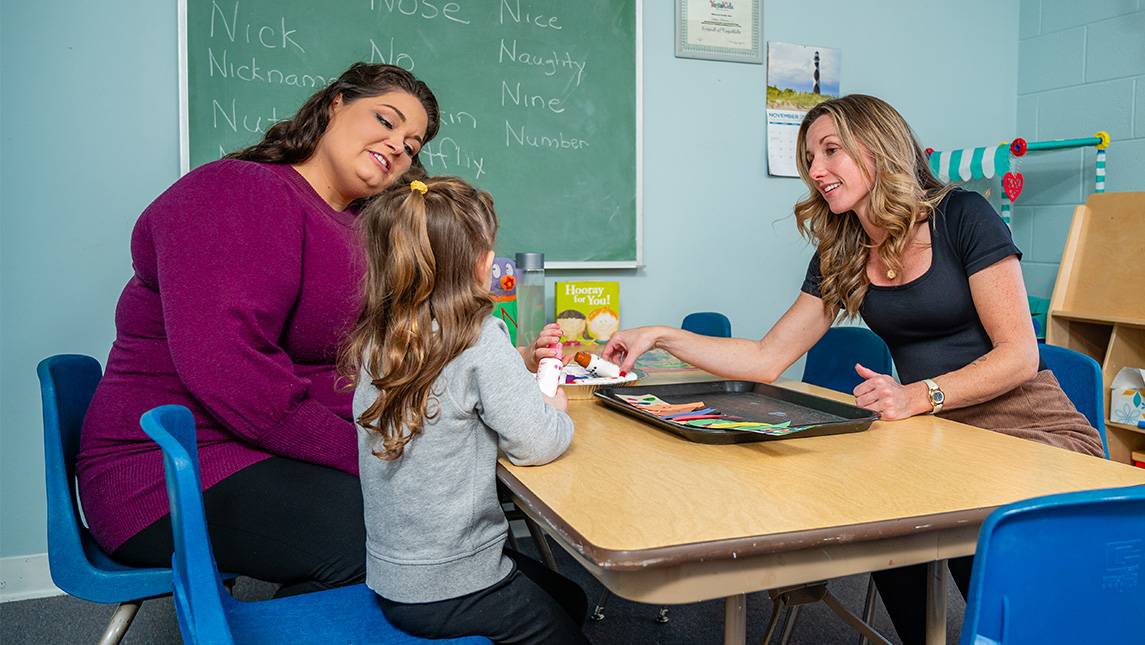
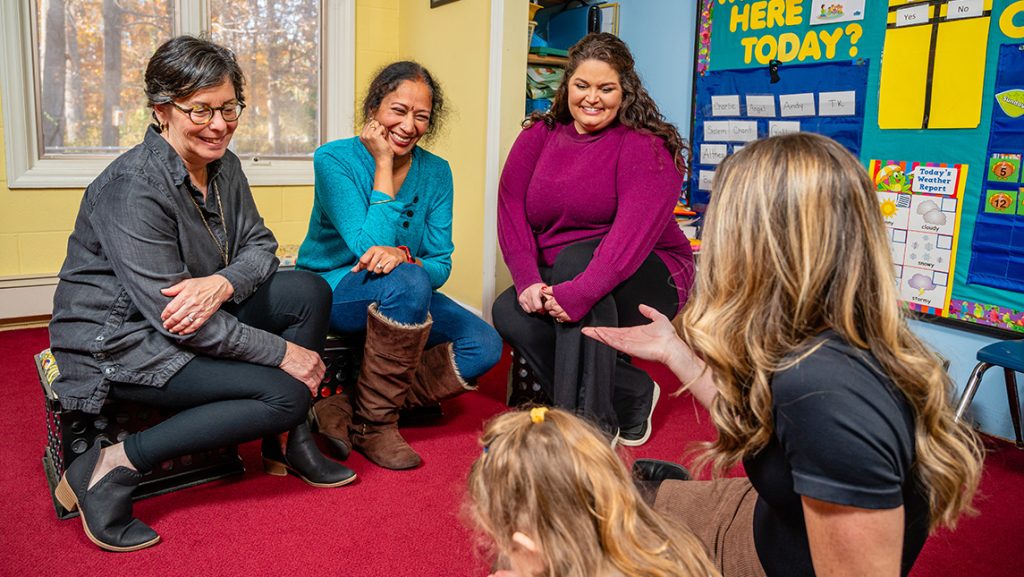
UNCG staff work with a preschooler.
CYFCP's Early Childhood Specialist Amanda Flynt.

For 30 years, UNCG’s Center for Youth, Family, and Community Partnerships (CYFCP) has been serving the community. Its team will celebrate with a night of fun, family, networking, and hockey!

Join them on Saturday, April 11 at 7 p.m. to watch the Greensboro Gargoyle’s take on the Worcester Railers at First Horizon Coliseum.

If you purchase tickets using this link, $10 of your purchase will go directly to CYFCP and the communities we serve.

Flyer promoting CYFCP Night at the Gargoyles.

Latest News

June 10, 2026

The 2026 National Principal of the Year is a Spartan

Before becoming the 2026 National Principal of the Year, Spartan Jason Johnson was a high school kid in Durham watching the way his ...

June 9, 2026

Sage Continues UNCG’s Passion for Poetry

Sage Short ’26 MFA was named poetry editor of "The Greensboro Review" in her second year at UNCG. She's another link in the long c...

June 4, 2026

Countdown to 250: Director of the Raleigh Museums

Ernest Dollar ’93, director of museums for the City of Raleigh, believes in making history feel relevant to people’s lives. As t...

What's Trending

Connect with Us

Subscribe to our Top 5

Subscribe today to our Top 5 Weekly email

This field is for validation purposes and should be left unchanged.

Share Your Story

For the Media

Posted on February 27, 2026

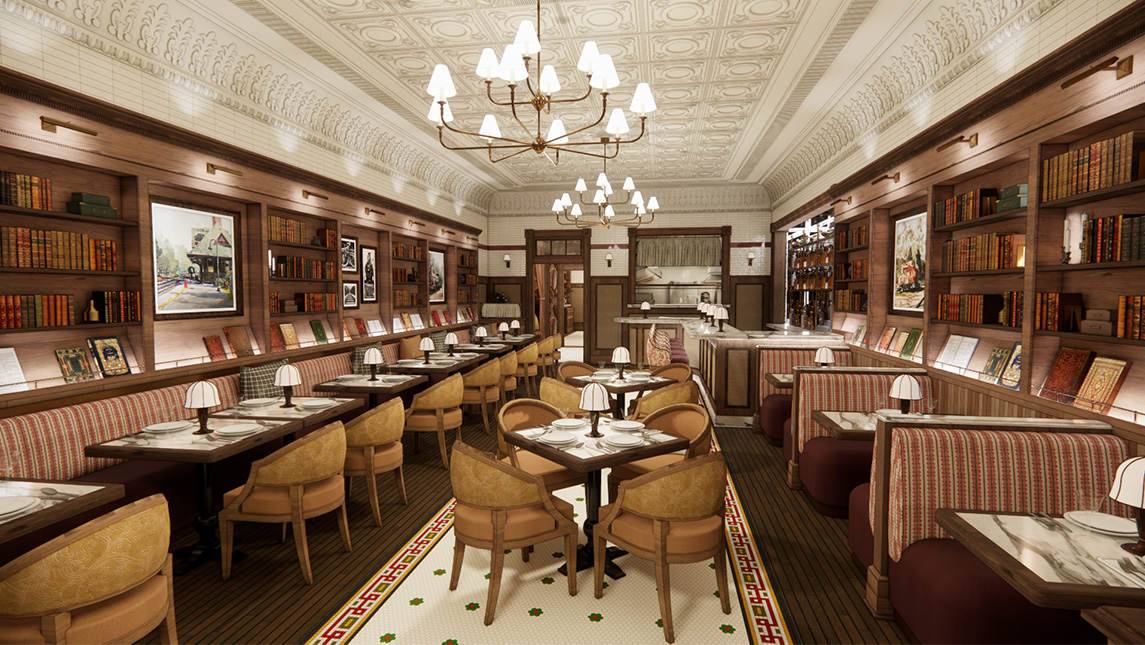
Conceptual layout of a restaurant by UNCG alumnus Aaron Solar.

An old, unused building on a busy street can mean something different to each person who passes by. Where some might experience a burst of nostalgia, others might see a dilapidated relic from a fading point in time.

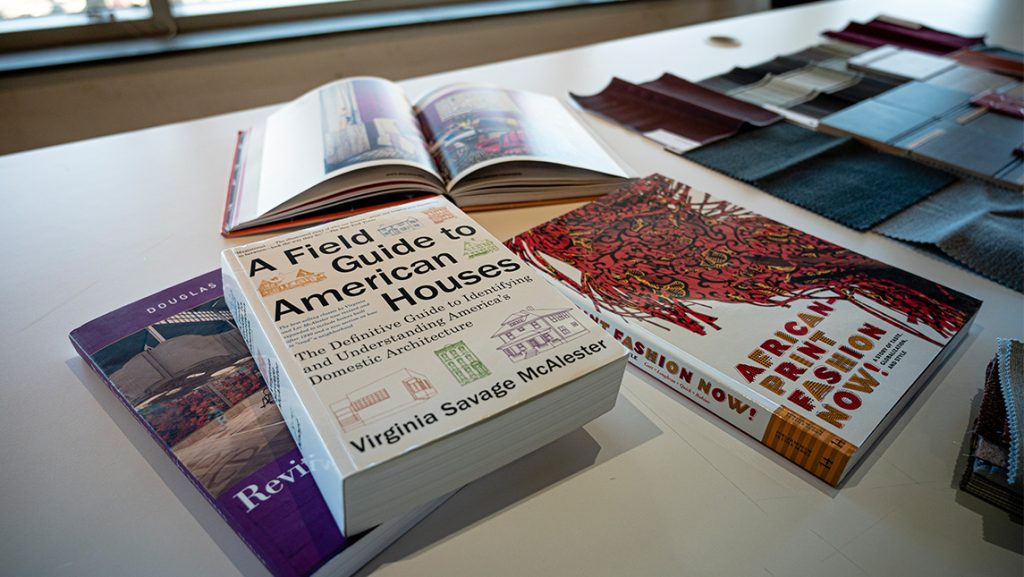
Students in UNC Greensboro’s Department of Interior Architecture (IARc) see the potential to give these old buildings new purpose.

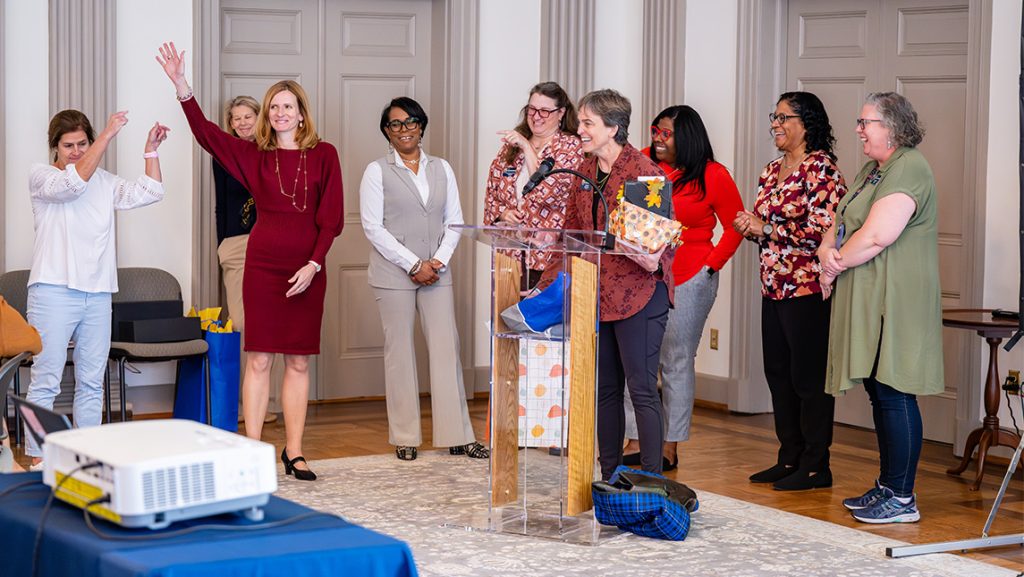
And thanks to that mindset, they also saw a clean sweep. Three proposals by IARc students to revitalize historic properties snagged every student category in the 2025 AIA Winston-Salem Design Awards.

Merit Award winner Maya Monteverde with interior architecture faculty, Dr. Asha Kutty and Matt Jones.

Aaron Solar ’25 had recently moved to Baltimore, Md., for a job with the Patrick Sutton design firm. After the awards ceremony on Dec. 4, a UNCG friend called with the news that his proposed redesign of Greensboro’s historic Fordham’s Drug Store won the Honors Award, the highest student category. He also shared the Citations Award won by a group that worked on another locale: the Douglas J. Galyon Train Depot.

“What really took these projects to the next level were the real-world implications,” says Solar. “It was cool to see my design fit into an existing space, to work with constraints I don’t always have when working on a hypothetical.”

Restaurant design mixes new and old flavors

Portrait of UNCG interior architecture alumnus Aaron Solar.
Aaron Solar ’25

Old buildings pose unique challenges. Students must work around structural limitations while making the spaces suitable for new business needs. AP Assistant Professor Matt Jones, MFA challenged Solar’s class to turn Fordham’s, a century-old drugstore on South Elm Street, into a mixed-use project with apartments, retail, and a restaurant.

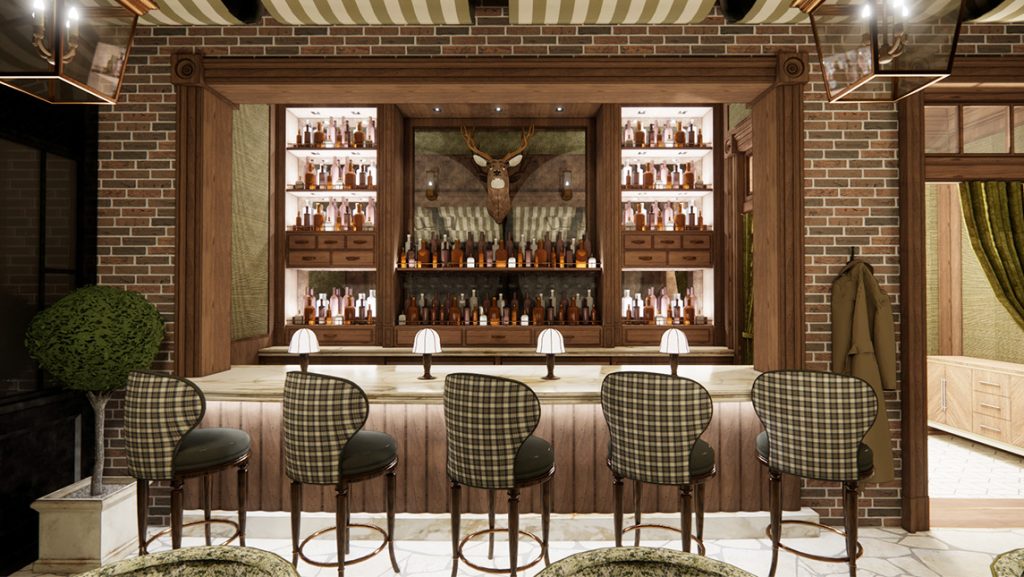
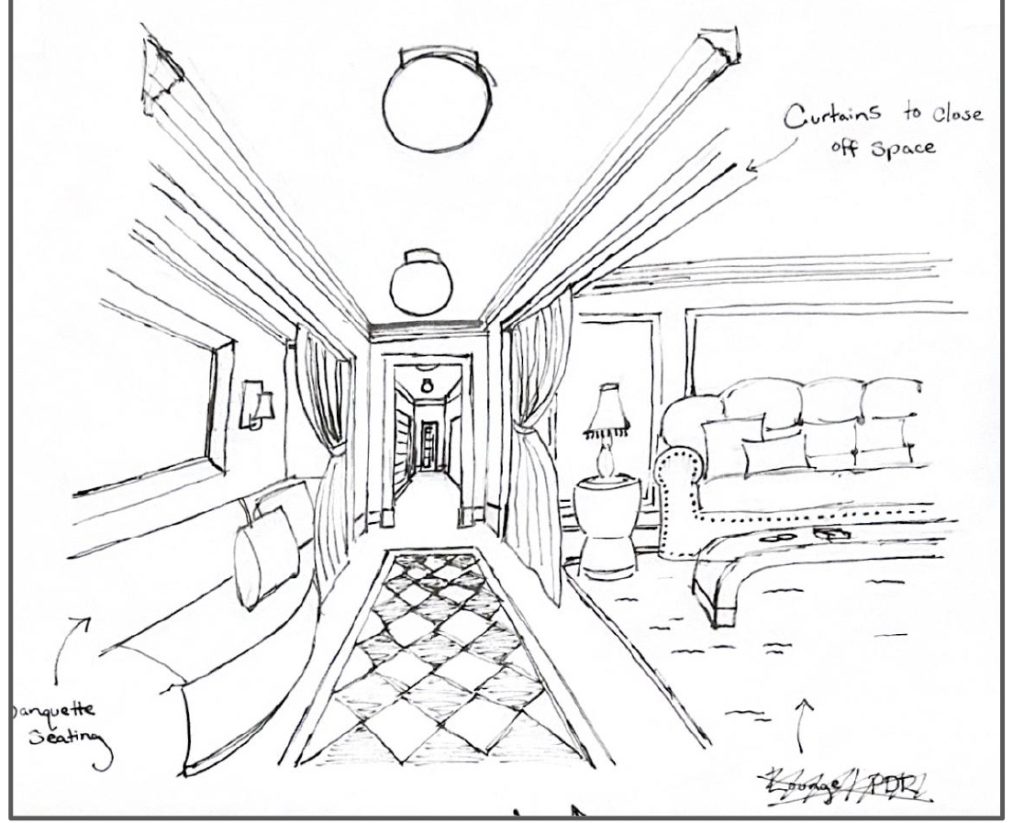
Solar came up with an English-themed restaurant for the ground floor, but he wanted the building to maintain its 19th century downtown character.

“It had these really old bookshelves along the walls, this beautiful mosaic tile floor, these tin ceilings that were sort of falling apart at this point,” he describes. “It’s amazing. When you walk in there, you get the feeling there are so many stories that you really want to keep alive.”

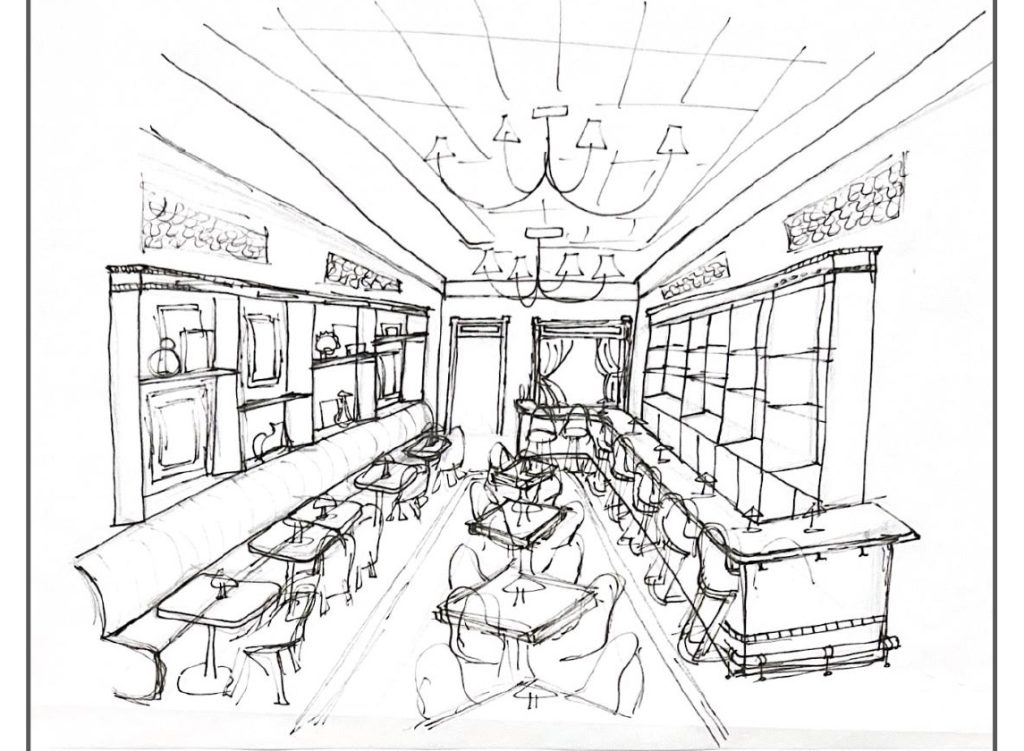
One limitation he learned to work around was Fordham’s narrow layout. Jones and Solar practiced with smaller projects called charettes to help him allocate space for seating and the kitchen. “I took heavy influence on old-world train cars,” Solar says. “The building is located very close to the train tracks, and so I wanted to bring in the details of what you might find in an old train car.”‘

Solar’s sketches and renderings.

It came as no surprise to Jones that Solar’s design won, especially after seeing him present the project at an event for Creative Greensboro.

“That was a huge success,” Jones says. “They weren’t just presenting to their peers, but hundreds of people from the community were coming through, and we got a lot of great feedback.”

Style meets comfort in maternity-minded makeover

UNCG interior architecture student Maya Monteverde.
Maya Monteverde

Historic significance and emotional well-being inspired Maya Monteverde, who won the Merit Award for her Nia and Vida Birthing Center concept. She was tasked with designing a property of MAAME, Inc. in Durham’s Hayti District, a neighborhood deeply connected to its African American history.

Its health care purpose posed additional challenges. “The building is very small, and a lot of medical equipment is very large,” she explains.

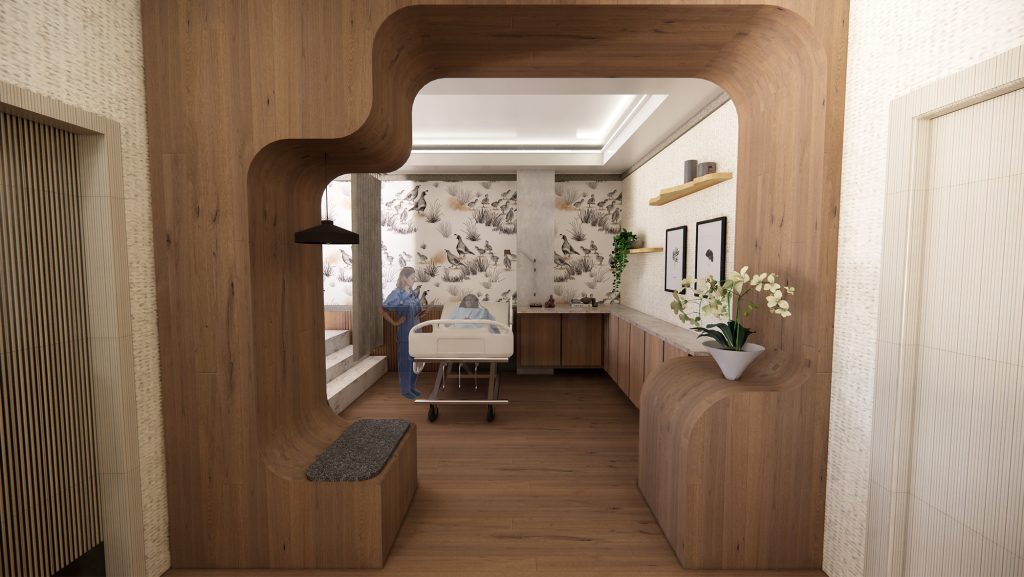
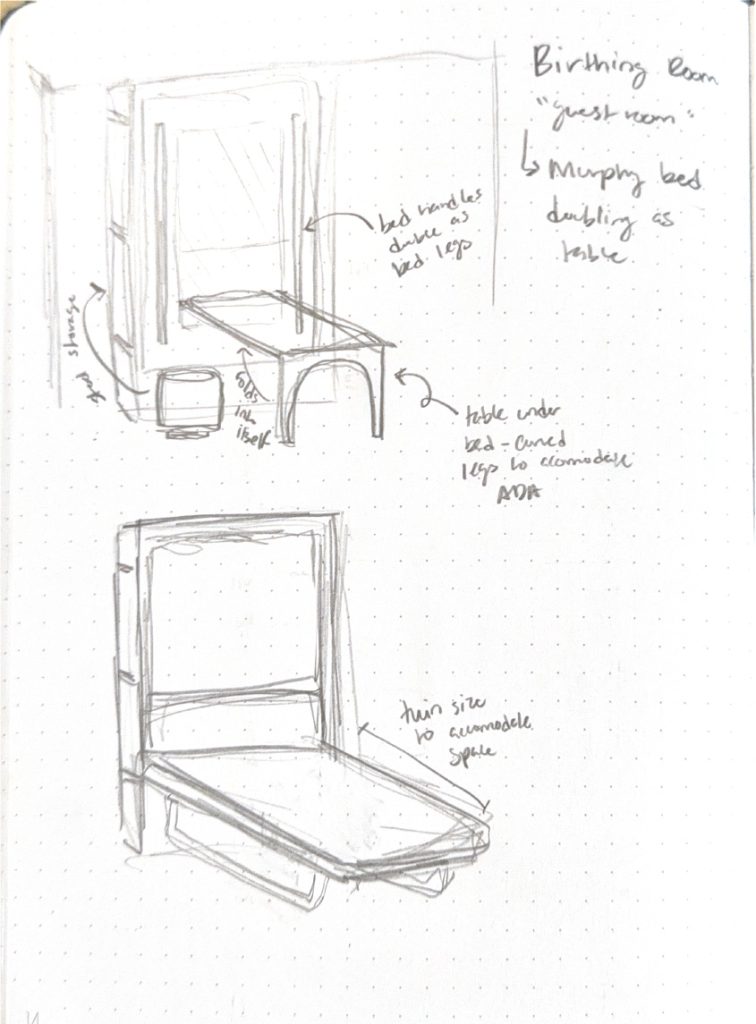
She designed built-ins to maximize floor space in the reception area and birthing units. She added birthing tubs and other relaxing spaces for families separate from the beds, while leaving room to maneuver a wheelchair or stretcher.

Monteverde also spoke with parents and doulas about what to avoid. Many people she surveyed described hospital interiors as feeling too cold and sterile.

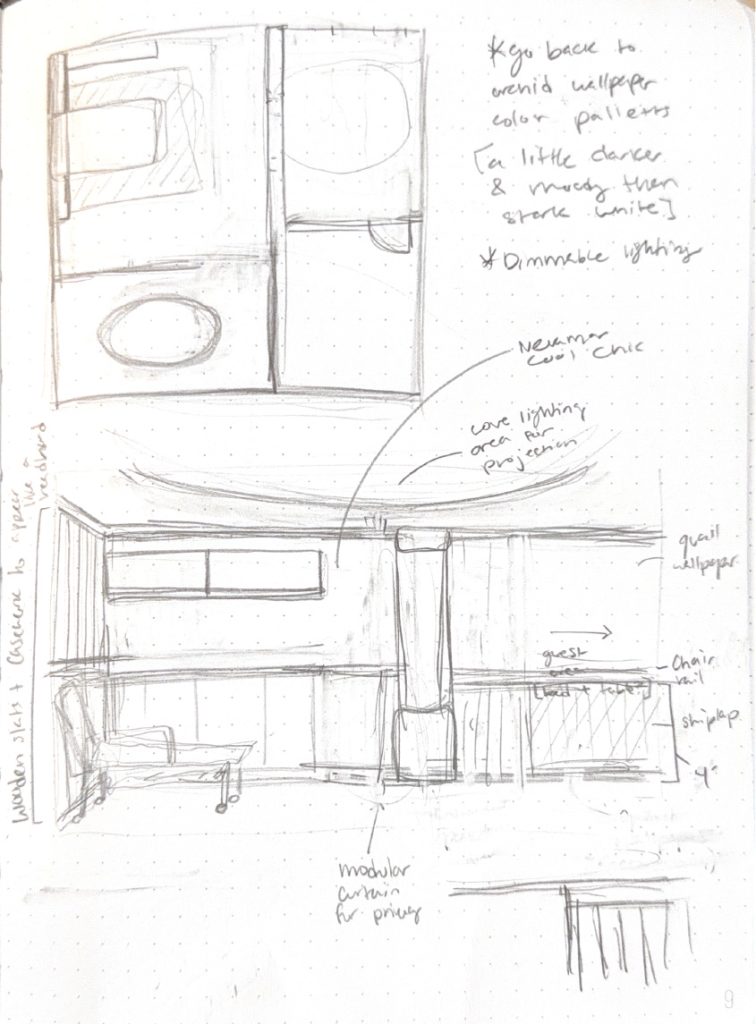
“I drew a lot of material selections and colors from traditional African patterns, as well as earth tones,” says Monteverde. “I tried to use a lot of stone, wood, and glass to help open up its spaces. Soft color palettes, a lot of relaxing tones, so as not to overwhelm families.”

Rendering of a birthing suite by UNCG interior architecture student Maya Monteverde.

Monteverde’s sketches and renderings.

Monteverde enjoyed developing a design connected to one of the clients of her faculty mentor, Dr. Asha Kutty. “She’s probably one of the most involved professors I’ve ever had,” she says. “All the projects I’ve done in her studio involved real clients. We can talk to them face to face and figure out their needs.”

Kutty says Monteverde’s designs stood out because of how well she researched and prioritized mental health needs. “Working with real community sites fosters a sense of ethical responsibility, as students understand their designs represent real people and lived experiences,” says Kutty. “She demonstrated a strong understanding of how interior environments influence emotional safety, dignity, and agency during childbirth.”

Award-winning work with real-world application

The AIA awards sweep means a great deal to the IARc department, one of the few programs of its kind in North Carolina. Department Head Travis Hicks, who mentored the winning Gaylon Depot group project, says “Our department has a deep and rich history of community-engaged design, following principles and practices that connect our talented faculty and students with community partners in impactful, real-world projects. It’s encouraging to have professional architects and designers validate this engaged way of teaching and learning with AIA design awards.”

Monteverde, who graduates this May, says UNCG gave her the place to develop interests she’s had since childhood. “My mom studied art curation and pushed me to be creative,” she says. “Her influence made me realize how much deeper we can go into designing a space, and how it can bring people together, especially communal and public spaces.”

Jones says the work of Spartans made such an impact that it might create new opportunities for students outside North Carolina.

“The jurors for this were from northern Alabama,” he explains. “They told us that their chapter currently does not have student awards categories, but because of the quality of these, they want to start having student designs as part of their show. That’s a win-win for everyone.”

For the awardees, these accolades go beyond a wall plaque or a point for a résumé. Solar says his concepts became great practice for the work he takes on in his full-time career. “The Fordham project was a great precursor for jumping into the real world and working on high-level restaurant projects,” he says. “I see so many restaurants that are like this, that make you think, ‘How do I fit a restaurant in a 15,000 square foot, 100-year-old building?'”

Monteverde says older buildings are full of life, and it’s great to have projects about keeping them in use. “It’s a very powerful feeling, to stand somewhere that’s old, to think about how someone made this wall by hand, carved out details like on a door frame. I think it’s essential to keep that life in them while moving forward.”

Story by Janet Imrick, University Communications
Photography by David Lee Row, University Communications
Additional images courtesy of Aaron Solar, Patrick Sutton; and Maya Monteverde, Department of Interior Architecture

UNCG student Maya Monteverde points at interior architecture graphics.

Create designs that honor history and build community.

Latest News

June 10, 2026

The 2026 National Principal of the Year is a Spartan

Before becoming the 2026 National Principal of the Year, Spartan Jason Johnson was a high school kid in Durham watching the way his ...

June 9, 2026

Sage Continues UNCG’s Passion for Poetry

Sage Short ’26 MFA was named poetry editor of "The Greensboro Review" in her second year at UNCG. She's another link in the long c...

June 4, 2026

Countdown to 250: Director of the Raleigh Museums

Ernest Dollar ’93, director of museums for the City of Raleigh, believes in making history feel relevant to people’s lives. As t...

What's Trending

Connect with Us

Subscribe to our Top 5

Subscribe today to our Top 5 Weekly email

This field is for validation purposes and should be left unchanged.

Share Your Story

For the Media

Posted on March 10, 2026

UNCG's Dr. Susan Keane with students in the hallway.

Dr. Susan Keane, who came to UNCG in 1983, has advanced research that can help families identify behavioral problems early and treat them. Her Candace Bernard and Robert Glickman Distinguished Professorship also helps her students get ahead in their own cutting-edge research.

Latest News

June 10, 2026

The 2026 National Principal of the Year is a Spartan

Before becoming the 2026 National Principal of the Year, Spartan Jason Johnson was a high school kid in Durham watching the way his ...

June 9, 2026

Sage Continues UNCG’s Passion for Poetry

Sage Short ’26 MFA was named poetry editor of "The Greensboro Review" in her second year at UNCG. She's another link in the long c...

June 4, 2026

Countdown to 250: Director of the Raleigh Museums

Ernest Dollar ’93, director of museums for the City of Raleigh, believes in making history feel relevant to people’s lives. As t...

What's Trending

Connect with Us

Subscribe to our Top 5

Subscribe today to our Top 5 Weekly email

This field is for validation purposes and should be left unchanged.

Share Your Story

For the Media

Posted on February 18, 2026

Hans signs digital partnership agreement on an ipad, with content displaying on a nearby tv.
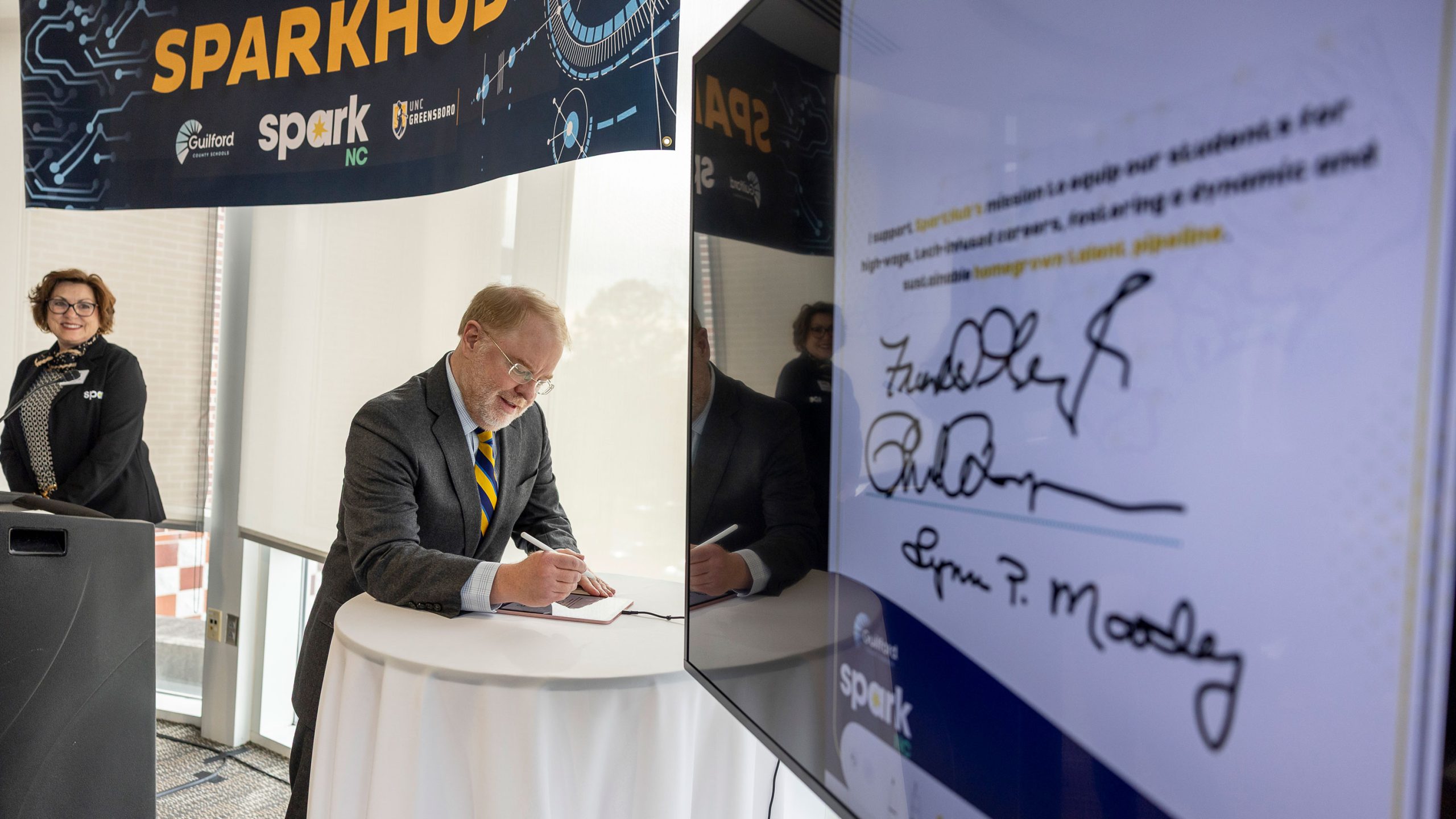
UNC System President Peter Hans signs the agreement launching NC's first SparkHub

New SparkHub at UNCG creates a first-of-its-kind bridge between K-12, higher education, and the global workforce


To bridge the gap between K-12 education, higher education, and the global workforce, SparkNC, UNCG, and Guilford County Schools (GCS) have launched North Carolina’s first SparkHub. This new learning environment is designed to connect high school students with innovative higher education experiences and in-demand technology careers.

Located on the UNCG campus, the SparkHub serves as a physical and intellectual bridge between K-12 education, higher education, and the global workforce. Through this partnership, GCS students will participate in immersive, hands-on learning experiences developed in collaboration with global technology leaders, including Apple, IBM, Epic Games, Lenovo, TEKsystems and Cisco. The launch is supported in part by Live Oak Bank, reflecting a shared commitment to expanding access to technology education.

The UNCG SparkHub is part of SparkNC’s growing inter-district network, enabling GCS students to collaborate with peers and technology professionals across North Carolina while gaining exposure to real-world career pathways.

“This partnership is about more than just teaching code — it’s about creating opportunity, confidence, and belonging,” said SparkNC President Lynn Moody. “By opening a SparkHub on the UNCG campus, we are breaking down barriers between high school and higher education and showing students where their potential paths can lead.”

“As a public research university, UNCG is committed to building pathways that expand access and drive economic mobility,” said Chancellor Franklin D. Gilliam, Jr. “This partnership demonstrates how higher education, K-12 schools and industry can work together to create meaningful opportunities for students across our state.”

NC’s first SparkHub launched on Tuesday with a digital signing ceremony including UNC System President Peter Hans, Guilford County Schools Superintendent Whitney Oakley, NC Senator Phil Berger, SparkNC President Lynn Moody, and UNCG Chancellor Franklin D. Gilliam, Jr.

High-tech curriculum for a digital future

Students participating in the SparkHub will engage in modular learning experiences aligned with some of the fastest-growing, most in-demand fields in the modern economy, including:

  • Artificial intelligence (AI) and machine learning
  • Game design and esports
  • Cybersecurity
  • Software development
  • UX/UI design
  • Data analytics
  • Exploring technology careers

The curriculum emphasizes experiential, project-based learning and is designed to evolve alongside industry needs.

A unique pathway to credit

Moving beyond fixed class periods and schedules, the SparkHub allows students to progress through learning modules at their own pace. By completing six learning experiences and building a professional portfolio students may earn a high school computer science credit through GCS.

This modular approach provides students with greater flexibility, autonomy, and ownership over their learning while aligning academic achievement with real-world skills.

The SparkHub launch event included remarks from signatories, current SparkNC students, and technology partners, followed by a tour of the UNCG ARCADE lab and technologies that will be available to incoming students.

Mentorship and innovation

The SparkHub’s location within the UNCG ecosystem provides students with access to faculty expertise and cutting-edge research through ARCADE (Applied Research in Computer Arts, Digitization and Esports). UNCG faculty will provide mentorship and guidance, connecting students to advanced technology applications across disciplines.

The initiative also serves as a living classroom for UNCG students, particularly future educators and researchers, who will support programming while gaining hands-on experience in next-generation teaching and learning environments.

Latest News

June 10, 2026

The 2026 National Principal of the Year is a Spartan

Before becoming the 2026 National Principal of the Year, Spartan Jason Johnson was a high school kid in Durham watching the way his ...

June 9, 2026

Sage Continues UNCG’s Passion for Poetry

Sage Short ’26 MFA was named poetry editor of "The Greensboro Review" in her second year at UNCG. She's another link in the long c...

June 4, 2026

Countdown to 250: Director of the Raleigh Museums

Ernest Dollar ’93, director of museums for the City of Raleigh, believes in making history feel relevant to people’s lives. As t...

What's Trending

Connect with Us

Subscribe to our Top 5

Subscribe today to our Top 5 Weekly email

This field is for validation purposes and should be left unchanged.

Share Your Story

For the Media