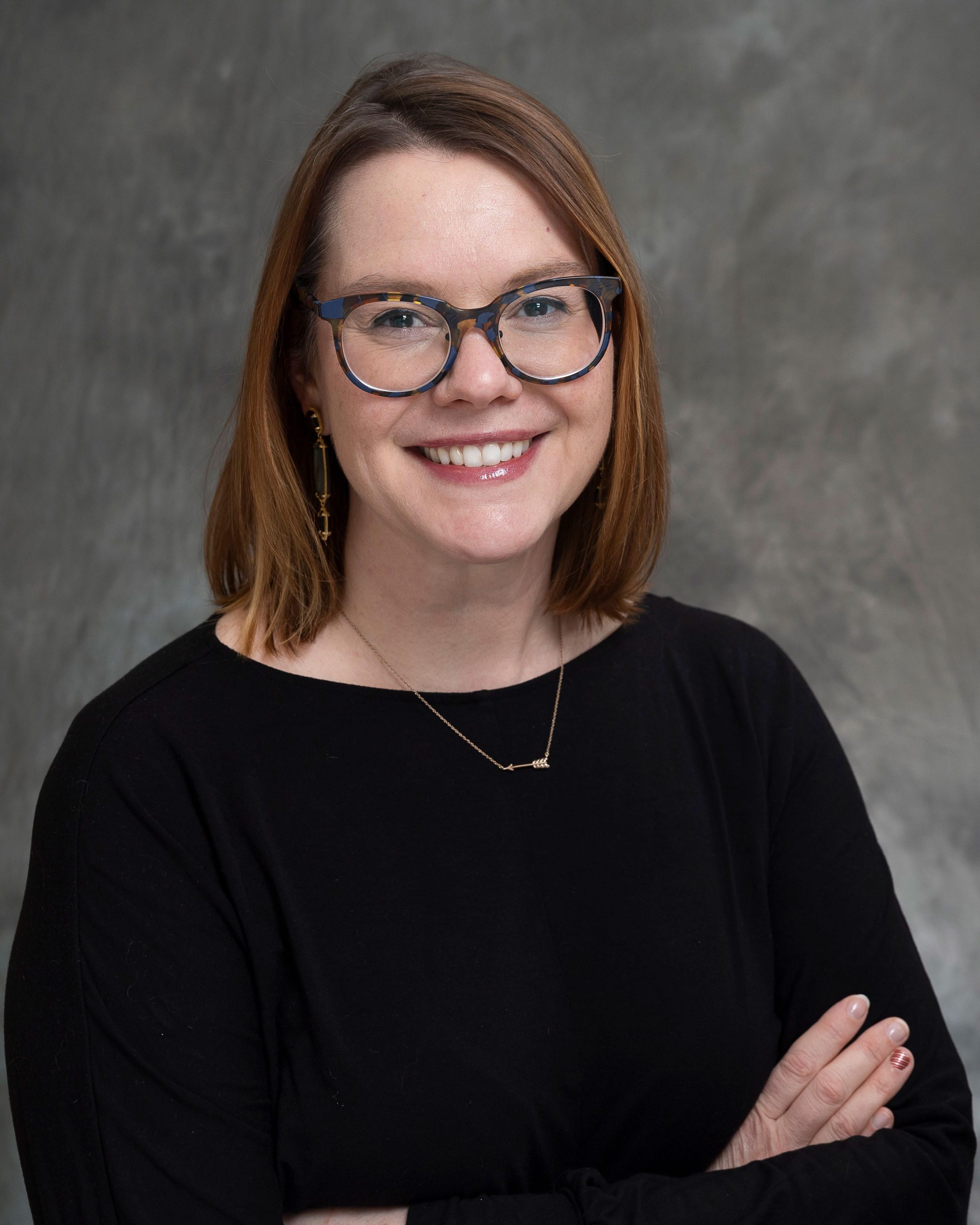
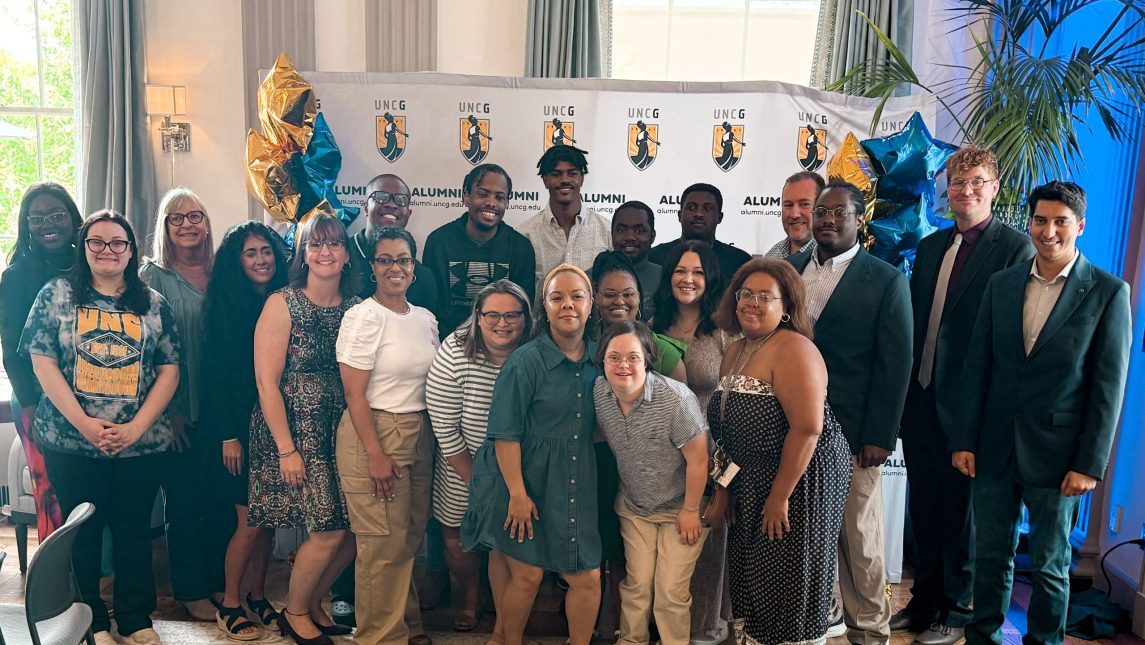
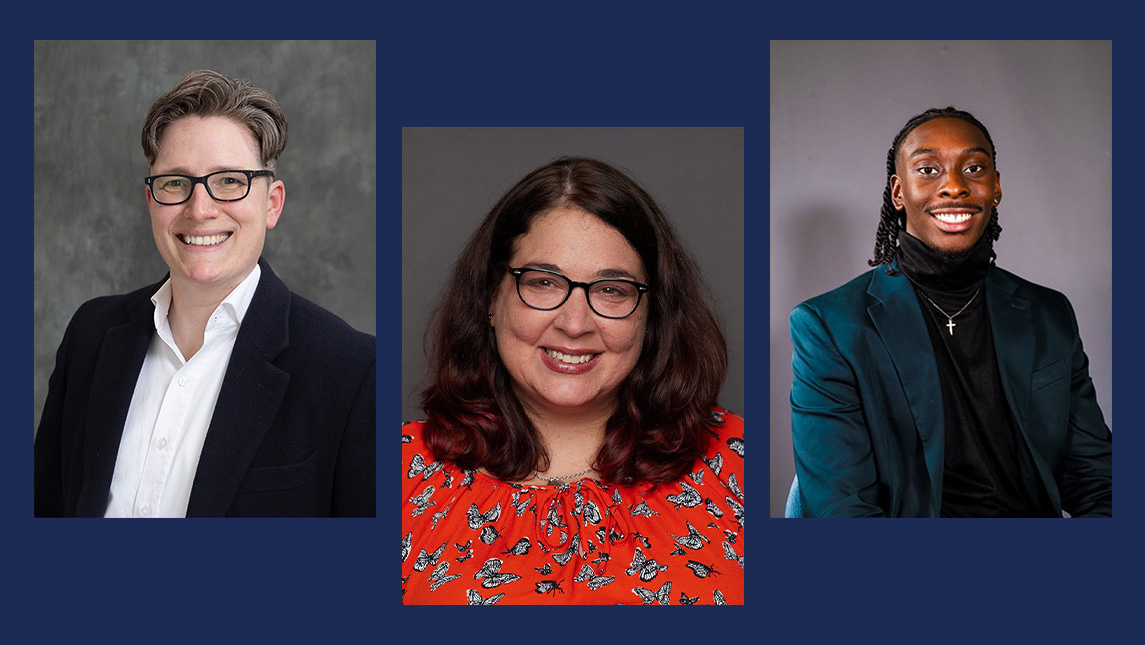
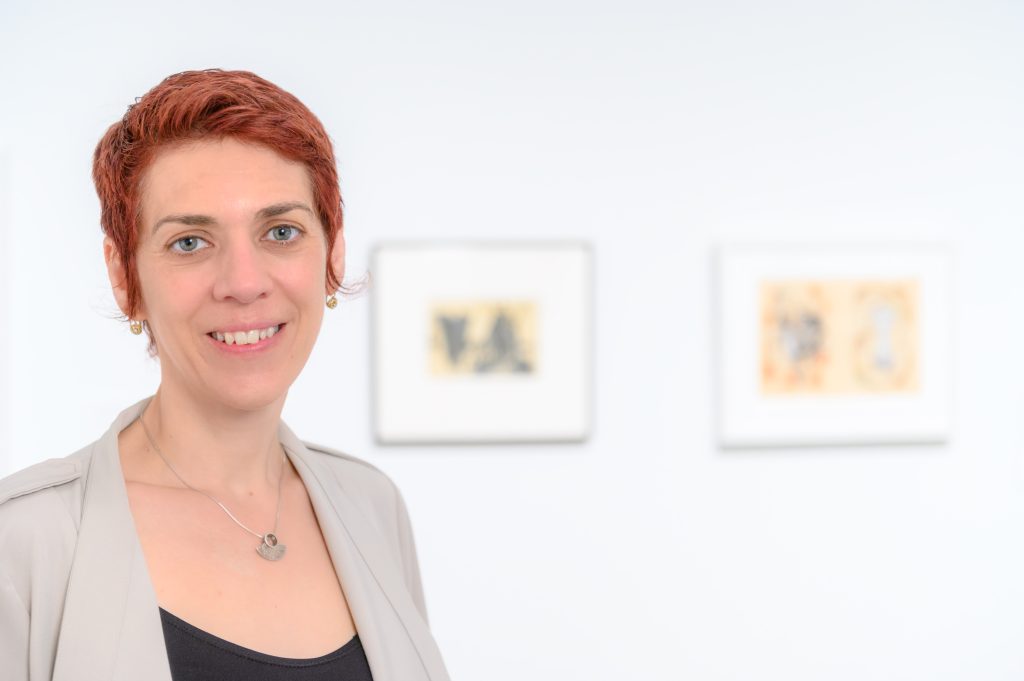
Dr. Heather Adams, associate professor of English, receives the Early Career Research Excellence Award for her groundbreaking scholarship in rhetoric, composition, and writing studies, with interdisciplinary specializations spanning feminist theory, feminist historiography, gendered health studies, reproduction studies, and public emotion.
Peers describe Adams as a preeminent early-career scholar in her field and one of her generation’s most prominent voices in feminist rhetorical studies. In her 9 years at UNCG, she has authored or coauthored an outstanding 17 peer-reviewed articles and book chapters as well as a book and a co-edited collection of scholarly essays — a level of scholarly activity one would expect from a full professor rather than an early career faculty member.
Adams’s work is published with top-tier publishers and journals, including the Quarterly Journal of Speech, which has a 6% acceptance rate, and Rhetoric Review, which has a 15% acceptance rate.
Her 2022 book, Enduring Shame: A Recent History of Unwed Pregnancy and Righteous Reproduction — which examines the raced and classed experiences of unwed mothers since the mid-twentieth century and traces a culture of shaming and blaming women into the present — won the highly competitive Horner Outstanding Book Award from the Coalition of Feminist Scholars in the History of Rhetoric and Composition. Her 2024 co-edited collection, Inclusive Aims: Rhetoric’s Role in Reproductive Justice, was released by the award-winning Parlor Press, which publishes some of writing studies’ most distinguished scholars.
Adams has delivered over 60 national and international conference presentations, earning a Distinguished Paper Award from the Rhetoric of Health and Medicine Symposium, and her invited talks include the prestigious 2023 Kenneth Burke Memorial Lecture at Pennsylvania State University. Her work has also appeared in Communication Currents, a National Communication Association publication that aims to explain scholarly information to broad and public audiences.
Beyond sharing her work with her scholarly peers, Adams also conducts extensive work in the realm of public advocacy. For example, she has been part of a community-engaged research team developing an advocacy tool to address stigma faced by those experiencing substance-exposed pregnancies.
Finally, Adams is known as a deeply engaged teacher who has published on pedagogy, collaborating with students, and undergraduate research. She is a principal investigator and the faculty director for the $5 million Mellon Foundation-funded “Humanities at Work” program that connects UNCG undergraduate humanities majors with community partners through paid internships. Her latest work with undergraduate researchers includes a digital exhibit of oral contraceptive advertisements from the 1960s that will be hosted by UNCG libraries.
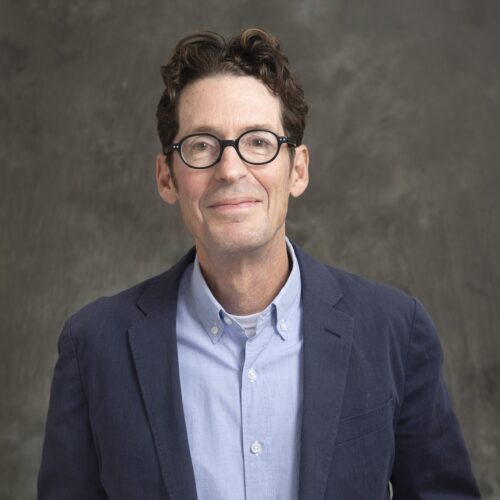
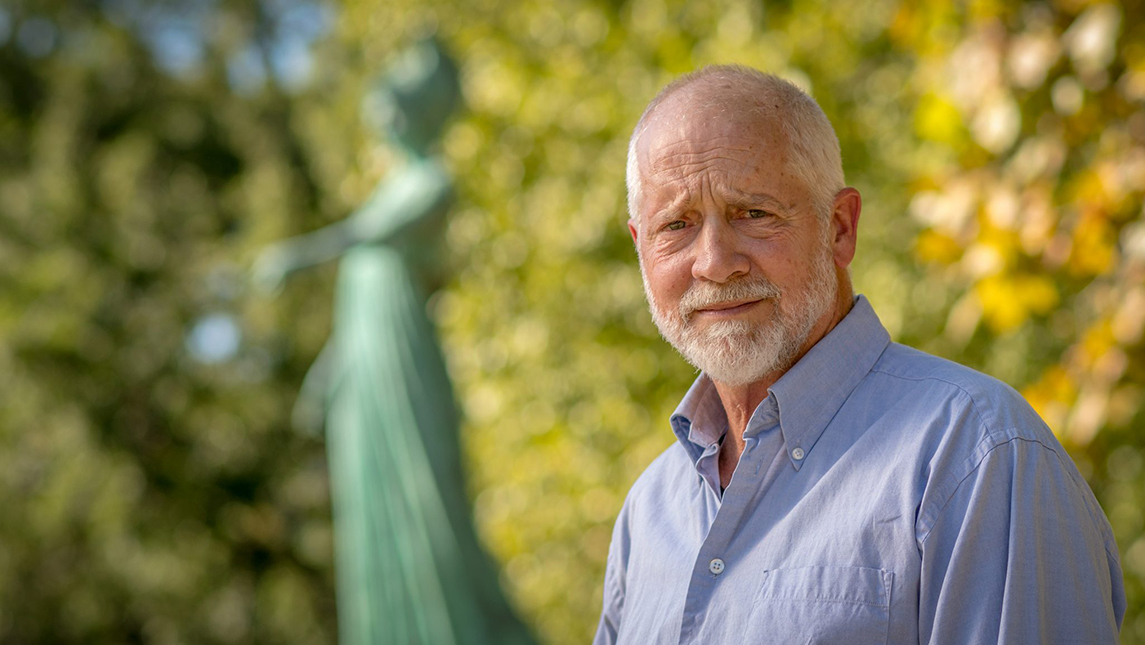
Dr. Paul Knapp, professor of geography, environment, and sustainability, receives the Senior Research Excellence Award for his innovative work in biogeography and climatology using dendroecological techniques.
Dr. Paul Knapp, professor of geography, environment, and sustainability, receives the Senior Research Excellence Award for his innovative work in biogeography and climatology using dendroecological techniques.
In the field and at his Carolina Tree-Ring Science Laboratory, Knapp uses tree-ring data to reconstruct centuries of environmental conditions and help scientists better understand complex atmospheric and forest ecological dynamics. His work explores how human activities affect environments and how climate affects human well-being.
Knapp is known by his peers for innovative work advancing the frontiers of biogeography, climatology, and dendrochronology and impacting environmental understanding and climate science, locally, nationally, and internationally. The important research has drawn over $1.3 million in funding over his career, from organizations including the NSF, USDA, Bureau of Land Management, and the NC Policy Collaboratory.
He has published over 92 peer-reviewed articles over his career — 62 in his 21 years at UNCG — and amassed nearly 3,000 citations. Over the last 15 years, he has published three to six papers a year. His research appears in top-tier disciplinary journals such as Global Change Biology, Global Environmental Change, and Annals of the American Association of Geographers, which is one of geography’s flagship journals — as well as in prestigious interdisciplinary outlets.
The diversity of journals in which Knapp’s publications appear reflects the wide, multidisciplinary impact of his research explorations.
He is known for his series of publications using isotopic analyses to demonstrate physiological changes to trees due to rising atmospheric carbon dioxide, a then-controversial concept known colloquially as greening. He is also known for work demonstrating the importance of atmospheric rivers — narrow, moisture-laden plumes in the atmosphere that transport massive amounts of water vapor — in the radial growth, or width, of pine trees.
Knapp introduced the since-confirmed concept that the impact of Arctic sea-ice on the atmosphere influences wildfires in the western U.S., and he has published evidence on how atmospheric warming is associated with changing storm dynamics in North America.
He has also used dendroclimatic data to shed light on human history, as with a Bulletin of the American Meteorological Society paper on the Lewis and Clark expedition that demonstrates how the Corps of Discovery experienced one of the most severe Pacific Northwest windstorms in 300 years on their journey.
Meanwhile, his paper on the historical factors and human-environment interactions leading to the dominance of the invasive species cheatgrass throughout the Great Basin has 800 citations alone.
Knapp has delivered well over 100 conference presentations and given invited colloquia at top-tier geography programs across the country.
His outreach efforts also extend to educating the public through campus tree walks and public tours of his lab.
Finally, Knapp is an inspiring mentor who has guided over 30 graduate students over his career. His students have coauthored 26 publications with him and have won five best doctoral and masters paper presentation awards and a best research poster award at his discipline’s most important regional conference. He is also lauded for his mentorship of faculty peers.
Knapp in the field at the Buffalo Mountain Natural Area Preserve in Virginia.
Announcement by Sangeetha Shivaji Feature photo by Sean Norona
Unleashing Harriet’s Powers Stitch by Stitch, Note by Note
Posted on April 21, 2026
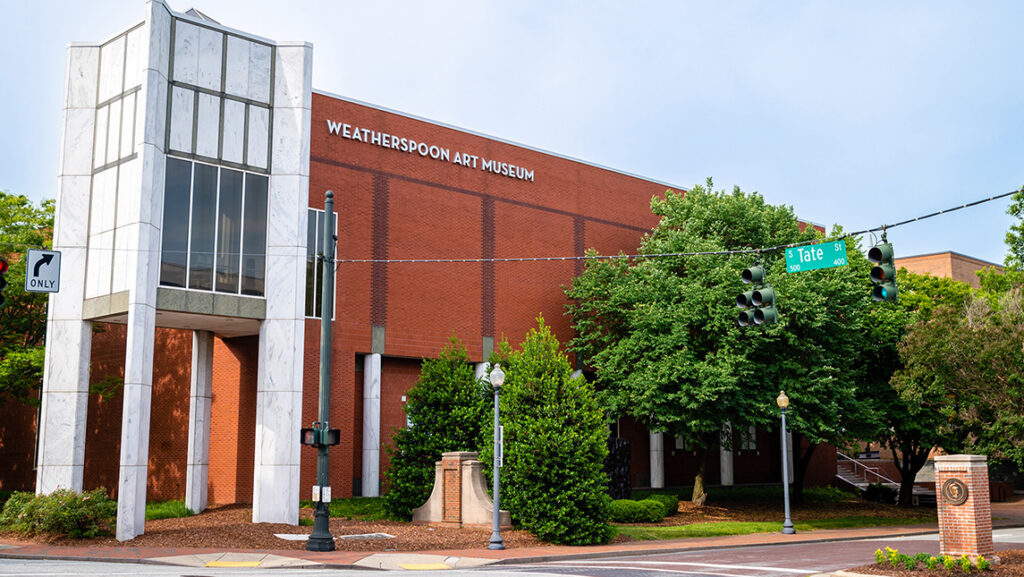
The story of one of the most impactful women in quiltmaking comes alive within the Weatherspoon Art Museum. Harriet Powers, born enslaved in Georgia in 1837, eventually became a landowning farmer and gained recognition at local fairs for her appliquéd quilts depicting biblical stories, scenes of rural life, and cosmic events.
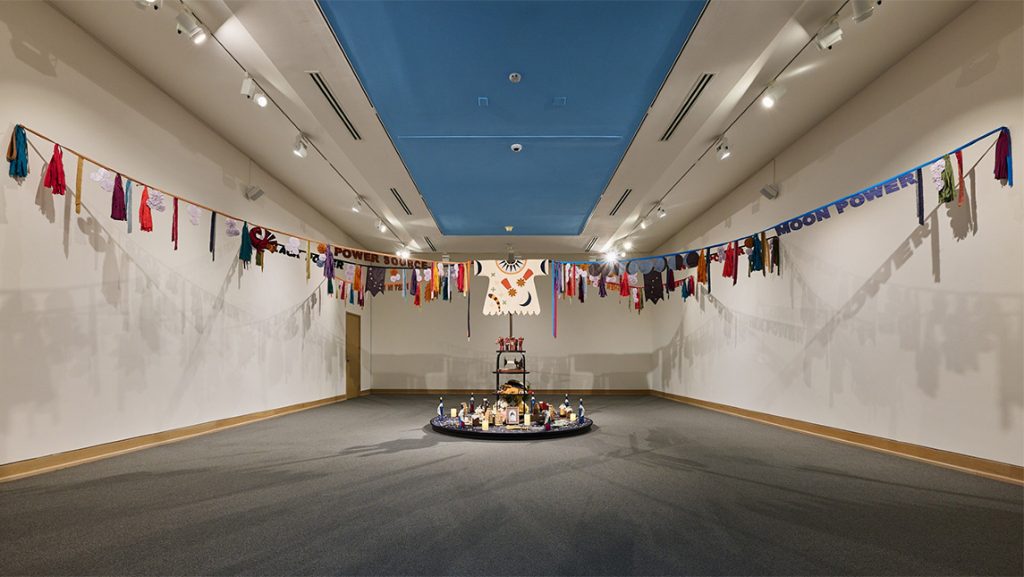
View of the installation Harriet’s Powers from the gallery entrance. Image courtesy of the Artist. Photographer Sally Van Gorder.
Like quilters who add blocks to a bee’s latest project, UNC Greensboro students were honored to contribute a touch of their artistry to Lovell’s installation, which opened alongside Of Salt and Spirit: Black Quilters in the American South, an exhibition on loan to the Weatherspoon from the Mississippi Museum of Art.
Harriet’s Powers and Of Salt and Spirit will be open to Weatherspoon visits into the summer. On April 23, Lovell will be in conversation with Of Salt and Spirit curator, Dr. Sharbreon Plummer. Starting at 5:30 p.m., they will delve into the legacies of Black Southern quilting as part of the Weatherspoon’s spring open house; a community reception will follow.
Students’ hand-sewn work becomes a piece of a bigger story
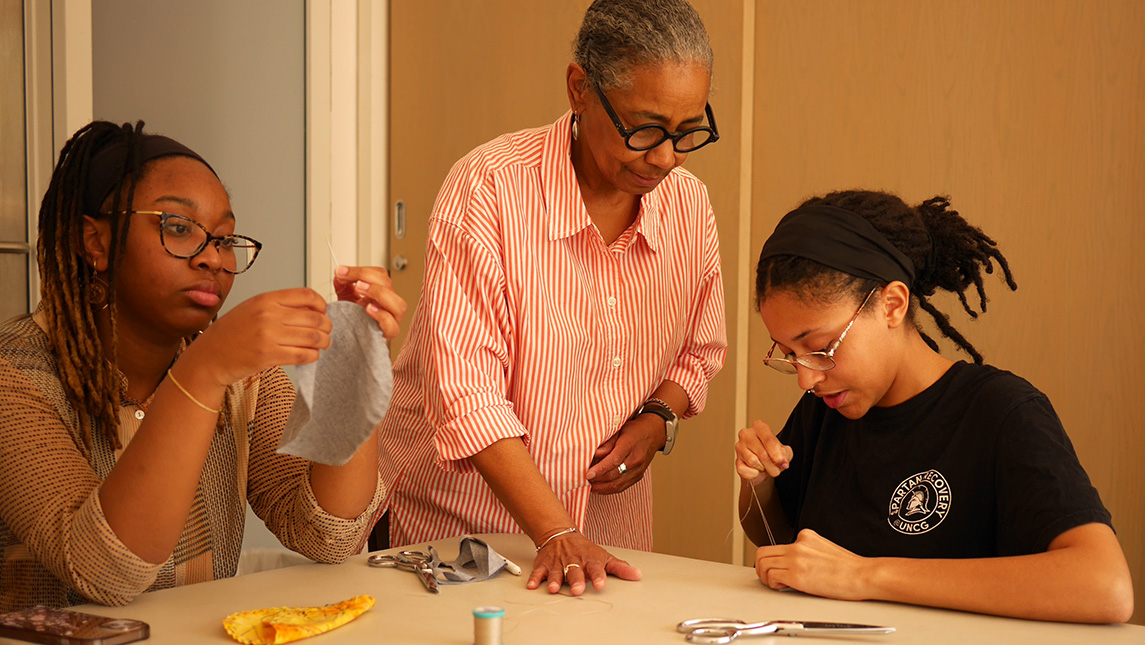
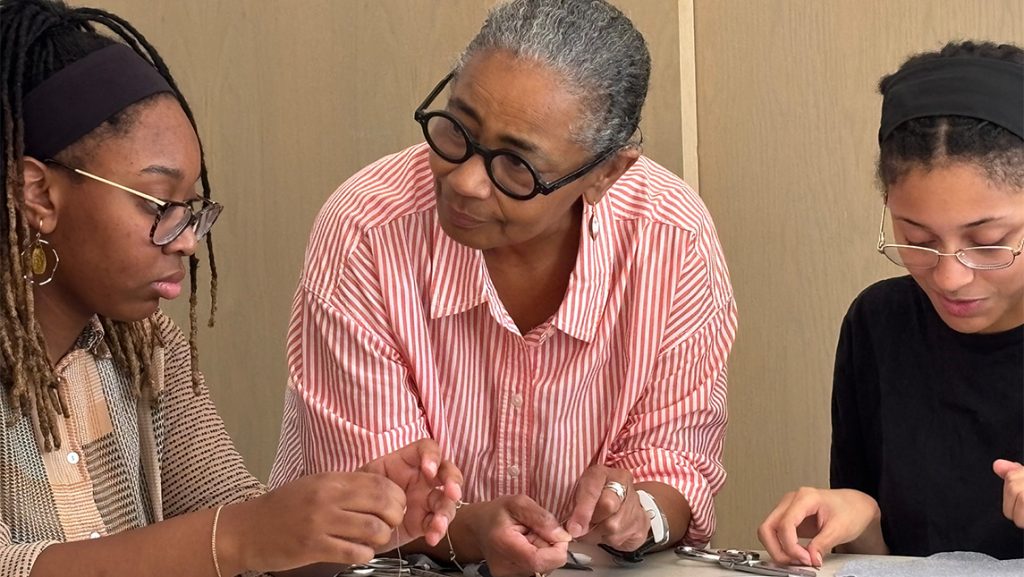
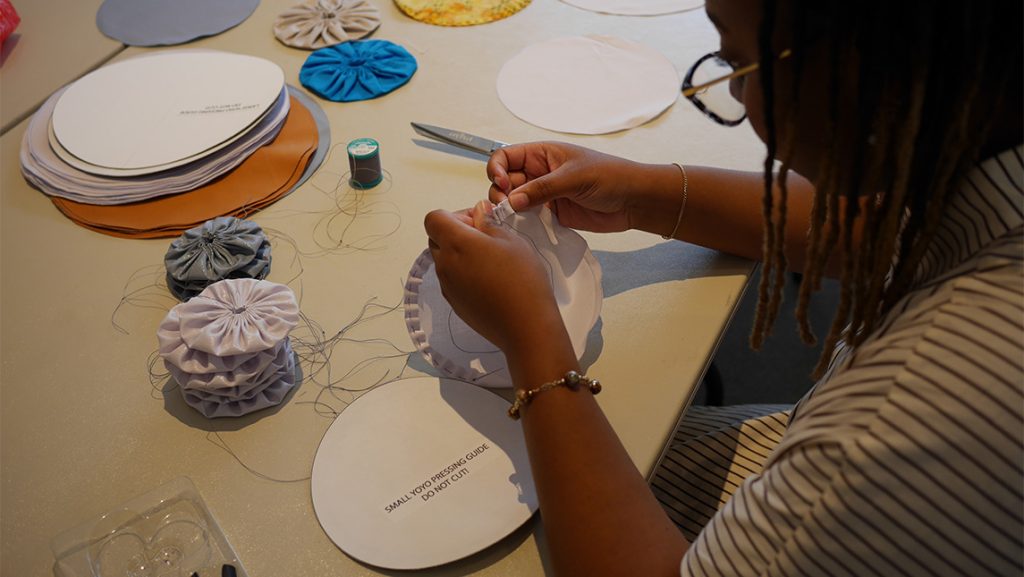
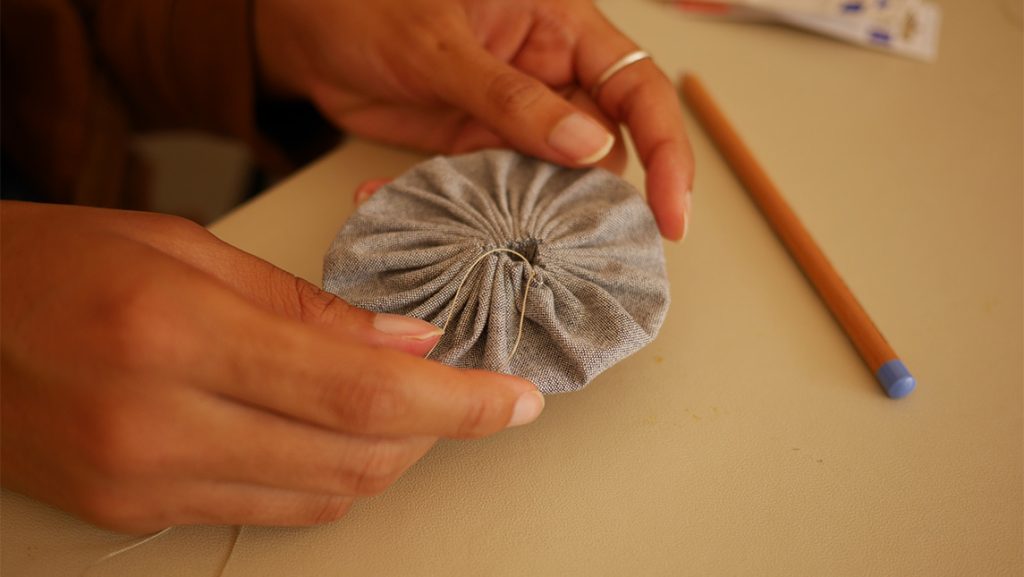
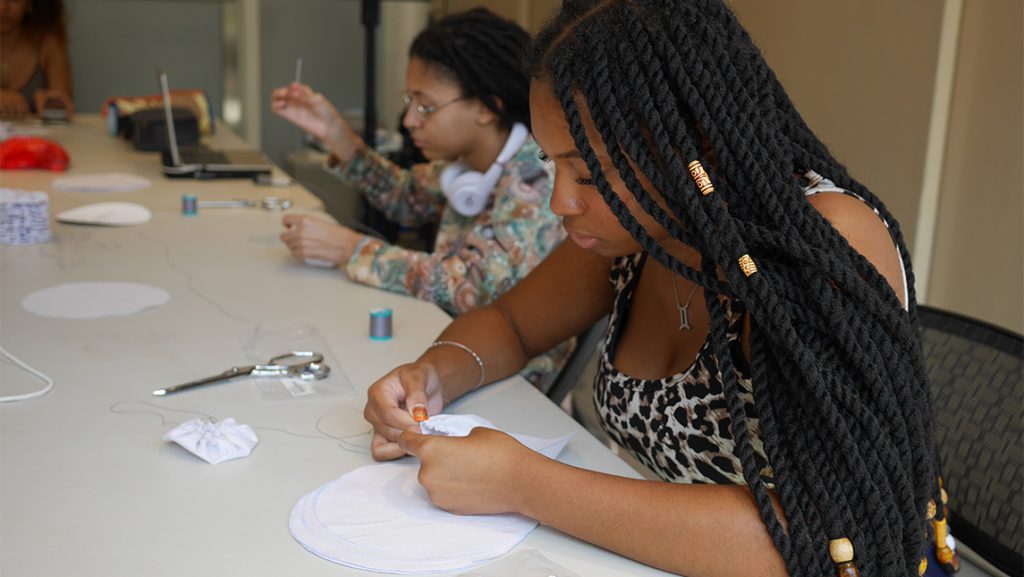
Gabrielle Wilson, an apparel design major, is one of the students from the Department of Consumer, Apparel, and Retail Studies (CARS) who worked with Lovell to create some of the visual elements in Harriet’s Powers. She and four of her fellow students helped sew the circular bunting elements, called “yo-yos,” that extend joyfully from the installation’s sculptural center up into the gallery’s ceiling.
As a whole, the artwork incorporates color, symbols, and artifacts to situate Powers’s history within a larger narrative of Black female lives in the South.
Precious D. Lovell (top left photo, center) works with CARS students.
It was a tangible learning experience for Wilson to see how art and needlework have been a part of American history.
“What stood out to me most about Harriet Powers was her dedication to quiltmaking and the intricate beauty of her designs,” says Wilson. “Many enslaved individuals had talents and gifts that they were not able to fully embrace or take pride in, which I find very saddening. However, it was also meaningful to see how Lovell paid tribute to her and her extraordinary skill in hand-sewing.”
CARS Associate Professor Melanie Carrico appreciates the opportunity Lovell’s project brought her students. “I was excited for them to collaborate with a practicing artist who values sewing and has a fashion industry background,” she says.
Music students lift their voices
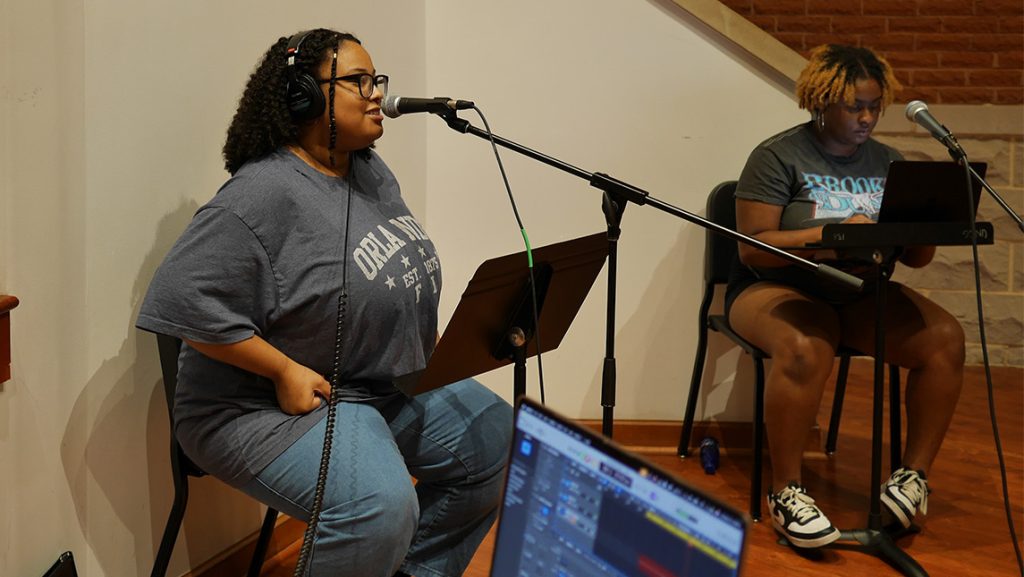
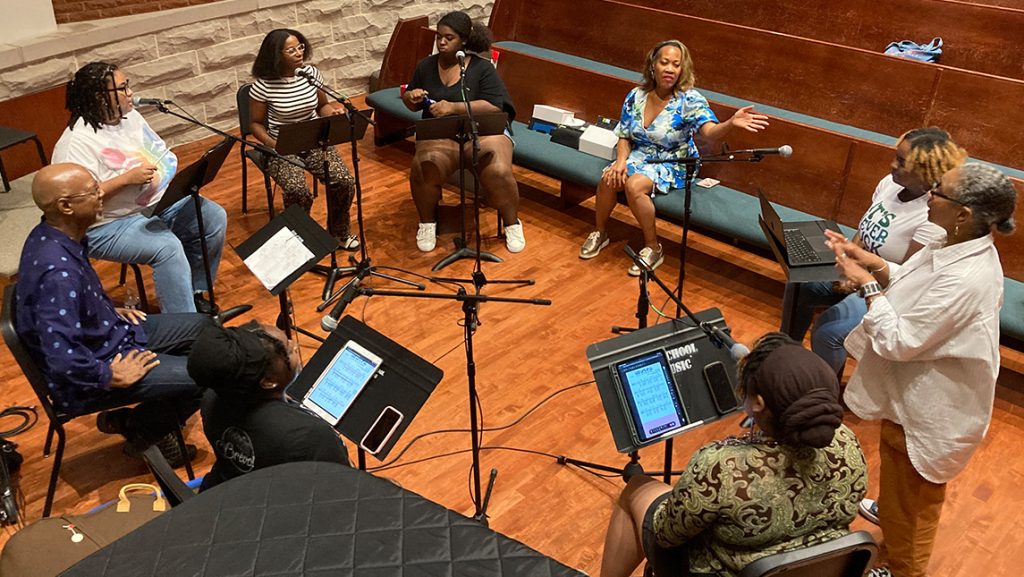
While CARS students helped form the visual components, students in the popular music and technology program (PopTech) added to its aural dimension. With their Assistant Professor of Commercial Voice Janinah Burnett and Grammy-nominated musician Bill Toles, they performed the songs woven into the soundscape.
Burnett says the soundscape elevates the message of the whole piece.
“Visitors not only see the profoundness of the many dimensions of the visual experience, but they hear unison singing, harmonies, rhythm, tone, text, silence, and depth,” says Burnett. “It is captivating. This audial connection makes the experience visceral for visitors, and therefore unforgettable.”
It also serves as a reminder, says Burnett, that the PopTech program is about more than contemporary trends; it reaches back into the past, including music’s technical grounding, creation, performance, and distribution.
“The meaning in every single object and action of Lovell’s artwork is deliberate and contains so much powerful depth of messaging that is more than meets the eye,” says Burnett. “It is only natural that PopTech participate in such profound work, as it too embodies, expresses, and is grounded in more than meets the eye.”
Carrico echoes the theme of linking students to history. “Contributing to an artist’s large-scale installation,” she says, “helped CARS students see how their skills connect not only to fashion, but to cultural storytelling, interdisciplinary art, and creative work beyond traditional design pathways.”
Of Salt and Spirit and Harriet’s Powers are on display at Weatherspoon through Aug. 1, 2026 and July 25, 2026.
Story by Janet Imrick, University Communications Photography courtesy of Weatherspoon Art Museum
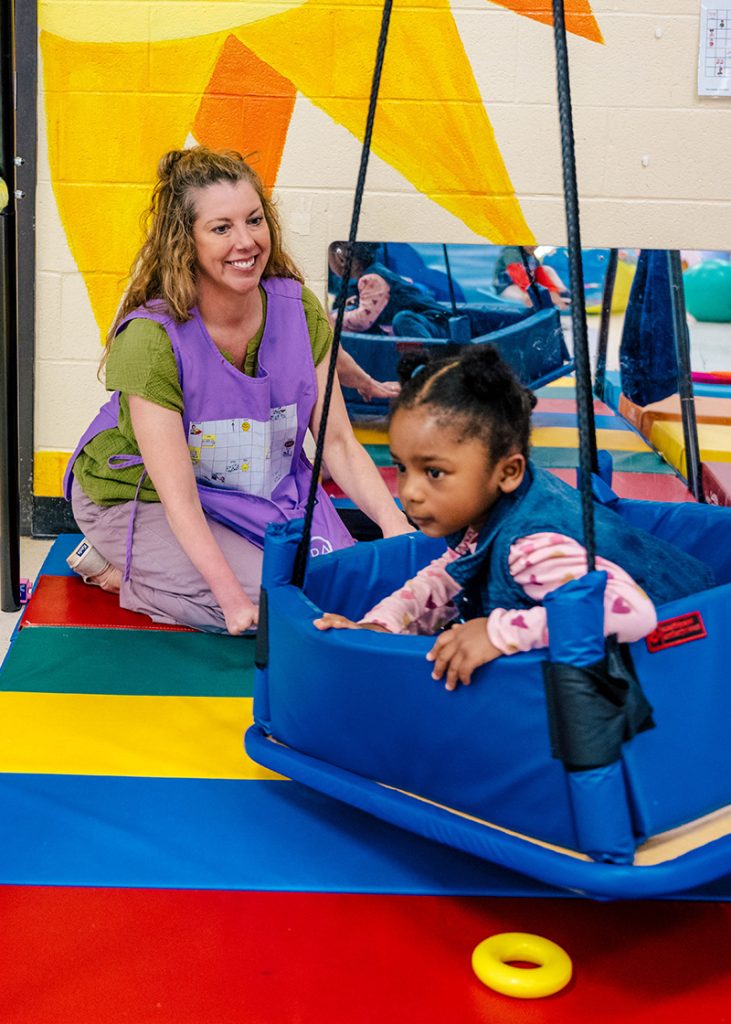
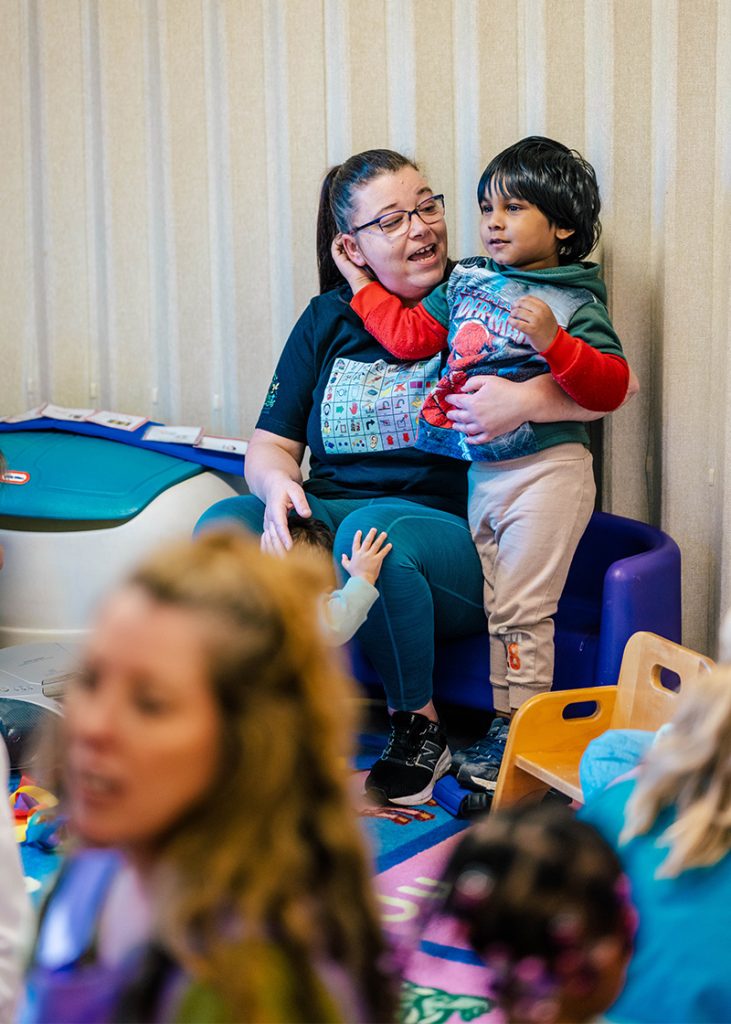
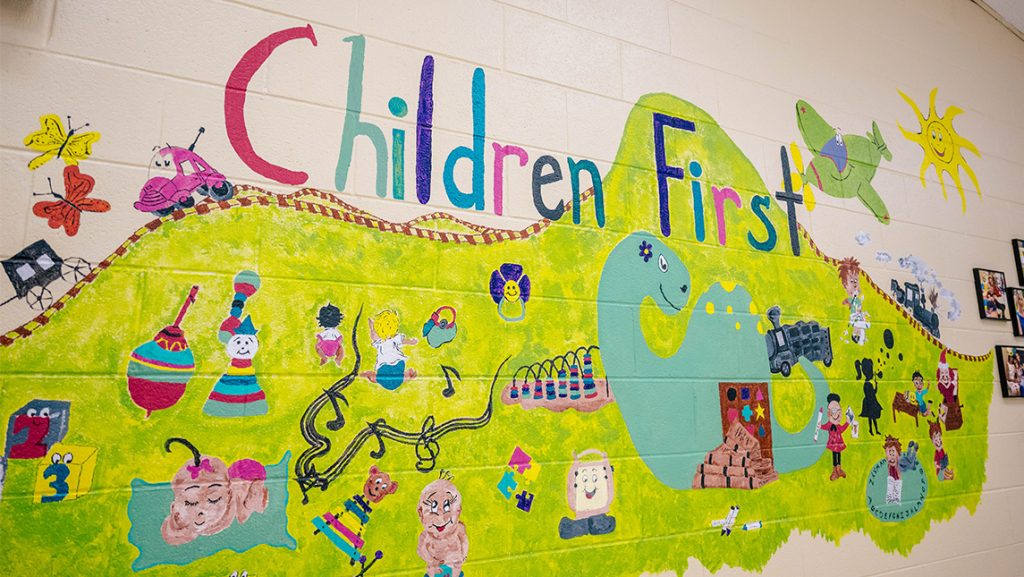
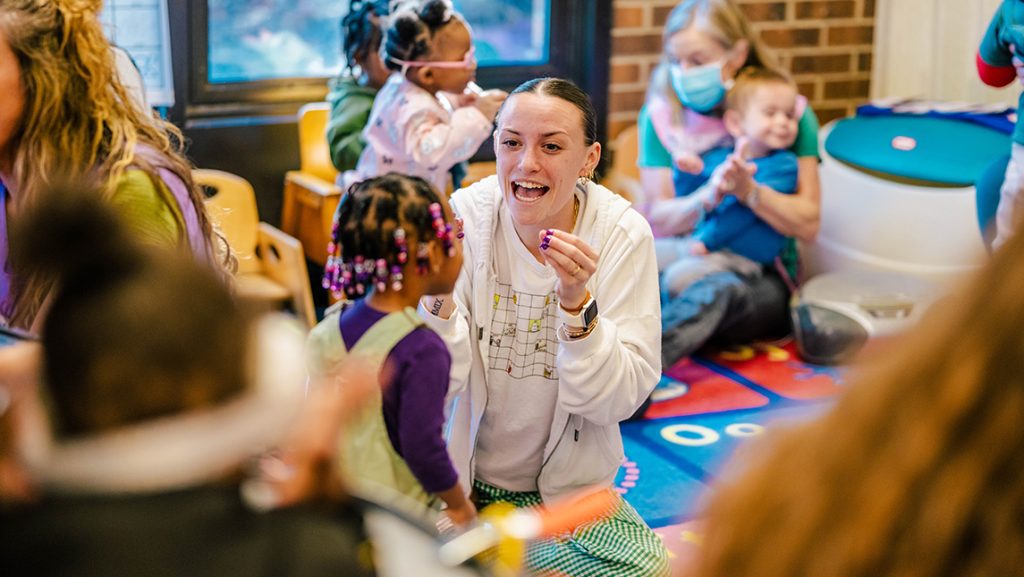
The names for the different children’s classes feel appropriate. Some of the kids are just barely old enough to walk. All have developmental delays or special health care needs. But in the comforting circle formed by their classroom leads, aides, and therapists, they happily sing along to “Wheels on the Bus” and other familiar nursery tunes as they participate in their speech, physical, or occupational therapy.
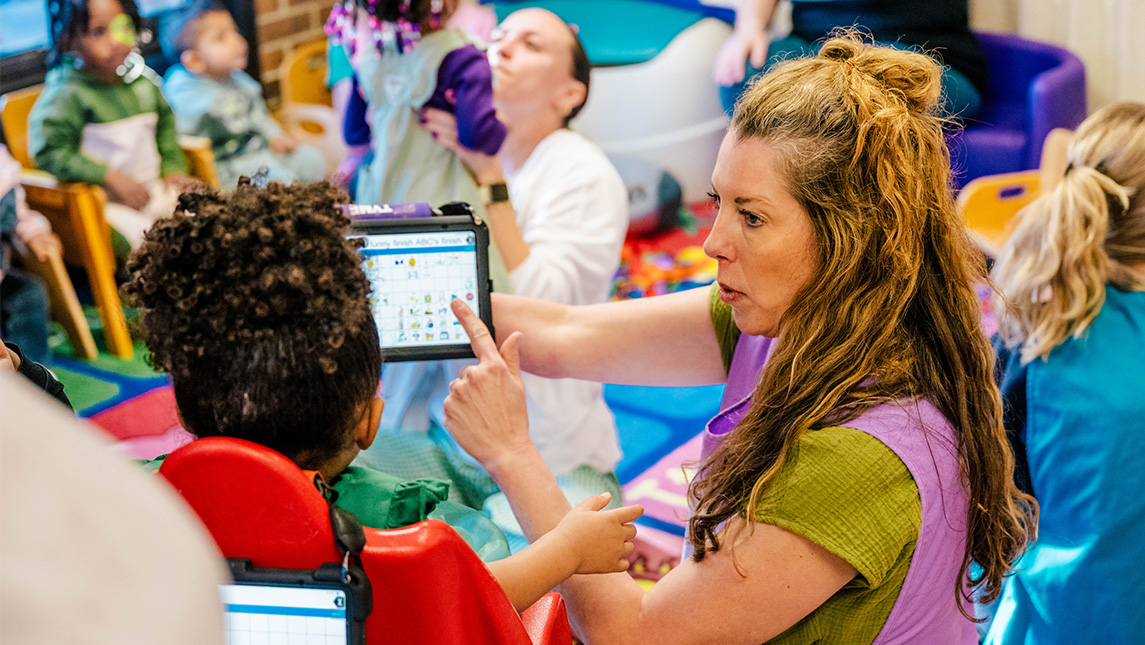
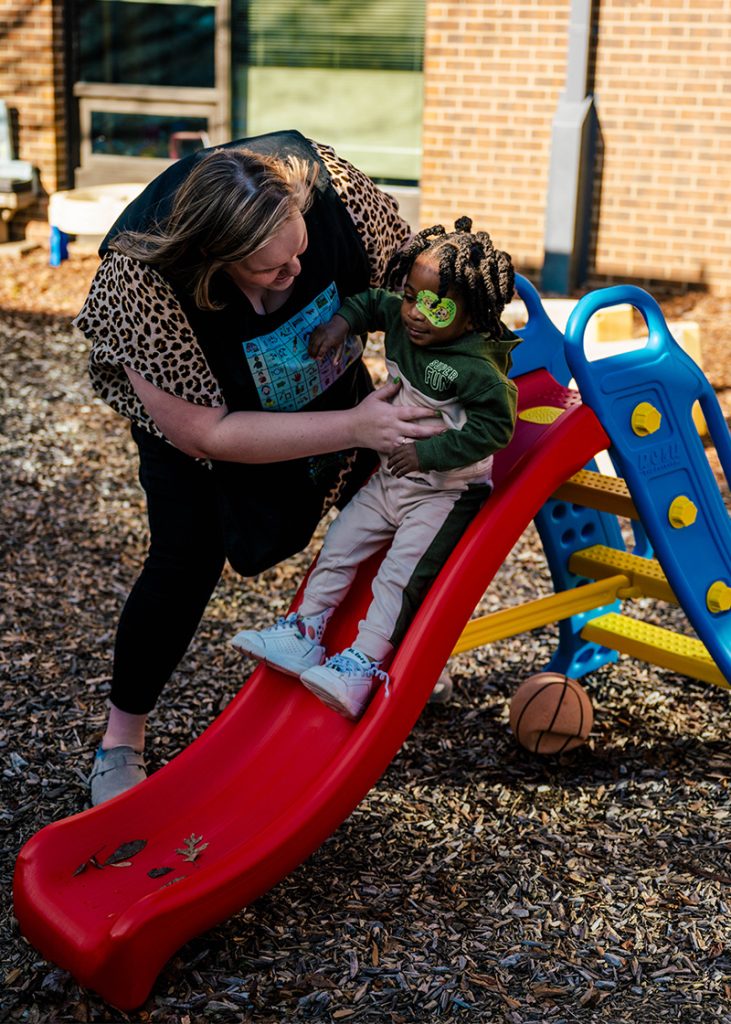
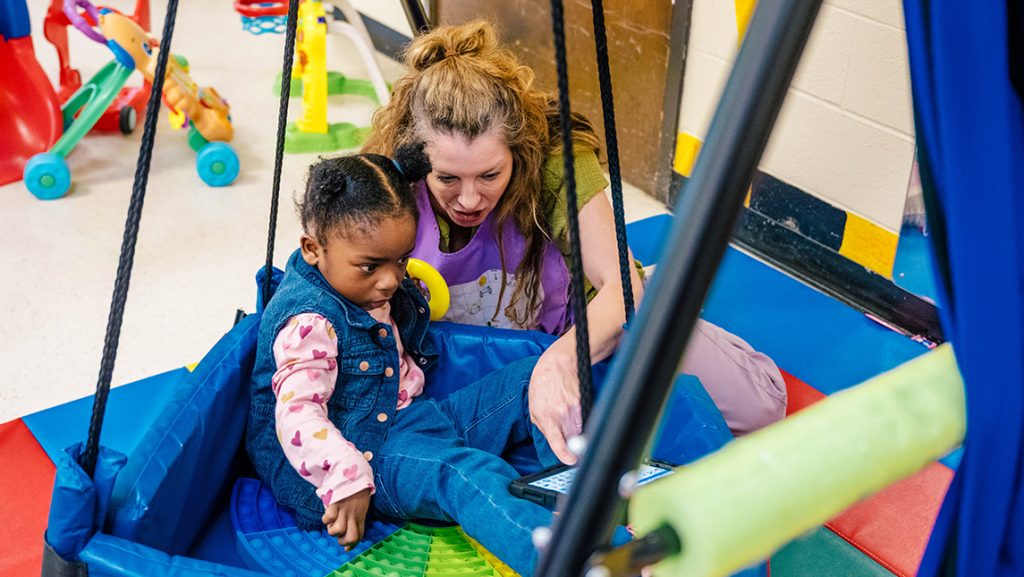
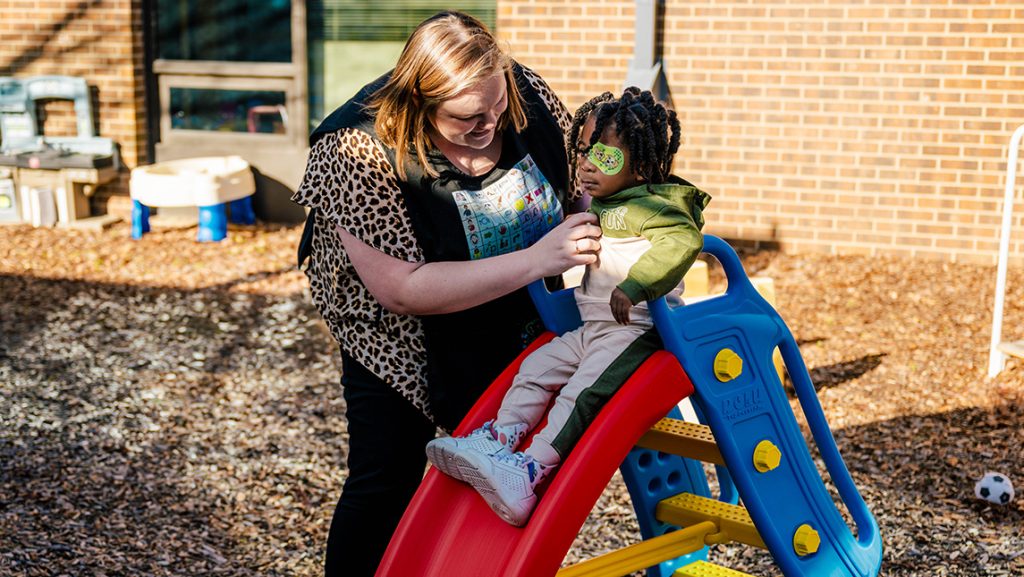
The staff wears colorful smocks decorated with a communication picture board. Children with speech delays or differences can point to the symbol of what they need, a system known as augmented and alternative communication (AAC). Similar boards cover their playground and the digital communication tablets they use in therapy sessions.
It feels like a place where a child can find their wings and soar.
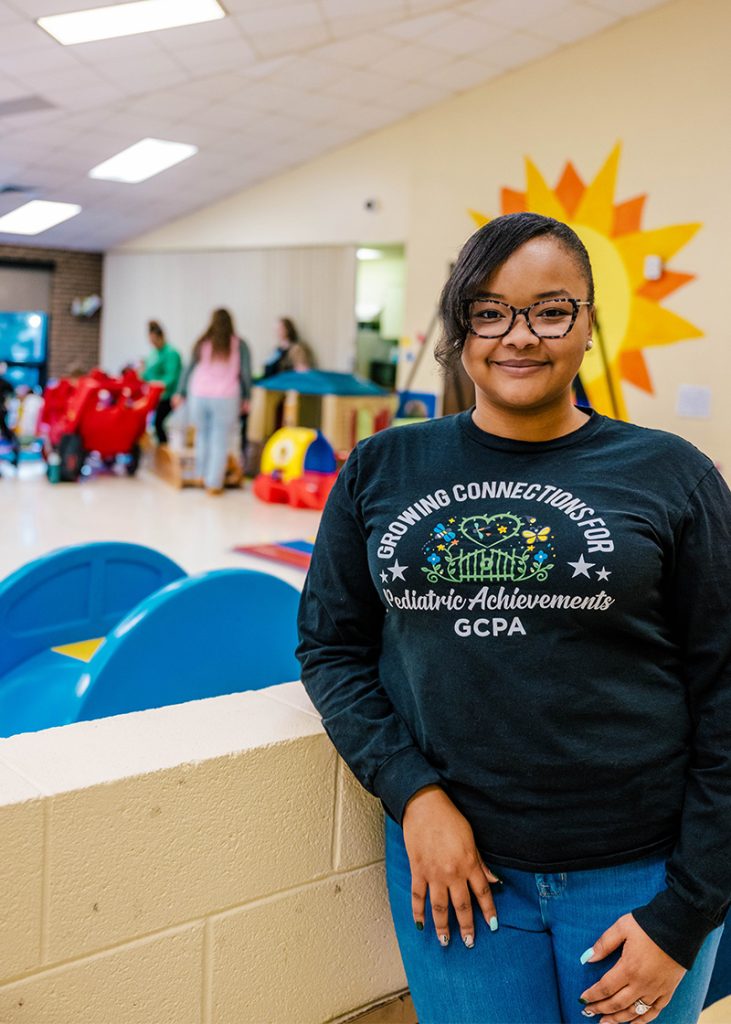
One of the things that makes GCPA stand out, according to Executive Director Ma’Kayla Jefcoat, is that its programs are for children from birth to 3 years old. “A lot of other programs start at age 2,” she says. “But 80% of brain growth happens in birth-to-three. Two is a late start to be going into early intervention.”
Another perk is its location. If not for this center housed at Guilford County Schools’ Gateway Education Center, many Triad parents might have to go an hour or two out of their way, driving their children to Winston-Salem or Chapel Hill.
And GCPA has gone through a lot of growth upon reaching its 75th anniversary. It not only serves as a launchpad for children; it’s been a platform for UNC Greensboro students with a passion for care.
She was drawn to GCPA because she knew she would see an immediate benefit from her contributions. “I wanted a project that I knew would be making an impact, instead of just doing one for a grade,” she says.
She got a sense of the importance of GCPA — then known as the Greensboro Cerebral Palsy Association — from her very first meeting with its vice president, Mike Krick, in 2020. “He got emotional talking about the program and how important the work was,” she relates. “That really spoke to me and made me excited to help them.”
One of her first tasks was taking over social media responsibilities. The young intern brought an internet savviness the older staff greatly appreciated.
Little did she know it would become much more than that.
Throughout her internship, she observed the operations, fundraising, and partnership strategies of a nonprofit, and she wrote down her own ideas for improving those functions. She shared her ideas with Krick.
To her surprise, he said, “That is something we want our executive director to do.” Within a matter of months, she was recommended by the vice president to take on that very position.
“Here we are, four-plus years later,” she says. “It was a shock, but I was excited. I like to start from a blank slate, to build and see what the possibilities are. It was kind of comforting that there wasn’t a ‘box.’ I could make that box.”
A growth plan serves growing minds
Jefcoat initiated a review of growth opportunities for the program. Changing the name was one of the first priorities.
“Greensboro Cerebral Palsy Association no longer fully reflected all of what we did after 75 years,” she says. “We serve children with all developmental delays and disorders: autism, Down syndrome. We’ve had rarer conditions. As long as a child needs developmental services, then we are a resource to them.”
Renaming GCPA also helped them promote connections to families in the rest of Guilford County, not just Greensboro.
One of their biggest growth achievements was taking advantage of new technology. Jefcoat and the team were able to secure AAC devices with multiple language capacities for children with speech delays.
“And we make sure they leave the program with a device,” she says, “because once they age out, if they try to get one through the school system, with all the medical and insurance documentation necessary, it can take over a year to get one. With our dedicated team, we can get it done in a month or two.”
And Jefcoat wanted to make sure support doesn’t end once the child ages out. “We expanded to provide outings and trainings to our alumni families,” she says. “Once they turn 3, we still provide those touchpoints every month. They can still come to us and ask questions. We have 5- and 6-year-olds who still come out to our events.”
Putting together the therapy dream team
The access to technology and education is inarguably life-changing, but it comes second to the personal interactions the children get each day with dedicated therapists, classroom leaders, and assistants.
Therapy Director and Speech Language Pathologist (SLP) Sarah Cunningham ’11 MA got to know GCPA during her UNCG graduate school fieldwork across the hall in the Gateway Education Center. She’s loved working with children since her childhood babysitting and nannying jobs. Eventually, she wanted to focus on kids with special needs. That led her to UNCG to get her master’s in speech-language pathology.
“I myself was born with a limb difference,” says Cunningham. “I have no fingers on my right hand, so I always had a propensity toward working with others in ways that might make a difference or help them improve their lives, to be accepted.”
CunninghamReynolds
Once the organization hired her as their full-time therapy director, she went to work getting GCPA credentialed and enrolled in additional Medicaid and other insurance programs. “That really opened up doors for me to invest in growing the therapy program,” she says. “Working with Ma’Kayla, I’ve had to stretch myself as a leader, be a more innovative thinker, be a role model, and be an advocate.”
Cunningham made several visits to UNCG to give alumni talks to SLP students. One of those was Roslyn Reynolds ’24 MA. “I thought it sounded a lot like what I wanted to do one day: open a childcare center for kids with special needs and have in-house therapists,” says Reynolds.
She came onboard as an SLP graduate student intern, while Cunningham was still doing speech and feeding therapy and had to spend a considerable amount of her hours trialing and obtaining AAC devices based on each child’s needs. Reynolds freed up Cunningham to focus on her other work obligations. Jefcoat and the board made her their center director, assisting with childcare licensing and compliance goals, and a specialty therapist focusing on AAC.
Reynolds says the work expectations of a non-profit versus a business — learning to advocate for her ideas to the GCPA board, seeking new funding sources, etc. — assures her that the children’s best interests always remain front and center. “It allows us to do a deep dive and think about how to best serve these kids,” says Reynolds. “We’re not just thinking about the 30 minutes they’re in our office. We’re thinking about how we can make things more accessible for their families, how we can meet their goals.”
In the business of making a difference
As part of Jefcoat’s job, she constantly looks for new funding and creative ways to stretch GCPA’s resources. Naturally, it made sense to lean upon a resource in her backyard: UNCG’s Bryan School of Business and Economics.
She already had a direct link through one of her board members, Dr. Sara MacSween, senior lecturer of marketing, entrepreneurship, hospitality, and tourism. Students in her capstone course Advanced Marketing Management must create a marketing plan for a real organization, so in 2024, she had them work on GCPA’s rebrand. The students compared GCPA’s services to similar health care programs. They proposed short-term and mid-term goals, including ways to attract more donors with increased marketing and a greater online presence.
They recommended revamping the name and mission statement and proposed a new logo. “We went back and forth with the graphic designer, making changes so that it was just perfect,” says MacSween. “It’s a very strategic logo with different insects like ladybugs. We intentionally put in all the animals that make up the classrooms.”
Additionally, MacSween recommended Alice Jones ’24, a student from the capstone course, join GCPA as an intern to help with implementation. Her contributions were vital to Jefcoat. “I’m the only person on the organizational side,” she says. “All the administrative things — fundraising, development — that’s on me. You can imagine there’s a lot of things on my plate. And so, [Alice] was instrumental in rebranding.”
MacSween says nonprofits are great spaces for marketing students to experiment. “When working with a small company, a nonprofit or startup, the marketing needs vary greatly by client by client,” she says, “So students have to get very creative and come up with cost-effective ways to promote these smaller organizations.”
Cunningham and Reynolds share Jefcoat’s gratitude in seeing how their work directly impacts their community. “Working in a nonprofit really takes money out of the equation, as far as you’re doing it for the betterment of the people,” says Cunningham. “We have more flexibility, more creativity, more thinking outside the box.”
“We really get to know the families,” says Reynolds, “And so we can celebrate their growth together.”
“UNCG produces some great people,” says Jefcoat. “We have an amazing team that is really dedicated to service and going above and beyond.”
Story by Janet Imrick, University Communications Photography by Sean Norona, University Communications
Commitment to Spartan Service Exemplified By 2026 Gladys Strawn Bullard Winners
Posted on April 16, 2026
Please join the UNCG community in congratulating this year’s winners of the 2026 Gladys Strawn Bullard Award.
The Bullard Award is given in recognition of those faculty, staff and students members who have shown commendable initiative and perseverance in their leadership or service roles at UNCG. In addition, award winners have demonstrated their ability to conceive and develop creative ideas and programs that advance the University.
Faculty awardee: Dr. Jennifer Feather, professor and department head of English; cross-appointed faculty, women’s gender and sexuality studies program.
Follow along Johnson’s day in the life as a student in the “Follow Me” video series, including his role in the Public Health Impact Network, and hear how he feels his leadership skills have developed during his time at UNCG.
April 7, 2026 was a beautiful day at UNC Greensboro, but the mood felt lighter than most spring semester days on campus.
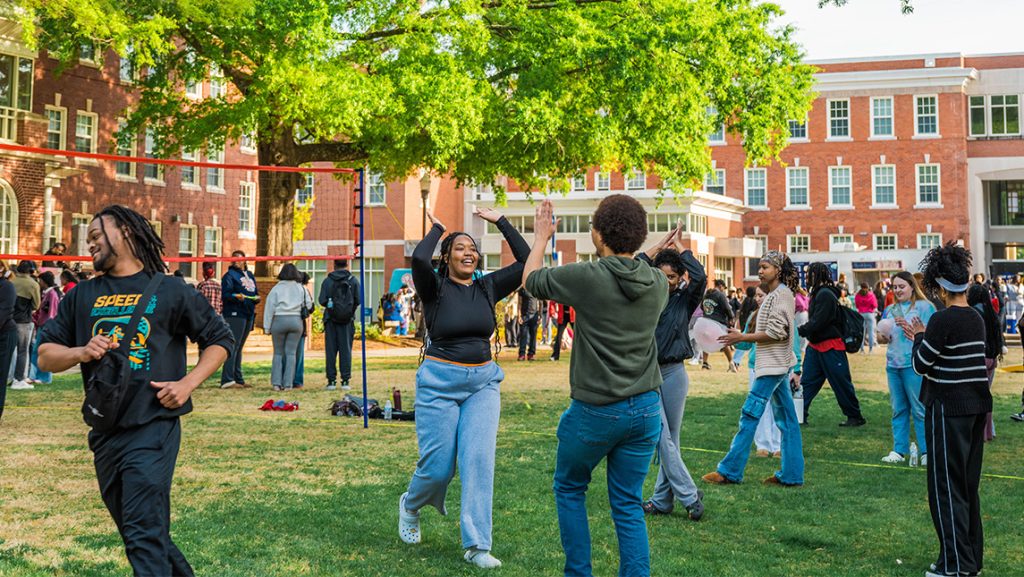
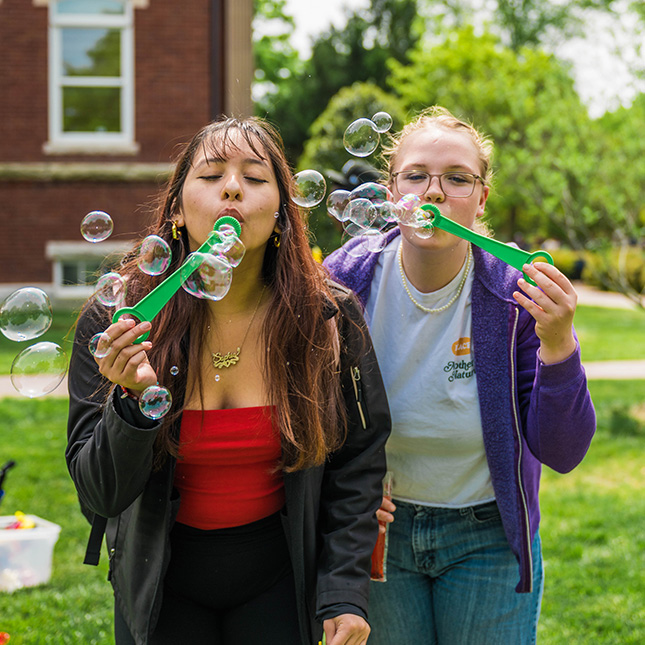
Bubbles floated by the Astera sculpture from a grassy area where students ate popsicles and played lawn games.
In Elliott University Center, students planted seeds along with paper slips with handwritten career goals in take-home terracotta pots.
At the Kaplan Center, the courts buzzed with pick-up volleyball and basketball games.
Music and laughter could be heard from across Spring Garden Street, as students crowded into a common room at Jefferson Suites for karaoke and ice cream.
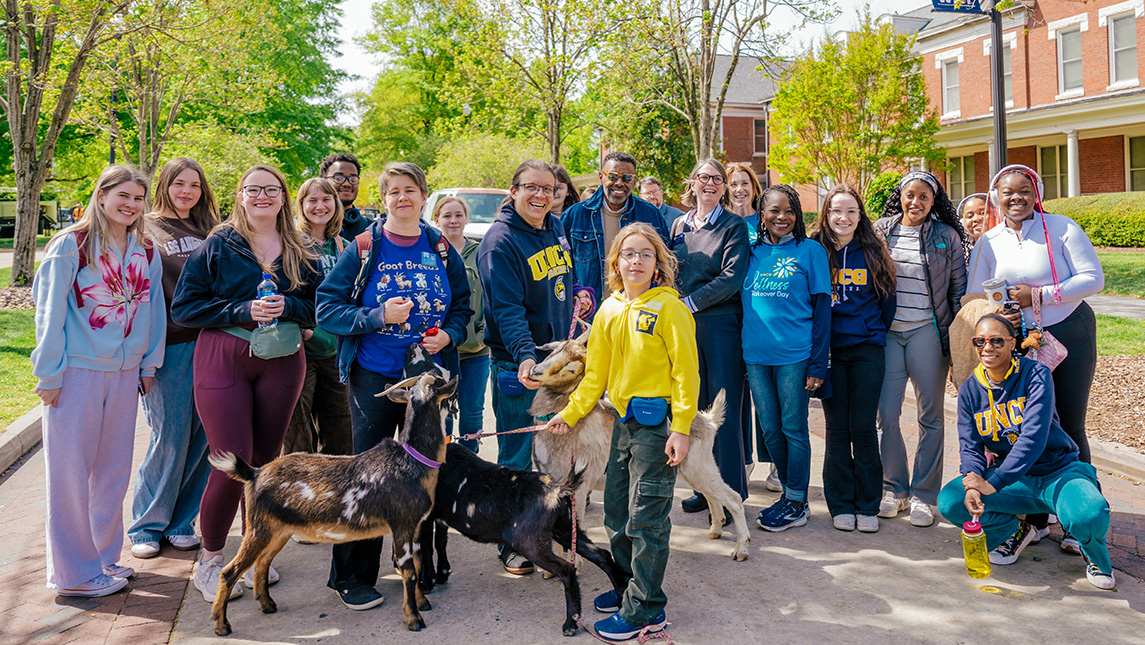
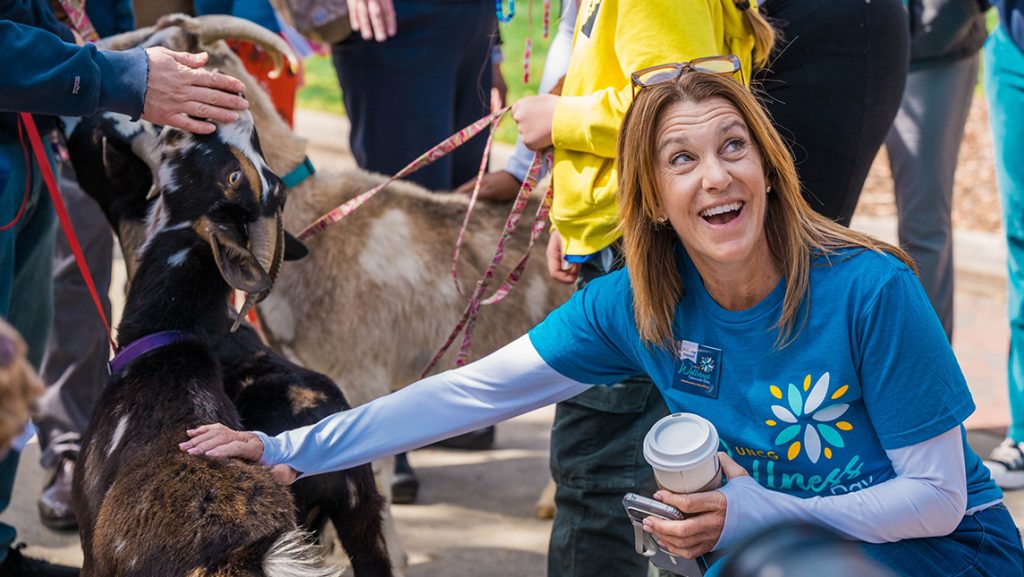
And a small group of walkers developed into a parade down College Avenue, following three leashed goats who flicked their ears as students gathered to pet their fuzzy heads and coo at them.
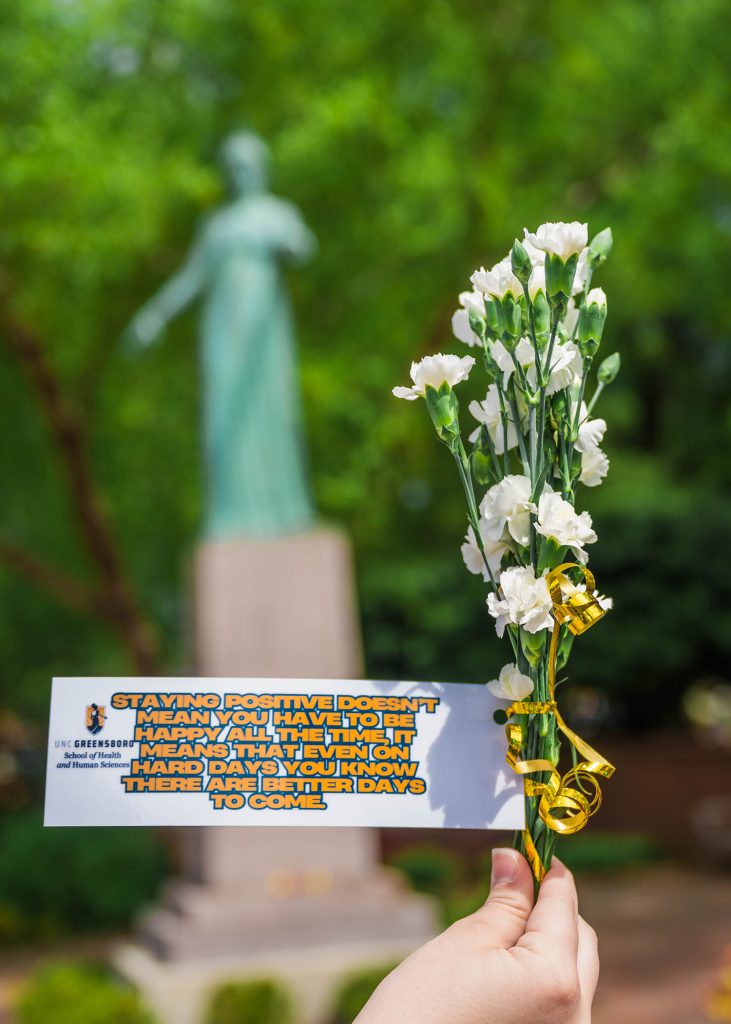
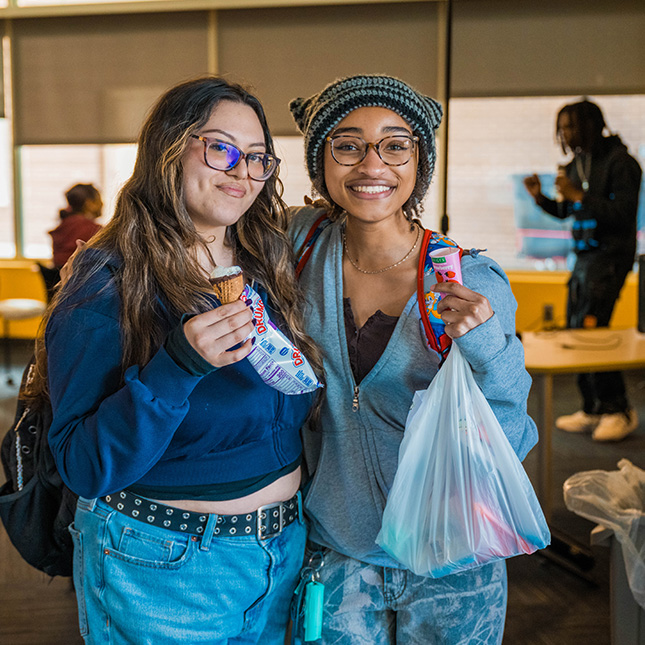
On the first ever Wellness Takeover Day at UNCG, positive vibes could be found at every turn.
Students who participated in the activities on Wellness Takeover Day appreciated the University’s focus on mental health, especially during early April when students are gearing up for the final push before exams.
“Mental health is more important than a grade,” said second-year art major YaMiah Meadows. “A lot of people are stressing, and it does take a toll on how you perform in class.”
Activities represented all dimensions of wellness: physical, emotional, social, intellectual, cultural, career, financial, and environmental. Over 100 events were organized by departments across campus including seminars, social media engagement, field day games, artistic expressions, special offerings in the dining hall, tabling activities, and giveaways.
Scenes from Wellness Takeover Day.Kim Sousa Peoples enjoys the G.O.A.T Walk.
Isabella Ellis, a master’s student studying counseling in education, sat on a blanket making friendship bracelets with students on the library lawn. As a volunteer with the Vacc Counseling and Consulting Clinic, she was particularly impressed with how the Wellness Takeover Day was received: “It’s really cool to see the University put together something like this that’s so accessible to students.”
Most organizations and departments were pleased with how students engaged with the Wellness Takeover activities they planned, but the most memorable event was the “G.O.A.T Walk” hosted by the College of Arts & Sciences Dean’s Office. Students met at the Foust Building for a walk with three goats, combining “gentle exercise with animal-assisted wellness.”
“Goats walking down College Ave wasn’t on our bingo card when we first discussed plans for this day,” joked Kim Sousa Peoples, senior director of First Year Student Engagement and Experience, “But the positive student reaction to this and other events across campus was exactly what our committee was hoping to achieve with the Wellness Takeover Day.”
Story by Becky Deakins, University Communications. Photos by Sean Norona, University Communications.
First TEACH Class Graduates, Improving the Piedmont Educator Pipeline
Posted on April 21, 2026
Asheboro City Schools will hold a ceremony for its first graduates of the new TEACH program on April 21. For the last two years, UNCG’s Institute for Partnerships in Education have worked with aspiring educators, helping them complete college credits and network with community partners so they can get to work in local classrooms.
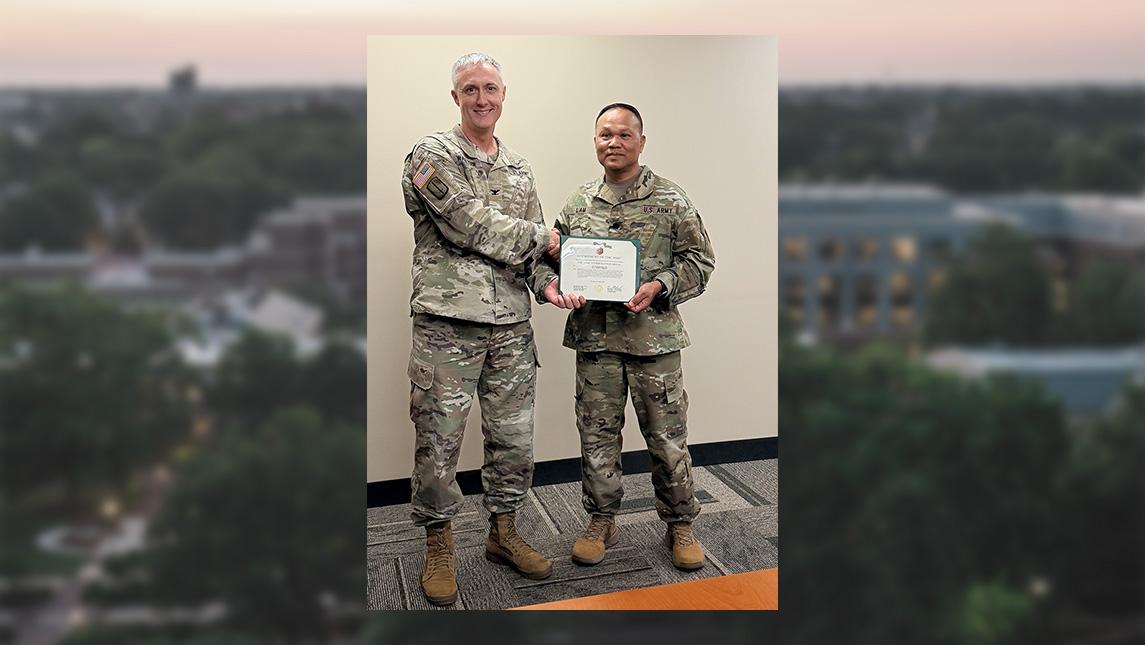
Lt. Col. SaQuang Lam, assistant director of Student Health Services, was awarded the Army Commendation Medal in recognition of his exceptional service and leadership with the 60th Troop Command.
Presented by the Department of the Army, the award honors Lam’s contributions as Chief Information Officer from March 2020 through July 2023. During this period, he played a pivotal role in strengthening knowledge management systems and enhancing operational readiness across the command.
According to the official citation, Lam demonstrated “critical thinking and anticipatory planning,” enabling senior leaders to navigate complex challenges and make informed, timely decisions. His efforts directly improved efficiency, ensured data accuracy, and supported mission success at scale.
Colleagues describe Lam as a steady, disciplined leader with a unique ability to translate complex information into actionable strategy. His approach to leadership reflects a quiet commitment to serving others first, ensuring that teams, leaders, and missions are set up for success.
The medal was formally presented on April 16 at Headquarters 60th Troop Command in Raleigh, North Carolina, by Colonel David Walliser. Fellow service members, colleagues, and supporters gathered to recognize Lam’s accomplishments and service.
For UNCG, Lam’s recognition underscores a broader narrative. Members of the University community continue to serve and contribute beyond campus, impacting the local community, the state, and the nation. His leadership reflects enduring values of honor, service, integrity, and commitment, principles that resonate across both military and academic environments.
The Army Commendation Medal is awarded to service members who distinguish themselves through sustained acts of heroism or meritorious service. For Lieutenant Colonel Lam, it marks a period of leadership defined by foresight, discipline, and an unwavering dedication to those he serves.
UNCG faculty, staff, and alumni honored for leadership and impact across the Triad
Posted on April 14, 2026
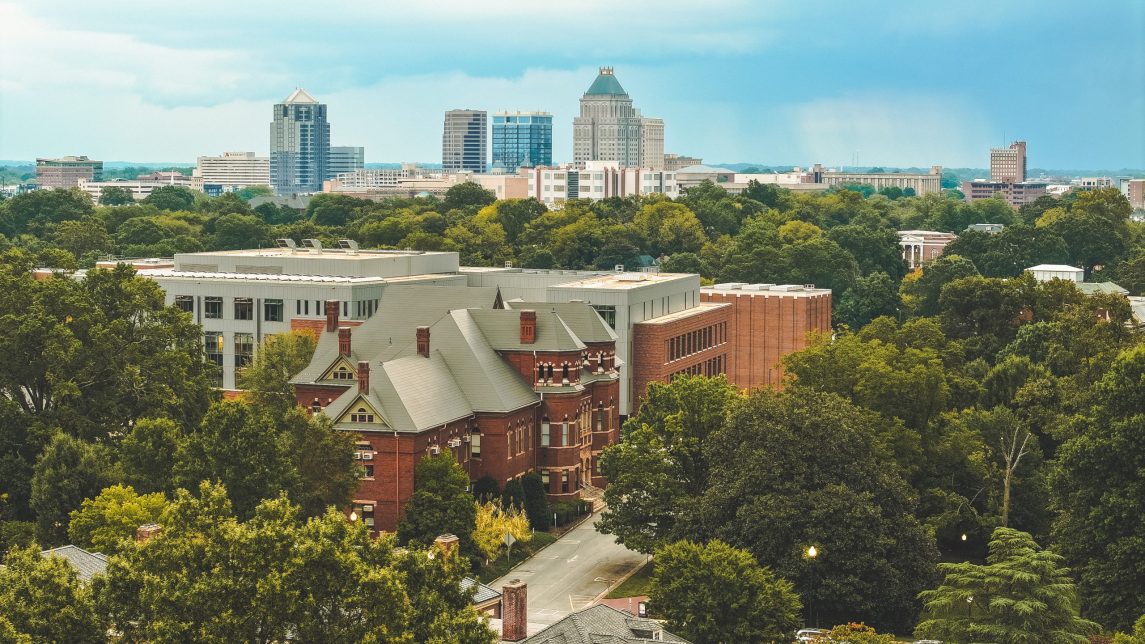
Arial photos of UNCG campus during the early morning at Week At The G.
23 Spartans honored in Triad Business Journal’s 40 Under 40, Outstanding Women in Business lists
Twenty-three UNC Greensboro staffers, alumni, and faculty have been recognized by the Triad Business Journal in its 40 Under 40 and Outstanding Women in Business lists. The honorees — ranging from business leaders and designers to nonprofit executives — highlight UNCG’s impact across the Triad and beyond.
UNCG’s Outstanding Women in Business
Juliette Bianco, Associate Vice Chancellor for Museums and Creative Practice and Anne and Ben Cone Memorial Endowed Director of the Weatherspoon Art Museum, carries a lengthy title and weighty responsibilities. The Weatherspoon Art Museum has been integral to the art community at UNCG and in Greensboro since 1941. It opened as the first public art gallery on any campus in the UNC System, and the fact that it is always free and open to the public weighed heavily in her decision to come to the G from Dartmouth College’s Hood Museum of Art.
Associate Vice Chancellor for Museums and Creative Practice and Anne and Ben Cone Memorial Endowed Director of the Weatherspoon Art Museum, Juliette Bianco
“I was born in New York City, where many museums were free for all residents,” Bianco says. “So, I grew up going to places like the Metropolitan Museum of Art, which helped me understand why it’s so important to have spaces that are truly for all people. My entire career I’ve only worked in university-based museums that are free and open to everyone, like the Weatherspoon.”
The Cole Levin Center is built on a gift from Carol Cole Levin, who donated funding for building renovations and programming, along with 270 works of contemporary art by more than 140 artists as part of UNCG’s Light the Way campaign. The center will be located on the first floor of the Weatherspoon and will house teaching, study, and exhibition spaces anchored by the Weatherspoon’s world-class collection of American art.
The Tannenbaum Center for Creative Practice, at the corner of Tate Street and Gate City Boulevard, will serve as a gateway to the UNCG campus. Its three main objectives are to be a hive of transdisciplinary creativity and academic innovation, to attract new students with creative opportunities, and to serve as a catalyst for innovation by bringing artists, academics, and community members together to solve shared challenges.
Both Centers are scheduled to open during the Fall 2026 semester.
“They’re going to reignite the idea that art and creativity at UNCG should serve our campus and community as broadly as possible,” Bianco says.
In addition to Bianco, seven UNCG alumnae were featured on TBJ’s Outstanding Women in Business list:
Maria Adams (Class of ’93, BS Interior Design) President/owner, Maria Adams Designs
Chartanay Bonner, director of strategic initiatives and research development within the Division of Research and Engagement, was named to the Business Journal’s 40 Under 40 list for the first time this year. Her entry on the list describes her dynamic role in expanding capacities of research at the University.
Director of Strategic Initiatives and Research Development Chartanay Bonner
Her successes include leading the department to a record-high $200 million in research proposal submissions last year, designing a roadmap for UNCG to reach R1 status under the Carnegie Research Classification framework, building two STEM institutes, and launching two workforce pipelines.
Bonner’s UNCG journey began at the Joint School of Nanoscience and Nanoengineering, a collaboration with NC A&T State University, where she says she began to recognize the value of collaboration in research and developed skills in building research infrastructure.
She moved to the research division in 2024.
“Through funding and strategic initiatives, I get to support the university, faculty, scholars, and the community,” she says of her current role. “We also keep an eye on what’s happening regionally, statewide, and nationally to understand what trends are taking place, particularly shifts in AI, cybersecurity, healthcare, and resources for research. I get the beauty of thinking about initiatives to support faculty research as we’re on the journey from an R2 facility to R1.”
Along with Bonner, 12 young alumni, one part-time faculty member, and one former faculty member were named to TBJ’s list:
Alex Wolfe (Class of ’11, BS Information Systems and Operations Management) President, Wolfe Homes
Ellen Trastelis (Class of ’16, BS Business Administration and Management) Senior Director Human Resources, Pace Communications
Rachel Stafford (Class of ’09, BFA Interior Architecture) Associate Principal Interior Design/Partner, CJMW Architecture
Honors College students who are selected for the program receive a stipend and funds for supplies. They each have a mentor for their projects, and the cohort meets online every other month to share process and progress, and to receive feedback.
A Percussionist Presents a Novel Idea
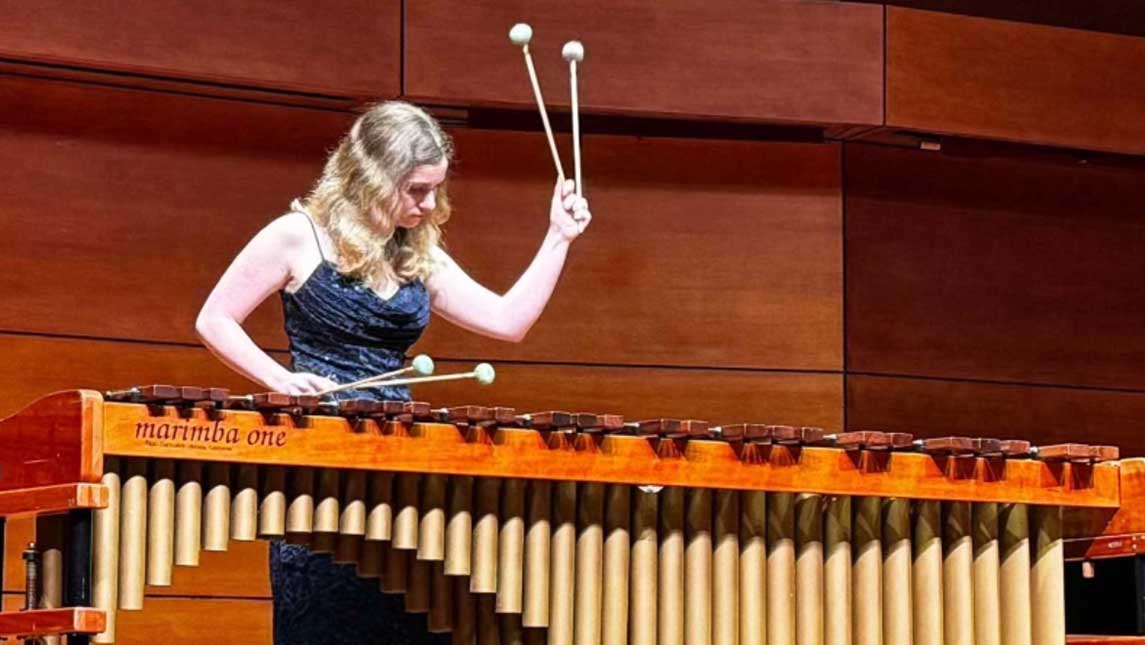
Second year student Madison Karan hopes to challenge modern-day narratives with her multimedia novel. Karan is a percussionist and music in performance major who plays “anything you can hit,” but primarily the marimba.
Last spring, prior to her decision to apply for the Pubantz Artist in Residence, the symphonic band played Karel Husa’s “Apotheosis of the Earth,” about the destruction of humanity through their own means. She thought to herself, “What would this look like if it was fictionalized?”
“My story, entitled ‘Apotheosis,’ centers around three human characters and their interactions with a rapidly evolving AI,” says Karan. “Through forces outside of their control, the Earth is destroyed, and only the AI is left to reflect on the events that led to this point. Uniquely, the AI is the narrator of ‘Apotheosis,’ and we follow its point of view as it transforms from a simple machine into a complex, sentient being.”
Although Karan’s novel does not directly address the human impact on Earth’s ecosystem like Husa’s score does, the two pieces are similar in tone. “While there are moments of lightheartedness; the bulk of the novel is solemn and reflective,” she says.
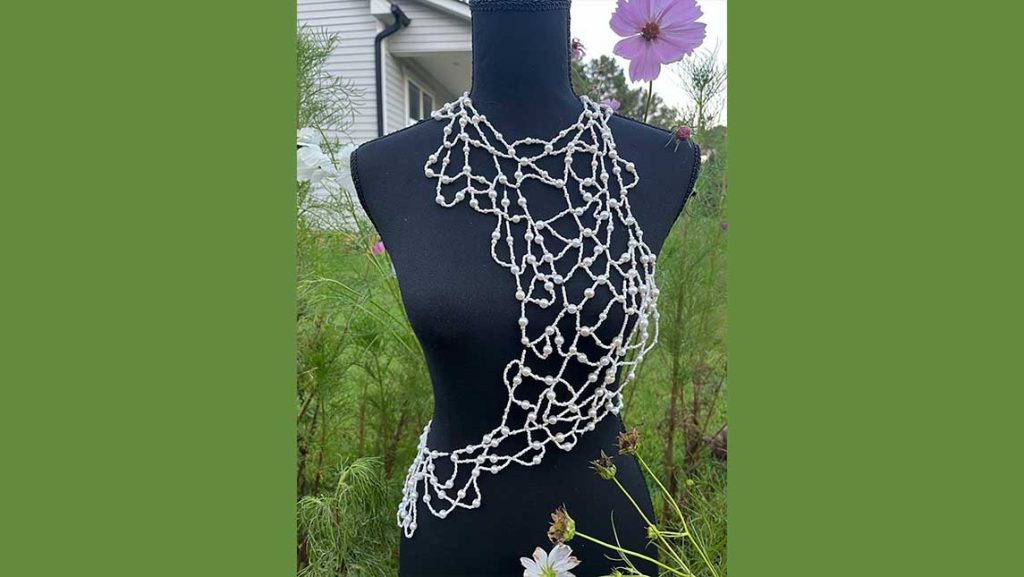
The novel includes features such as jewelry created by Karan. All her characters represent a type of media she works with — music, writing, and jewelry.
“For instance, one of my characters is a musician, and at one point in the story, he discusses a composition he made,” she says. “The QR code I put there directs to a piece I wrote, but in-universe, it is his.”
“The arts are a fundamental part of the human experience that cannot be replicated by a machine,” says Karan. “While there are necessary uses for AI, that place is not within art. When people see my work, I want them to consider their own beliefs about the topic at hand. Of course, I would love to see the reader enjoying the experience, but the questions ‘Apotheosis’ asks the reader are the most important part of it all — in this way, the story is a vehicle to inspire reflection.”
A Sustainable Design Project for Grandmother’s Furniture
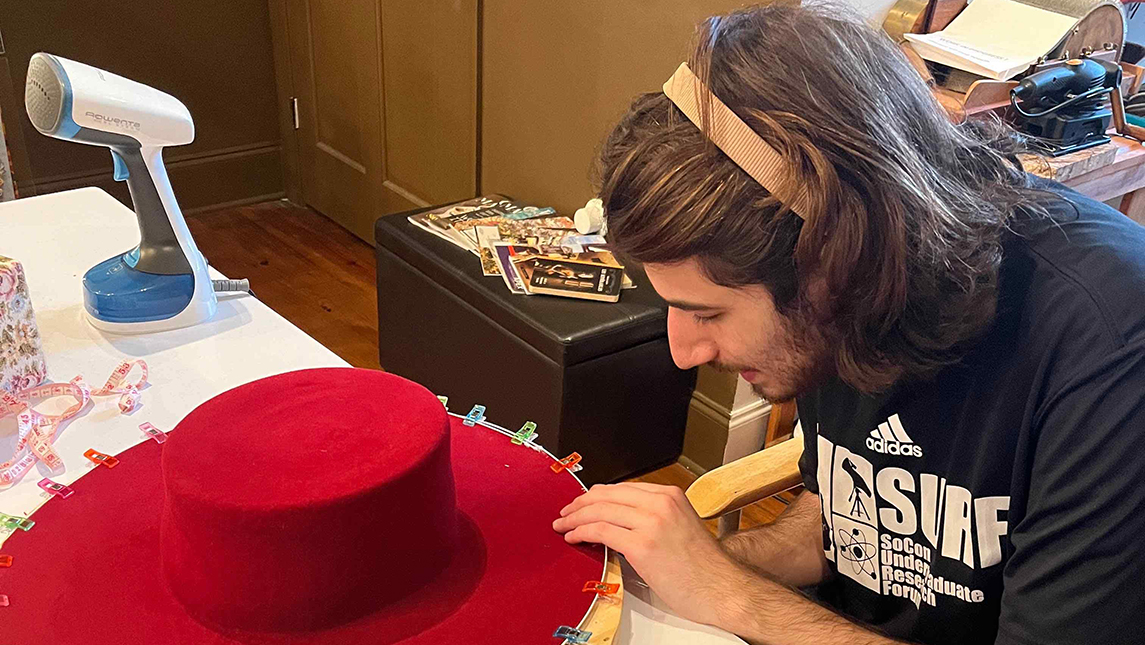
Interior architecture major Sophia Weaver commits to a theme of sustainability by repurposing her grandmother’s furniture. The 1900s furniture is mostly dark, solid wood and some of it is quite ornate. There are unique features we do not see anymore, like tile on top of wood.
“I thought ‘What if I take all these pieces of furniture and give them a new life instead of them going to a landfill?’” she says.
Her process has been to take the furniture apart, lay out all the pieces, and then combine them in unusual ways. For instance, she took a bed frame and side tables and turned them into an armoire.
In her grandparents’ house, she not only found old furniture, but also tools like finishes and wood glue to use for her project. “The whole purpose of the project was that I didn’t want to spend any money on buying something new,” says Weaver.
She is producing 10-12 pieces of furniture, but not all of it will be on display. The goal is to have one completed set, and the rest will be proposed later.
Using Palm Leaves to Push the Boundaries of Linguistic History
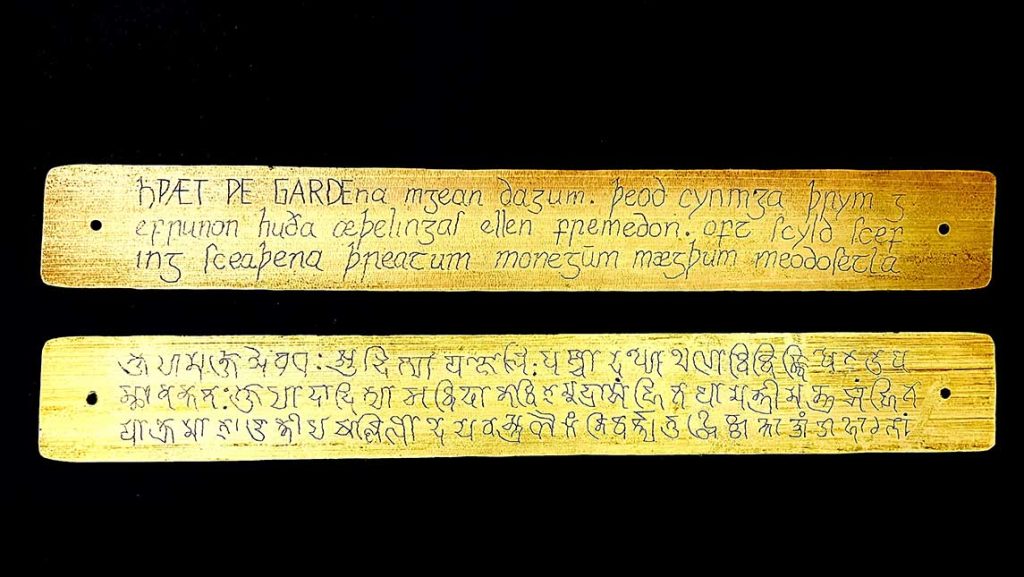
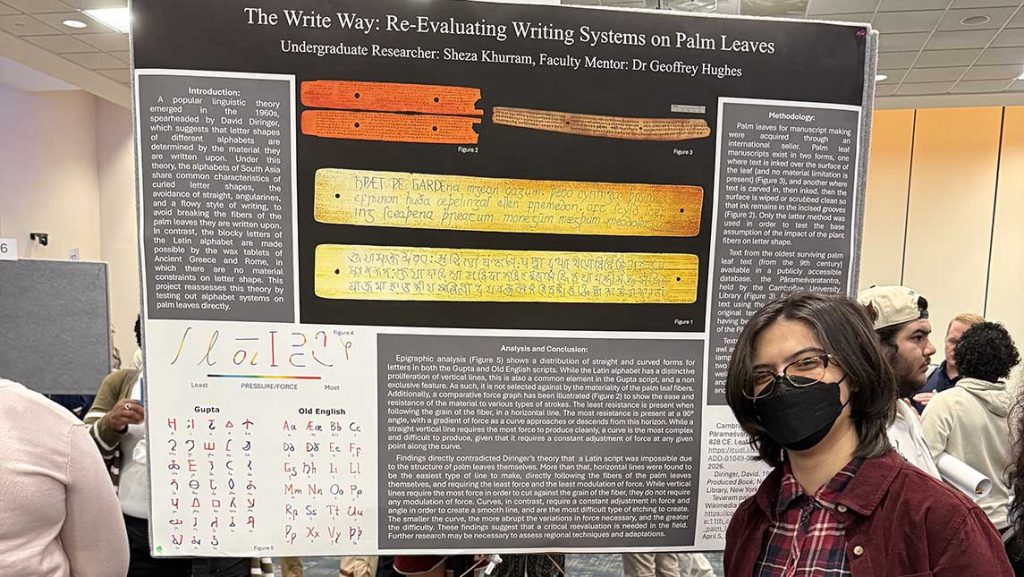
Senior Sheza Khurram knew from the beginning that her work would be reconstructive and linguistic in nature. Her project, “The Write Way — Re-evaluating Writing in Palm Leaf Manuscripts,” is an experimental archaeology project merging historical linguistics and language reconstruction. It is based on the theory that Latin letters look blocky because they were originally made with wax, and South Asian letters are curly because they were written on palm leaves.
Khurram engaged in two different methodological practices. She reproduced existing palm leaf manuscripts in the Hindu script, then she inscribed English letters from the Latin alphabet on palm leaves.
“After this process, I do a cross-sectional analysis to measure the incisions and other details and see how that matches up to museum artifacts,” she says.
“I wanted to do something original and push boundaries in my field,” says Khurram. “This program allowed me to do that.”
In addition to some creative craftwork and student workshops in the School of Education’s makerspace, Khurram is an officer of Make Cool Stuff, which offers opportunities for students to create on campus.
“This is the first opportunity I’ve had to do my own research on an entirely independent project, so it’s been huge,” she says. “It’s a feeling of success and triumph because I’m getting to branch out into my field in a way that’s self-led, but then there’s also the pressure of ‘I want this to turn out well, and I want to prove that I can succeed in this field.’”
‘A Southern Love Letter’ Inspired by Italian Sculpture
Shaye Scales, a senior with a double major in painting and arts administration, is serious about her work.
“Art is a craft. I hope to shock the audience at the Undergraduate Research Expo and inspire them to take a second look and take it seriously at least for a moment,” she says.
Scales’ work “A Southern Love Letter” centers on Christianity and being Black in the American South. She says she got inspired last year during a trip to Florence, Italy.
“I saw Renaissance and Baroque sculptures about Catholicism, and I thought ‘What if I did that, but I did it about being Black in the South?’” she says.
Her focus is on the positive aspects of growing up in the Black church. She hopes to combat, or at least challenge, some of the negativity of how Christian nationalism is manifesting in the country right now.
When not in class, Scales plays rugby and is the art director of the Coraddi, UNCG’s art and literature magazine. Off campus, she volunteers at least once per month at the Tiny House, where she gives people experiencing homelessness space to create art.
“Helping to bridge the community and the arts is an experience that I really enjoy,” says Scales.
Her project includes paintings, prints, multimedia, and wood sculpture. She says working on the Pubantz project is similar to working on any type of art.
“You go through a bunch of turmoil, you go through inspiration, motivation, a bunch of lulls, and then you actually start to see the piece come alive,” she says, “and you get excited again, and then you start working again and then it happens—the piece is done.”
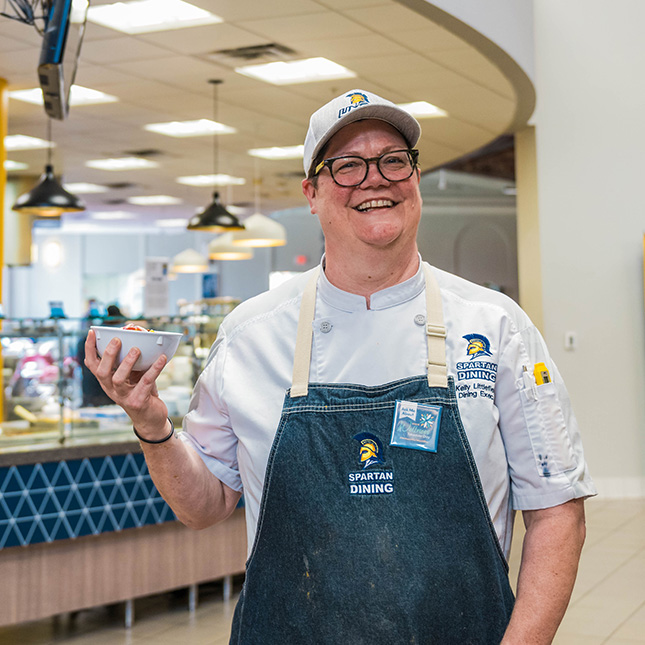
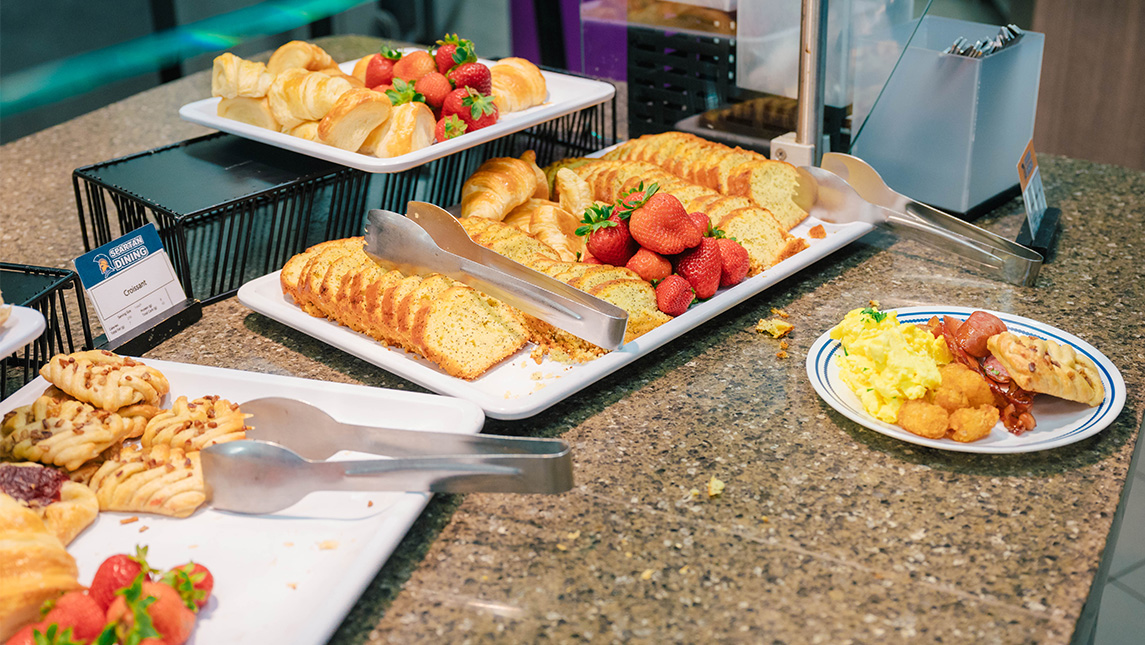
Late Night Breakfast is back, and Spartan Dining is looking for volunteers to help make it a great experience for students.
On Wednesday, April 29, they will serve up a fun night of breakfast favorites once classes end and before exams begin. Volunteers will assist with serving, stocking food and beverages, and engaging with students throughout the event.
Volunteer shifts run from 6:30–9 p.m. The event starts at 7 p.m.