UNCG Introduces Minerva’s Health Chariot to Bring More Healthcare Services to the Triad
Posted on April 30, 2026
UNC Greensboro has launched Minerva’s Health Chariot, a mobile health unit operated by the School of Nursing that offers primary and preventive care in Guilford, Forsyth, Alamance, Rockingham, Randolph, Davidson, Davie, and Caswell counties.
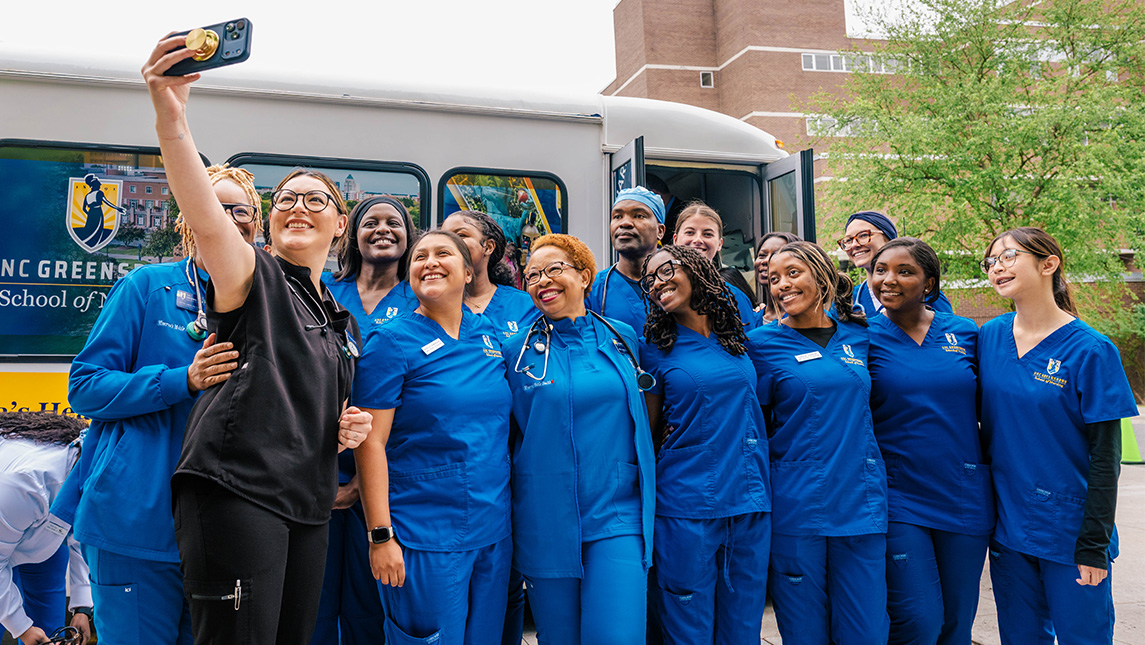
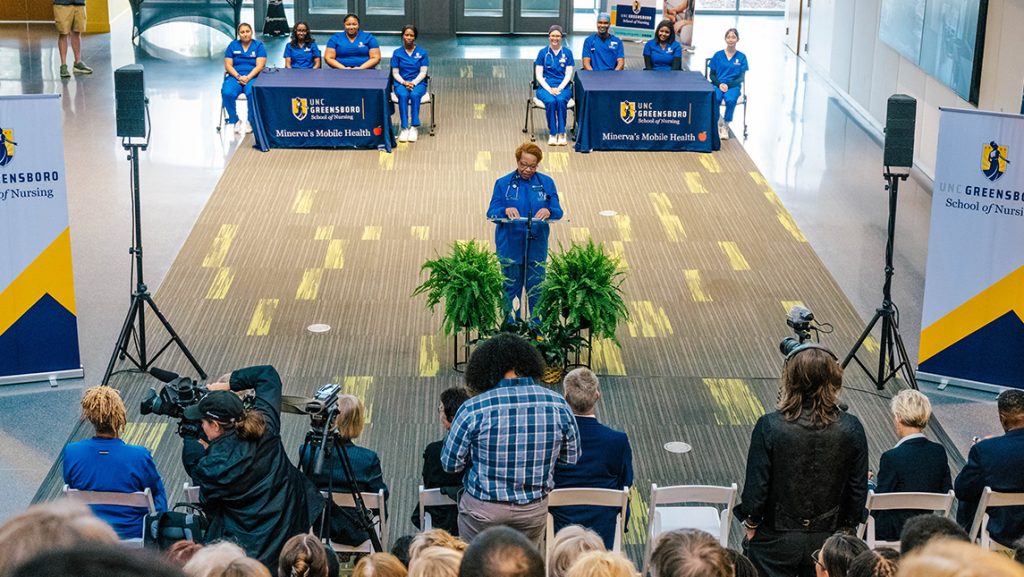
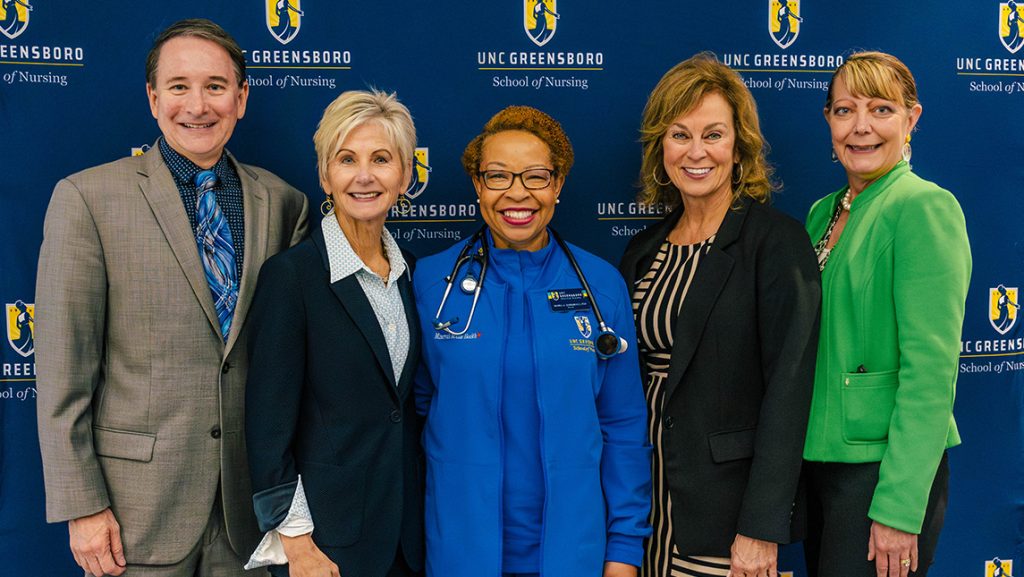
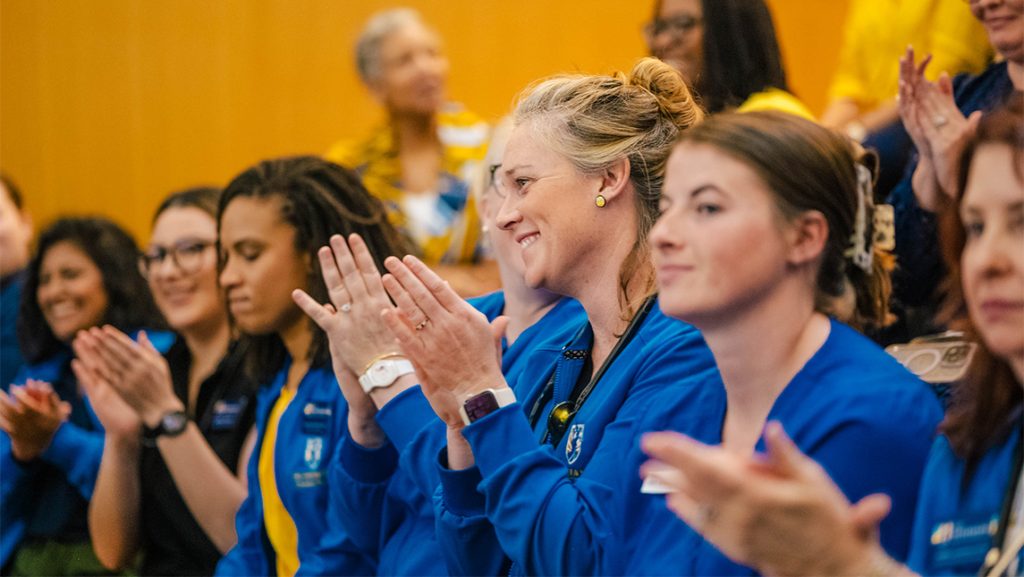
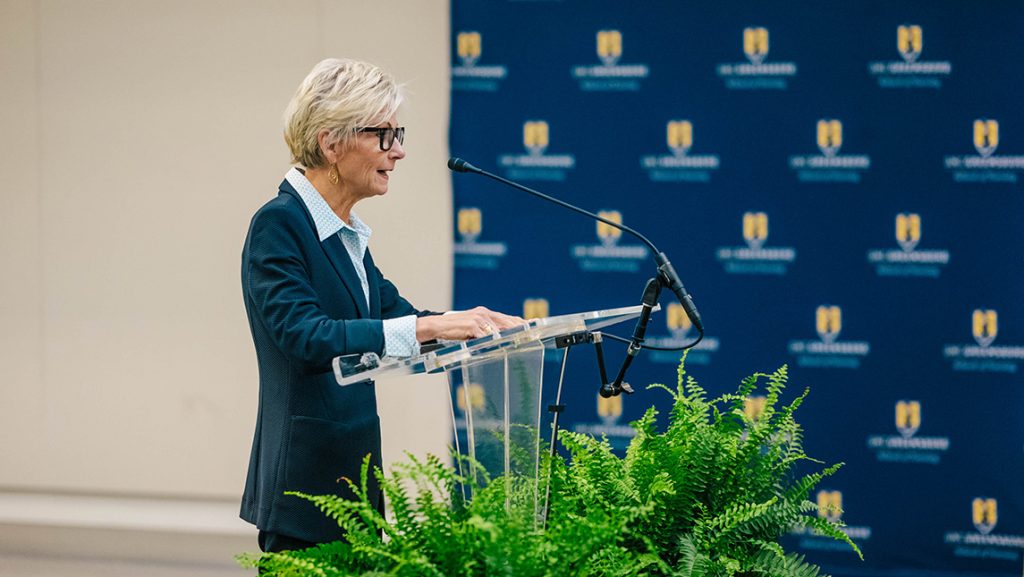
Dr. Debra Barksdale, dean of the School of Nursing; Chancellor Franklin D. Gilliam, Jr.; Anita Bachmann, CEO of UnitedHealthcare Community Plan of North Carolina; were joined by other trustees, faculty members, and community representatives to unveil Minerva’s Health Chariot outside the Nursing and Instructional Building on April 29.
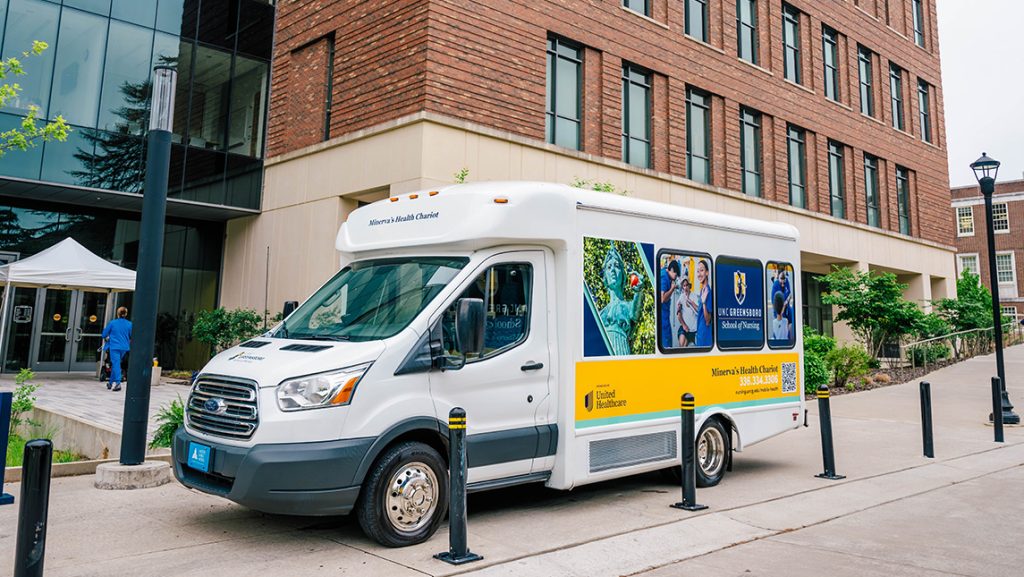
Minerva’s Mobile Health Chariot outside the Nursing and Instructional BuildingDean Debra Barksdale
Since its launch, the MHU has delivered care to over 3,000 people in the Triad who might not have received medical attention otherwise. The second unit will further increase access to essential health services in the region.
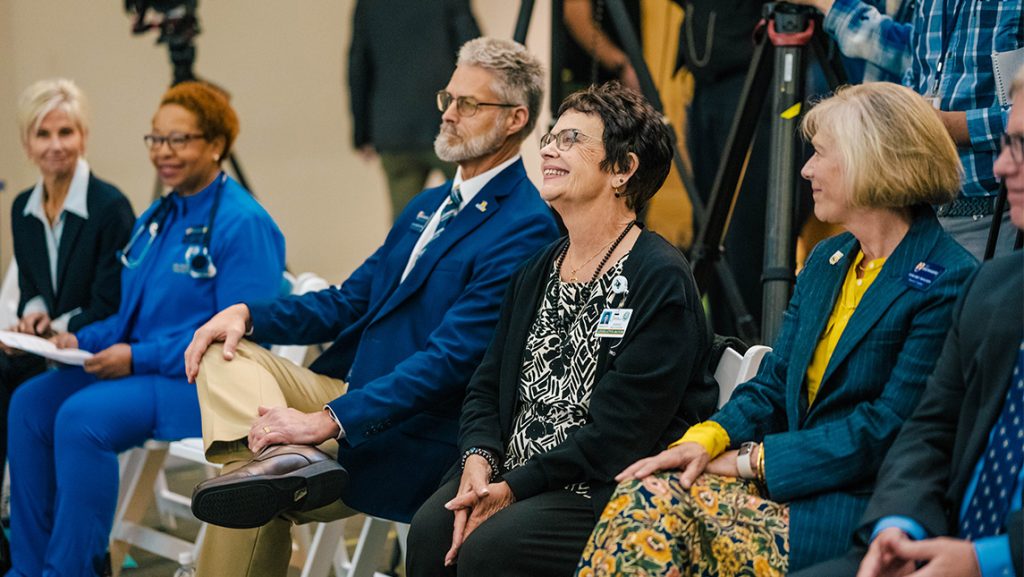
Chancellor GilliamProvost Alan Boyette, Greensboro Mayor Marikay Abuzuaiter, and Trustee Margaret BenjaminOnboard Minerva’s Health Chariot, left to right: School of Nursing Advisory Board member Robbie Franks, Director of Development Miriam Fields, Advisory board member Davette Williams, and Dr. Tiffany Gibson, clinical associate professor
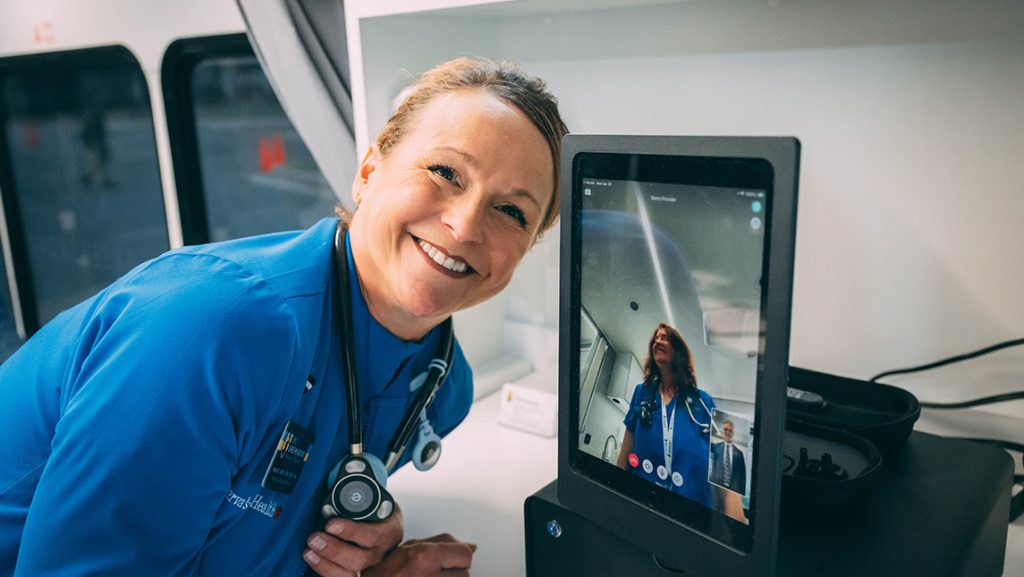
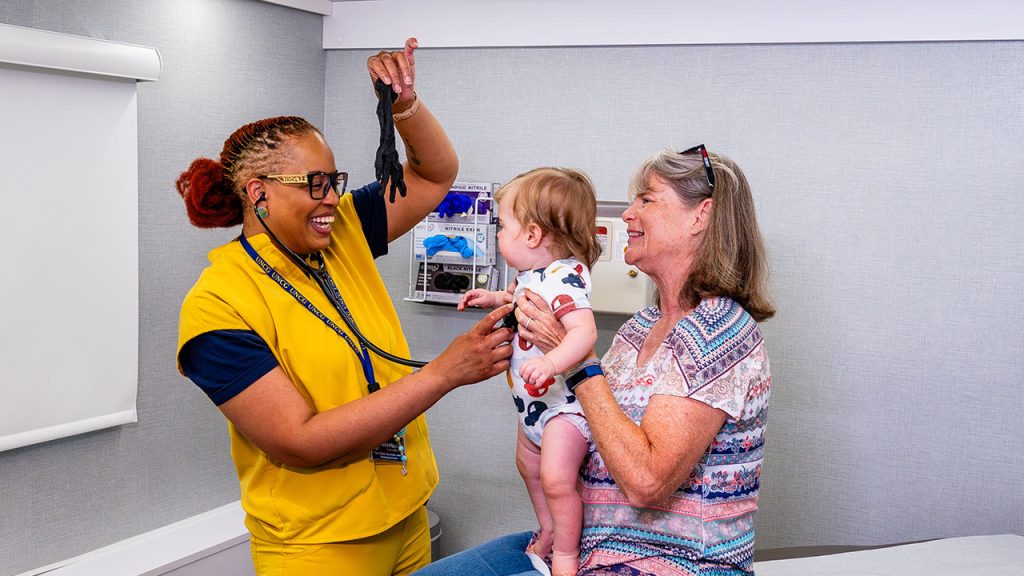
Minerva’s Health Chariot introduces a new feature to the fleet: integrated telehealth technology. This lets patients connect with a primary care provider in real time during their visit, making follow-up and ongoing care easier. The unit is a repurposed transit van, and its smaller size means it can reach more locations.
Tiffany Gibson, Ph.D., RN, a faculty member and dually certified family and women’s health nurse practitioner, has been a key part of the School of Nursing’s mobile health efforts since the MHU went into service. She sees patients on the unit several times a week and serves as its director.
“What sets Minerva’s Health Chariot apart is its ability to turn a routine screening or test result into a same-day primary care, telehealth visit. This is an essential service for rural and underserved communities where access to medical care may be limited,” said Gibson.
Both mobile health units also give UNCG nursing students valuable real-world training. Nursing students and graduate nurse practitioner students get real-world, hands-on experience working with patients through the Minerva Mobile Health Scholars program.
“Remarkable change doesn’t happen without the right tools, the right people, and partners who believe in the work. Minerva’s Health Chariot brings all of that together — giving our nurse practitioners and students the platform they need to meet our neighbors where they are and deliver care that truly transforms lives,” said Barksdale.
Bachmann, who also serves on the UNCG Board of Trustees, said, “At UnitedHealthcare Community Plan of North Carolina, we believe that everyone deserves access to quality healthcare, no matter where they live, and Minerva’s Health Chariot will help increase access said Anita Bachmann, CEO, UnitedHealthcare Community Plan of North Carolina. “By bringing telehealth-enabled, preventive care directly into neighborhoods across the Triad, this mobile unit breaks down barriers that have kept too many people from getting the care they need.”
Anita Bachmann, CEO, UnitedHealthcare Community Plan of North CarolinaSarah Apel, Minerva Mobile Health Unit Nurse Manager
Minerva’s Health Chariot is one part of UNCG’s growing service to underserved communities. At the ribbon-cutting, Chancellor Gilliam announced UNCG’s recent approval to participate in the Rural Residency Medical Education and Training Fund. With this funding from the UNC System, UNCG will help increase the healthcare workforce in rural communities. The School of Nursing will receive $200,000. Another $200,000 was awarded to be shared by the Department of Social Work in the School of Health and Human Sciences and Psychology in the College of Arts and Sciences.
To learn more or find out when Minerva’s Mobile Health Unit will be in your area, visit nursing.uncg.edu.
Story by Debbie Fuchs, School of Nursing Photography by Sean Norona, University Communications
Excellence and Career-Readiness Define the UNCG Class of 2026
Posted on May 04, 2026
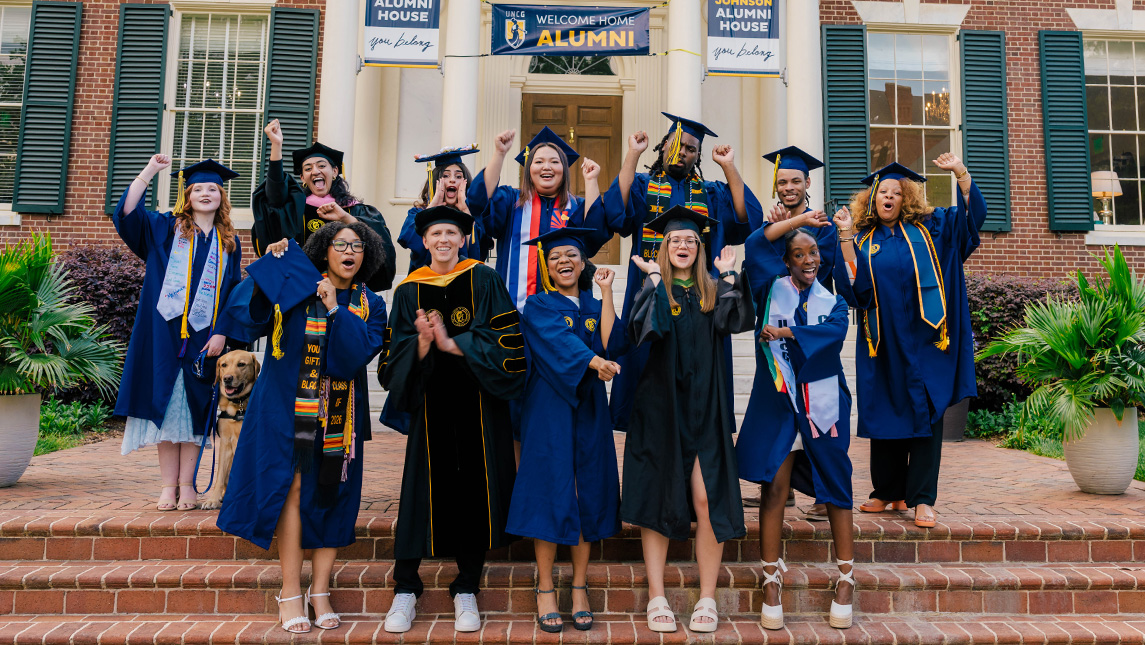
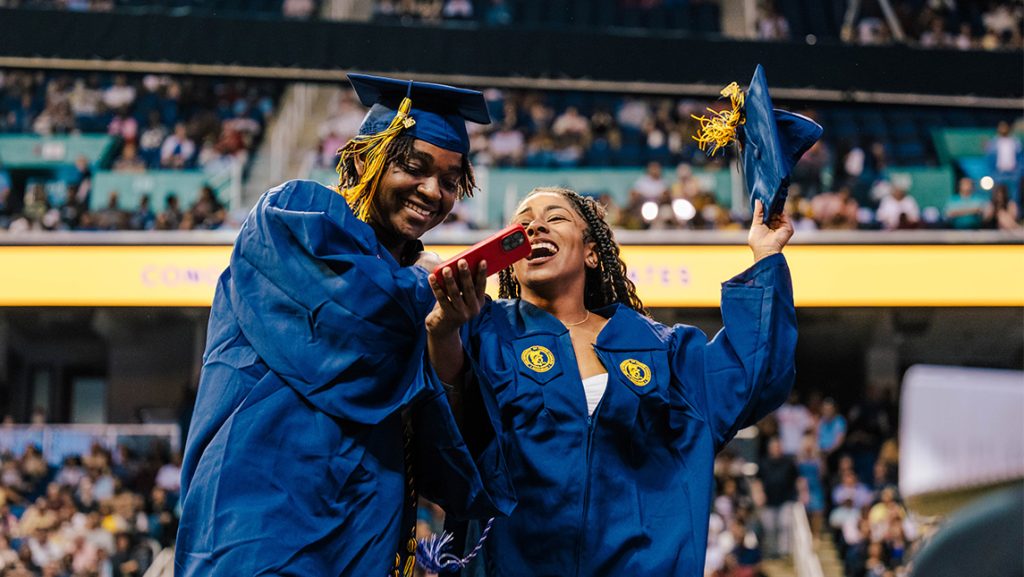
Seania Burnett (front row, center) leads members of her Class of 2026 in a cheer on the steps of Marcus T. Johnson Alumni House.
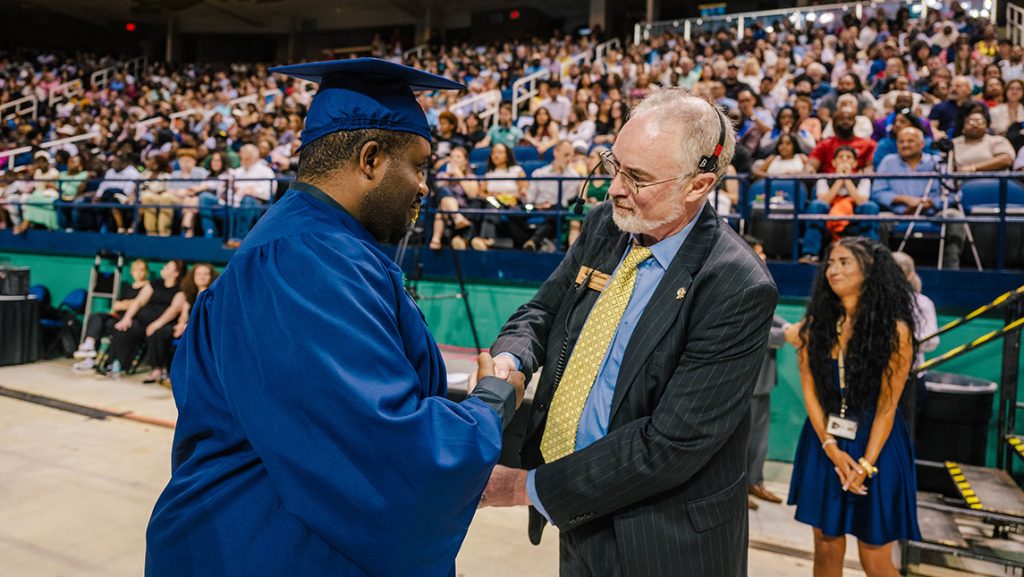
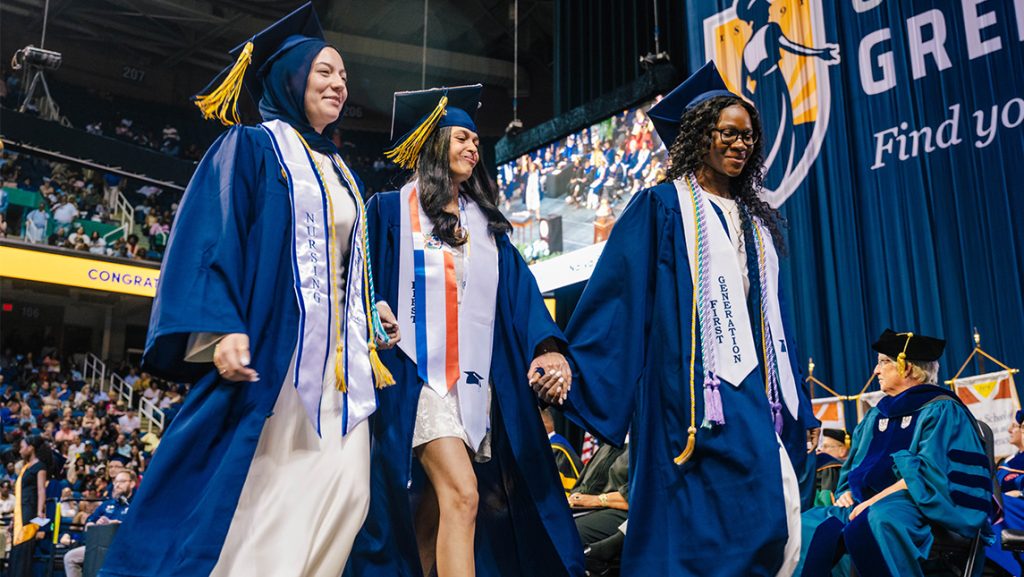
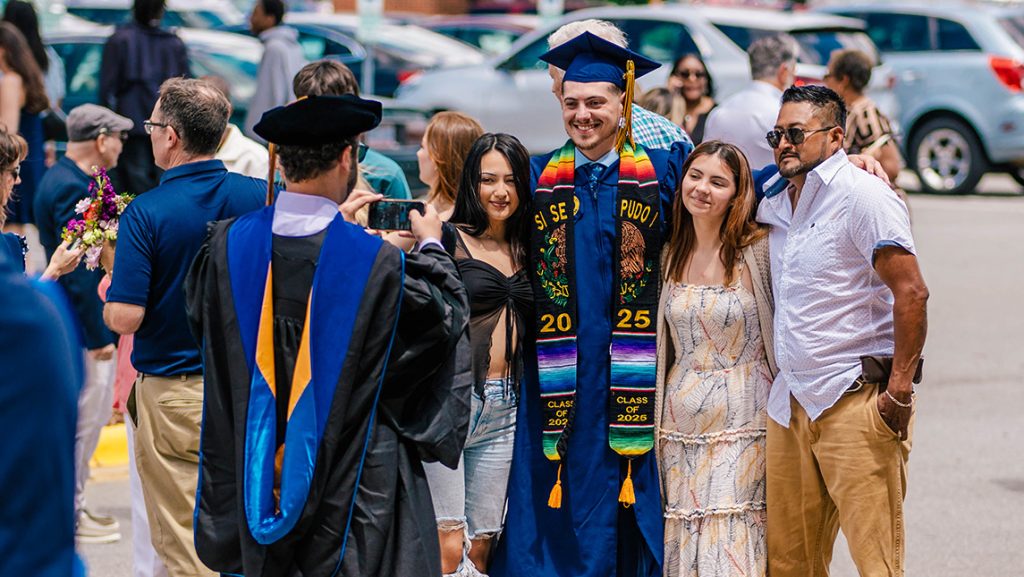
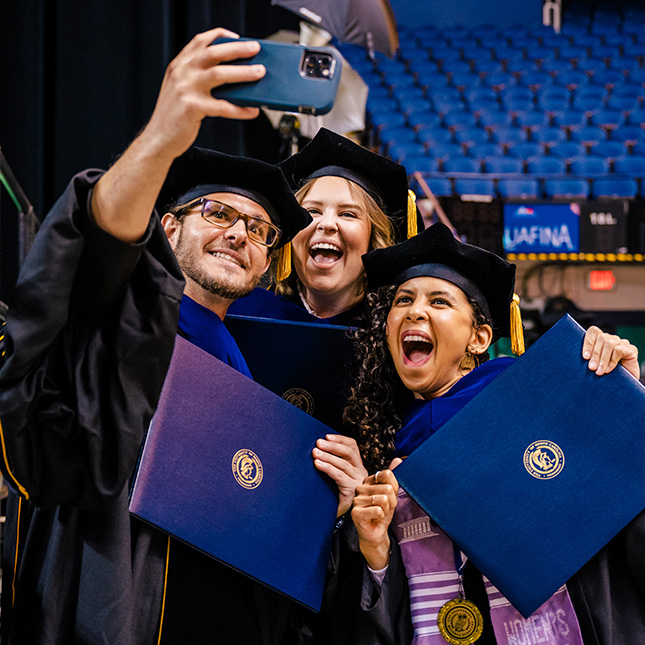
As UNC Greensboro’s newest alumni get ready for Commencement Day, many add flourishes to their mortarboards. These decorations tell the stories of what brought them to this point, the people who inspired them, the doubts they quashed, and the dreams they’re ready to bring into reality.
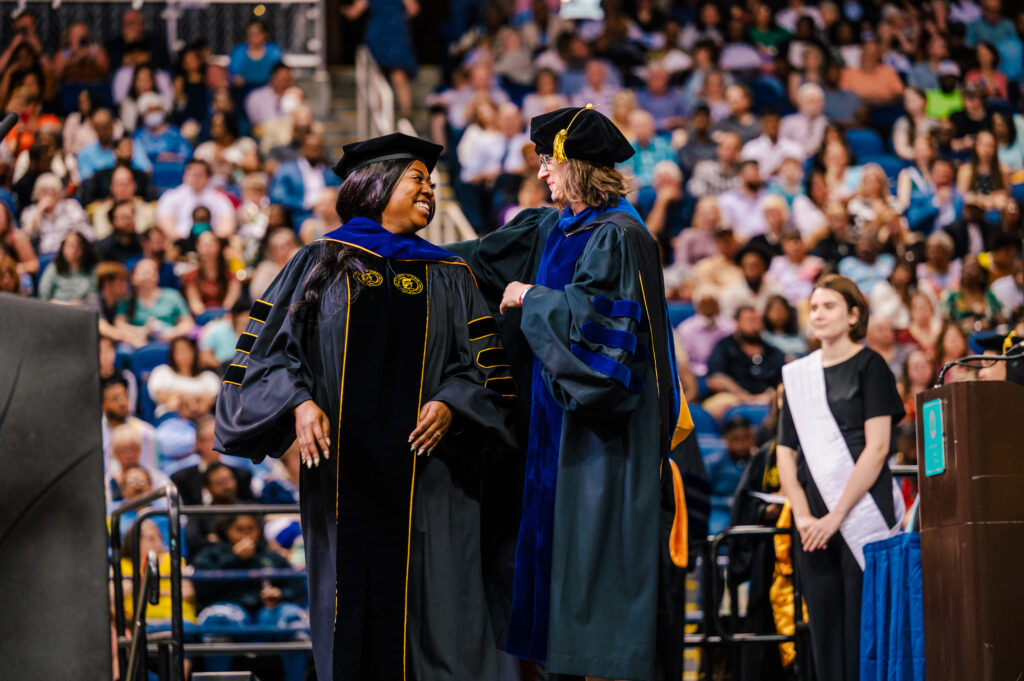
But the matching blue of the undergraduates’ robes on May 8 — and the black of the graduates’ robes on May 7 — will speak to another truth: Wherever their futures take them, they stand united as Spartans.
Degrees in hand, our graduates move forward having already changed the trajectory of their own lives. They seized opportunities, built real-world skills, and persevered through challenges that open the door to economic stability, social mobility, and meaningful work.
Words of wisdom to carry forth
This semester’s undergraduate ceremonies will be led by performance-minded UNCG students with a knack for building excitement in audiences.
Jiyah McLaughlin will deliver the Undergraduate Commencement speech at First Horizon Coliseum. She will describe her expectations when she first set foot on campus and what surprised her along the way. She will talk about what goes beyond her paper degree and describe the community, the commitments, and the moments that shaped her.
Before Chancellor Gilliam and the faculty process to their seats, drama major Seania Burnett will welcome everyone in the traditional hype video.
Once all the names have been read, fellow theatre classmate Christian Bartney will lead the turning of the tassels. Then Fatima Galvan-Ruiz, also of media studies, will deliver the send-off, with the customary ringing of the bell, alongside alumna Jana Welch Wagenseller ’76.
Honors by the thousands
Nearly 3,000 diplomas will mark the accomplishments that culminate this semester. UNCG will confer 2,030 undergraduate degrees, 704 masters’ degrees, and 79 doctoral degrees.
The undergraduates studied in 67 different majors with 255 different advisors. More than 800 of all the graduates will do so with honors.
Forty-two of the grads are aged 50 years or older. Among them, Dr. Andra James, an ob-gyn and professor emeritus at Duke University, who returned to school 30 years after earning her MD. She will leave UNCG with a bachelor of arts in history. James plans to do volunteer work in public service.
Another standout is Janae Wofford. The Goldwater Scholar has already logged hours in the lab as an undergraduate, discovering plant-based antibiotic alternatives with Dr. Nadja Cech. Wofford was accepted into every graduate school she applied to. She’ll continue her education and research at Emory University in Atlanta, Ga., with support from a National Science Foundation Graduate Research Fellowship. It is the oldest fellowship of its kind and is awarded to only 16% of its applicants.
Know Before You Go
First Horizon Coliseum fills up fast and traffic gets heavy — plan ahead to make your big day smooth:
Guests should arrive early — before 9:30 a.m.
Carpool with friends and family.
Skip the stress. Park on campus for free and ride the Spartan Chariots.
Thursday: Shuttles will service from the Walker Deck with pickup on Stirling Street starting at 7 a.m.
Friday: Shuttles will service from the Walker Deck at UNCG with pickup on Stirling Street starting at 7 a.m. and from Oakland Deck with pickup on Forest Street.
Shuttles will run continuously until an hour after the ceremony ends.
The Coliseum recommends entering without a bag. If necessary, guests are permitted to bring one small bag or clear bag that meets policy guidelines.
Special guests prove Spartan success
Brian Hall is the Master’s and Doctoral Commencement speaker. The president of real estate at Samet Corporation earned his master of business administration from UNCG. Over a 17-year-long real estate career, Hall has developed more than 5 million square feet of industrial and medical spaces across the Carolinas.
This semester, UNCG will confer two honorary degrees to philanthropists responsible for two professorships. Healthcare entrepreneur Susan Morris Safran ’77 has supported health education at her alma mater. Her $1 million gift in 2023 established the Susan Morris Safran Endowed Professorship in Nursing. The second, Randall Kaplan, created the Randall R. Kaplan Distinguished Professorship in Innovation, elevating Bryan School faculty who advance the workforce’s most in-demand skills.
After the commencement ceremonies conclude and the caps and gowns are put away, McLaughlin, Bartney, Galvan‑Ruiz, and Burnett will seek other stages for displaying their talents. Other Spartans will put their skills to work by serving patients and communities, leading in their own classrooms, or launching careers built with hands‑on experience. Some, including Wofford, will continue their momentum in graduate study and research.
Because being a Spartan means graduating ready to work and to uplift the community while doing it.
Story by Janet Imrick, University Communications Photography by Sean Norona, University Communications
CELEBRATE OUR GRADS!
Graduates and their families are encouraged to share their accomplishments on social media by tagging the University accounts and using the hashtag #UNCGGrad. Visit UNCG’s digital swag page for Commencement-themed graphics and templates.
Mention @UNCG in celebratory posts on Instagram and X and @uncgreensboro on TikTok.
Wade Maki Appointed to Senior Advisor Position Within UNCG
Posted on May 04, 2026
Dear Colleagues,
I am pleased to announce that Wade Maki has been appointed Senior Advisor to the Chancellor for Strategic Initiatives in the Office of the Chancellor, effective July 1, 2026.
In this role, Wade will serve as a key connector across academic leadership, administrative offices, and the faculty, ensuring strong coordination and execution of institutional priorities aligned with the University’s strategic plan and UNC System goals. He will lead Chancellor-sponsored initiatives, including continued implementation of the strategic plan and an enterprise-wide AI strategy. He will also serve as a liaison between administration and faculty and work closely on implementation of UNC System policies.
Wade brings a deep understanding of the University and the UNC System, along with a strong record of leadership and collaboration. As Chancellor’s Fellow for Strategic Planning since 2024, he led the “Forward Together” Strategic Plan refresh and supported key initiatives, including artificial intelligence and career readiness.
Wade will complete his two terms as Chair of the UNC System Faculty Assembly, which began in 2022, at the end of this semester. He advanced policy efforts such as updates to faculty workload and post-tenure review, the Foundation of American Democracy requirement, and a consensus definition of academic freedom.
A member of the UNCG faculty since 2004, Wade has been a principal lecturer in philosophy and a recipient of the Anna Maria Gove Award for Teaching Excellence. His leadership roles have included director of the Bachelor of Liberal Studies Program and co-director of the Faculty Teaching and Learning Commons. As he transitions into this new role, Wade will step down from his faculty position in the Department of Philosophy.
Please join me in congratulating Wade on this new role and in thanking him for his continued leadership and service to UNCG.
Vice Chancellor Tina McEntire Announces Retirement in August
Posted on May 05, 2026
Dear Colleagues,
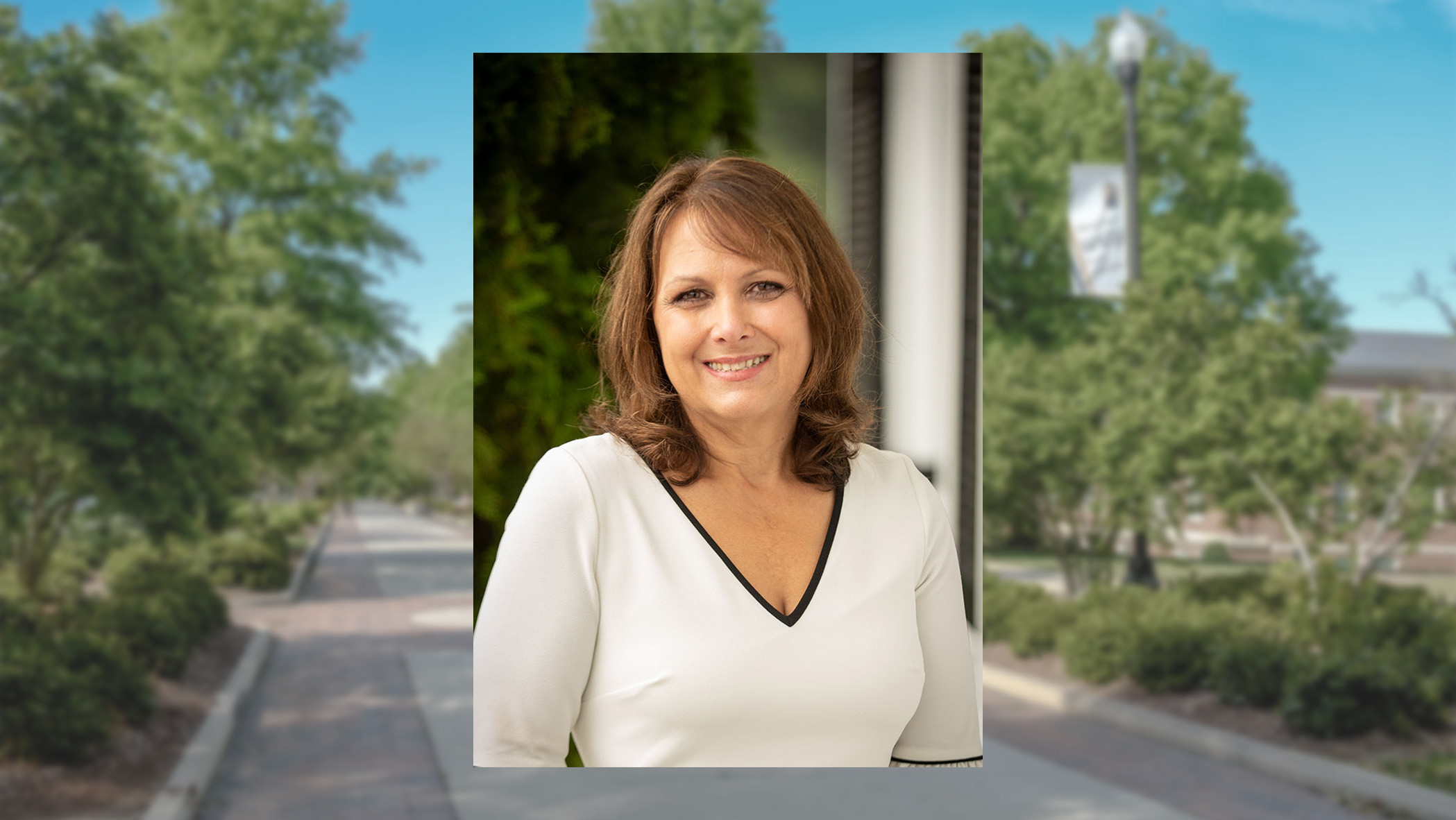
I am writing to share that Tina McEntire, Vice Chancellor for Enrollment Management, will be retiring from UNCG on Aug. 1, and to recognize her extraordinary contributions to the University.
Tina will be concluding a 30-year distinguished career in the UNC System, including service at UNC Charlotte and the last six years at UNCG. During this time, she has led and supported high-impact initiatives across the UNC System, including directing a completion grant program and advising campuses on student success and enrollment.
She joined UNCG at a pivotal moment – the onset of the COVID-19 pandemic and a period of national enrollment decline – and was the first enrollment leader at UNCG to report directly to the Chancellor, reflecting the strategic importance of this work to the institution. In this role, she has provided innovative, decisive leadership marked by a results-driven, no-nonsense approach, and an unwavering commitment to the mission of the University.
Tina led a comprehensive transformation of our enrollment enterprise, rebuilding a fragmented structure into a coordinated, high-performing operation grounded in best practices and data-informed decision-making. She strengthened teams across all enrollment units and introduced the University’s first multiyear enrollment projections to guide strategy and planning.
Her leadership has delivered strong results in a challenging environment. Over the past three years, UNCG has grown total enrollment by 5.3%, with new student enrollment up 13% since 2022. Fall 2025 marked our largest enrollment in four years, including our biggest incoming undergraduate class since 2019 and the strongest graduate enrollment since 2021.
Tina also modernized our enrollment infrastructure, significantly improving service, efficiency, and the student experience. She expanded and diversified our enrollment pipelines – strengthening transfer pathways, reengaging stop-out students, growing opportunities for adult learners, and reaching students not previously considering higher education. In addition, she enhanced our financial aid strategy to extend access and supported continued growth in graduate enrollment through targeted digital marketing.
In August, Tina will begin a new chapter as a Principal and Senior Consultant with EAB, partnering with colleges and universities to address the same challenges and opportunities we have navigated at UNCG.
We are deeply grateful for Tina’s leadership and lasting impact on this University. Please join me in thanking her and wishing her all the best in her next chapter. We will share more information about next steps in the coming weeks.
UNCG Thanks Dedicated Staff at Excellence Awards Ceremony
Posted on May 22, 2026
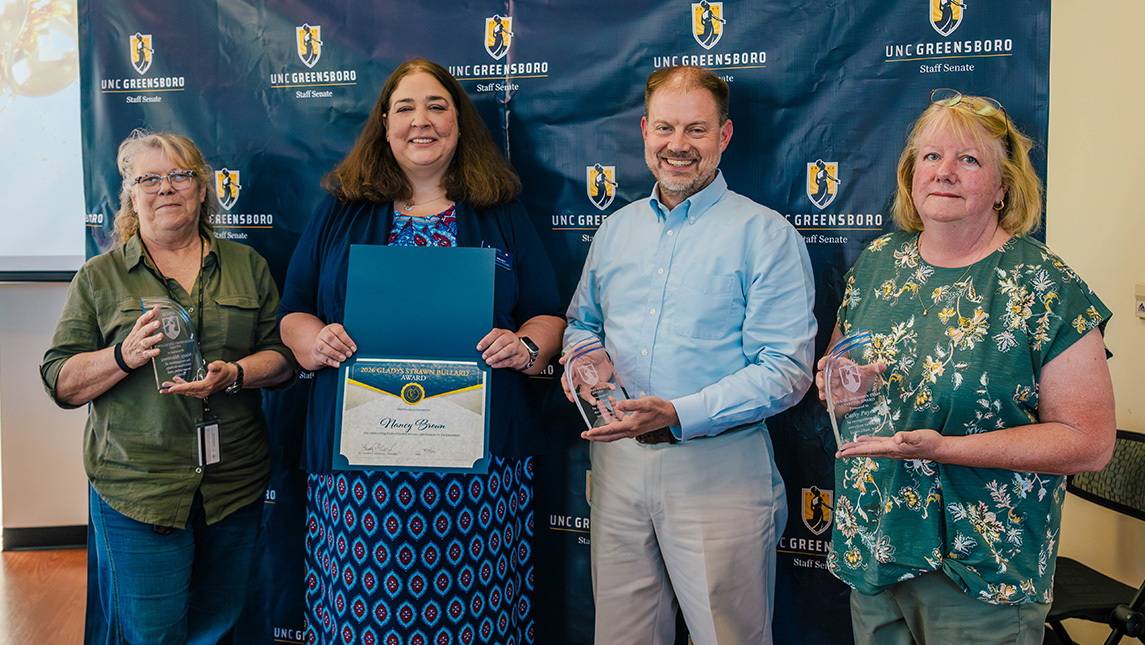
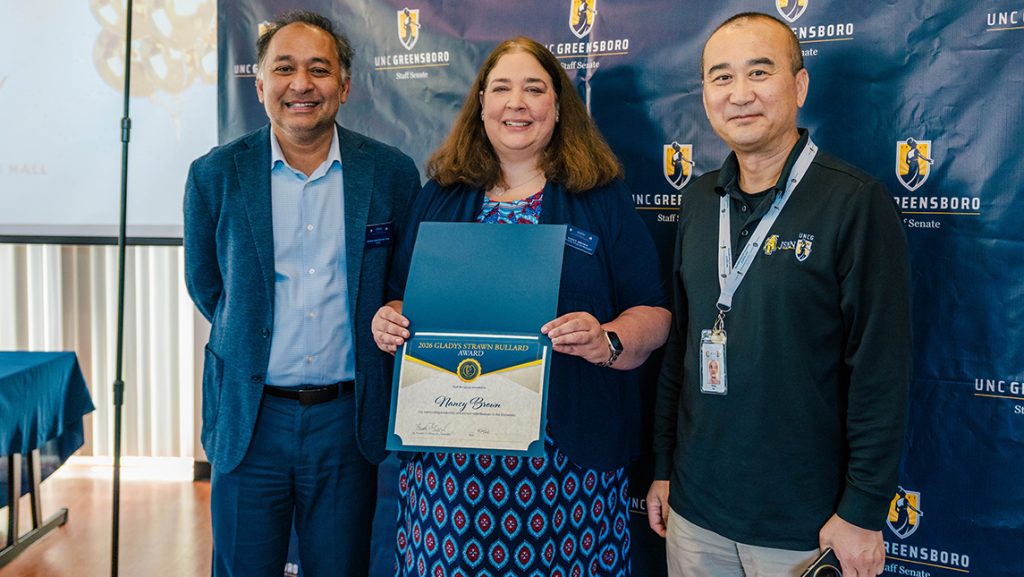
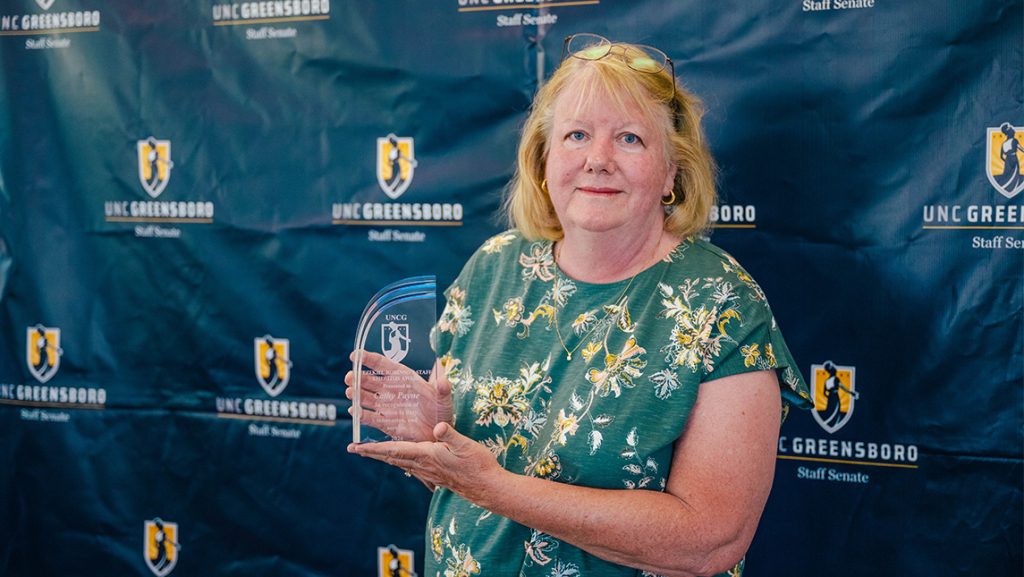
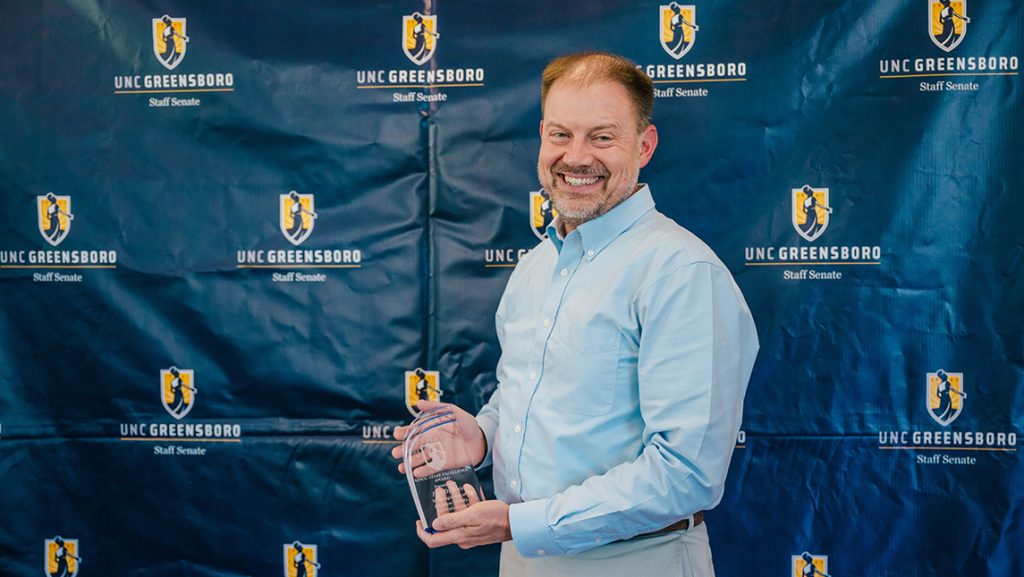
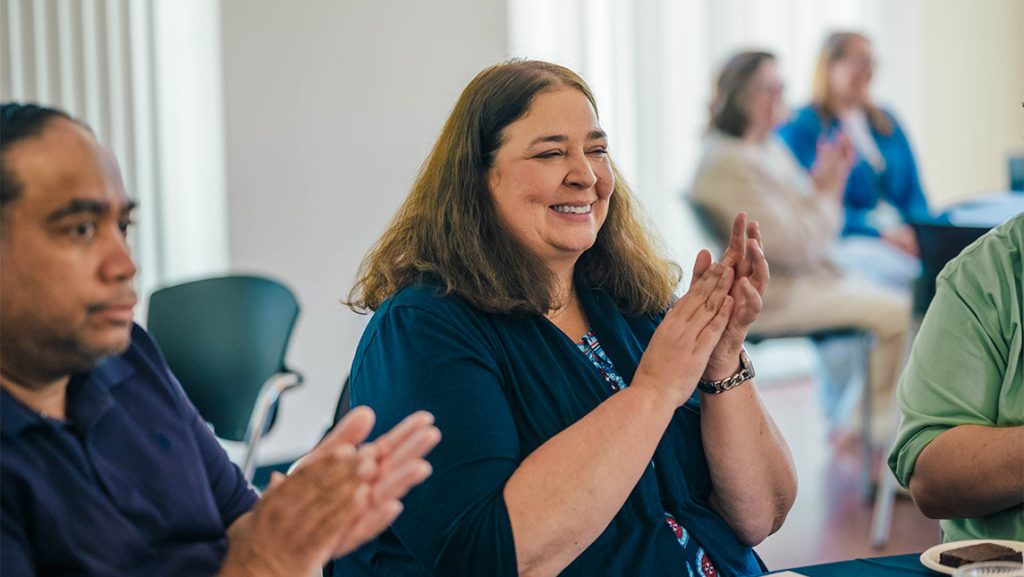
Left to right: Cathy Payne, Nancy Brown, Ian Draves, Mary Martinez
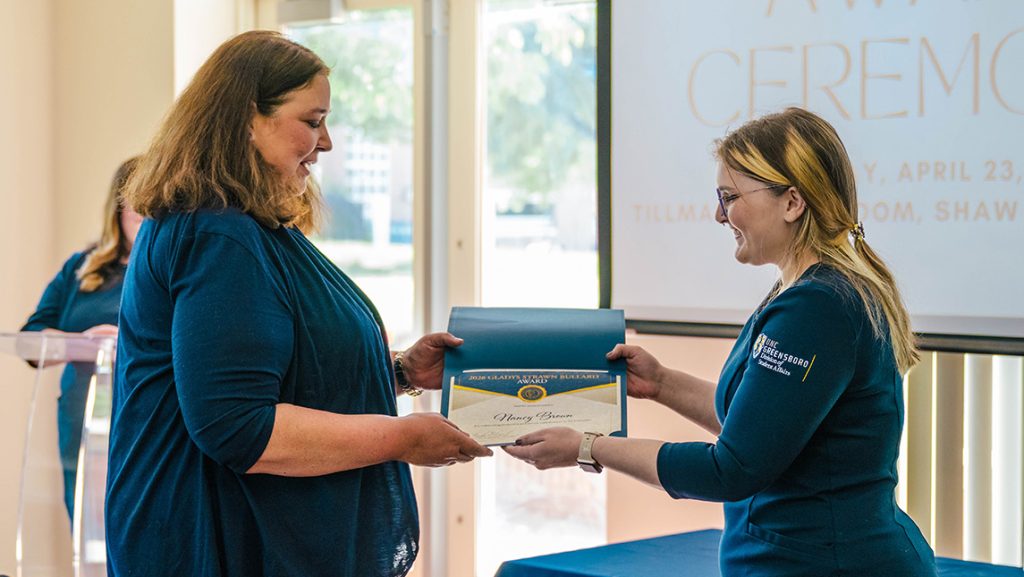
The Staff Excellence Award ceremony was held on April 23.
This year, UNCG honored Ian Draves and Mary Martinez, winners of the Staff Excellence Award; Nancy Brown, winner of the Gladys Strawn Bullard Award; and Cathy Payne, winner of the Ezekiel Robinson Staff Emeritus Award.
The University Staff Excellence Award recognizes staff members who have demonstrated excellence in their contributions to the University. It is presented to deserving permanent SHRA or EHRA Non-faculty employees employed by UNCG for at least two years. Staff, faculty, supervisors, administrators, and students may all nominate someone.
Conferral of Emeritus status is an honor granted by the Staff Senate and the Department of Human Resources at the UNC Greensboro upon the retirement of staff members who have long, distinguished records of service, dedication, and leadership to the university. A staff member may be recommended for this honor by any current employee, faculty member, administrator, or student. Recommendations will be approved by the Chancellor, Unit Vice Chancellor, Associate Vice Chancellor of Human Resources, and Staff Senate.
The Gladys Strawn Bullard Award was established to recognize and reward members of the student body, faculty, and staff of UNCG who provide outstanding leadership and service to the University. Members of the faculty and staff are eligible after two years of full‐time service to the University. Students must have completed three semesters of full-time course work.
Dr. Brett Carter Caps off Career with Student Affairs Professional Award
Posted on March 23, 2026
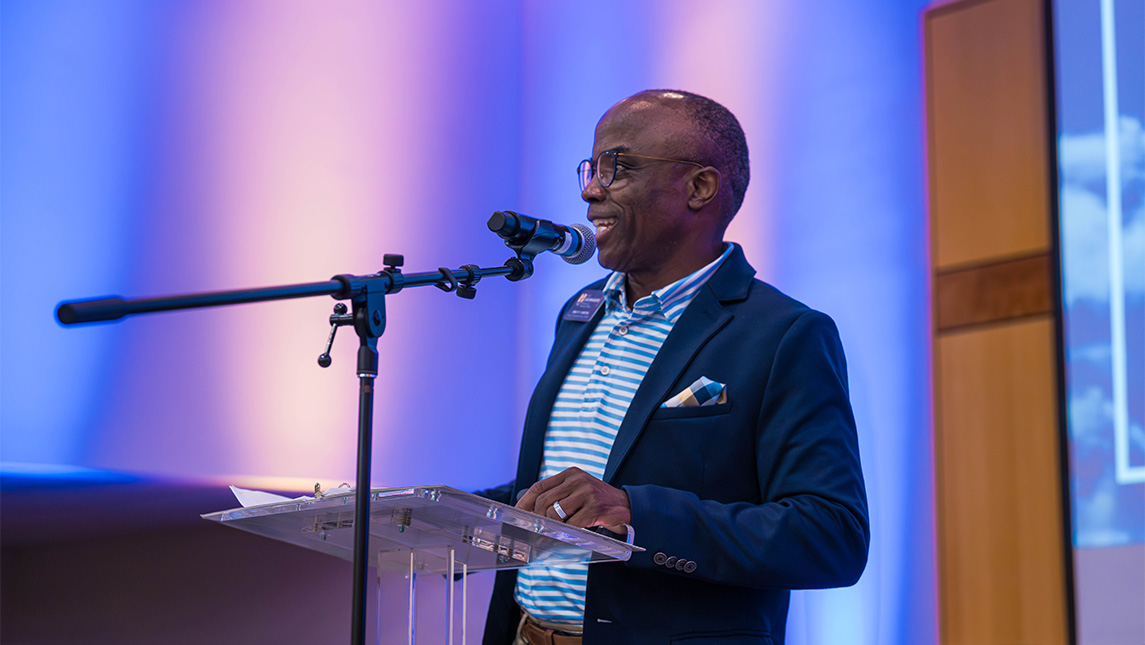
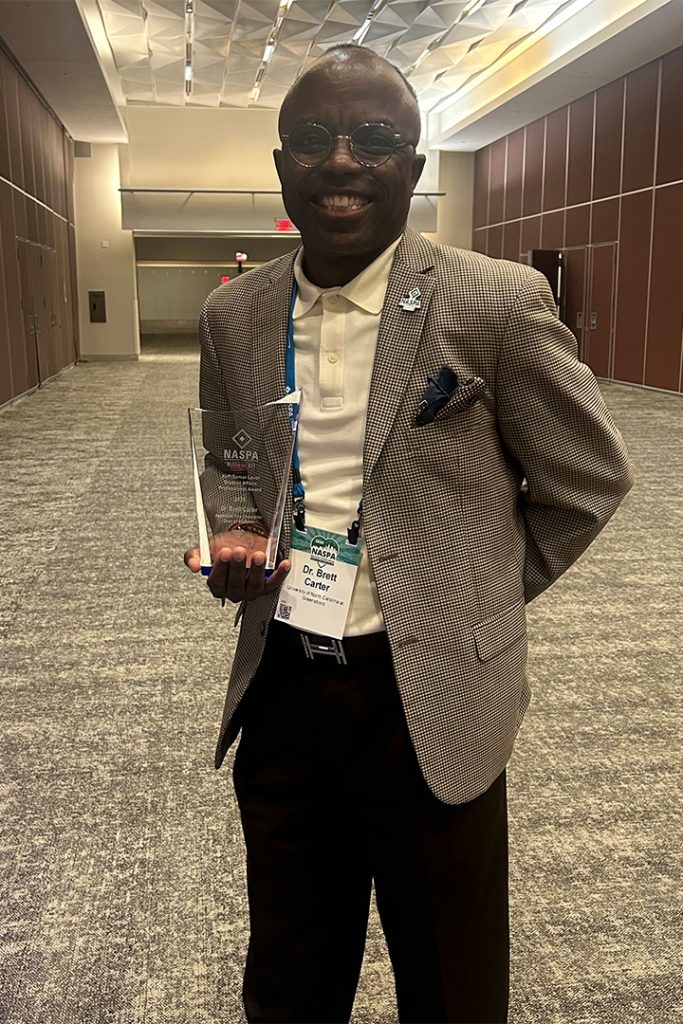
Dr. Brett Carter, Associate Vice Chancellor for Student Affairs and Dean of Students, was recognized months ahead of his retirement by his professional colleagues in the region for his strong and distinguished career in higher education.
He was awarded the Region III AVP/Senior Level Student Affairs Professional Award from NASPA, an association with 15,000 members dedicated to the advancement, health, and sustainability of the student affairs profession.
In August, Carter will retire with more than 30 years of service. When he first announced his retirement in November, Provost Allen Boyette said Carter has “dedicated more than three decades of distinguished service to UNCG, shaping the student experience through his steadfast commitment to advocacy, well-being, and success.” Moreover, he said Carter’s contributions have gone beyond UNCG to shape the profession at a state, regional, and national level.
Carter is a nationally recognized executive in higher education, distinguished by more than 30 years of progressive leadership. His expertise encompasses student affairs, crisis management, policy development, and institutional transformation. Throughout his extensive career, he has demonstrated a commitment to advancing the quality and effectiveness of higher education administration. In his role as Associate Vice Chancellor and Dean of Students, Carter continues to lead and innovate within the educational landscape. His focus remains on developing holistic, student-centered systems that prioritize engagement, retention, wellness, and academic success. Through these efforts, he aims to ensure that students receive comprehensive support and opportunities for growth.
His previous accolades include:
High Point (NC) Housing Authority 2021 Pillars of Fame Award
2017 Recipient of the UNCG Gladys Strawn Bullard Award
2008 R. Randy Rice Service Award, North Carolina Housing Officers Association
2001 North Carolina College Personnel Association Outstanding Professional
“UNCG will always hold a special place in my heart,” says Carter. “It was here that I was given the opportunity to dream, to believe in myself, and become the successful student affairs professional I am today. To my colleagues at UNCG, I am deeply grateful for the time, energy, and support you invested in me. Our shared journey of learning and collaboration has been invaluable, and I sincerely hope that you will continue to carry forward the spirit of mentorship and support by investing in others as we did together.”
In recognition of Carter’s work, UNCG has rolled out a giving campaign to support the special funds he created during his time here. All people interested can contribute now to Honoring Dr. Carter’s Legacy.
The Gamer, the Barista, and the Man Behind the Books on Economics
Posted on April 22, 2026
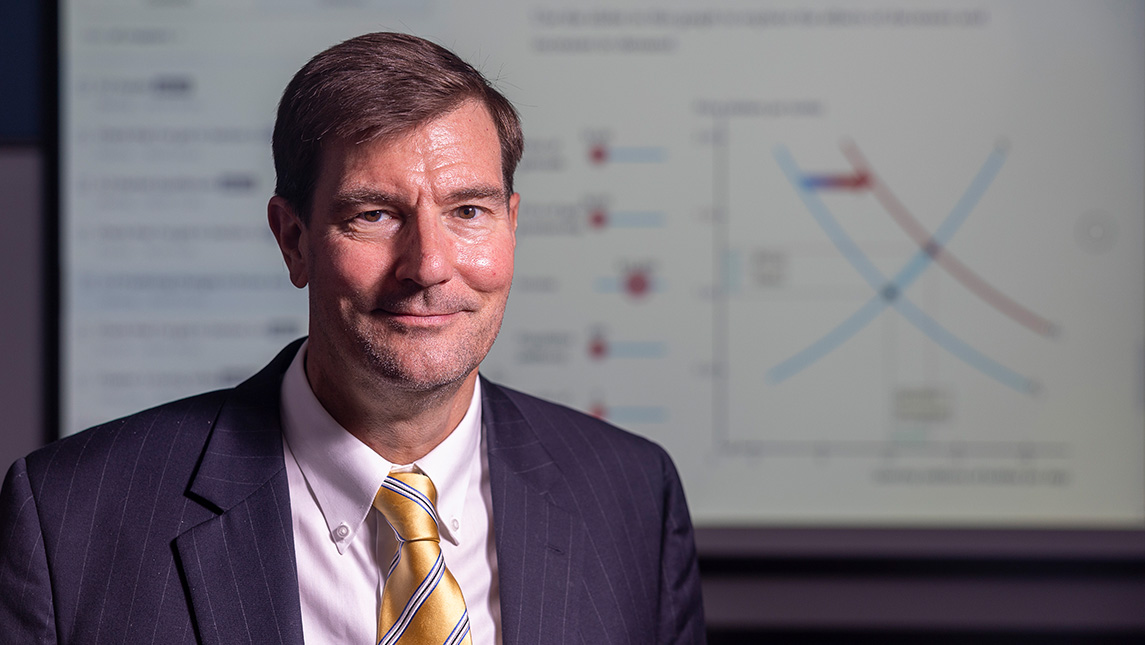
Of all UNC Greensboro’s incredible faculty, no one may have personally impacted more students’ education than Dr. Jeff Sarbaum.
He had that detail pointed out to him by a previous Dean of Undergraduate Studies. “Over the course of my 26-year career at UNCG, I have taught over 20,000 students, which, according to Andrew Hamilton, is likely more than any other faculty member in the history of UNCG,” says Sarbaum.
Dean Joy Bhadury adds that with his hard work and mentorship of fellow Bryan School faculty and doctoral students, Sarbaum is “helping to shape the next generation of economics educators.”
Roughly 20 years ago, the UNCG Division of Continuing Education asked him to help develop a course for themaster of liberal studies. As he helped build its 100-page website, he also designed his own Flash game to teach microeconomics.
He built upon what he learned from the game to come up more creative ways of engaging students. He made a website about the economics of coffee and fully embraced the bit, as remembered by his peer Professor Emeritus Michael Parkin from the University of Western Ontario.
“I first met Jeff Sarbaum in a video shown by a Pearson Education editor at a meeting in Boston in May 2017,” says Parkin. “He was dressed as a barista, filling coffee orders and illustrating the key economic principles of production and cost. I was immediately impressed both by the imaginative setup and the clarity of his explanations.”
His research on student performance based on the coffee website impressed textbook publisher Pearson Higher Education. It engaged Sarbaum to co-author two highly successful, digital-first multimedia textbooks, “Microeconomics Interactive and Macroeconomics Interactive.” This year, he is co-authoring the 10th edition of “Foundations of Economics” for Bade and Parkin.
“Pearson has informed me other economics titles are now working to add interactive elements to their eBooks,” says Sarbaum. “I’d like to think my co-authors and I have incentivized a trend.”
Students recall transformative classes
Sarbaum’s presence in a classroom makes all the difference — a testament repeatedly made his students and his colleagues. In 2023, Department Head Anne Royalty sat in on the course Introductory Microeconomics, which Sarbaum had to take over mid-semester. The abrupt change of instructor and the circumstances leading up to it had left many of the students anxious and defensive.
Royalty says Sarbaum began by handing out Halloween candy, cracking jokes, and telling stories about his kids. The relief of the students was palpable. She says many of them followed up at the end of the semester to say they would gladly take another class with him.
“Jeff went above and beyond the call of duty in this situation, as he often does,” says Royalty. “He did so with great aplomb and a graciousness that turned around these students’ experiences.”
But it doesn’t take extraordinary circumstances for his confidence to rub off on students. “Although I have had the opportunity to be taught by many world-class researchers and professors, I seldom have teachers as great as Professor Sarbaum,” says Francesca Pauca. She attended UNCG as a non-degree student after completing her bachelor’s at Princeton University.
Sarbaum’s teaching style was so impressive that she reached out to introduce herself after the first lecture. “It is obvious to me how deeply Professor Sarbaum wants his students to learn,” says Pauca. “He walks around the whole classroom as he lectures, making a point to address every student. I noticed him looking at students’ responses to his teaching, constantly evaluating whether they are comprehending the material or not.”
Forsyth Medical Health Care Distinguished Professor of Economics Dr. Jeremy Bray says praise for Sarbaum even pops up in passing conversations. “He always strives to give every student a ‘small class’ educational experience no matter how big the section is,” says Bray. “He teaches both face to face and online courses with the same commitment and is a go-to resource for the department, School, University, and the broader field.”
Another feather in his cap for accolades
Bhadury describes Sarbaum’s record as “nothing short of extraordinary,” echoing Hamilton’s observation that he has taught approximately 20,000 students.
“His student evaluations are equally impressive, with instructor and course ratings exceeding 4.0 out of 5 for nearly all sections,” Bhadury says. “This level of student satisfaction is particularly noteworthy given that Jeff teaches challenging courses like Principles of Microeconomics and Macroeconomics, which many students find difficult due to their significant quantitative content.”
Bhadury highlights that Sarbaum’s dedication extends not only to students, but to his fellow faculty: “A true, and rare, measure of an outstanding academic is their commitment to inculcate their own excellence in their colleagues. In that regard, Jeff’s influence extends beyond his own classroom. He has played a crucial role in mentoring and supporting graduate students and junior faculty members.”
Sarbaum is proud of all the ways he has translated complicated concepts into comprehensible scenarios so that his many students would hold their heads high while crossing the stage at graduation.
“Teaching economics presents the challenge of conveying abstract mathematical and graphical models in ways that are accessible and engaging,” he says. “I’ve met this challenge by embracing the oldest form of teaching there is: storytelling. Whether writing scripts for an educational video game, creating an interactive website, teaching in the classroom, or presenting at a conference, I start each new topic with a story.”
Story by Janet Imrick, University Communications Photography by Bert Vanderveen, Vanderveen Photography
Spartans Build Knowledge and Confidence with 2025-26 Teaching Excellence Awardees
Posted on April 27, 2026
Across all grades, the hurdle a teacher often faces on the first day of class is not lack of knowledge, but intimidation. In many cases, their students are reluctant to step up in front of classmates and risk making a mistake, cowed by Imposter Syndrome or the challenges of the coursework that came before.
The UNC Greensboro faculty who received the 2025-26 Teaching Excellence Awards are among the top role models for settling those nerves. At the end of the semester, their students feel empowered to explore avenues they never expected and make mistakes, knowing they can learn from them.
Though the faculty are all pioneers in their fields, students and colleagues repeatedly say that the following stand-outs never lose their approachability with students just starting their college experiences.
Dr. Jeff Sarbaum, Sue W. Cole Distinguished Senior Lecturer of Economics UNC Board of Governors Excellence in Teaching Award
This year’s highest post-secondary award in the state goes to a faculty member who has helped students transition into successful business careers for more than two decades. One look at the career of Dr. Jeff Sarbaum proves economics are anything but dry or boring. From an online Flash game, a website themed around making coffee, and multimedia textbooks, he emerged as an entertaining instructor, inspiring students and faculty alike to follow in his footsteps. Read all about the gamer, the barista, and the man who wrote the books on economics.
Dr. Faye Stewart, Associate Professor of German and German Studies Mary Settle Sharpe Alumni Teaching Excellence Award
In a letter of recommendation for Dr. Faye Stewart, Ellis Ash Hiser ’22 describes transferring to UNCG to major in languages, literatures, and cultures (LLC). By the time he enrolled in the class Gender and Sexuality in German Film, he’d gone a full semester without a German class and was worried he would not be able to keep up with his peers. Stewart constantly encouraged him to stay engaged and push his skills to the next level.
“Taking this course got me back into the rhythm of engaging with the German language and increased my confidence in my speaking and writing abilities,” Hiser says.
Students who study under Stewart — she also teaches for Lloyd International Honors College and the Women’s, Gender, and Sexuality Studies Program — quickly learn their lessons aren’t limited to textbooks. They use graphic novels, food, music, movies, and games. Stewart has found great success by creating multisensory learning environments, crafted especially for students who have never traveled abroad to experience the culture.
In a class on global graphic novels, students create comics that engage with multiple languages and cultures. In her upper-level film classes, students perform oral film reviews and act out their own “interviews” with the actors or characters from the movies they watched. In an upper-level culture class, students create 3-D sculptures from recycled materials to represent what they learned about nature, sustainability, and the environment in German-speaking countries.
Dr. Mariche Bayonas, Department Head of LLC and professor of Spanish linguistics, describes Stewart as “kind and generous with her knowledge and time with students. She is always willing to take on tasks that involve them and is extremely passionate about teaching and prioritizing the wellbeing of the students.”
Beyond UNCG, Stewart is part of the international collaboration behind Grenzenlos Deutsch, a free and open-access curriculum featuring gender plurality and social justice in language classrooms. She has partnered with the German Embassy on co-curricular programming about German politics and culture.
Fellow faculty compliment her ability to juggle in-person and online classes, as well as the way she makes students feel comfortable in addressing challenges with the grammar and vocabulary. Dr. Alejandro Hortal, senior lecturer of Spanish, as co-taught with Stewart several times. He says, “Feedback from our courses frequently highlighted her as a standout instructor who made the material accessible and thought-provoking.”
For Stewart, it’s important to lead by example so that students also encourage their classmates to make them feel valued. “It is especially important in language courses,” she says, “that students have a safe space for making mistakes and testing out ideas, so that they can feel better prepared and more confident before presenting their findings to the class as a whole.”
Dr. Insa Lawler, Assistant Professor of Philosophy James Y. Joyner Alumni Teaching Excellence Award
Logic lessons rely on specific rules and math-like skills. Dr. Insa Lawler’s ability to break down the barriers to understanding tricky concepts inspires her students to explore the concepts more deeply.
She begins courses with an anonymous survey including questions about the students’ background knowledge and personal learning goals. She explains, “Some students take my classes because they are excited about the topics treated; others take them mainly to complete a general education [GenEd] requirement.”
Then she includes questions at the end of each assignment about what they found easiest and most challenging. “I get information that might prompt me to repeat or deepen course content or to meet with a student,” she says. “Equally important is that the students appreciate what they mastered and identify what they still struggle with.”
Lawler always thinks outside the box. She used UNCG’s lightboard to create easy-to-follow video lectures. Her adjustments to one foundational course, rearranging the complex language lessons to be taught earlier in the semester, made it one of the highest-rated classes in her student evaluations. When student feedback in an online class showed they had trouble switching from asynchronous instruction to synchronous discussions, likening it to “a kind of pop-quiz,” Lawler restructured the breakout sessions so they would feel better prepared and less intimidated.
By broadening her own education, she leads by example, spending several years on new certifications, including the Certificate for Effective College Teaching from the Association of College and University Educators.
She creates clever ways for students to practice logic outside the Department of Philosophy. She developed UNCG’s first humanities course for the GenEd Qualitative Reasoning category. Every year, she organizes the Ethics Bowl, in which multiple teams compete to debate ethically difficult scenarios.
Participating in the Ethics Bowl was a milestone for pre-law student Abigail Gallegos, given her early qualms about the subject. She recalls logging onto her first online logic course at UNCG worried about navigating the material on her own, and Lawler quickly put her fears to rest. “It was clear she genuinely wanted her students to succeed,” she says. “Dr. Lawler welcomed students with a thoughtful and detailed announcement outlining course expectations, available resources, and strategies for success, not only for students, but also for herself as an instructor.” Gallegos’ experience was so good that she sought out electives focused on logic.
Cohan Council says Lawler went above and beyond to help him pursue other opportunities. “She made the study of logic accessible, engaging, and intellectually rewarding,” he says.
Dr. Lindsay Draper, Associate Professor, Professional Track of Advanced Nursing Education Anna Maria Gove Alumni Teaching Excellence Award
Nursing students need a reliable guide for their demanding, ever-evolving field. At UNCG, they have many touchpoints with Dr. Lindsay Draper along the way, as she has taught everything from early undergraduate to doctoral-level courses.”
“My teaching philosophy is grounded in the belief that education is a collaborative and transformative process that empowers students to become critical thinkers, reflective practitioners, and lifelong learners,” she says. “Active learning strategies are reinforced through low-stakes assessments such as reflective journals, discussion activities, and short quizzes that encourage students to regularly engage with course material.”
Dr. Wanda Williams, associate professor of Advanced Nursing Education, points out Draper’s average student evaluation score across more than 30 courses is 4.7 out of 5. “Her academic credentials are complemented by her extensive experience in both clinical and educational settings, making her a well-rounded educator who bridges theory and practice effectively,” Williams says.
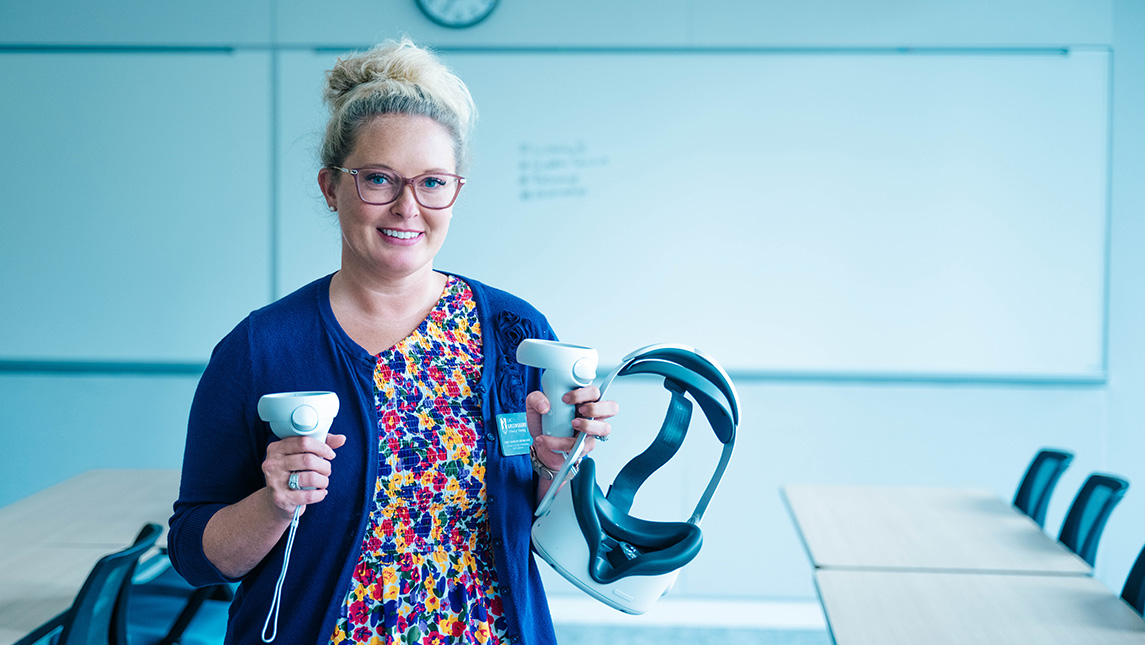
And just as Draper adapts easily to changes in nursing technology and culture, she’s also innovating the field. She is one of the School of Nursing’s faculty introducing students to artificial intelligence’s applications, developing a two-week module for graduate students. She customized two AI tools named Navi and Kate. Students can ask them questions or get feedback on drafts of professional memos, emails, and executive summaries. She also contributed to the UNC System’s Foundations of AI course, leading development of its “AI in Health Sciences” module.
On top of all that, she supports her fellow faculty as a mentor, textbook author, and a lead faculty of the UNC System’s Nursing Open Educational Resources initiative. Eloise R. Lewis Excellence Professor Pamela Rowsey says, “Her contributions to nursing education and her leadership in curriculum innovation and development make her a role model for colleagues and an inspiration to students.”
“Ultimately, my goal as an educator is to prepare nurses who are not only clinically competent but also capable of leading change within complex healthcare systems,” says Draper.
Story by Janet Imrick, University Communications Photography by Sean Norona, University Communications
Kids Foster Creativity, Confidence, and Community at Summer Camps
Posted on April 09, 2026
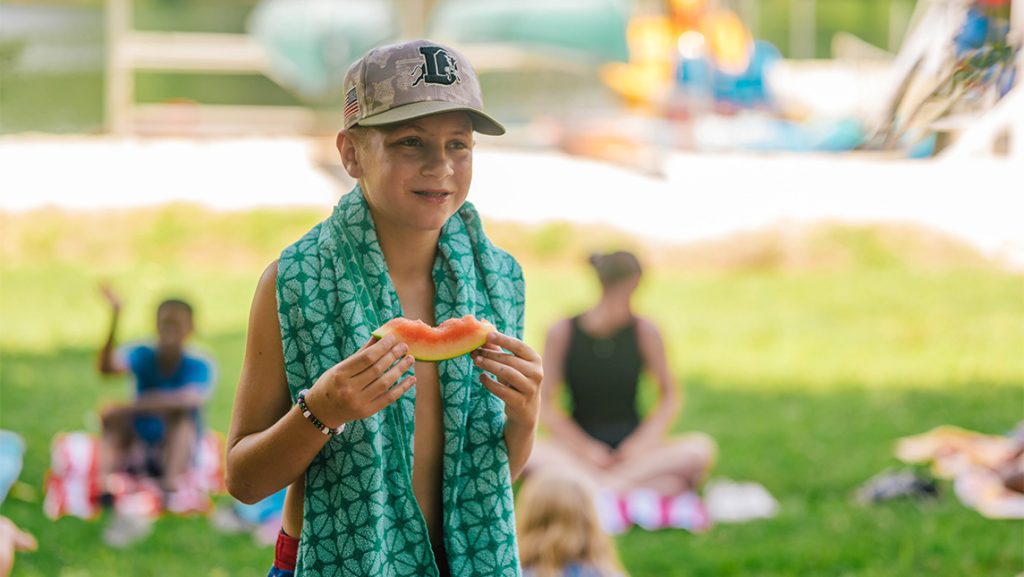
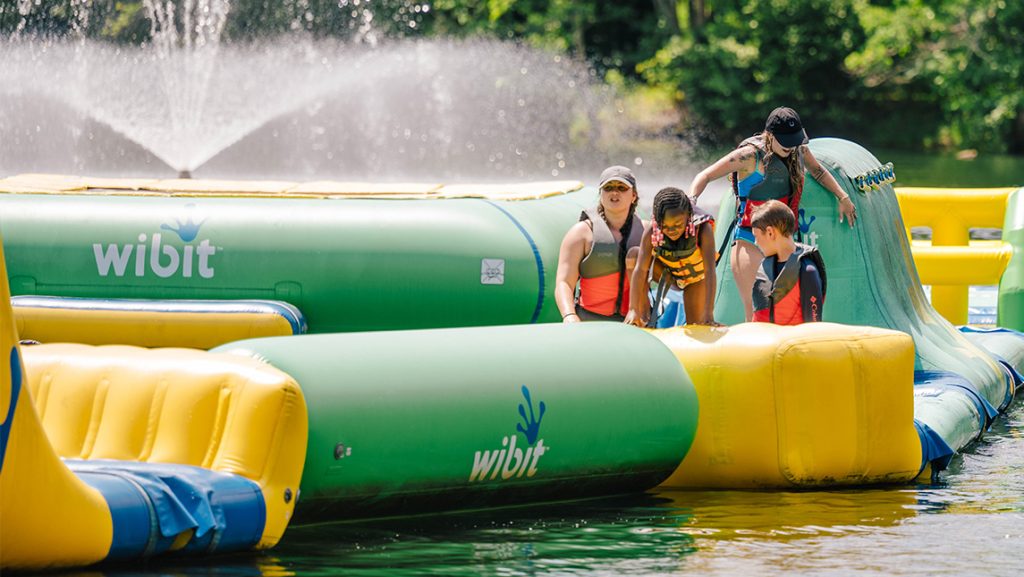
In the summertime, UNC Greensboro buzzes with the happy squeals of kids swimming in Piney Lake, the thud of basketballs echoing off the hardwood, the swoosh of paintbrushes upon canvases, and lively musical beats filtering down studio hallways.
As most Spartans head home for their well-earned break between semesters, UNCG’s faculty and staff open their classrooms and workspaces to children from the community with summer camps satisfying a range of personalities and interests. Some kids want to refine their athletic prowess before their next season or find inspiration with expert artists. Others with medical conditions that make a traditional camp a challenge find a sense of belonging thanks to activities led by graduate students who are experts in their field of care.
No matter which experience brings them to UNCG, campers leave with smiles and a sense of fulfillment to carry them through the rest of their year.
Maestros in the Making
Music Camp
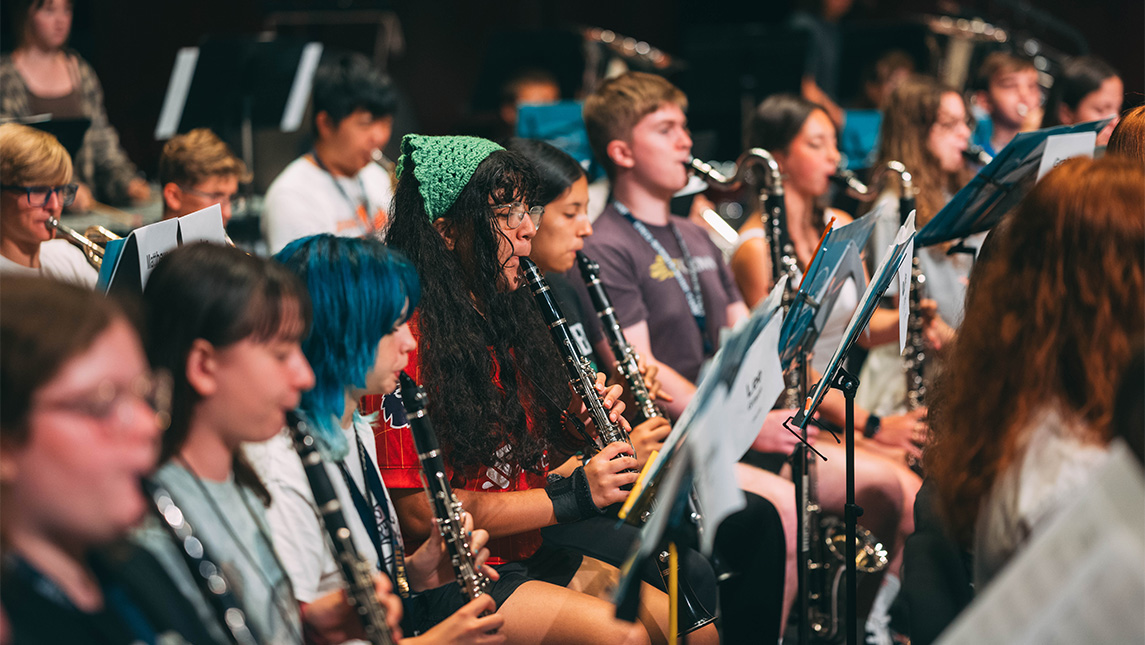
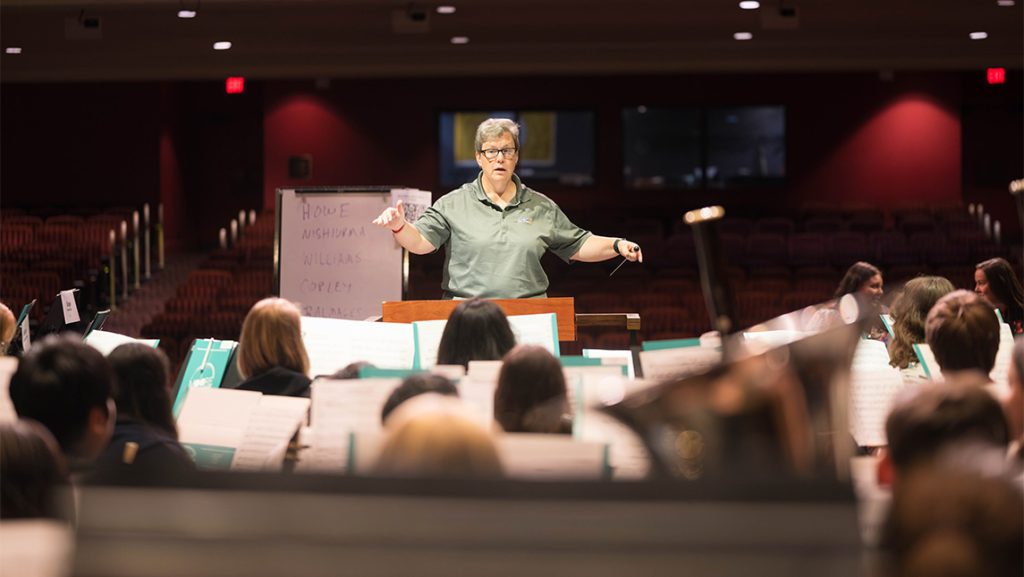
This immensely popular camp attracts roughly 1,600 high schoolers skilled in all kinds of instruments. The emerging artists get to practice alongside distinguished professors and conductors from UNCG in a weeklong session, closing out with a performance for families and community members. Programs will center on band, chorus, orchestra, and piano, and they can sign up for beginner-, junior-, and senior-level sessions.
Summer Arts and Design Intensive
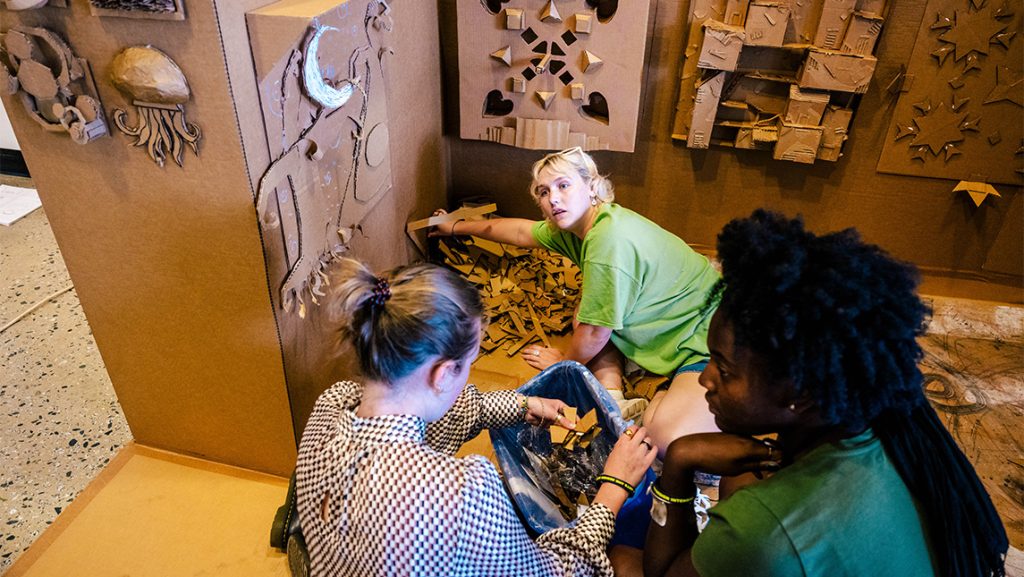
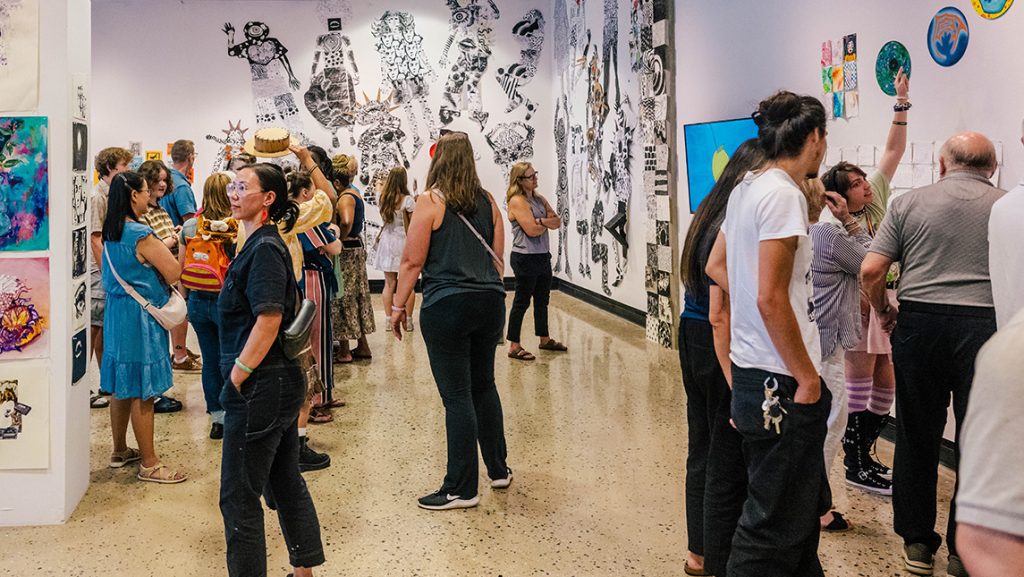
Up to 100 teens may take part in a week-long residency where faculty-led studios combine lessons in traditional art techniques with contemporary experimentation. Campers can experiment with various art forms. They will hear artist talks, visit galleries, and attend a career seminar. At the end of the residency, they’ll host their own student art exhibition at the Maud Gatewood Studio Arts Center.
New this year, the School of Art and Department of Media Studies will provide a filmmaking class. Other art forms include drawing, painting, printmaking, sculpture, photography, animation, and graphic design.
“I grew up in a rural area where musical opportunities were limited, so I truly treasured my summers at camp. Those experiences helped to shape my love of music, and they’re a big part of why this work means so much to me today.”
— Emily Scotton ’06, former Music Camp participant, now associate director
The Esports and Gaming Summer Camps are for children ages 8–17. Over five days, campers will get tech-driven STEM education by instructors from Black Rocket. Each attendee can focus on two major subjects — one in the morning and one in the afternoon — with plenty of time allotted for gameplay and friendly competitions.
Global Leaders Academic Exploration Program
This camp, hosted by the Global Engagement Office, is all about raising the next generation of leaders. High school students will join interactive workshops and complete projects about leadership, personal growth, foreign language, and global awareness. Field trips to museums, movie theaters, bowling alleys, and more ensure they get their fill of educational fun.
The camp is also open to international students, who will enjoy an extended stay to immerse themselves in United States culture and work on their English-speaking skills. In the second week, they join domestic students to gain a deeper understanding of one another.
Technovation 4 Good
Rising high school sophomores through seniors develop key technological skills that will serve them in the long term. Led by the Department of Information Systems and Supply Chain Management, campers get hands-on lessons in programming, cybersecurity, data analytics, mobile app development, the Internet of Things, sustainability, and analytics.
“It’s not an opportunity every student gets…. I was thinking, ‘Do I want to go into the tech field?’ Now I’m helping more students feel comfortable with that decision.”
— Ashley Mejia, Technology4Good former participant and residential leader
In a week with ExPlorers, high school students build their knowledge of phosphorus sustainability in North Carolina. They observe and work with innovative technology, including 3D-printing, conduct their own interactive experiments and problem-based learning, and take field trips to learn more about agriculture. They also see how STEM comes into play every day in industries, the government, and global communities.
Scoring Goals for the Game and Sportsmanship
Soccer? Baseball? Basketball? Softball? What sport puts a smile on your child’s face? They’ll learn more about it at the G. Spartan coaches and team staff hold these camps for kids to hone their skills and work up a sweat. They form a healthy athletic outlook that will benefit them in the game and the game of life.
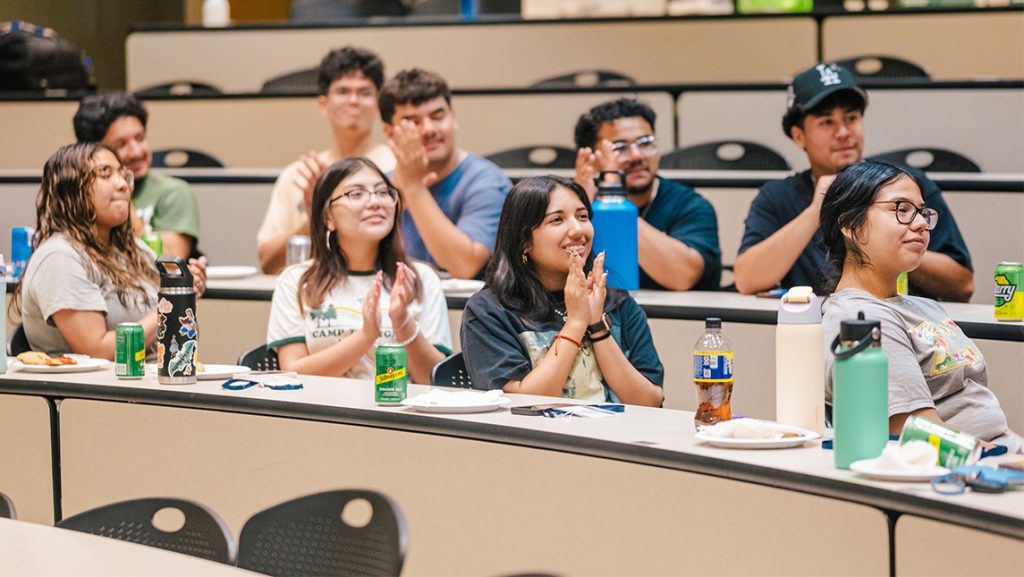
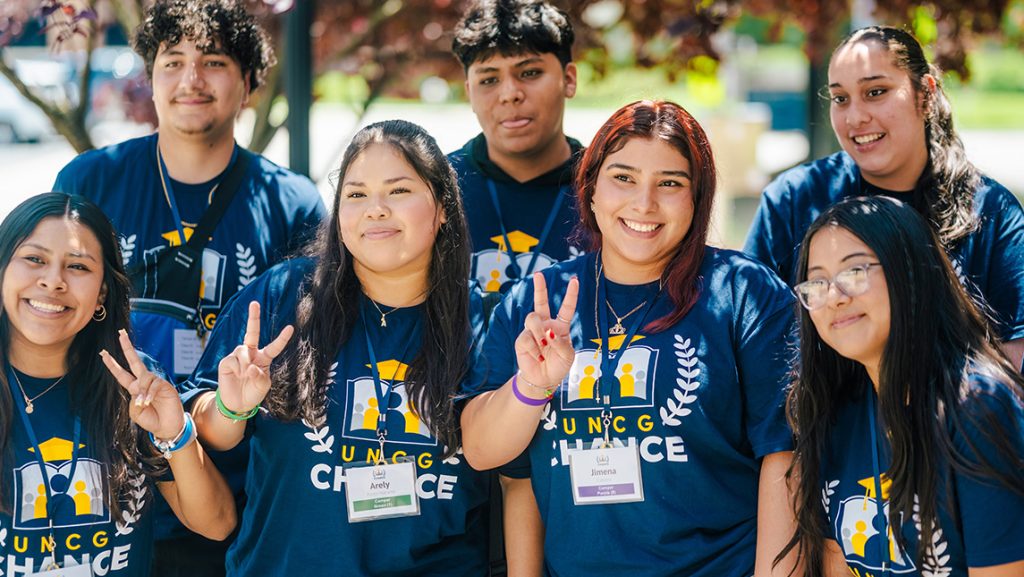
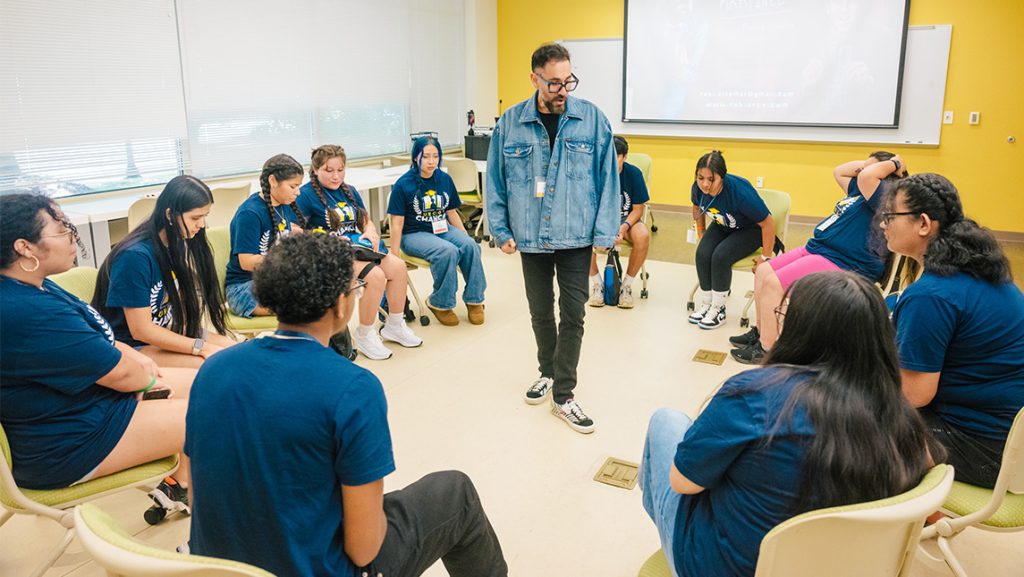
The highly popular CHANCE Camp combines rolls a sample of the college experience into the fun and games. With activities centered on academic success and personal growth, it encourages high school students to pursue a college degree by showing that it is well within their reach. The weeklong experience links them with mentors and teaches them about leadership, empowering them to make an impact in their communities.
Extending the Camp Experience to Everyone
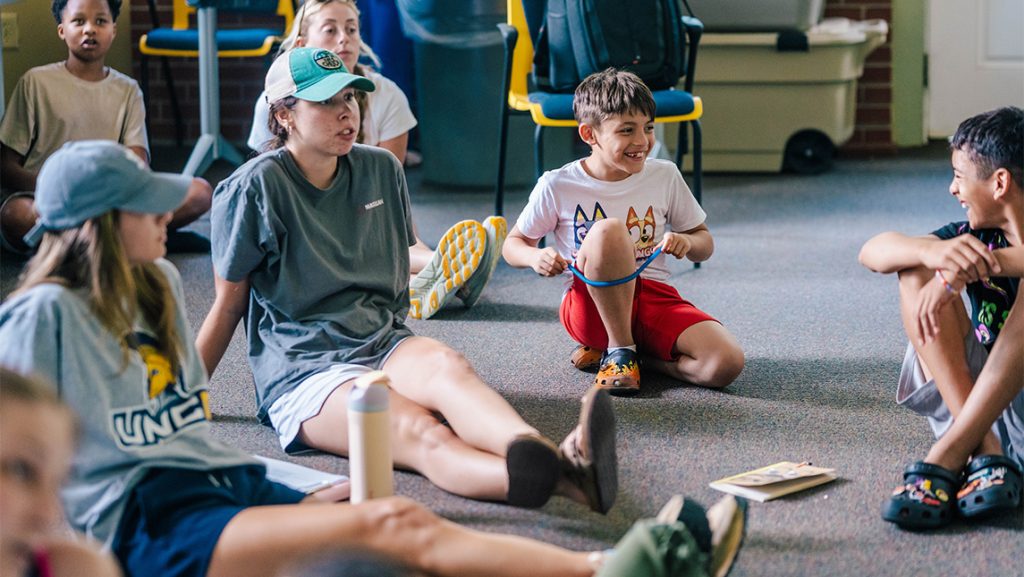
In keeping with UNCG’s mission to enrich the community and serve those most in need, some of its programs ensure that all kids enjoy summer camp, especially those with disabilities or medical challenges. These come together thanks to the dedicated work of faculty and their graduate students.
“Kids are getting to do the same things that kids at other camps are doing, like swimming, yoga, playing, and yet they’re still working on skill-building and they’re having fun while doing it.”
— Dr. Lisa Fox-Thomas, Assistant Director, Speech and Hearing Center
Camp Speakalot
This free camp is tailored specifically to children with stutters. They will take part in all the staples of summer camps: hiking, art, games, and water activities at Piney Lake. This camp is also part of the Department of Communication Sciences and Disorders’ research study of Acceptance and Commitment Therapy, so the participants will receive special attention from certified speech-language pathologists and graduate clinicians.
Listening Lab
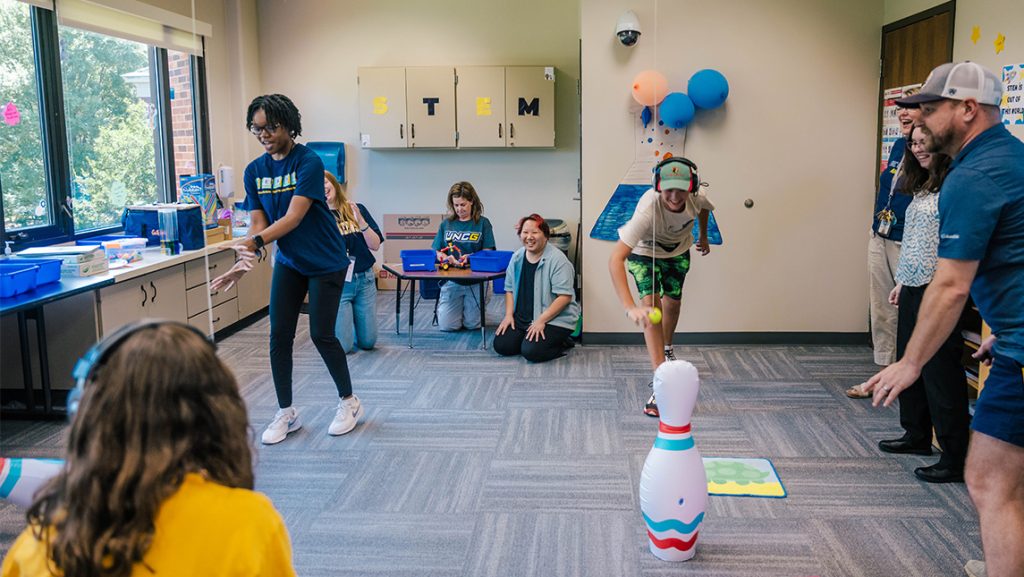
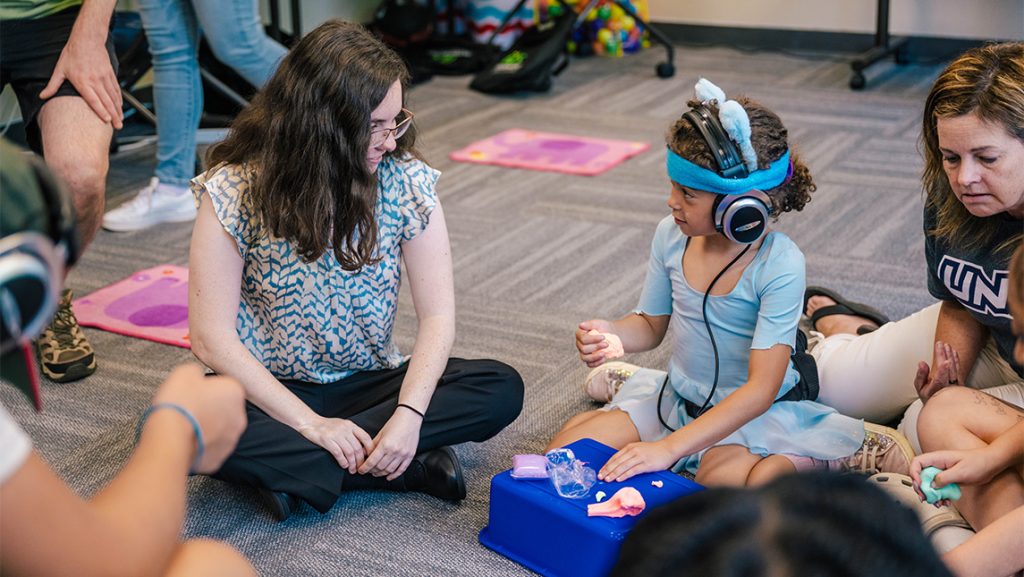
The Listening Lab turns 10 years old this year. Thanks to the UNCG Speech and Hearing Center, elementary-aged children with auditory processing disorders get to enjoy engagement with professionals and their peers. They rotate between listening stations and receive group and one-on-one training, alongside speech-language intervention and emotional regulation strategies.
UNCG’s Psychology Clinic hosts Dream Camp every year, a summer day camp for children with social skills and friendship challenges, including — but not limited to — autism spectrum disorder. In between arts and crafts, musical performances, and sports, the campers practice communication and coping skills and emotional awareness while gaining socialization experience with one another. Adolescents will receive appropriate life skills training.
Story by Janet Imrick, University Communications Photography by Sean Norona and David Lee Row, University Communications Video by David Lee Row, University Communications
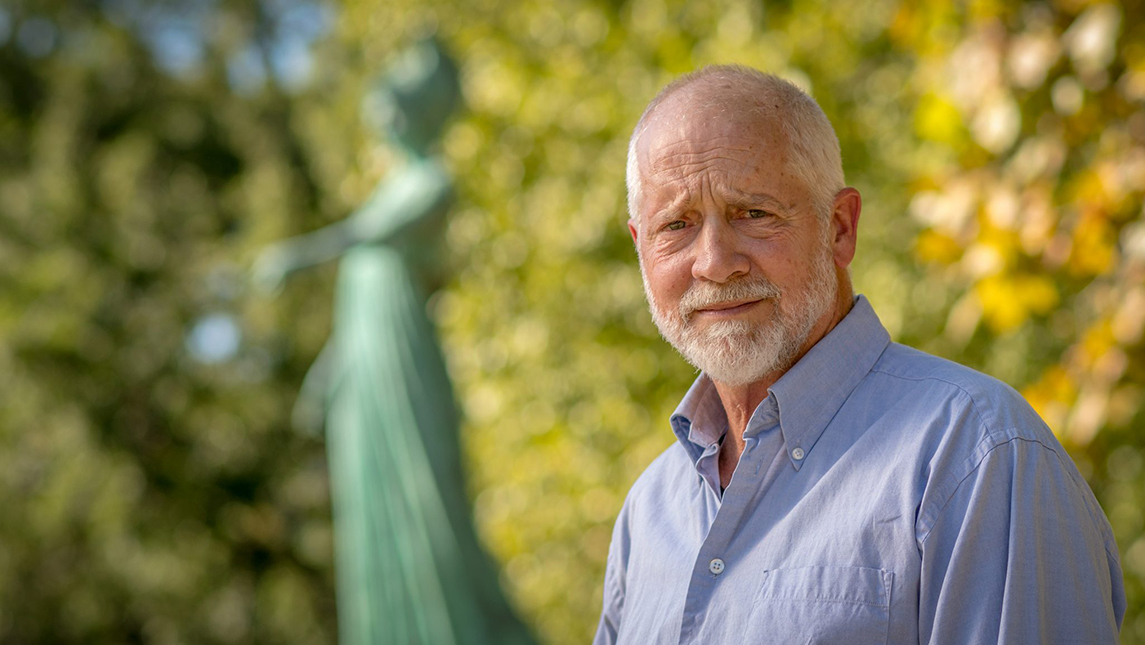
Some of Greensboro’s most iconic artwork — Nathanael Greene, the February One sit-in leaders, and UNCG’s own iconic Minerva — sprang from the mind of alum James Barnhill ’82 MFA. He’s also mentored thousands of students and displayed his sculptures across the nation. An exhibition of 30 works by Barnhill will open to the public on May 8 at Greensboro’s Continental Club Gallery.