UNCG scientist investigates geography’s impact on access to jobs, recreation
Posted on May 01, 2024
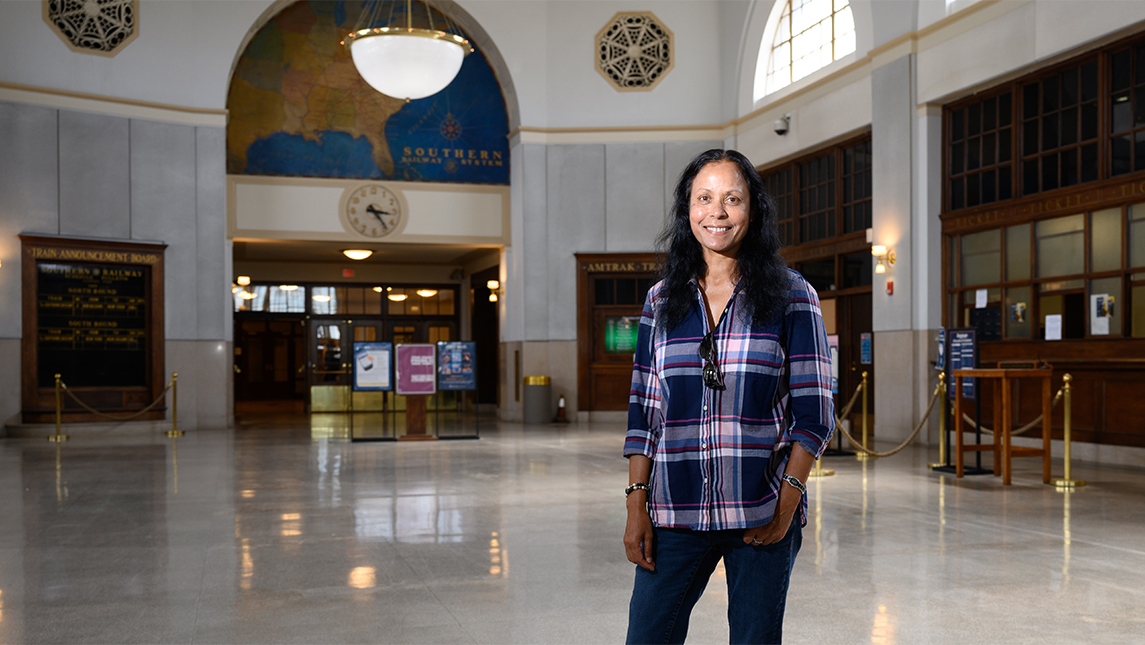
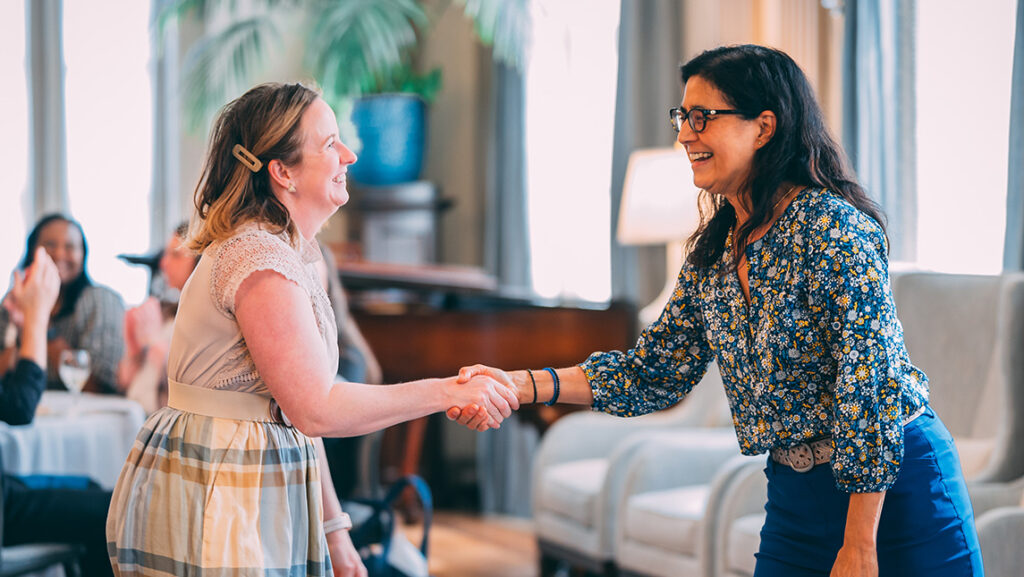
Dr. Selima Sultana, a fellow of the American Association of Geographers, is an expert on geography and urban transportation research.
When Selima Sultana was a graduate student living in Atlanta, Georgia, she was excited about a potential new job until she faced a hurdle in the application process.
“When I was interviewed, they asked whether I had a car and I said I didn’t. They were very hesitant to hire me,” she says.
This conundrum became the crux of Sultana’s dissertation research. Now, as a professor and the associate department head in UNC Greensboro’s Department of Geography, Environment, and Sustainability, Dr. Sultana is a leader in transportation and urban research. She has published and authored over 50 peer-reviewed papers, two books, and another book under contract. In 2024, she was named a fellow of the American Association of Geographers – a prestigious recognition for select scholars who have made significant contributions to geography.
Sultana’s research focuses on how the geographic location of jobs and housing significantly impacts people’s access to opportunities, jobs, and recreation – creating consistent barriers for some.
A long commute is not just an annoyance; these daily drives are linked to many downsides.
“Studies suggest that if people are commuting a long distance every day, their productivity goes down,” she says. “Longer commuting is linked to a variety of mental and physical health impacts, including obesity.”
Sultana says the design of a city can leave people with few options, forcing them to either commute extensively or face unemployment if working from home is not an option.
For her dissertation research, Sultana applied geographic information systems to determine the degree to which people are separated from their jobs. She found this job-housing imbalance was prevalent in the Atlanta metropolitan area.
“I was integrating geographic information into urban and transportation planning, which was rare at the time,” she says.
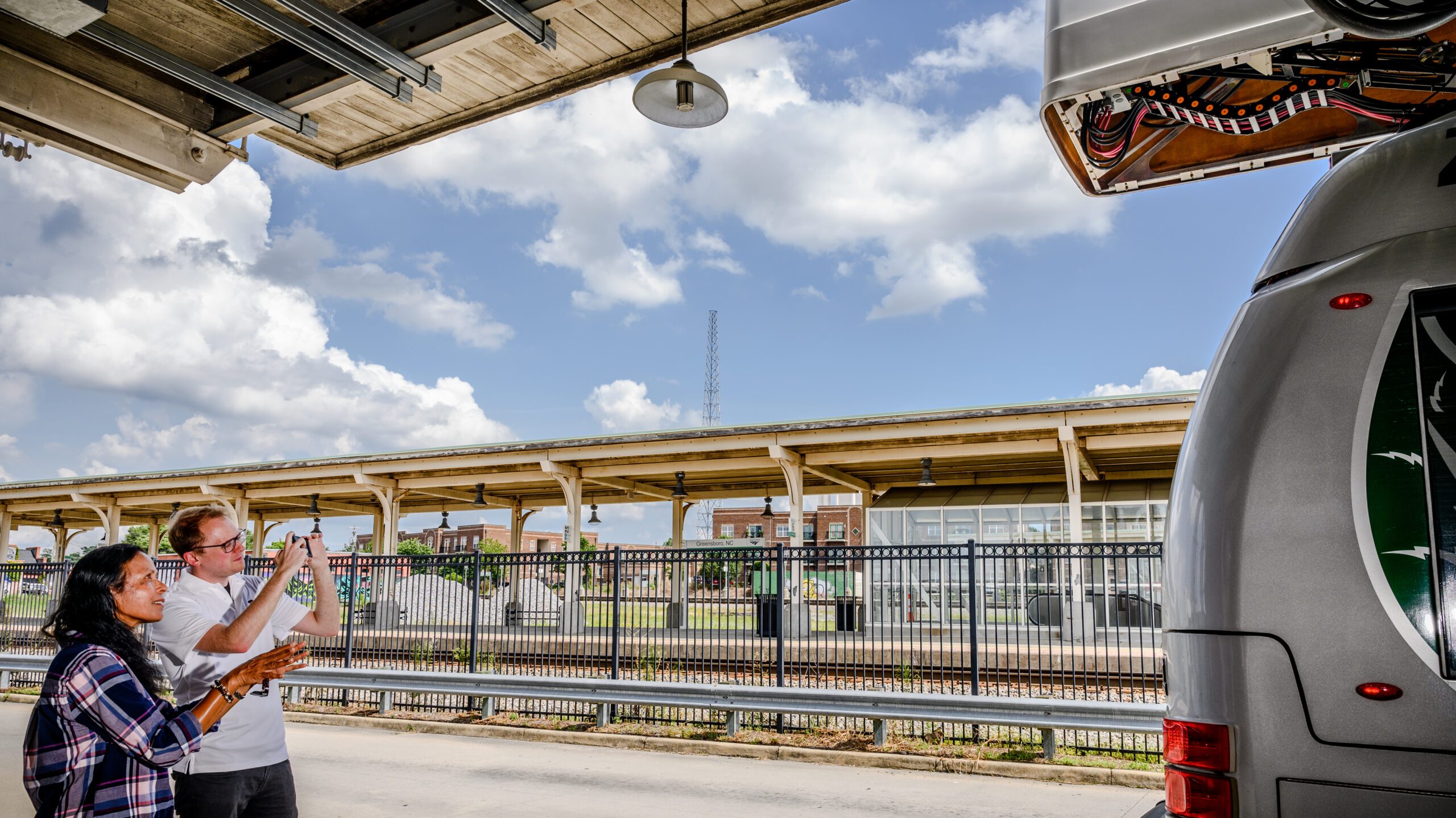
Since this initial study, Sultana has expanded her transportation research, including recent work investigating the accessibility of electric vehicle charging stations. Her goal is for her research to help policymakers and leadership make meaningful changes that foster equal access for all individuals.
“My motivation is always to solve real-world problems and make sure the solution helps the community equally,” Sultana says.
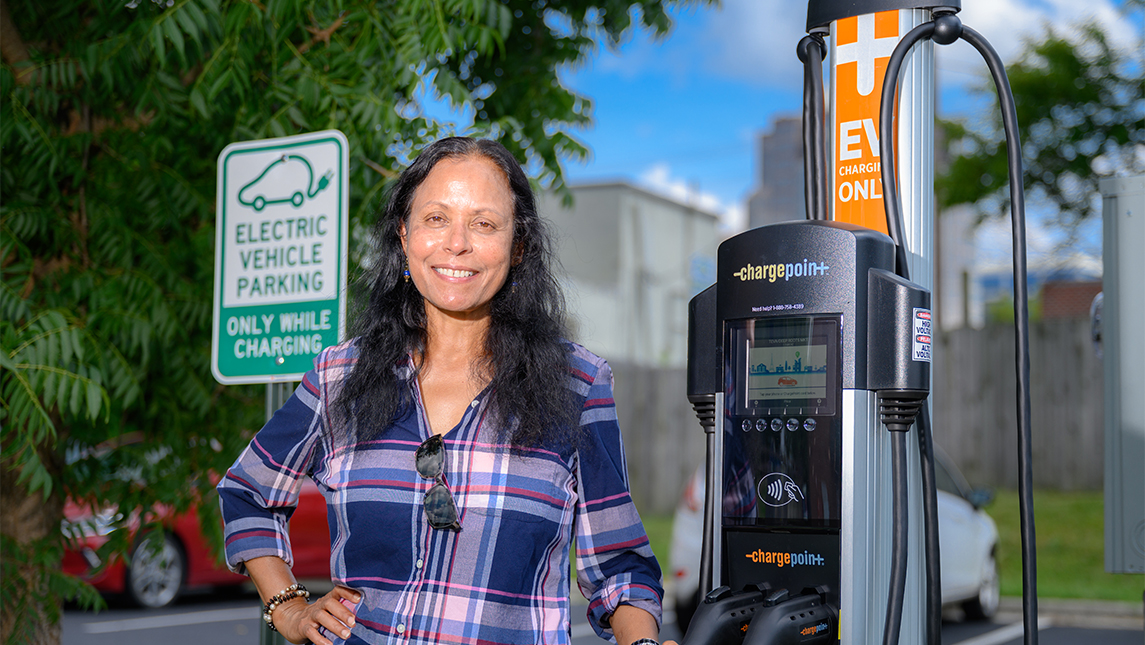
Among Sultana’s areas of expertise, she has investigated the accessibility of charging stations for electric vehicles.
Accessing national parks
When Sultana moved to the United States from Bangladesh, she was captivated by the National Parks. She resonated with the parks’ beauty, but also the mission of the National Park to make nature accessible to everyone.
“The concept of National Parks is really an American concept of access for everybody,” she says. “The goal is preservation of the parks from generation to generation.”
Sultana says preserving the parks – and its funding – hinges upon ample visitors. Like Sultana, who took solo trips to the parks as a young adult, sleeping in her car, and soaking up the sights.
“All of a sudden, I looked around and thought, ‘How come the people who visit these National Parks are predominately white?’” she says.
Sultana’s musing sparked a multi-decade long collaboration with Dr. Joe Weber, a professor at the University of Alabama who grew up in Death Valley National Park. Together, they have published multiple papers and books, including their recently published book, “The Parks Belong to the People,” in which they examine park visitation rates, geography, and how the parks are changing over time.
Among their findings, the scientists have found that many Black Americans have the least accessibility to the parks, which Sultana says contributes to lower visitation rates. Sultana has built on this work in a recent study by visiting Great Smoky Mountains National Park with UNCG students.
Their goal: better understand why there are fewer Black visitors to the park, despite geographic information indicating many Black individuals live close to Great Smoky National Park.
“We found that Black Americans are seldom mentioned in Great Smoky Mountains National Park’s historical records and only minimally featured in public materials and exhibits,” she says. “This historical pattern might have conveyed to Black Americans that the park is an unwelcoming space for them.”
Sultana shared these findings with the National Park Service. She says working with students, including on this study, is one of the highlights of her job – whether watching their eyes light up when a concept clicks or they publish a paper.
For Sultana, being a faculty member is more than conducting research and mentoring students. She also invests in service – both within the University and for geography organizations – to make a positive dent in the field.
“When you get involved and you have a seat at the table, you can always make an impact,” Sultana says.
Story by Rachel Damiani Photography by Martin Kane
UNCG Students Invited To Attend United Nations Session
Posted on April 30, 2024
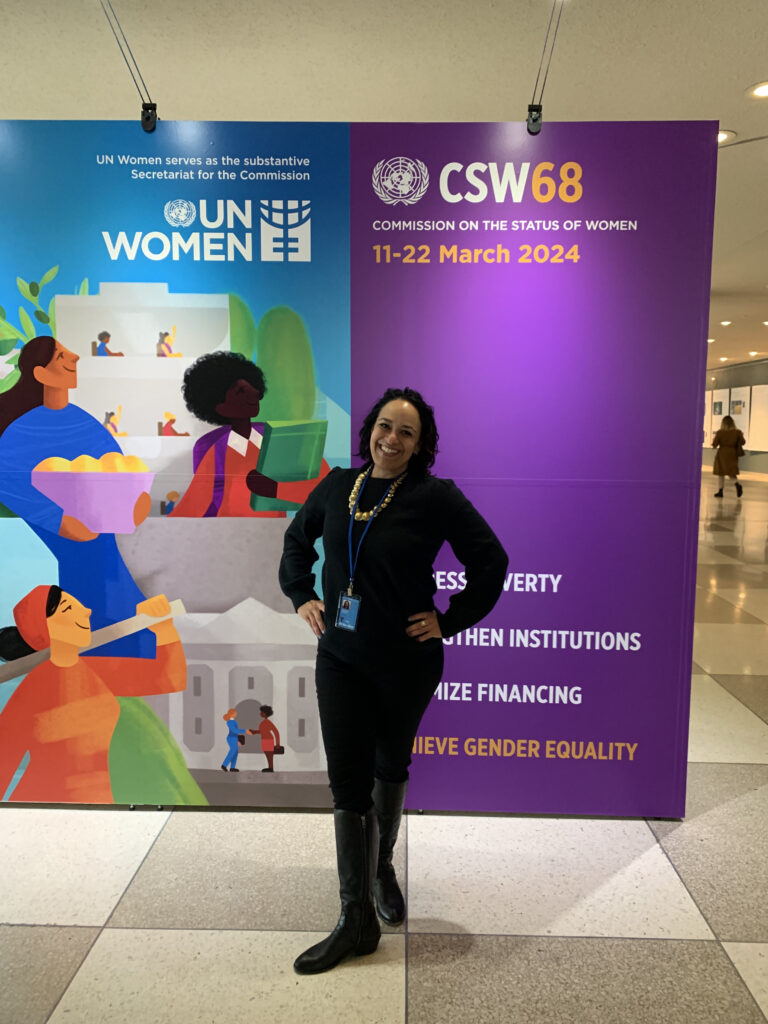
Two UNC Greensboro students earned the honor of attending the United Nations 68th Annual Session of the Commission on the Status of Women. The meeting is the largest gathering on gender equality and women’s empowerment, held at the United Nations headquarters in New York City.
Doctoral student Nida Qamar and graduate student Cathy Knowles ’98 both attended the session in March 2024, having been invited through different organizations.
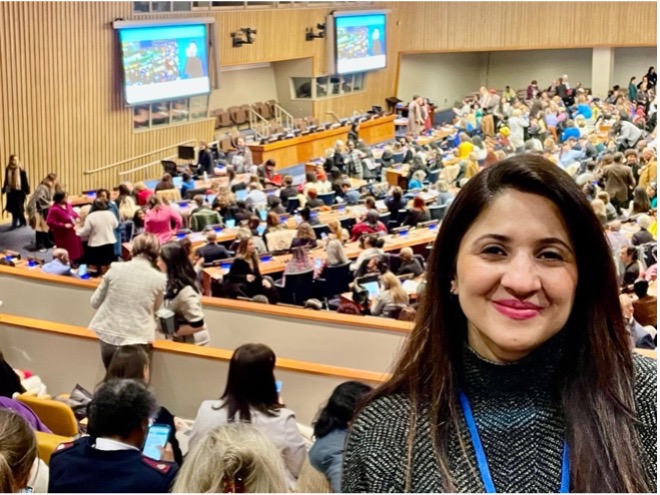
Qamar at the UN 68th Annual Session of the Commission on the Status of Women
Qamar’s research interest is in identifying and preventing human trafficking among foreign-born people in the U.S.
“Sessions such as ‘Innovative Partnerships to End Trafficking in Women and Girls,’ and ‘Collaborative Efforts in Technology and Policy to Fight Human Trafficking” provided invaluable insights into the complexities of this issue,” Qamar says. “The discussions highlighted the crucial role of technology in aiding law enforcement and other service providers efforts while emphasizing the need for collaborative approaches and policy reform to combat human trafficking effectively.”
This trip was the first time Qamar has ever been to the United Nations headquarters.
“It was very interesting and empowering,” she says. “It was amazing to see experts from all across the world come together for these sessions.”
Originally from Pakistan, Qamar earned both her bachelor’s degree and master’s degree abroad and has lived all over the world, including in Lebanon, UK, Italy, Fiji Islands, and Thailand, but it was UNCG’s Department of Public Health Education that brought her to Greensboro.
“I am interested in working in the community with refugees and immigrants, so when I was searching for a PhD program, I came across UNCG’s community health education program,” says Qamar. “I spoke with the faculty, and they were amazing. They were very knowledgeable and responsive. It was exactly what I wanted. North Carolina is also a hub for refugee resettlement agencies, so it worked out perfectly.”
COMING FULL CIRCLE
Cathy Knowles at the UN 68th Annual Session on the Commission on the Status of Women.
Knowles says going to the United Nations was a “dream come true.” She earned her undergraduate degree from UNCG in 1998 and is now working on her graduate degree in peace and conflict studies, with a focus on sustainable peace and justice. She spent the last 20+ years working at non-profit organizations in New York, Los Angeles, and now the Community Foundation of Greater Greensboro.
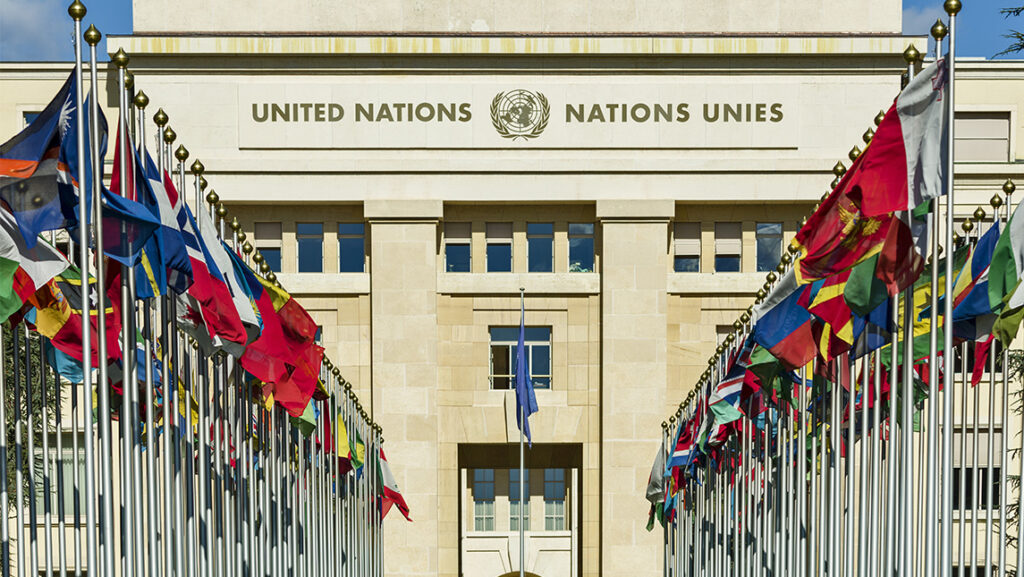
“I got into my career because I am a strong administrator, but my heart has always been in field work,” she says. “UNCG started me off in that area, and now I feel like I’m coming full circle with some childhood dreams. Standing in front of all the flags at the United Nations, having a security pass, getting to see all of the artwork, and seeing all of the people from around the world, it was very transformative.”
“Dr. Hale met with me and listened to what my interests and passions are. She then forwarded me this opportunity and wrote one of the best recommendation letters I’ve seen in 24 years as a professional. It was so thoughtful,” she says.
During the five-day trip, Knowles was able to attend 17 different sessions related to women and gender issues, including the first Indigenous-led session.
“It was a fully female panel, hosted by Canada and Mexico. They ranged from doctors and lawyers to ministers and talked about issues like recognizing Indigenous sciences to the crisis of missing and murdered indigenous women, girls, and two-spirit people. I knew about the crisis, but I didn’t know much, which is why I’ve chosen it as my research topic.”
DIGNITY AT THE FOREFRONT
Knowles would like to apply her learnings to issues facing women, girls and gender-diverse people. It was a guest speaker in her peace and conflict studies program that shifted her perspective.
“He talked about how, in every interaction that he had with someone in the field as a peace builder, he keeps dignity at the forefront of every single conversation,” Knowles says. “So, everything that he is doing in his practice is about paying attention to the humanity of the other people, and I thought that was a wonderful way to navigate work.”
The trip has helped to inform Knowles’ graduate studies, not just by introducing her to new research opportunities, but also from hearing about how people are working on local solutions to real world issues.
“It was one of the best experiences of my life, and it only happened because I’m enrolled in this small department at UNCG with a very dedicated and compassionate faculty,” says Knowles.
Story by Avery Craine Powell, University Communications Photography courtesy of Cathy Knowles and Nida Qamar Feature photo courtesy of adobe.stock.com
Dr. Channelle James, a lecturer of marketing, entrepreneurship, hospitality, and tourism was named a Leader in Diversity by the Triad Business Journal. The awards celebrate companies and individuals who have worked to establish and advance diversity and inclusion efforts in their workplaces and communities.
Dr. Michael Hemphill, associate professor of kinesiology, is one of the keynote speakers at the International Organization for Physical Education in Higher Education conference in Finland. On May 14, Hemphill will speak on theoretical underpinnings of restorative justice and discuss its implications for transformative practices in physical education.
History Professor Charles Bolton published an article on the Oxford University Press blog titled “The US South: A deadly front during World War II.” The piece is related to his book, “Home Front Battles: World War II Mobilization and Race in the Deep South,” forthcoming with Oxford this spring.
The This Old House website rolled out tips for seniors to comfortably adjust during a move, courtesy of Dr. Rebecca Adams, professor of gerontology and sociology.
Psychology Professor Bob Wiley published the English Sublexical Toolkit on Behavioral Research Methods. By analyzing patterns in English words, this suite of tools provides novel measures of sound-spelling consistency that enhance understanding of reading and spelling behaviors for both real and pseudowords.
Stand-Out Students Set the Tone in UNCG’s Class of 2024 Hype Video
Posted on April 29, 2024
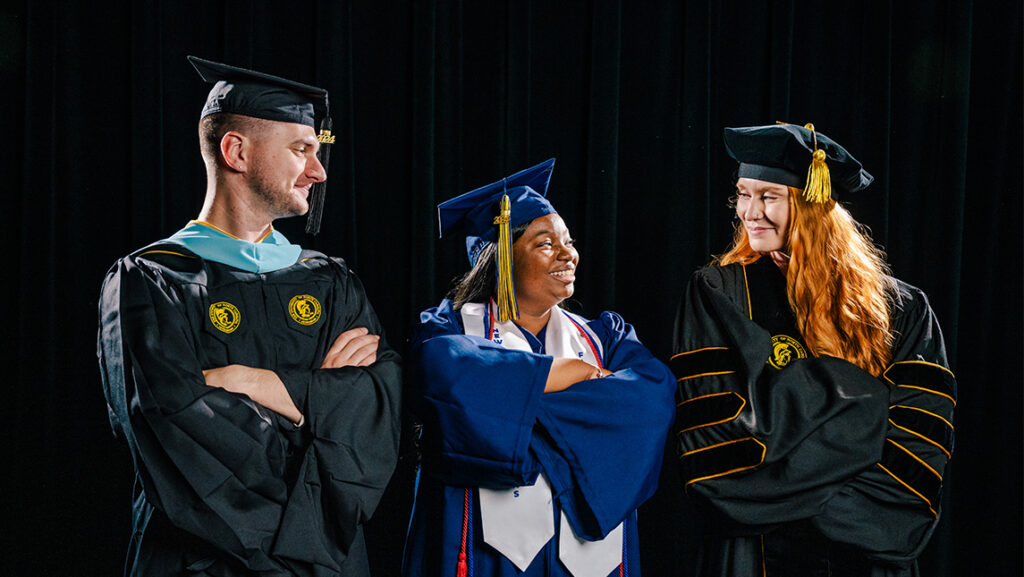
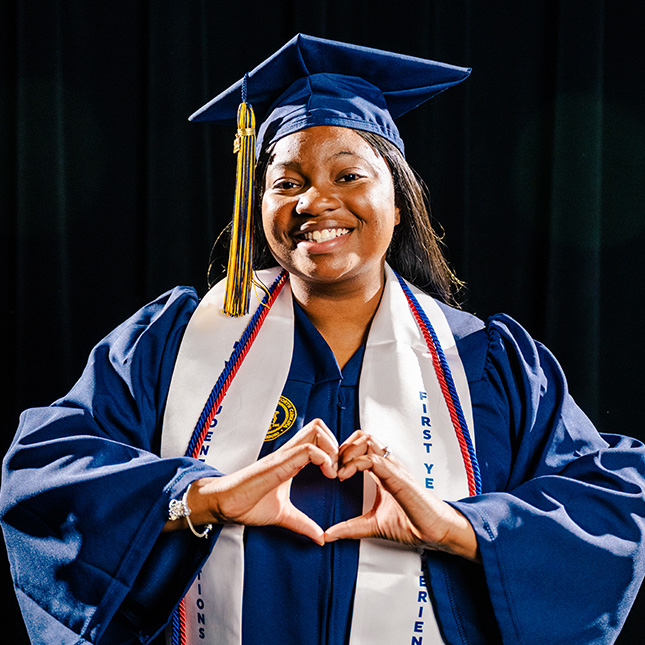
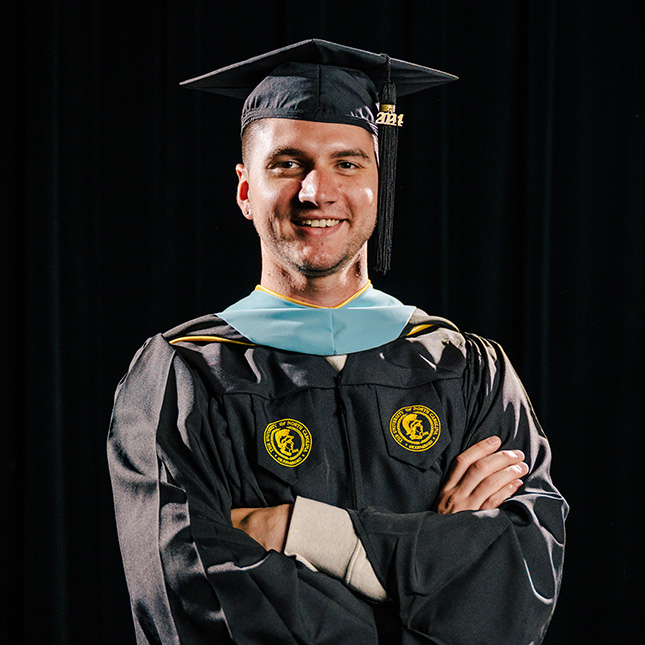
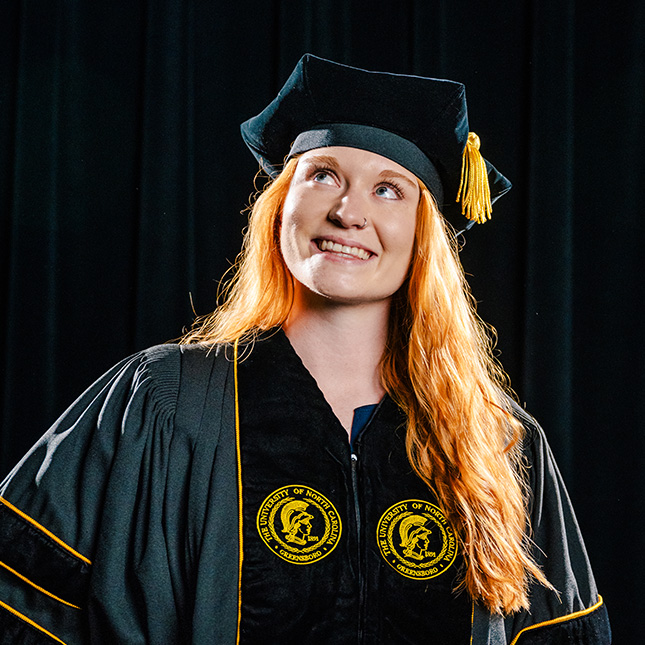
The commencement hype video has become a ceremony opener that sets the stage for excitement, pride, and all-around Spartan spirit.
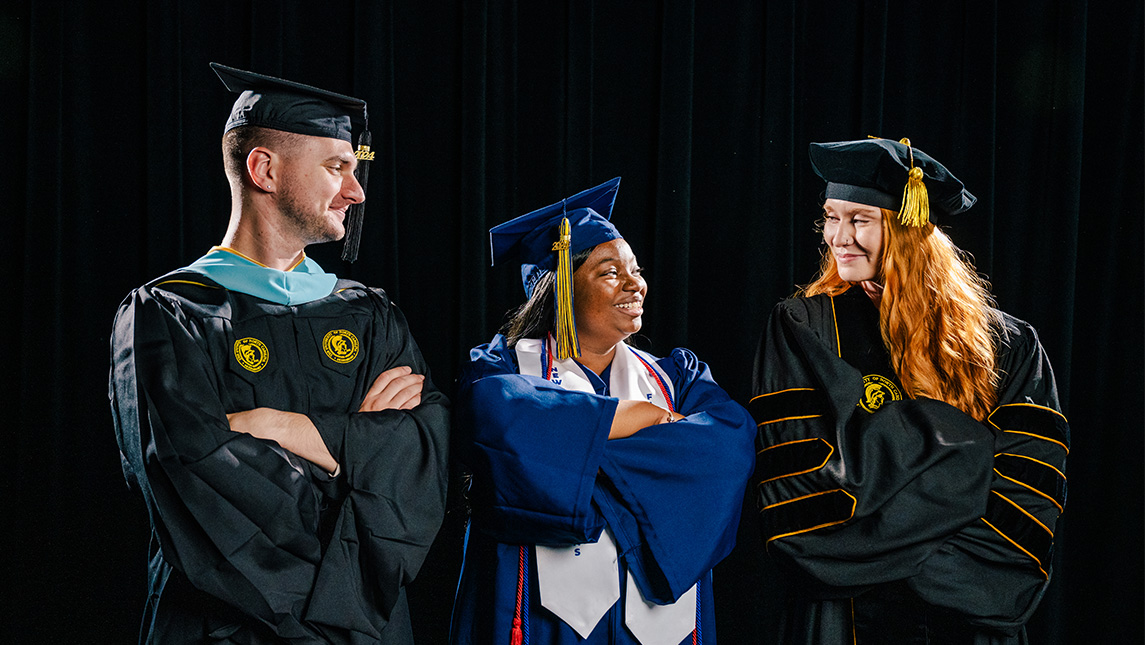
Selected from academic departments and student organization recommendations, an undergraduate, master’s and doctoral student represent their graduating classes in the video. Although auditions and interviews aren’t involved in the selection process, the selected students never fail to bring the requisite hype of an excited and accomplished grad.
To follow are this year’s hype video stars. Follow in their footsteps and you could be the one bringing the hype at your commencement!
Post-graduation plans: I plan to become a certified doula and work in maternal health.
What drew you to UNCG initially? The diversity, sense of community, and support for first generation college students like me.
What unexpected opportunities did you find during your time here? I found a new passion and career path to become a doula through my internship and amazing mentors who are always putting me in positions to grow professionally and academically.
What are you most grateful for about your college experience? I am most grateful that I met my best friends/sisters Makalah and Janae. My experience wouldn’t be an experience without meeting them and the memories we’ve made together.
How will you celebrate commencement? I will celebrate by spending time with family and friends.
Campus activities & honors: Bronze Level Spartan Leadership Challenge Workshop Facilitator, Silver Level Spartan Leadership Coach, Chi Sigma Alpha (Student Affairs Honors Society), HESA (Higher Education Student Association), Spartan Leadership Award (2023), organized first international trip for the SAAHE program to experience the field of Student Affairs abroad in Toronto, Ontario, Canada
When I was applying to graduate programs, I had a chance to meet with Dr. Brad Johnson, the program coordinator and faculty member in the Student Affairs Administration in Higher Education program. He made me feel like a valued member of UNCG, even before I had submitted my application. I knew I would be able to converse openly with faculty members here. At other institutions, I felt just like a number in their system.
What unexpected opportunities did you find at UNCG?
At UNCG, I organized the first international trip for my master’s program. I formed a new international partnership with the University of Toronto to visit their campuses and meet with their Student Affairs offices. This experience allowed us to see a completely different side to our field. It was a unique and enlightening experience!
What are you most grateful for about my college experience? I am most grateful for the relationships I have made with classmates, professional staff, faculty, and community members. I have met incredible people who have pushed me to grow in many ways and I am excited that they will stay a part of my life in the future. I am lucky to be surrounded by classmates who are changing the field for the better and who are pushing the boundaries of how we can support students, and staff and faculty who serve as inspirations for future generations of changemakers.
How will you celebrate commencement? I will take some time to celebrate this achievement with friends and family. I was not able to celebrate my undergraduate commencement in a traditional manner because of the COVID-19 pandemic, so this graduation will serve as a celebration of both of my degrees!
Undergraduate Degree: BS in Biological Sciences & minors in Chemistry & Psychology
Campus activities & honors: I am the first scientist to discover that honeybees have a reproductive microbiome and that antibiotics used in beekeeping negatively affect honeybee reproduction. I have shared my research results and implications during invited talks for Beekeepers Associations across North Carolina and was awarded the John T. Ambrose Student Researcher award in 2021 by the NC State Beekeepers Association.
My research has earned nearly $900,000 in grant funding which includes a USDA predoctoral fellowship, and a collaborative USDA grant with colleagues at NC State University. I have given research presentations at large annual conferences and have won 3 presentation competitions.
I also served one year as the biology department senator for the UNCG Graduate Student Association, followed by two years as vice president and programming committee chair where I conceptualized, organized, and hosted over 35 events for graduate students.
Post-graduation plans: I will continue working for my advisor until August to finish publishing papers while I apply to biotech and other industry positions.
What drew you to UNCG initially?
When I was applying to PhD programs, I found my advisor who had aligning research interests and she happened to be starting a lab at UNCG. Coming from North Dakota, I was excited about the North Carolina weather and being close to the ocean. I visited Greensboro and UNCG in my last semester then moved here two weeks after graduating to start my PhD research!
What unexpected opportunities did you find at UNCG?
As an undergraduate, I did not participate in student government or campus activities, but there were many opportunities to get involved here and I was compelled to try to positively impact my fellow students and the UNCG community. I never expected to become so involved, but it benefited me with purpose and leadership skills. Over my six-year PhD at UNCG, I have sat on two panels and 11 committees.
What are you most grateful for about my college experience? I am most grateful for the life lessons I have learned from the amazing people I have worked with. Not only have I had the opportunity to work with top notch mentors at UNCG, but I have also helped empower the next generation by teaching general biology labs and conducting research with 13 undergraduates throughout my degree.
How will you celebrate commencement? After graduation, I will be going on a relaxing week-long vacation to the Outer Banks with my fiancé, parents, and brother to celebrate achieving my PhD.
Story by Becky Deakins, University Communications. Photos by Sean Norona, University Communications.
CELEBRATE OUR GRADS!
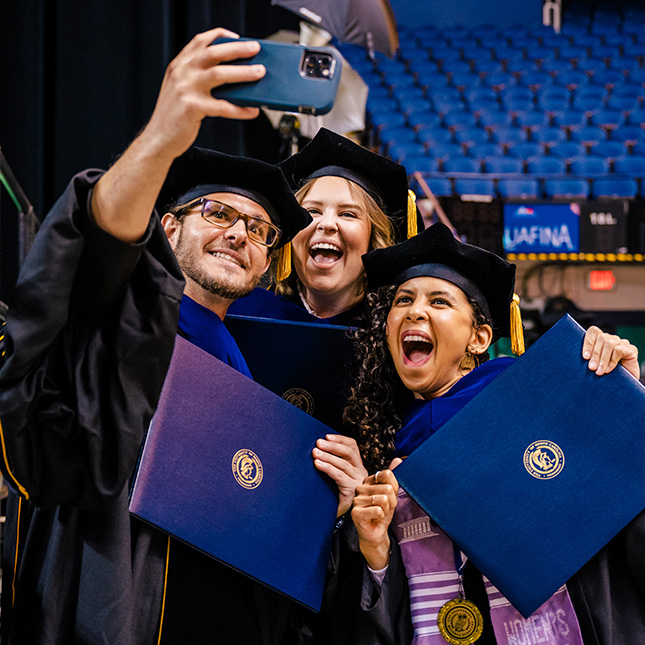
Graduate Commencement: May 2 at the Greensboro Coliseum Undergraduate Commencement: May 3 at the Greensboro Coliseum
Graduates and their families are encouraged to share their accomplishments on social media by tagging the University accounts and using the hashtags #UNCGGrad and #UNCGWay. Visit UNCG’s digital swag page for graduation-themed graphics, filters, and templates.
Mention @UNCG in celebratory posts on Instagram and X and @uncgreensboro on TikTok.
UNCG Awards Teaching Excellence and Stellar Mentorship
Posted on April 29, 2024
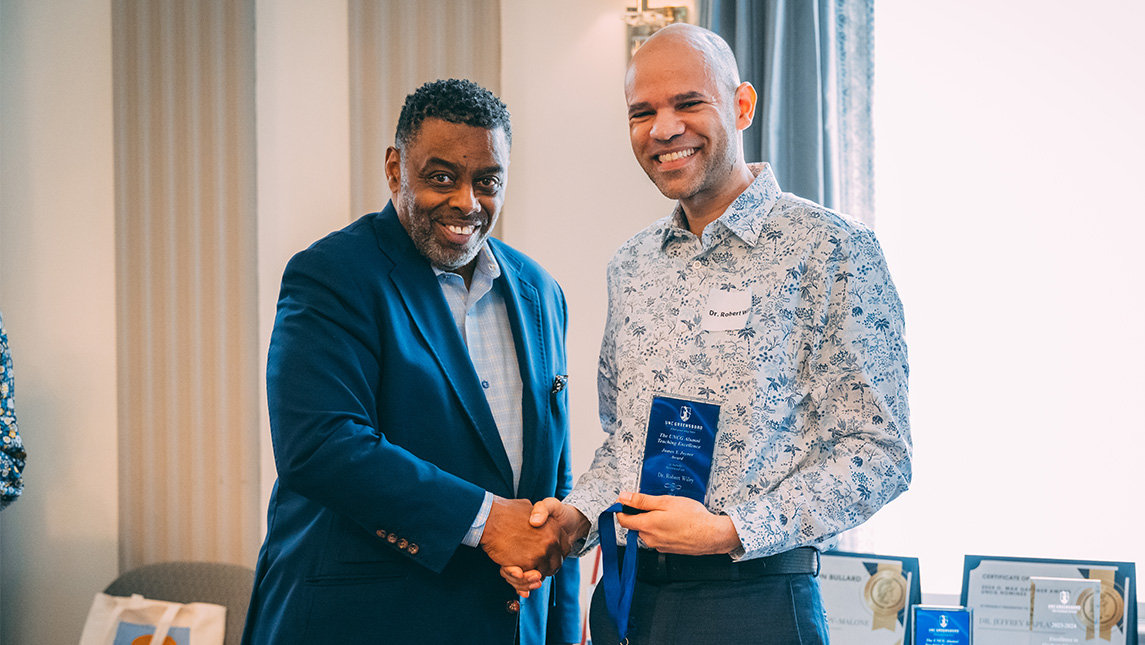
Dr. Robert Wiley, recipient of James Y. Joyner Teaching Excellence Award with Chancellor Gilliam
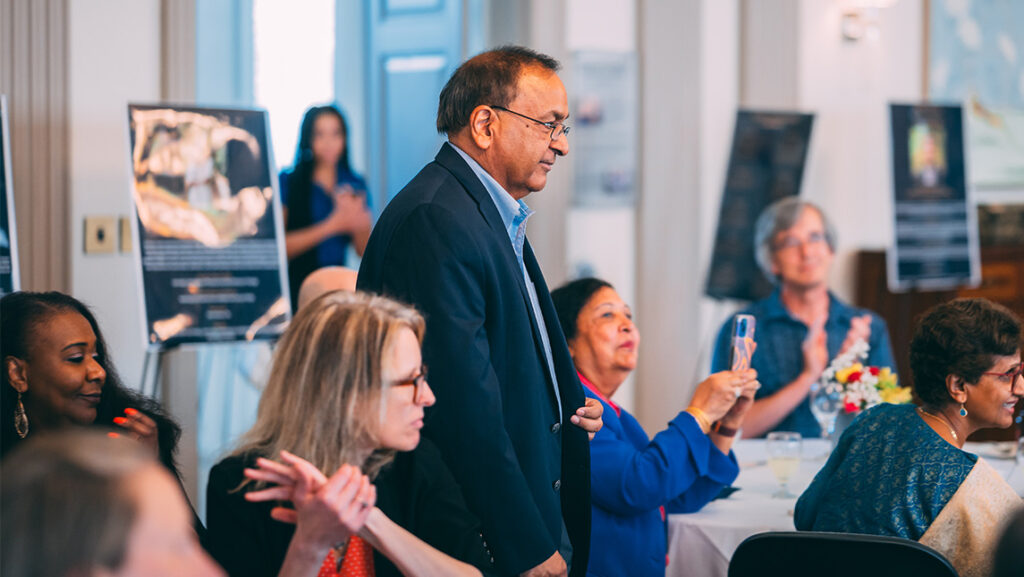
A guiding hand in a research lab, a word of encouragement, and attention to detail in the classroom can make the difference in a student’s success. The dedication of UNC Greensboro’s faculty to crafting a meaningful learning environment on campus and off campus is recognized at the end of each academic year.
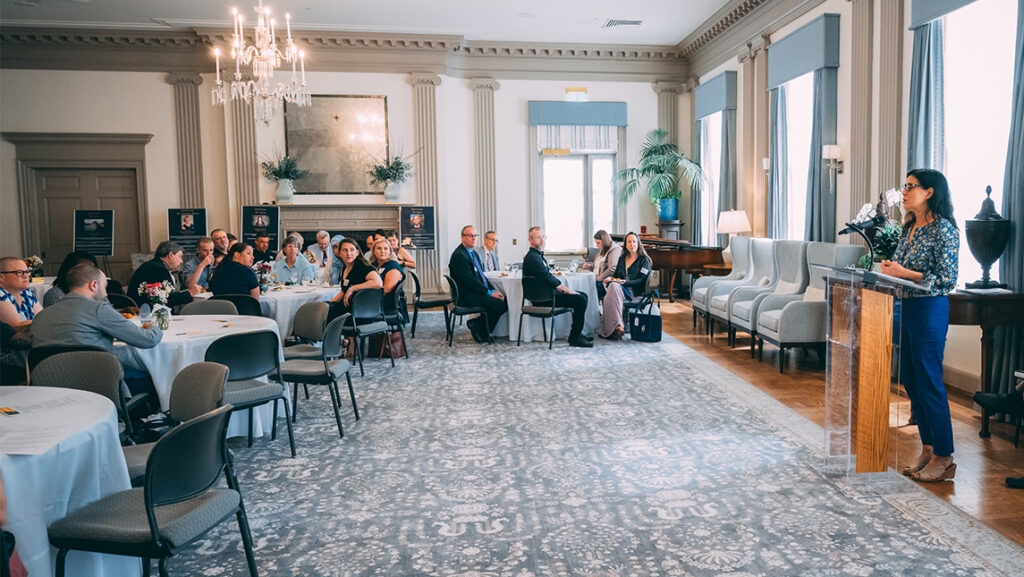
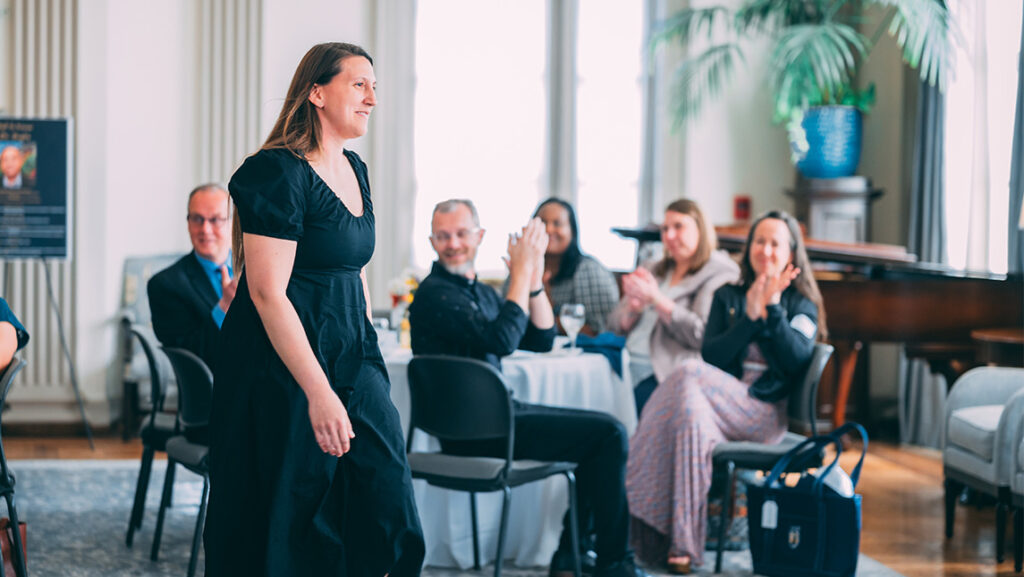
Chancellor Franklin Gilliam and Provost Debbie Storrs led the 2023-24 faculty awards ceremony at the Alumni House. They recognized the many ways that faculty set the bar for excellence and help Spartans reach their individual academic goals.
Teaching Excellence Awards
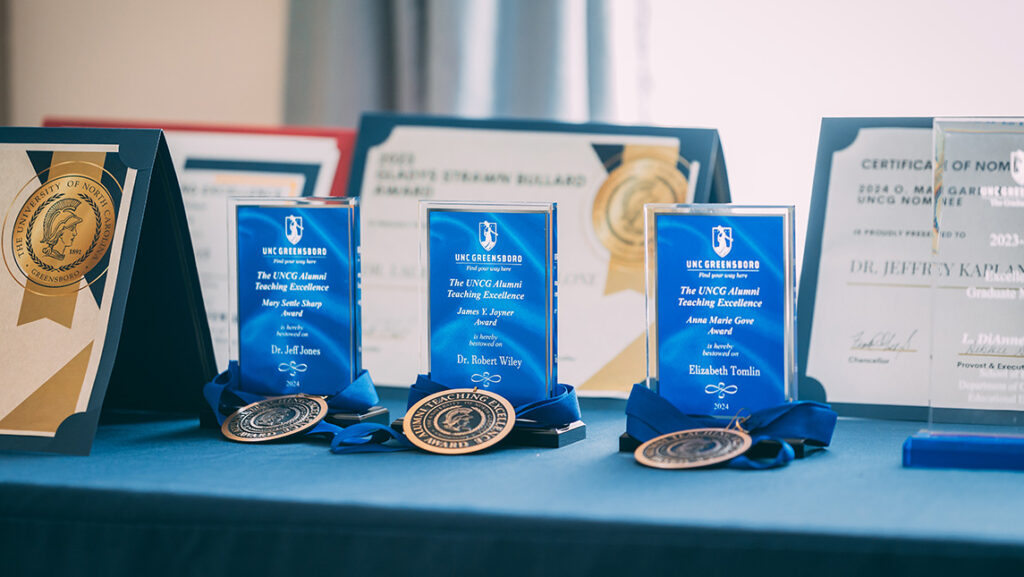
UNC System Board of Governors Award for Excellence in Teaching Dr. Eric Willie, professor of percussion, School of Music
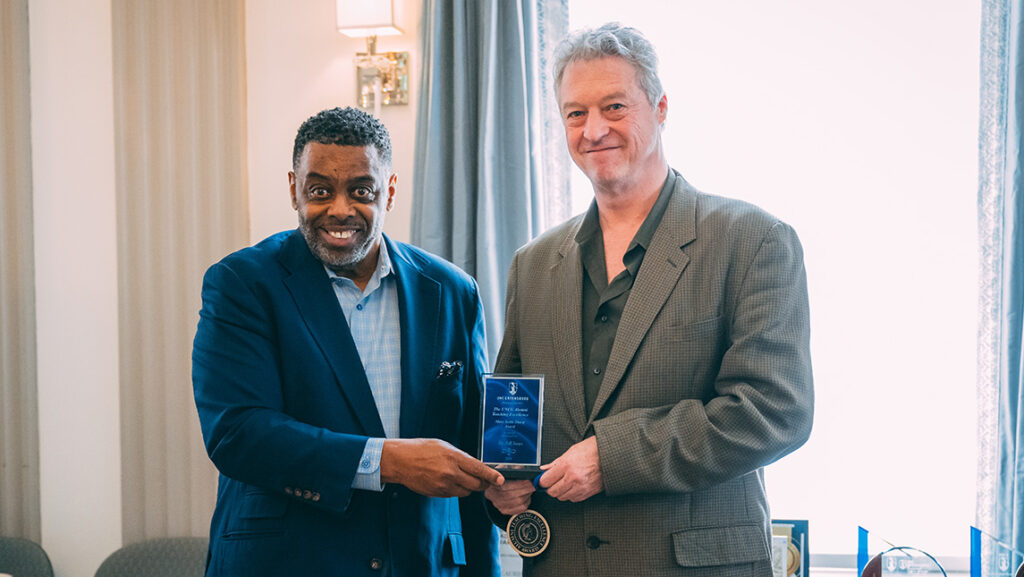
Mary Settle Sharp Award Alumni Teaching Excellence Dr. Jeff Jones, assistant professor of history
James Y. Joyner Award Alumni Teaching Excellence Dr. Robert Wiley, assistant professor of psychology
Anna Maria Gove Award Alumni Teaching Excellence Dr. Elizabeth Tomlin, senior lecturer of biology and chemistry
O. Max Gardner Award UNCG Nominee Dr. Jeffrey Kaplan, assistant professor of philosophy
Instruction and Education Awards
Excellence in Graduate Mentoring Award Dr. L DiAnne Borders, Burlington Industries Excellence Professor of Counseling and Educational Development
Thomas Undergraduate Research Mentor Award Dr. Sat Gupta, professor of mathematics and statistics (tenured category) Dr. Michaeline Jensen, associate professor of psychology (pre-tenured category)
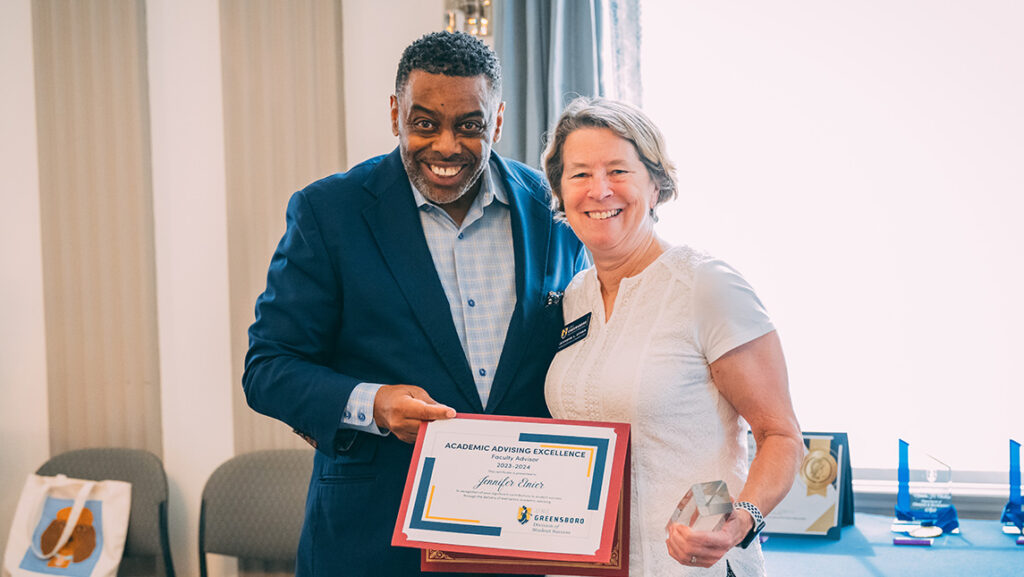
Academic Advising Excellence Award Dr. Jennifer Etnier, Julia Taylor Morton Distinguished Professor of Kinesiology
Service Leadership Award
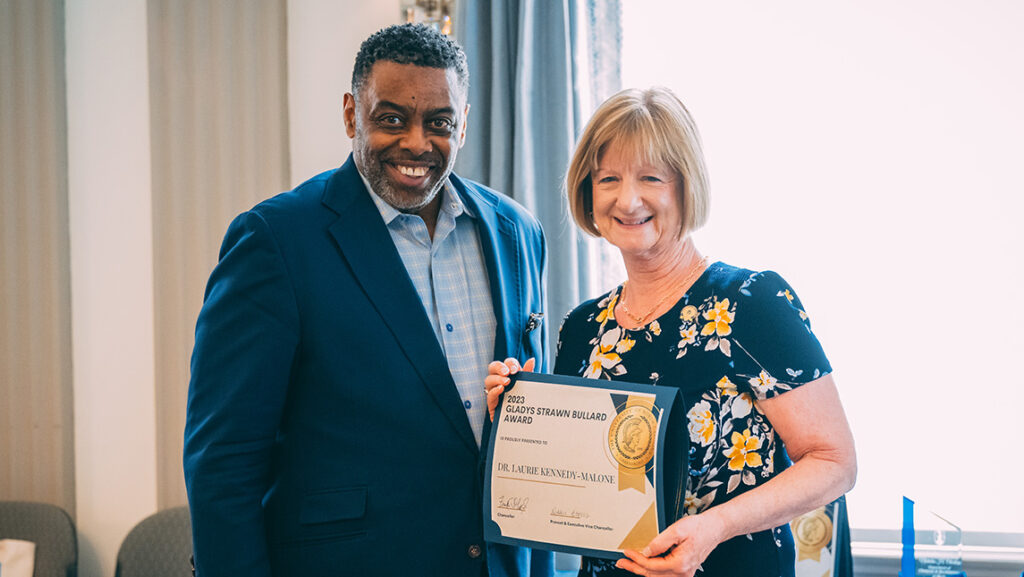
Gladys Strawn Bullard Award Dr. Laurie Kennedy-Malone, associate professor of nursing
Research Excellence Awards
Senior Research Excellence Award Dr. Nicholas Oberlies, Patricia A. Sullivan Distinguished Professor of Chemistry
Junior Research Excellence Award Dr. Jaclyn Maher, associate professor of kinesiology
Story by Janet Imrick, University Communications Photography by Sean Norona, University Communications
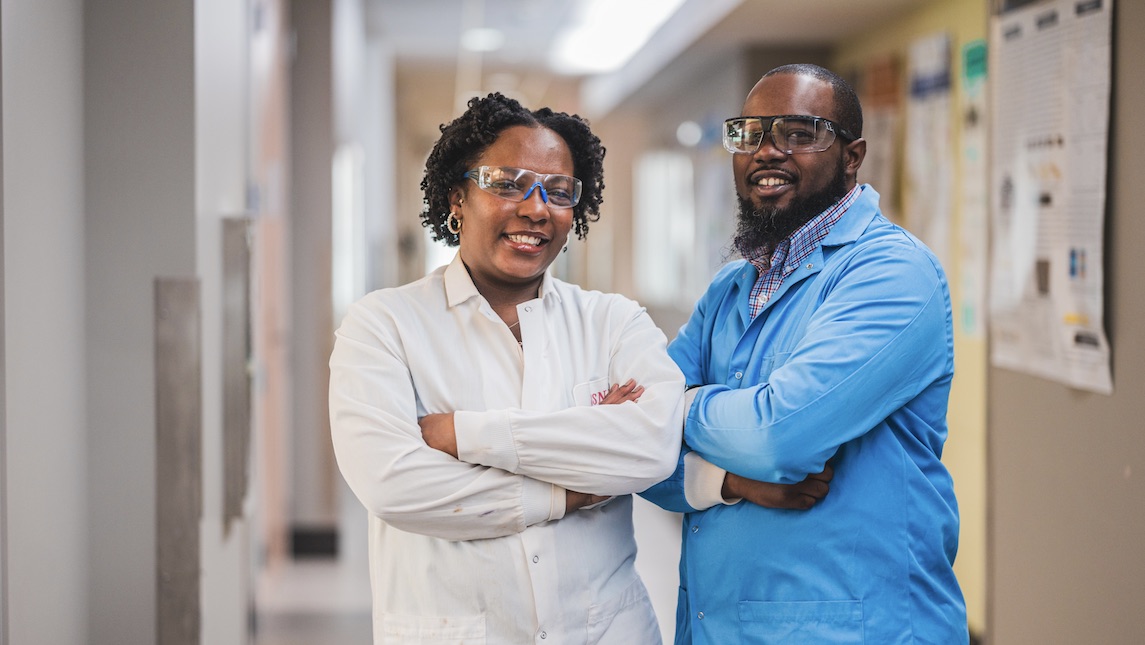
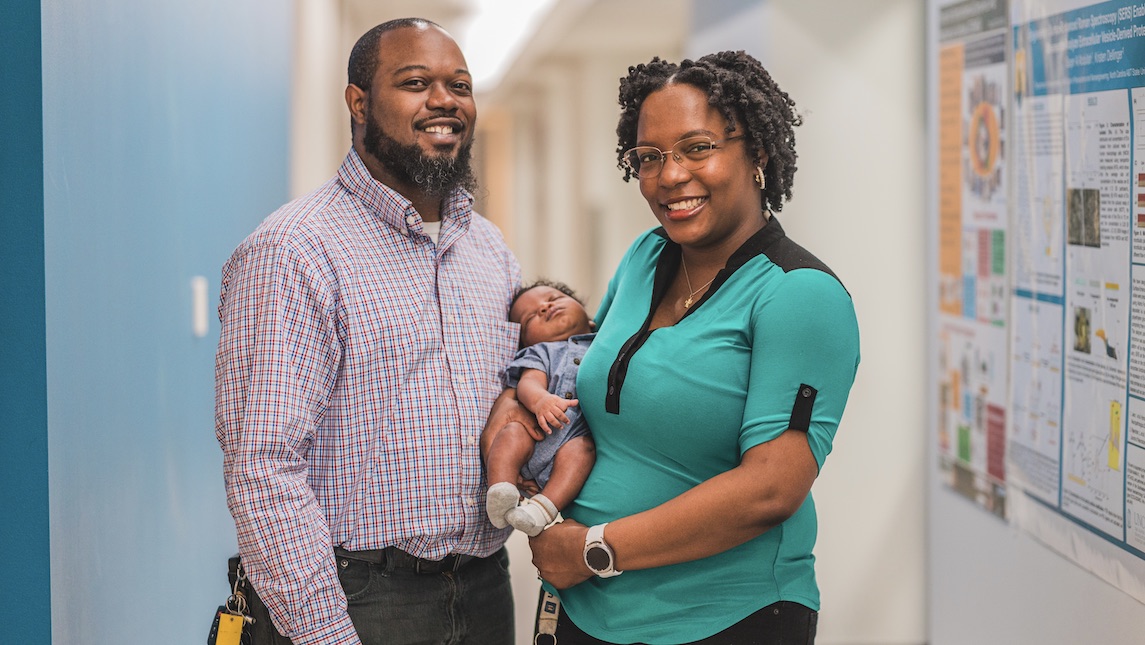
On May 2, they will proudly walk together in regalia as not only new graduates but also new parents as they welcomed their first child in March.
Sharing the JSNN Experience
Going to graduate school with your partner is a unique experience. Selina and Eric had all their classes together for the first two years, but they let classmates figure out they were married.
The Laws decided early on they would not discuss research at home, and they did work in separate research groups, but their labs were side by side.
“Between Eric and I, and our respective research labs, we have access to every instrument in the school,” says Selina.
The Laws did have to set boundaries with fellow students as they would come to Selina looking for Eric and vice versa. JSNN students eventually treated them as separate people with separate expertise.
“We have different personalities, and we move differently in class and at work,” says Selina.
Eric appreciated the couple’s daily lunches throughout their program: “We would eat lunch together, decompress, and have a personal conversation. This would reset us for the next half of the day.”
Tough Start, Ample Support
Selina and Eric started school in August 2019. COVID hit during their second semester, which both agreed was challenging.
“The first year, when COVID hit, everything shut down. We were just trying to get our footings in the lab, but that came to a screeching halt because we could not be in lab,” says Eric. “The school wanted to reserve any available space for the seniors, rightfully so.”
Fortunately, senior students produced videos with lab instructions to assist those unable to physically be there. After a year, Selina and Eric returned to the lab and furthered their training.
That was just the beginning of the support the Laws discovered at JSNN.
“My advisor Hemali Rathnayake was willing to go into lab with me and figure things out. As a student, you can be frustrated by a challenge, but she would just roll up her sleeves and join me in lab,” says Selina.
She adds that JSNN students get hands-on experience with the instruments whereas other universities may not let students operate them. Selina was empowered to conduct her research from the ground-up, making and characterizing a new material independently.
Impactful Research
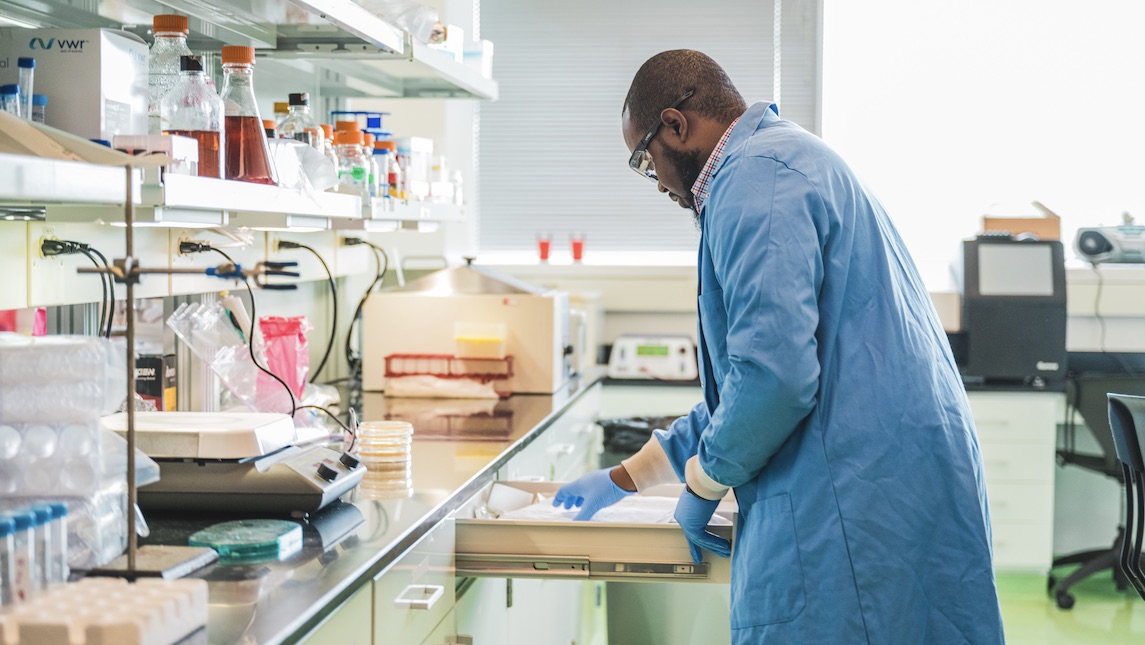
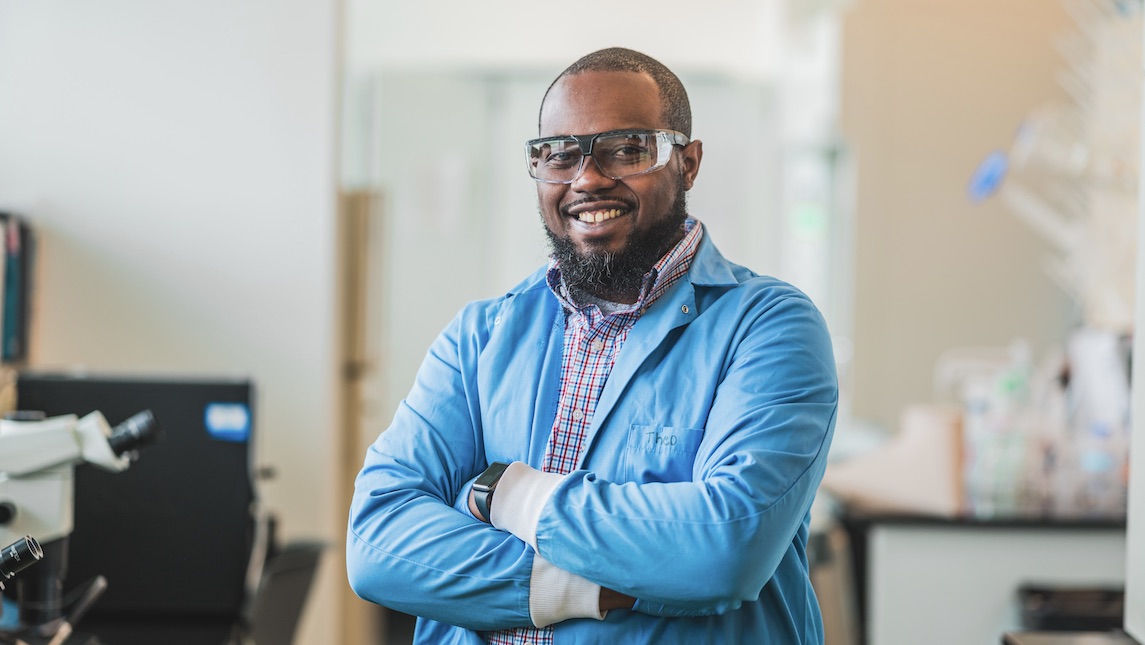
A self-proclaimed “lab rat,” Eric’s research focuses on manipulating and controlling bacterial motion. In the lab, he makes and functionalizes polymer nanoparticles, so they interact with bacteria. He then observes the bacteria to see how they move and how they appear.
“My research ties into bioelectronics—making an electrode out of bacteria,” says Eric. “It could have many applications, for example, with water filtration of bacteria or drug delivery systems. In fact, there could be different ways to maximize CAT scans and MRIs if you modify these materials in the correct way.”
Selina’s research focuses on designing new bio-inspired materials with water-loving and water-repelling components that self-organize. This is similar to how phospholipids self-organize to make up the cell wall or are employed as drug delivery vehicles.
“My materials were created not only to organize with themselves but also with various metals,” says Selina. “The impact would be to provide a novel platform for advanced miniature devices, specifically developing property-specific multifunctional devices.”
New Graduates, New Parents
Just ahead of graduation, Selina and Eric welcomed a son into their family. As a new mother, Selina will focus her attention on the baby, but in the future, aspires to be a formulation scientist conducting research.
Eric is applying to post-doctoral positions now and hopes to one day teach and run his own research lab.
As they reflect on their UNC Greensboro experience, they offer words of advice to the students who will follow them.
Selina says to “choose your advisors wisely, maybe even before entering your program,” and Eric champions the benefit of “students collaborating with one another more.”
As new graduates and new parents, the Laws family embarks on a new path following graduation.
Story by Amy Burtch, AMBCopy Photography by Sean Norona, University Communications
CELEBRATE OUR GRADS!
Graduate Commencement: May 2 at the Greensboro Coliseum Undergraduate Commencement: May 3 at the Greensboro Coliseum
Graduates and their families are encouraged to share their accomplishments on social media by tagging the University accounts and using the hashtags #UNCGGrad and #UNCGWay. Visit UNCG’s digital swag page for graduation-themed graphics, filters, and templates.
Mention @UNCG in celebratory posts on Instagram and X and @uncgreensboro on TikTok.
Engage with peers and UNC Greensboro’s stellar faculty and staff in a variety of arts, gaming, technology, science, music, or athletics camps hosted at the University.
UNCG offers various camps to promote the academic interests of youth in the community and help them build critical motor and social skills.
Here’s a list of some of the camps provided this summer, and how to register:
“CHANCE is so much more than just a camp. For once in my life, an educational institution acknowledged me. They acknowledged my community. They recognized our barriers, our struggles, our efforts.”
Grecia Navarro, CHANCE volunteer
CHANCE camp
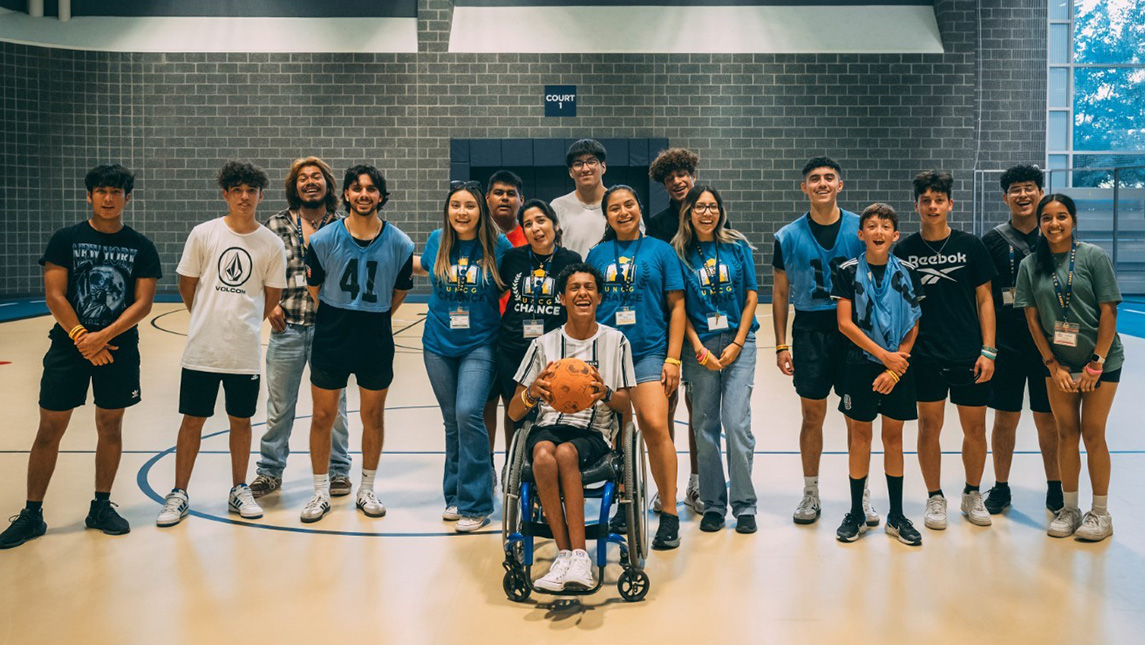
CHANCE is a four-day summer program for Latino and Hispanic high school students. CHANCE aims to equip them with the knowledge and skills to advance their education with UNCG as a school of choice. At CHANCE, campers live in a residence hall, eat in the dining hall, and learn more about the resources and opportunities UNCG has to offer. The dates for CHANCE camp are July 17 – 20.
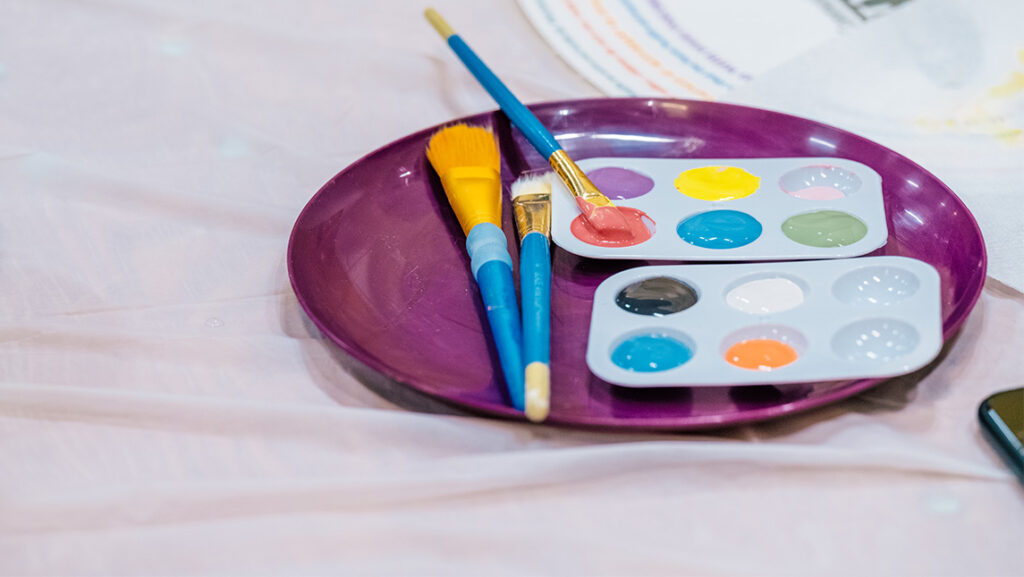
UNCG’s Summer Arts and Design Intensive camp (SADI) is a residential art program for young artists. SADI covers various art forms such as drawing, painting, printmaking, sculpture, photography, graphic design, and animation. Students in grades 8 through 12 work alongside UNCG School of Art faculty, art education staff, and the Weatherspoon Art Museum to engage in college-level studio classes and create portfolio-quality artwork. The dates for UNCG Arts and Design Intensive camp are July 14 – 19.
“On a personal level, working at the camp has deepened my appreciation for the resilience and strength of children despite facing numerous challenges.”
Melina Sneesby, DREAM volunteer
UNCG Esports and Gaming camp
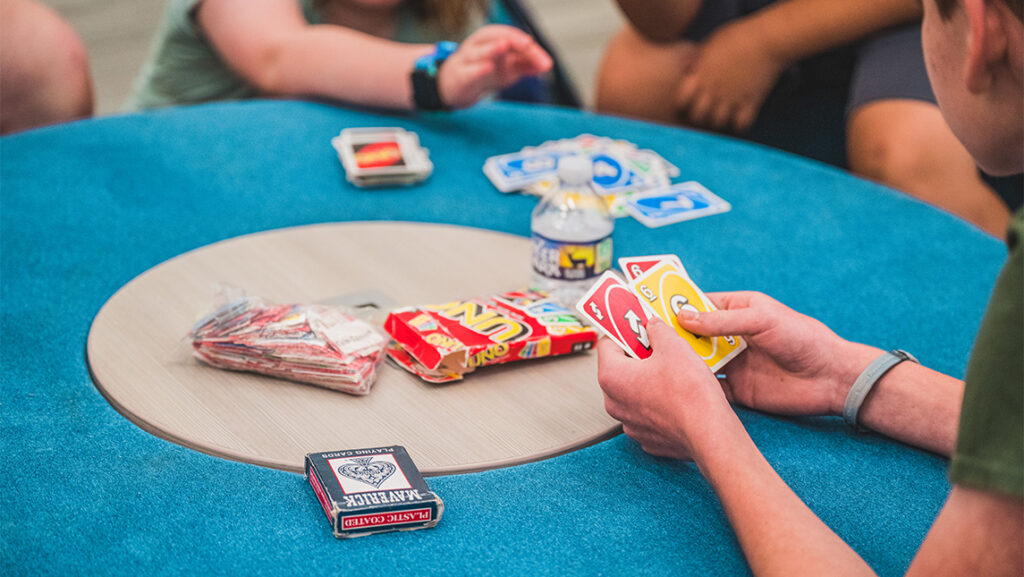
UNCG Esports and Gaming camp is a summer program for ages 8-14 and 13-17. These seven one-week camps are offered on campus in the Esports Arena and computer lab spaces. In addition, a new camp, Unreal Engine Gaming Academy, kicks off this year for ages 13-17. Campers focus on two subjects each week with plenty of free time for gameplay and friendly competitions. The dates for UNCG Esports and Gaming camp are June 17 – August 2.
Technovation for Good, made possible by Alex Lee, Inc. is a day and residential program for rising high school sophomores – seniors. The program is administered by the Information Systems and Supply Chain Management department at the Bryan School of Business and Economics. Students experience hands-on learning in programming, cybersecurity, data analytics, mobile app development, sustainability, analytics, and more. Promoting inclusiveness and education equity, students can expect to hear from local professionals, meet other students, and attend workshops to enhance their information technology and business skills. The dates for Technovation for Good are June 22 – July 2.
“I have experienced and witnessed firsthand how guidance and encouragement can empower students to overcome obstacles and achieve their goals.”
Agustin Saldana, CHANCE volunteer
DREAM camp
DREAM is a day camp for children and adolescents ages 8 to 18 with social and friendship challenges, including, but not limited to, those with high-functioning autism. The focus is to engage campers in a community that fosters development and enhances their life skills. Campers will take part in arts and crafts, musical performances, and sports. The dates for DREAM camp are June 17 – 21 and July 8 – 12 from 9 a.m. – 3 p.m.
Camp Speak-a-lot is a free program designed for children who stutter, ages 7-13. Located at UNCG’s Piney Lake, researchers from the UNCG Department of Communication Sciences and Disorders help to guide children through questionnaires about mindfulness and their thoughts and feelings related to stuttering, seeking to improve future therapy outcomes. Camp activities include art, theatre, hiking, games, water activities, and yoga. The dates for Camp Speak-a-lot are June 17 – 28 from 1 p.m. to 4 p.m. For more information on how to register, reach out to Kelly Harrington at ktharrin@uncg.edu.
Listening Lab
Listening Lab is a program designed for children with (central) auditory processing disorder, ages 7-12. Located at UNCG’s Speech and Hearing Center, supervising clinicians focus on strengthening foundational auditory skills needed for listening, learning, and communication. Campers rotate through listening stations and receive group and/or individual training in various areas. The dates for Listening Lab are June 17 – 28 from 1 p.m. to 4 p.m. For more information on how to register, reach out to Lisa Fox-Thomas at lfoxthomas@csdshc.uncg.edu.
“The most fulfilling thing about volunteering with DREAM camp was being able to see our campers achieve the goals that they had set at the start of the week for camp.”
Gregory Chase, DREAM volunteer
UNCG Summer Music Camp
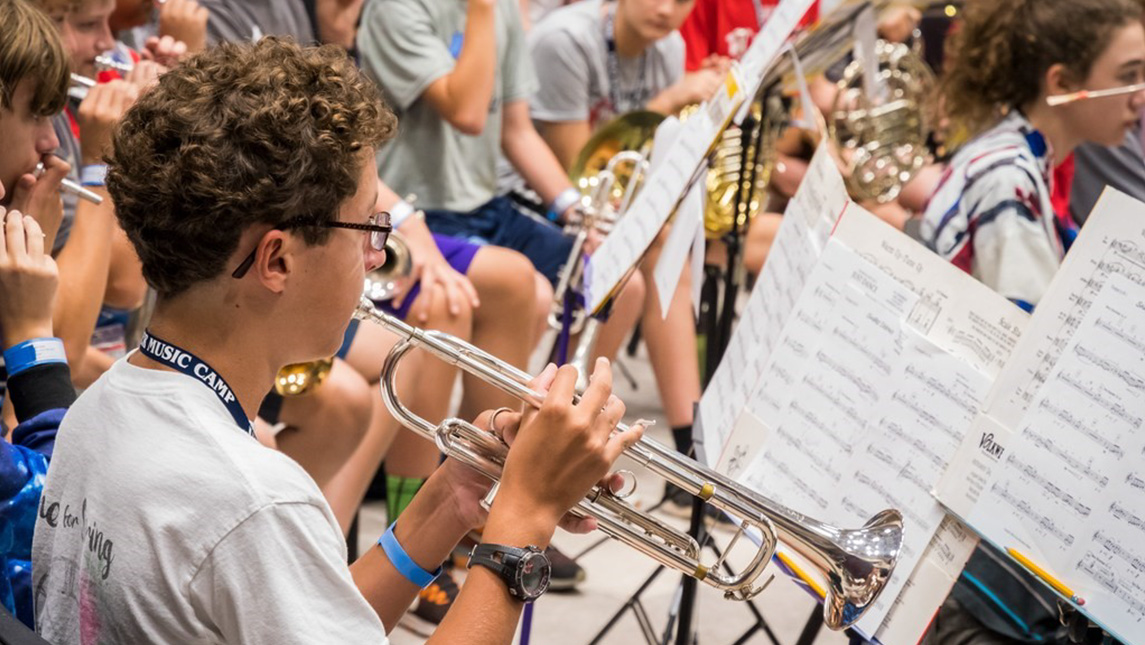
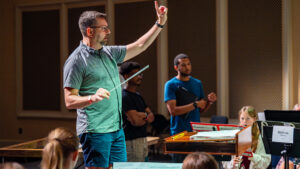
UNCG Summer Music Camp offers a two-week program in band, mixed chorus, orchestra, and piano. Students work with artist-faculty of the UNCG School Of Music and other music teachers, performers, and conductors throughout the state and nation. Each camp concludes on Friday with a concert for parents, relatives, friends, and community members. The dates for UNCG Music Camp are July 7 – 12 and July 14 – 19.
The Joint School of Nanoscience and Nanoengineering (JSNN) is where innovation and interdisciplinary research converge to tackle pressing global challenges. JSNN ExPlorers Summer Camp is a free one-week program for high school students in grades 10-12 with a passion for STEM. With an emphasis on Phosphorus sustainability, students connect STEM concepts to real-world experiences in the classroom. Camp activities include gaining laboratory experience, developing 3D printing skills, visiting a local farm, and attending college tours. The dates for JSNN ExPlorers Summer Camp are July 8 – 12 from 9 a.m. to 4 p.m.
UNCG hosts several summer sports camps run by the UNCG coaching staff. Click the link below for more information on programs for different sports and ages, session dates, contact information, and links to register.
“In the program, we were able to accommodate many types of students with a variety of backgrounds, abilities, and preferences. It was exciting to see the interest and commitment many of the students had towards their future in college.”
Paige Terwilliger, Arts and Design Intensive volunteer
Story by Lauren Segers, University Communications Photography by Sean Norona and David Lee Row, University Communications
Class of 2024: Hannah Ward Says Yes to Opportunity
Posted on April 29, 2024
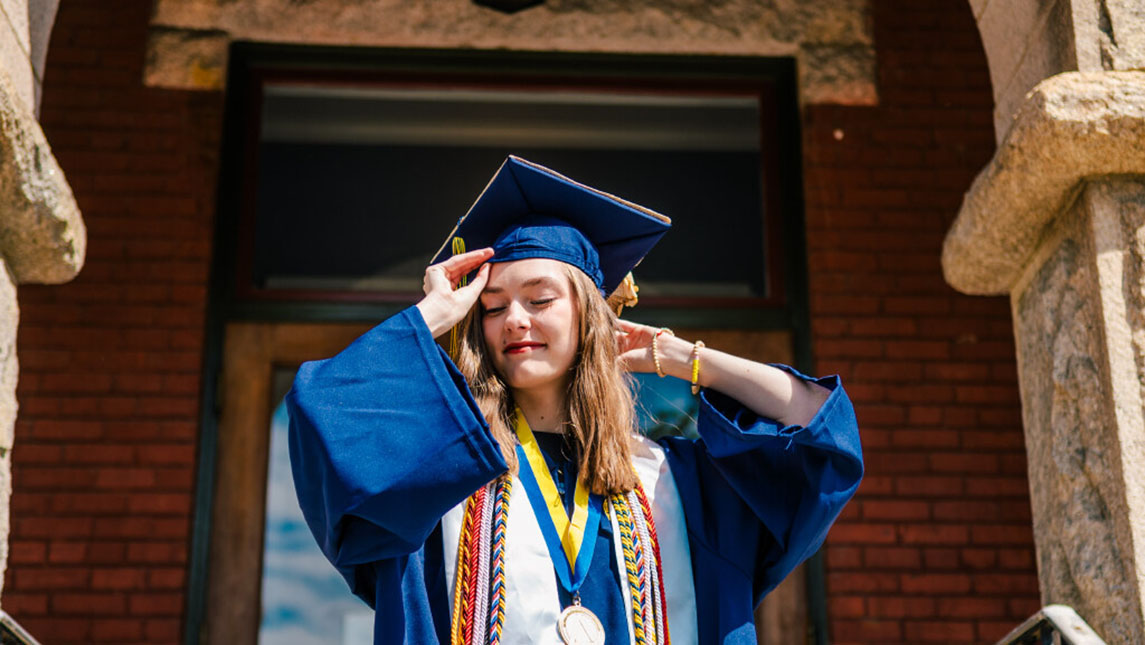
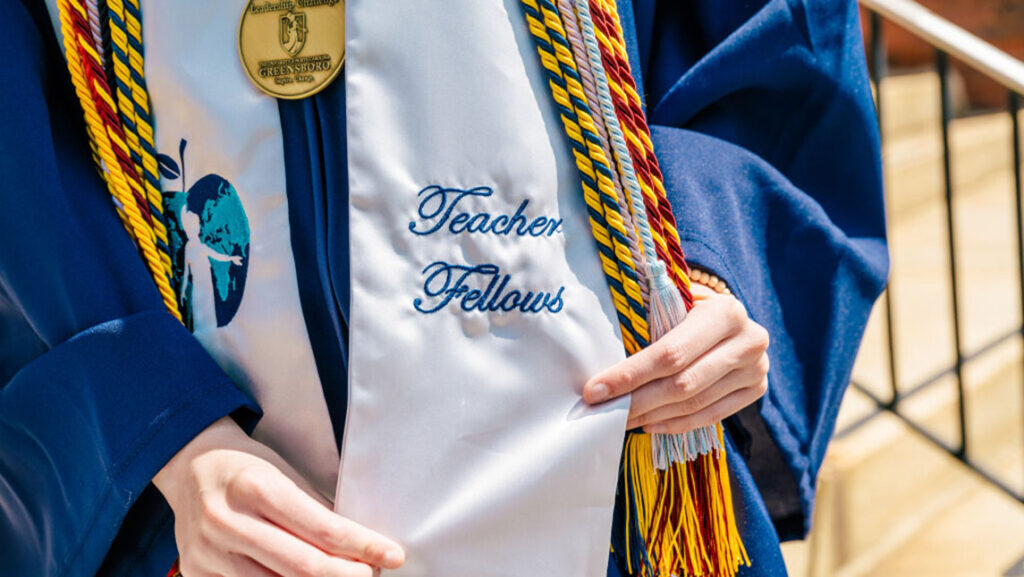
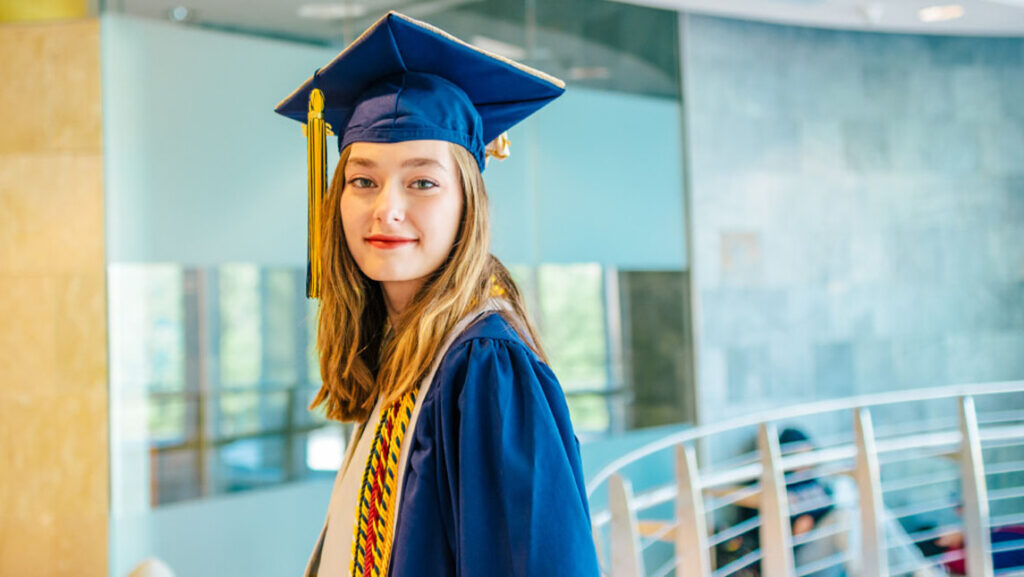
Stepping onto campus as a first-year student and Teacher Education Fellow, Hannah Ward had a mission: make her hometown of Morganton, North Carolina proud and major in music. Through her fellowship and the Lloyd International Honors College (LIHC), Ward soon encountered mentors, opportunities, and experiences that took her down paths she had not considered and helped her discover her true calling: teaching English.
“I’m 100 percent ready to teach,” Ward says. “I love it so much.”
On the job – early
Early in her time at UNC Greensboro, Ward was pursuing a degree in music but realized she was more interested in the stories that people tell in songs than the music behind them. With the encouragement of her mentors, she switched her major to English.
“As a Teacher Education Fellow, I took an extra teaching internship in an online English classroom and I loved it,” she says.
As a Teacher Education Fellow, Ward has the added advantage of on-the-job experience that started her first year at UNCG.
“I’ve been in classrooms since day one, which is two years earlier than most other education majors,” Ward explains. “I am a student teacher right now at Southeast Guilford High School and I love it. I love my classroom, I love my kids, I love planning instruction. It’s something that is very important for me to do.”
Ward was one of 12 fellows in her cohort. The fellowship is a community of like-minded pre-service teachers who engage in teaching-related activities designed to develop and enhance their leadership abilities, commitment to the campus and broader community, and awareness of socio-cultural considerations from the individual to the global scale. In addition to early access to internships, Teacher Education Fellows each receive $20,000 in scholarship funds over four years. In addition, they attended weekly seminars to collaborate and share ideas on what they learned in the field and participate in the Spartan Leadership Challenge to build experience in organization, service, and leadership.
“The 12 of us became a really close-knit cohort,” Ward says. “There were people who always wanted to see me succeed. People who were interested in what I was doing and wanted to help me out.”
During the faculty-led program to London, Ward broadened her intercultural perspective and found herself taking an unexpected academic path.
“We had classes in the morning and spent the afternoons at historical sites like author’s houses and the Tower of London,” Ward says. “I began a research paper thinking I would explore feminist figures in medieval and Victorian history, but I discovered in the research that women were executed much more often compared to men. Then I took a deep dive into the different torture methods.”
Ward’s final project for the study abroad program focuses on executions at the Tower of London. She researched literary representations of torture methods, classism, and the entertainment value of public executions. This spring, she presented that research at the Southern Regional Honors Council conference in Jacksonville Florida.
Unexpected new skills
As a student in the LIHC, Ward found another supportive community.
“It is so different from other honors colleges. It’s not just taking classes, it’s a culture that encourages having debates over issues, student-led discussions, and bringing our own ideas rather than following a set curriculum,” Ward says.
Ward served as an ambassador for LIHC, helping other students adjust to UNCG and the honors college. She also received a Pubantz Artists in Residence award during which she wrote a novella.
“I really like the idea of retold stories, so I analyzed structural theory of fairytales and the common elements in fairy tales across cultures, and how to translate those elements to a young adult retold fairytale genre,” Ward says. “I studied many cultural versions of “Cinderella,” and then I wrote my own short version called ‘The Shoemaker.’”
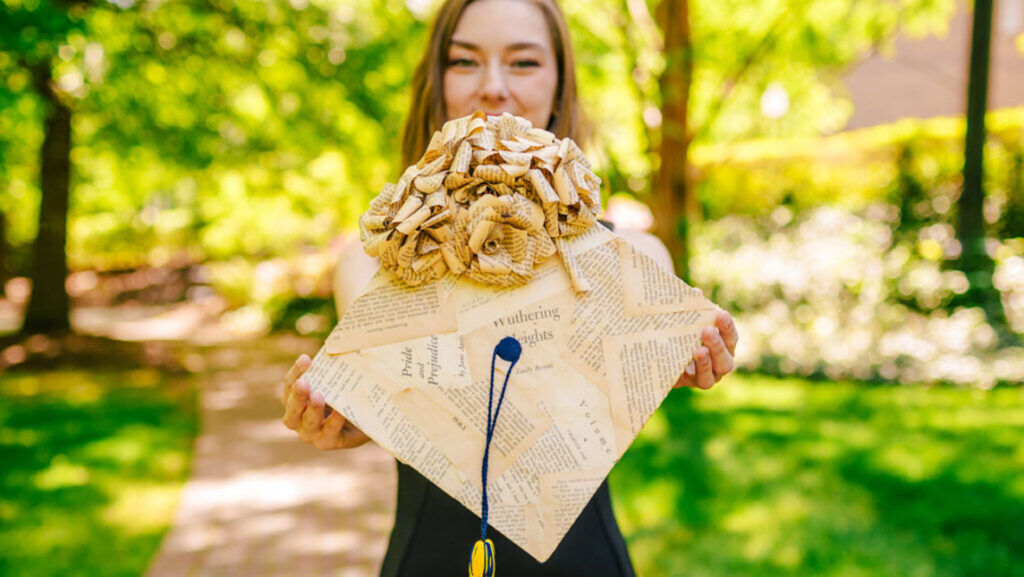
With the stipend she was awarded, Ward took a class on hand binding books. “I learned different bookbinding techniques and about cover design and typography,” Ward says. “I wrote my book, designed my own cover, the typography inside, and hand-bound a few copies to keep.”
A Storybook Ending
As Ward crosses the stage at Commencement, she will do so knowing she took advantage of every opportunity in her reach at UNCG. While she is still awaiting a teaching assignment, she knows that she found her calling to be a classroom teacher. Ward credits her community at UNCG with helping her define her goals and purpose.
“There are so many things I got to do that made my college experience pretty special,” Ward says. “I am still in contact with all my mentors from both the Teaching Education Fellows program and LIHC. I know I am going to continue those relationships as I move into a professional career.”
Story by Alice Manning Touchette Photography by Sean Norona, University Communications
CELEBRATE OUR GRADS!
Graduate Commencement: May 2 at the Greensboro Coliseum Undergraduate Commencement: May 3 at the Greensboro Coliseum
Graduates and their families are encouraged to share their accomplishments on social media by tagging the University accounts and using the hashtags #UNCGGrad and #UNCGWay. Visit UNCG’s digital swag page for graduation-themed graphics, filters, and templates.
Mention @UNCG in celebratory posts on Instagram and X and @uncgreensboro on TikTok.
Comparing the Data: UNCG Research Provides Multi-Faceted View of Families’ Health
Posted on April 24, 2024
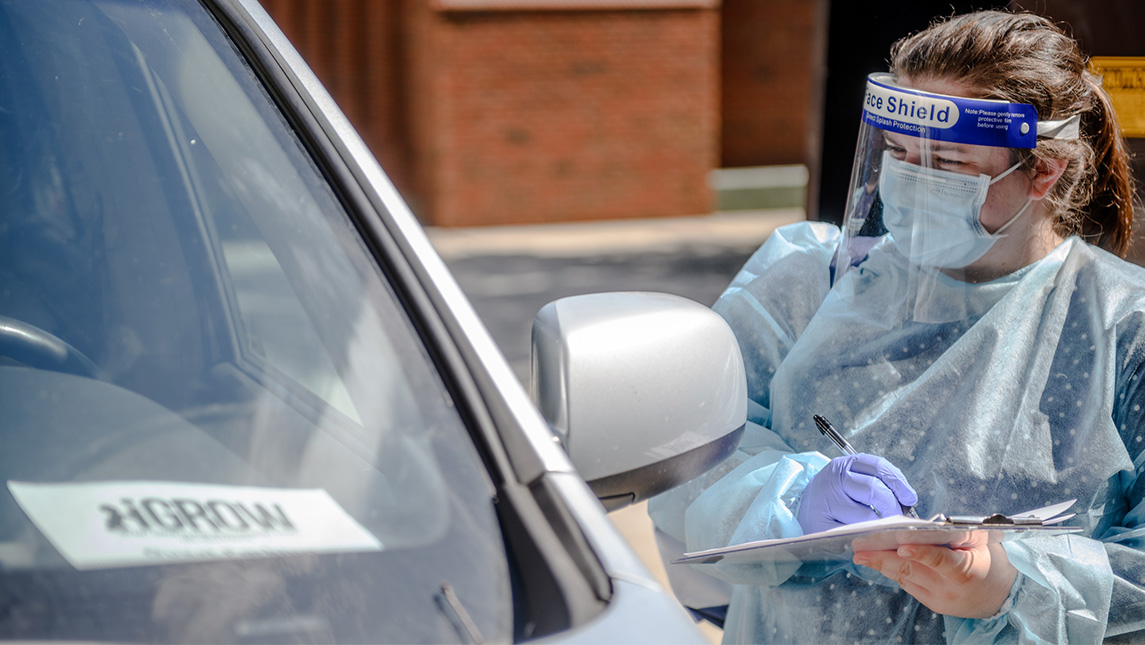
With $1.6M in NIH funding and the iGrow child obesity study data set, UNCG researchers are investigating how the pandemic impacted parents – psychologically, socially, and economically. Project lead Dr. Kierra Sattler hopes their findings will help future public health professionals dealing with multi-system disasters.
Music of Moran: Shared Piano Brings Out UNCG Students’ Talent
Posted on April 25, 2024
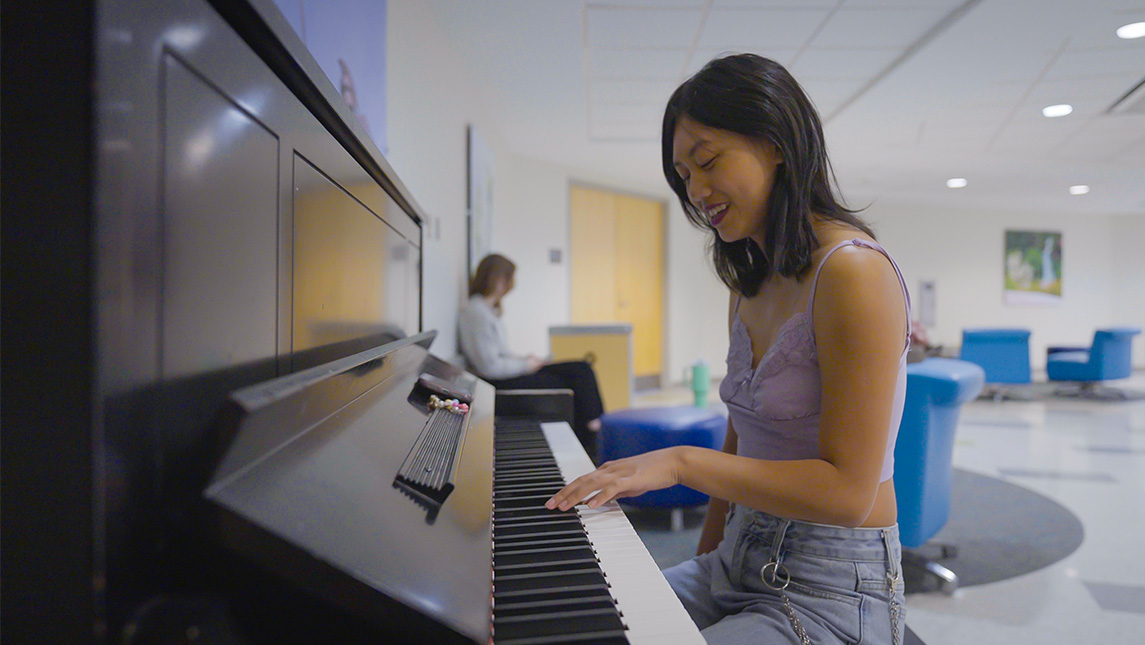
Music can be heard from one end of UNC Greensboro’s Moran Commons to the other – from the doors to College Avenue and up the stairs to Fountain View Dining Hall. It’s all thanks to UNCG students who like to share their favorite tunes at the community piano in the center of the building.
On any given day, one might stumble across an impromptu concert of chart-topping hits, video game soundtracks, or niche favorites. There are no rules for who can play the piano, what they can play, or when.
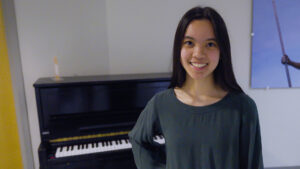
The idea for a public piano is something Madelyn Good, a third-year computer science student, has had for quite a while. She requested this piano at the end of last semester and was surprised by how easy it was to bring the School of Music staff and leadership on board with her idea.
Good feels that music helps students de-stress and wants them to express their talent and skill. “Walking around Moran Commons almost every single day and seeing friends or complete strangers collaborating at the piano with each other, is just a beautiful thing.”
Songs from the Heart of Campus
Good grew up playing violin and piano in Chapel Hill, North Carolina and initially came to UNCG to study music education. She changed her major to computer science, but she retains a deep appreciation for all kinds of music. While touring college campuses, she’d had a positive encounter with a “public piano” on another campus, and she wanted the UNCG community to share in that benefit, playing and adding music to the everyday experience.
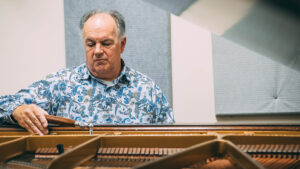
Stephen Duncan, School of Music piano technician
As a previous music major, Good knew the practice rooms in the School of Music – positioned on the northeastern corner of the main campus across the bridge through Peabody Park – are a far walk for students who do not have a reason to go there. She felt the University needed a piano in a central location.
Before installing the piano, a survey was made available in the practice rooms, letting students vote on where to place the piano. “There were about 80 responses,” says Good. “Moran Commons won by about 20 votes. Moran Commons just felt like a good spot.”
She reached out to the School of Music and Stephen Duncan, UNCG’s piano technician, went into the surplus warehouse and was able to install an upright piano in Moran Commons’ hallway.
UNCG’s North Spencer and Grogan Resident Halls and the Sullivan Science Building also have pianos, but this one sits in one of UNCG’s most heavily trafficked areas – a short walk from the Esports Arena, the mail room, and various food courts. Students will sit to listen while they work on schoolwork or chat with friends after class. “I’ve heard people say, ‘I’ll meet you at the piano.’” says Good.
A Soundtrack to Relax, Study, or Hang Out
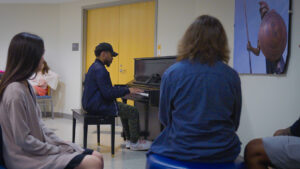
Justin Logan studies information sciences and grew up playing piano for his church. “Music is a place where I can retreat and just get some time to self-reflect and relax,” he says.
Justin Logan plays for an audience
Logan calls the piano a nice touch to a space used for studying as well as socializing. “Music takes you to another place. So, regardless of how students are feeling throughout the day – they could be feeling down, or they could be feeling pretty happy – music brings excitement and joy to their lives.”
“I get so many kinds of reactions from people – standing in the corner to watch or coming up to me and saying that I sound great, or people coming up and dancing,” says Raiola.
Madelyn Good
Because Moran’s foot traffic ebbs and flows throughout the day, a student who is nervous about playing in public may stop by when it’s not so busy. One full semester since its installation, the piano has already fulfilled Good’s intention to make music more accessible to the entire UNCG community.
“Whether you’re a student, a music major, an avid player, a listener, or just a passerby, I think the piano has captivated many,” says Good, “And has brought many people together through the shared enjoyment of music.”
“To get together over something beautiful, something artfully done, is just amazing to see,” says Raiola. “I like to see students just relax and have a good time.”
Story by Janet Imrick, University Communications Photography by Sean Norona and David Lee Row, University Communications Video by David Lee Row, University Communications