Spartan Club Showcase: Wrapping Up a Semester Full of Student Involvement
Posted on May 15, 2025
Spartans who find their way at UNC Greensboro often share one goal: to make a difference. But why do it alone?
What makes any good club rewarding is, first and foremost, how it transforms strangers into lifelong friends. They forge connections with the potential to grow long after everyone has earned their college degree.
The clubs and student groups of UNCG do that and more. They inspire personal and professional growth. They help students build career-ready skills such as leadership, budget management, and goal setting.
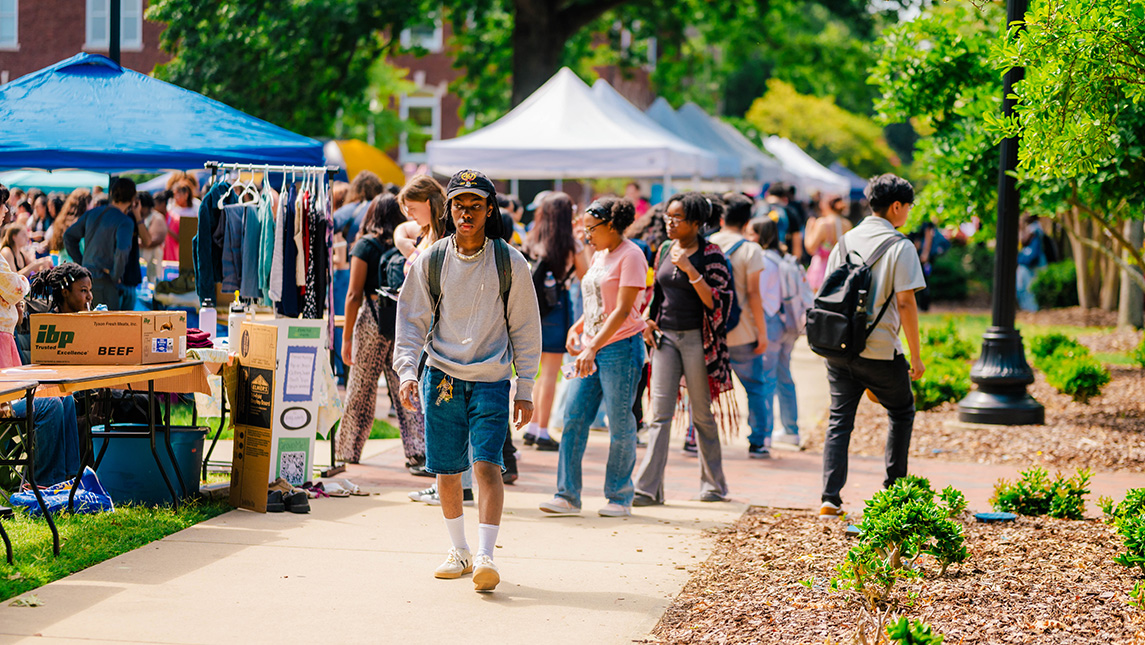
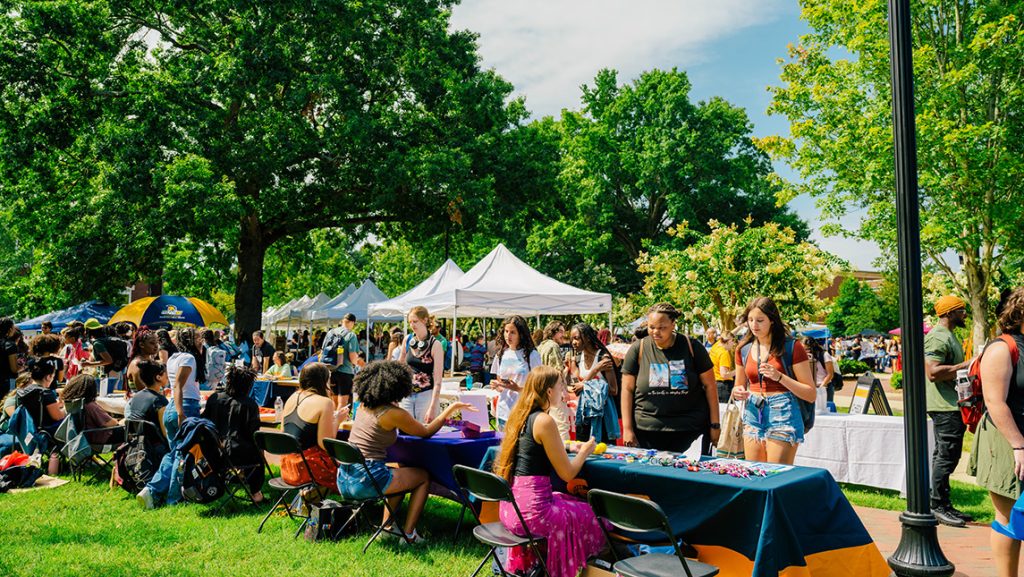
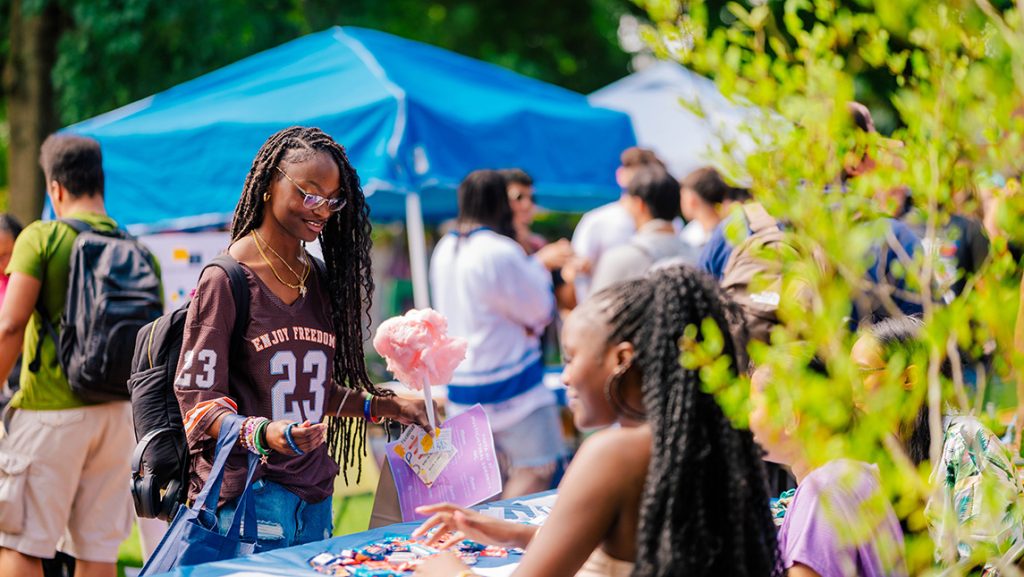
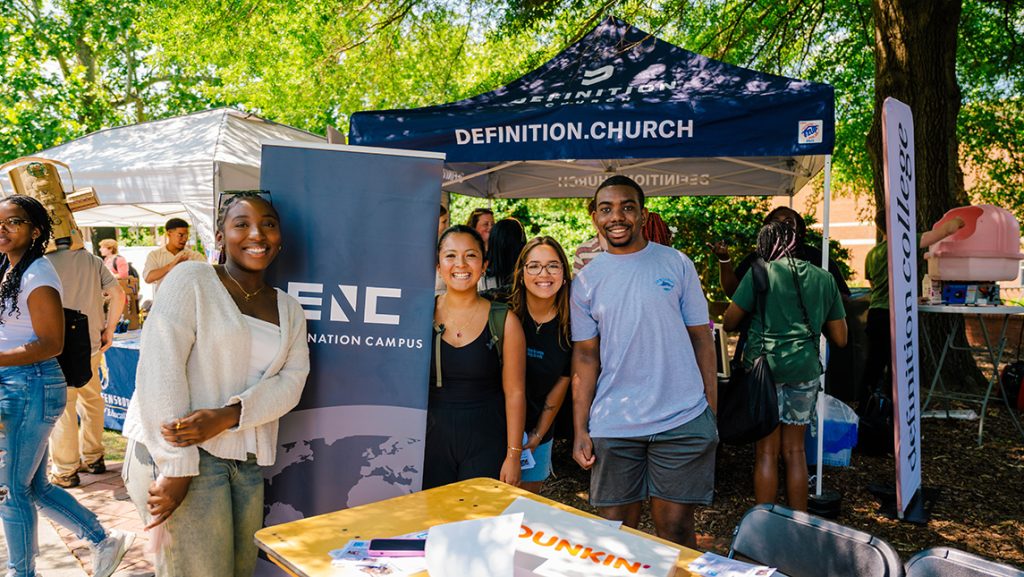
Joining a group on campus starts with knowing where to look. Besides Spartan Connect, organization fairs are a good opportunity for students to find their people. Every year, Spartans look forward to annual events like Fall Kickoff on College Avenue, which features more than 100 student groups and campus departments. The Winter Involvement Fair provides a similar opportunity each spring semester. Throughout the semester, student groups also set up tables in the EUC Commons, making it a perfect place to linger after class or check out during a lunch break.
Student Clubs Are More than Membership
When it comes to embracing campus life, it’s tempting to play it safe at first. But UNCG’s many student organizations illustrate the importance of joining communities driven by purpose and meaningful impact.
From service to academic mentorship, from empowerment to creative expression, all UNCG clubs go the extra mile to exceed their members’ expectations.
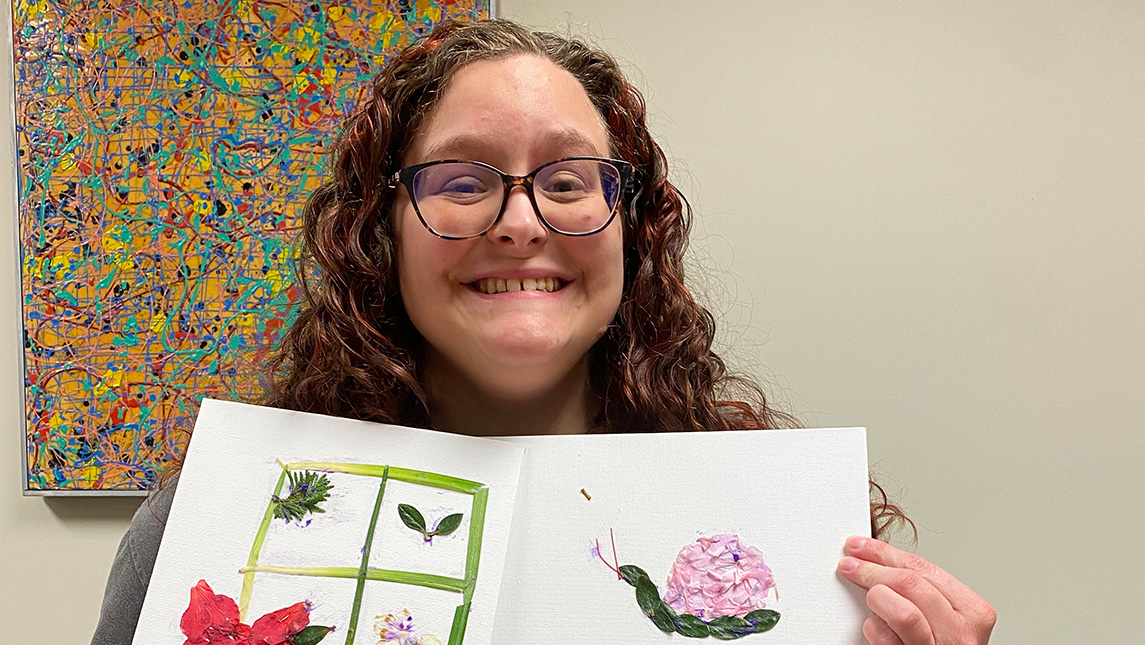
Across these four student organizations, common themes emerged: Students often shared how their involvement helped them recognize what they’re good at, how they gained valuable experience in teamwork, felt a genuine sense of belonging, or were able to improve themselves mentally and physically.
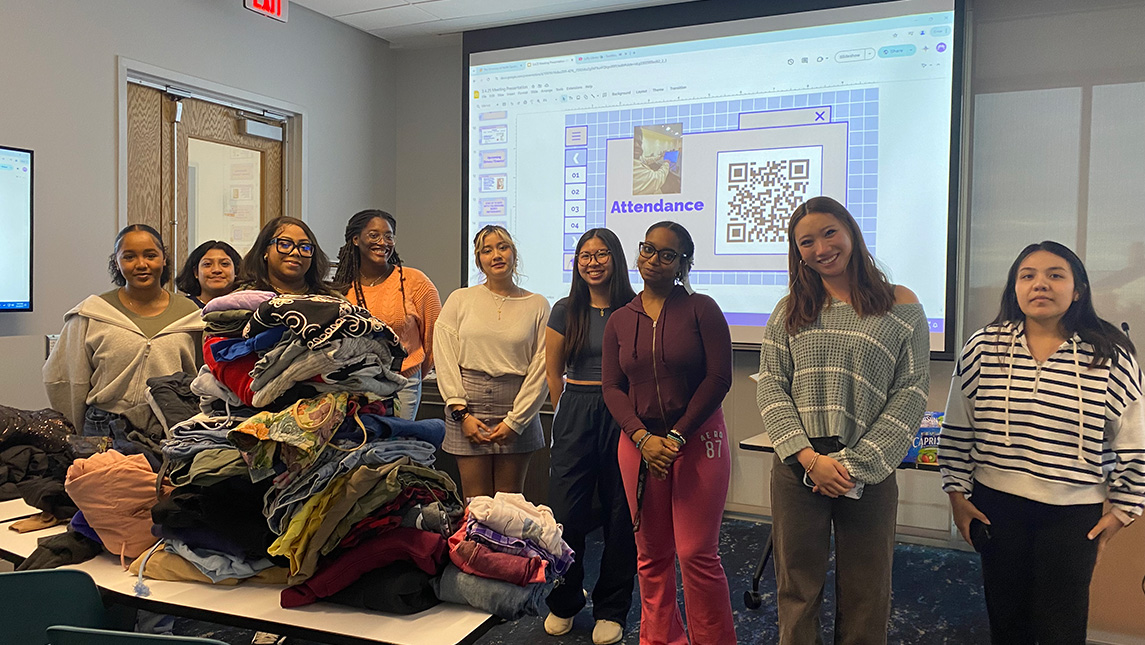
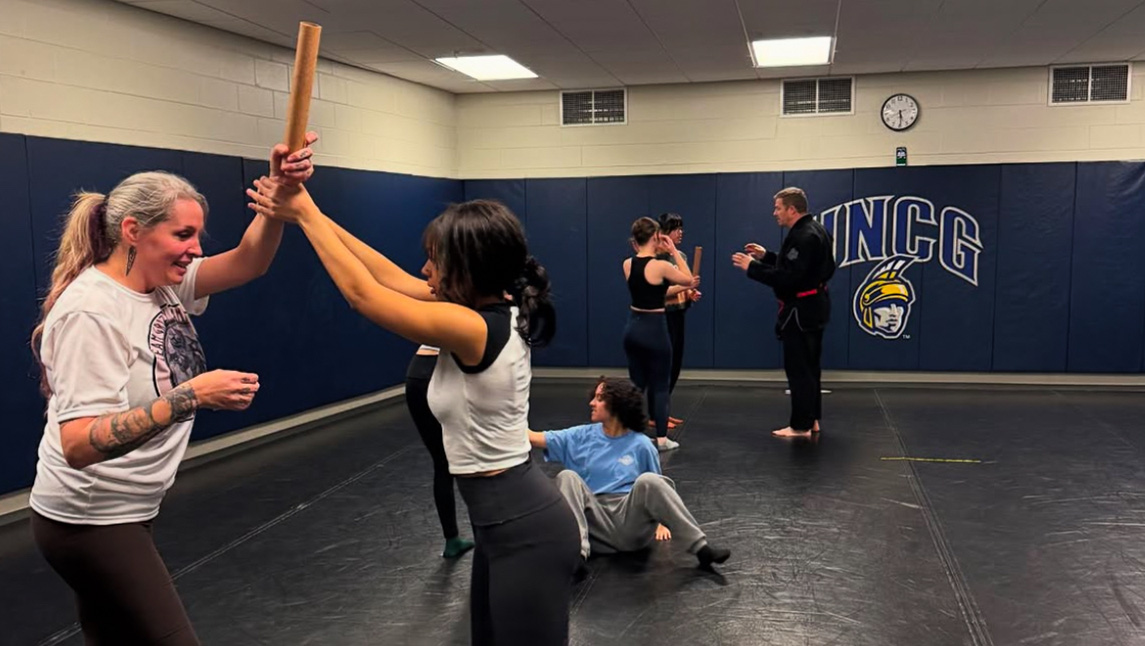
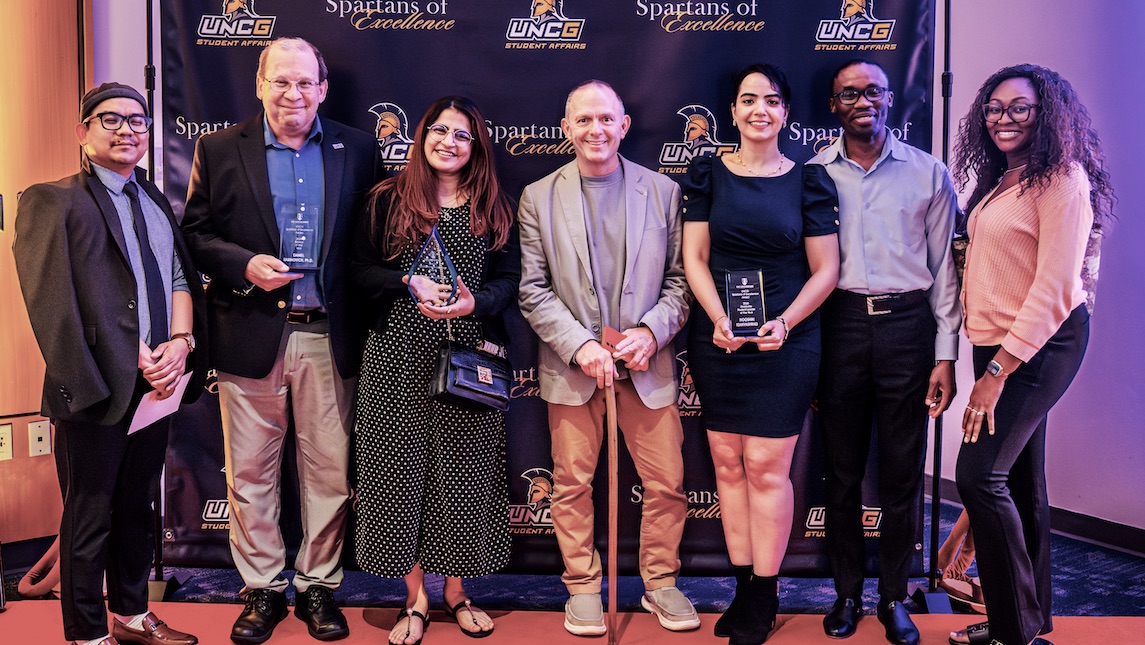
This semester’s Spartan Club Showcase featured four groups, each promoting an atmosphere of excellence and belonging while taking a unique approach to engage members.
Social Wellness is one of the key dimensions of overall well-being. Setting goals for social wellness can push a student outside their comfort zone.
It’s normal to feel nervous when meeting new peers for the first time, but forming your Spartan identity is not a race. Know that those around you are navigating the same experience at their own pace.
Here are five practical ways students can get the most out of their club involvement:
Explore new opportunities by browsing the Events or Organizations tab on Spartan Connect and reach out to inquire about upcoming meetings. If you’re looking for a club related to your field of study, consult a faculty member or your advisor for guidance.
Give yourself time to see if a club is the right fit – it’s easy to retreat back to your dorm after an hour of socializing, but seeing it through could make all the difference.
Start conversations – you never know what lifelong relationships are waiting on the other side, and club members are always excited to share what they do. By going to events like Homecoming, Spring Fling, or the Piney Lake Opening, students can easily cross paths with other like-minded individuals.
Try arriving early to connect with club leadership before the meeting begins or offer to help clean up after the meeting. Small acts of kindness are always appreciated, and they just might make attending the next meeting feel a little less intimidating.
Lastly, understand that student organizations exist for your benefit. Capitalize on the resources they offer to support your personal and professional growth.
What new opportunities could campus life bring you? You might check out that cultural event that happens every semester. You might volunteer with peers who have hearts for service, or stay up to date with that one student organization that caught your eye earlier in the year. Whatever it is, there’s no wrong way to get involved. The Spartan experience is yours to shape. You’re encouraged to do it your way.
Students interested in creating a group of their own can visit Campus Activities & Programs to learn about the requirements and read tips for success.
Story by Lauren Segers, University Communications Photography by Sean Norona, University Communications
Professor Nir Kshetri on vital AI education for university students
Artificial intelligence (AI) is booming. The AI market is projected to reach $244.22 billion in 2025, with business and legal services making up 13.7 percent of the entire market. Nir Kshetri, professor in UNC Greensboro’s Bryan School of Business and Economics, specializes in how emerging technologies like AI, blockchain, Web3 and the metaverse transform global economies, organizations, and societies. Ksherti received a Fulbright Scholar award to conduct research in Nepal. He plans to focus his research on the impact of AI on higher education.
“No one should graduate from higher education without understanding how AI works,” he says. “I plan to incorporate my Fulbright research into my international business and cybersecurity courses.”
“Cybersecurity is something that everyone needs,” Kshetri says. “At UNCG, I started offering a cybersecurity management course – it’s accessible for everyone, even those without a technical background.”
In the course his business students study how people and businesses are victimized by cyber criminals. He teaches how governments are responding in the regulatory landscape and the classes discuss policy changes.
Blockchains and Bitcoin: The Financial Frontier
Companies and consumers are exploring the future of cryptocurrency, the Metaverse, and blockchain technology to conduct business. Professor Nir Kshetri is spearheading research to help them.
“I have written several articles about how different generations of AI—predictive AI, generative AI, and the emerging third generation known as agentic AI, which refers to autonomous systems capable of independent decision-making and goal-directed actions—can both help cybercriminals and enhance cybersecurity,” he says. “I’m arguing that on the policy, sociocultural side that more people should understand how AI and cybersecurity work so they can better use it and protect themselves and their companies.”
Kshetri feels passionate about educating students about the AI/cybersecurity landscape because it impacts data flow between the U.S. and other parts of the world.
“AI policies and regulations are different in different parts of the world. The way that data privacy and security are handled varies in these different economies,” he says. “It makes it complicated for international business and ethics in AI.”
University of Nepal teaching and research
Kshetri is currently hosted by The School of Management Tribhuvan University in Nepal, for his Fulbright Scholar work. There he will teach courses and help the university develop a curriculum around AI.
“I predict artificial intelligence will become a required course for all university students at some point. Many universities are already investing in faculty who can teach how it applies to different disciplines,” he says. “Universities will have to change their curriculum to add value for students, some of whom use AI and believe it can replace traditional education.”
Kshetri’s research will focus on AI in the academic sector – the subject of his forthcoming book The Era of Generative and Agentic Artificial Intelligence in Academia: From Disruption to Collaboration and Value Creation, currently under contract with The State University of New York Press.
“I’ll be researching the impact that AI has on universities from a global perspective, how they’re responding to it, and what may be the best way to deal with this,” he says. “For many students outside of the West, they do not have as many AI resources or access to it because many AI languages are developed in high resource languages like English and German.”
Prompt engineering
When Kshetri returns to UNCG’s campus, he plans to teach his Bryan School students that the basics of ChatGPT and other generative AI are not enough.
“When ChatGPT came out almost two and a half years ago, then everyone suddenly started thinking they were an expert. Just being able to use and get an answer from ChatGPT is not sufficient,” he says. “You have to think critically about the best way of asking things and to get the best possible answer – that’s prompt engineering.”
Prompt engineering is essential for understanding how AI tools work. Their limitations and biases reflect the information it is scanning.
“Students should not enter the workforce without knowing how AI works and they should always pay attention to all the tools cyber criminals are using,” Kshetri says. “Be aware of all the new techniques that these different actors are developing. It is essential for students and consumers who use the internet to know so they can safely use AI tools and protect themselves.”
About the Fulbright U.S. Scholar Program
Since 1946, the Fulbright Program has provided more than 400,000 talented and accomplished students, scholars, teachers, artists, and professionals with the opportunity to study, teach, and conduct research abroad. Fulbrighters exchange ideas, build people-to-people connections, and work to address complex global challenges. Notable Fulbrighters include 62 Nobel Laureates, 93 Pulitzer Prize winners, 82 MacArthur Fellows, 44 heads of state or government, and thousands of leaders across the private, public, and non-profit sectors.
More than 800 individuals teach or conduct research abroad through the Fulbright U.S. Scholar Program annually. In addition, over 2,000 Fulbright U.S. Student Program participants — recent college graduates, graduate students, and early career professionals — participate in study/research exchanges or as English teaching assistants in local schools abroad annually.
Fulbright is a program of the U.S. Department of State, funded by the U.S. Government. Participating governments and host institutions, corporations, and foundations worldwide also provide direct and indirect support to the Program, which operates in more than 160 countries worldwide.
In the United States, the Institute of International Education implements the Fulbright U.S. Student and U.S. Scholar Programs on behalf of the U.S. Department of State. For more information about the Fulbright Program, visit https://ful-brightprogram.org.
Written by Alice Manning Touchette
Photography by Mike Dickens, Bryan School of Business and Economics; and Jiyoung Park, University Communications Graphics by Jaysen Buterin and De’Andre Gilliard, University Communications
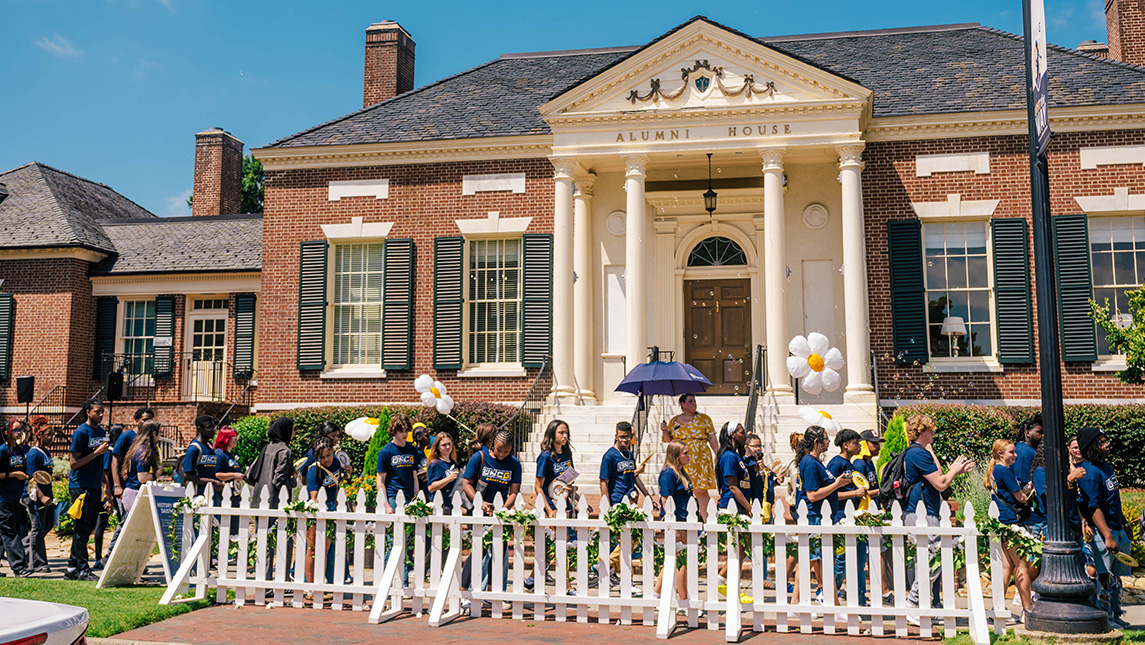
The traditional daisy chain welcomes new students and marks the beginning of a new semester.
Faculty are invited to kick off the new academic year at the annual Faculty Convocation on Wednesday, Aug. 27. Chancellor Gilliam and Provost Boyette will make their comments at 3 p.m. A resource fair and social will begin at 4 p.m. with time to socialize with old and new colleagues. Live music, food, and drink will be provided.
Faculty Senate will host the Convocation at the Oakley Reception Room in the Alumni House.
Swag Store Provides Giveaways for Tabling and Events
Posted on August 05, 2025
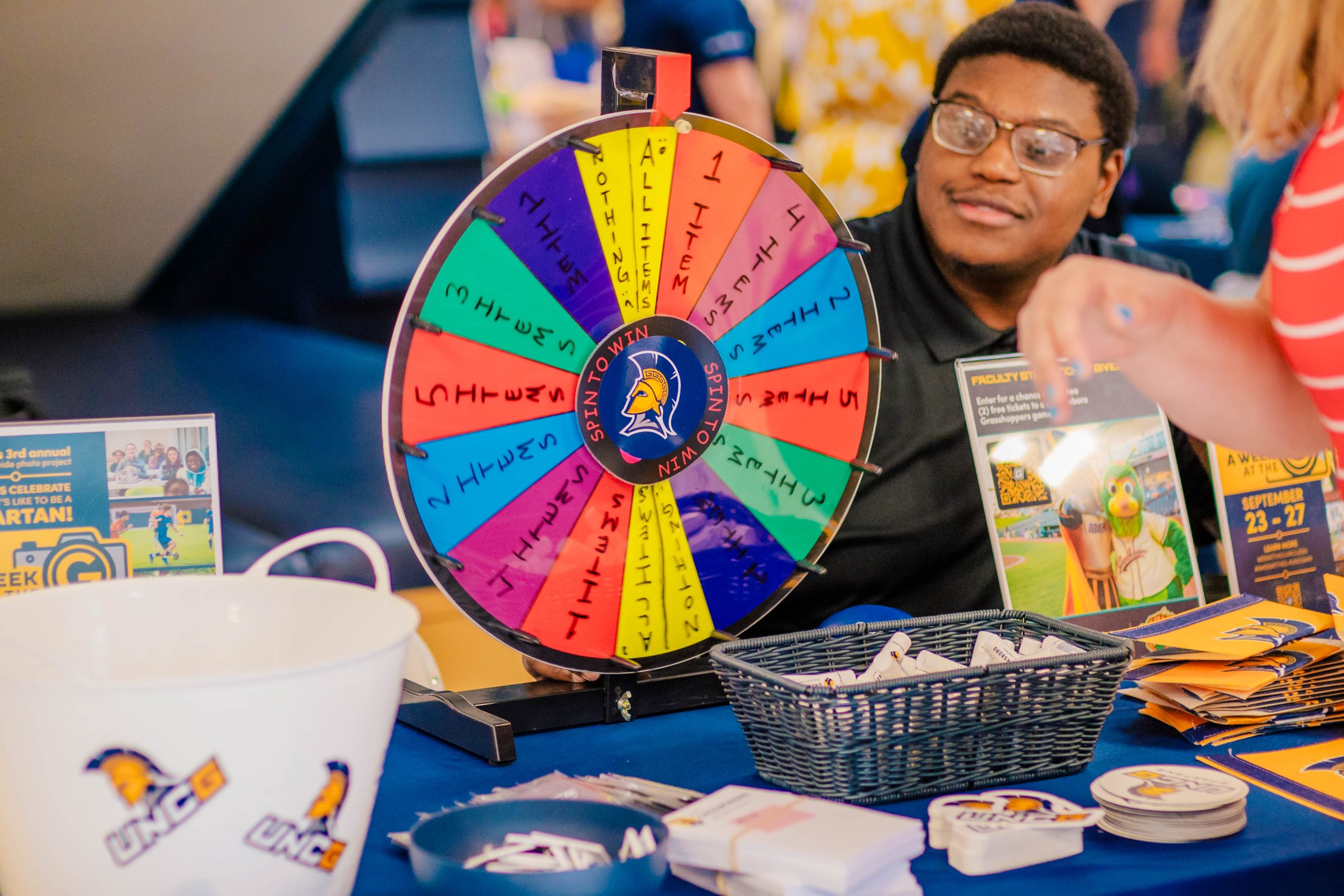
Faculty and staff spin the wheel for swag from UC at the Welcome Back luncheon.
UNCG departments and units can make their message stand out without starting from scratch. University Communications (UC) offers ready-to-use resources to help faculty and staff promote programs, events, and initiatives — quickly, on-brand, and sustainably.
Branded Swag Without the Bulk
For event organizers who need items for tabling or giveaway bags, the UNCG Swag Store offers many different options.
T-shirts, hats, water bottles, notebooks, pens, stickers, and more
Items available at bulk pricing (as few as one to as many as what’s currently in stock)
All items sourced from licensed, approved vendors
Saves time, reduces waste, and supports campus branding
For those who would like to order something not in the swag store or have it branded with a specific department logo, remember that University policy requires using an approved vendor. Organizers may contact UC for the list.
Swag given out during Churros with the Chancellor.Staff promote UNCG programs and events during Spartan Cinema at LeBauer Park.
Borrow for Events
UC will also help a setup look professional without the need to purchase new gear. These branded items are appropriate for info sessions, open houses, and campus fairs. They are first come, first served. Including, but not limited to tents and tent walls, pull-up or expanse banners, feather flags, and table cloths.
Anyone interested in more information can contact Libby Schinnow at laschinn@uncg.edu.
UC swag table at Mentoring Monday.
More Resources
In addition to swag and event materials, UC may provide strategic support for faculty and staff communicators.
‘Fighters for Freedom’ Ushers in Weatherspoon Fall 2025 Exhibitions
Posted on August 08, 2025
An exhibition from the Smithsonian American Art Museum is coming to the Weatherspoon Art Museum this Fall. “Fighters for Freedom: William H. Johnson Picturing Justice” brings together artworks illustrating the lives and impact of cultural figures, civil rights advocates, and mid-century politicians and world leaders.
Additionally, the museum at UNC Greensboro will open for two Sundays this fall with programming to learn more about “Fighters for Freedom.” These special events bring an opportunity for the public to preserve snapshots from their personal history through the “Conversations in Black” exhibition, which draws from photographs submitted by community members for the initiative of the same name.
An overview of the year will be at the annual Fall Open House on Sept. 25, 5–7 p.m. This chance to see both new and returning art is free with live music and light refreshments.
Fighters for Freedom: William H. Johnson Picturing Justice
Sept. 6 to Nov. 29
“Fighters for Freedom” pays creative tribute to African American activists, scientists, teachers, performers, and heads of state. Using a colorful palette and the addition of tiny buildings, flags, and vignettes, artist William H. Johnson captures a historic perspective with a message that the pursuit of freedom is an ongoing, interconnected struggle full of moments of both triumph and tragedy.
Born in Florence, South Carolina, a teenage Johnson left the Jim Crow South for New York City in 1901. He was accepted into the National Academy of Design, where he won most of the prizes the academy offered during his five years of study.
Left to right: William H. Johnson, Marian Anderson, about 1945. Oil on paperboard, 35 5/8 x 28 7/8 in. Smithsonian American Art Museum. Gift of the Harmon Foundation; 1967.59.657 William H. Johnson, Booker T. Washington Legend, about 1944-1945. Oil on plywood, 39 7/8 x 30 7/8 in. Smithsonian American Art Museum. Gift of the Harmon Foundation; 1967.59.664 William H. Johnson, Harriet Tubman, about 1945. Oil on paperboard, 28 7/8 x 23 3/8 in. Smithsonian American Art Museum. Gift of the Harmon Foundation; 1967.59.1146
He moved to Scandinavia where his style became influenced by European modernism. Upon his return to New York in 1938, he began painting African Americans in different scenarios: Southern sharecroppers, city hipsters, Black soldiers training for war, and religious events. “Fighters for Freedom” was Johnson’s last series painted in the mid-1940s.
“Fighters for Freedom: William H. Johnson Picturing Justice” is organized by the Smithsonian American Art Museum. Generous support for this project is provided by Art Bridges.
Conversations in Black
Aug. 9 to Jan. 10, 2026
Leading into the Fall 2025 semester, the Space for Engagement/Tannenbaum Gallery will feature photographs from “Conversations in Black,” a grant-funded collaborative initiative to collect and make accessible the rich history and contributions of African American educators, lawyers, artists, doctors, teachers, and everyday Greensboro citizens.
The exhibition invites comparisons to the people and professions explored in “Fighters for Freedom,” highlighting local equivalents whose contributions have made a lasting impact on our community.
“Conversations in Black” is in collaboration with UNCG University Libraries and Conversations in Black: African American History and Heritage, Greensboro, NC.
Curator’s Talk: Fighters for Freedom Sept. 11, 5:30 to 6:30 p.m.
Join Dr. Virginia Mecklenburg, senior curator at the Smithsonian American Art Museum, for a presentation about William H. Johnson’s work and legacy.
Gallery Talk: Fighters for Freedom Sept. 19, Noon to 1 p.m.
Artists Panel: “Whose Freedom Are We Fighting For?” Oct. 9, 6 to 7:30 p.m.
Join the dynamic discussion with Greensboro artists who will respond to William H. Johnson’s artwork through a contemporary lens to explore issues of identity, liberation, and representation. It will be moderated by Karen Archia, visual artist and community partnerships coordinator at Creative Greensboro.
Art Crawl: Fighters for Freedom Oct. 11. Time to be determined
Enjoy Creative Greensboro’s Neighborhood Arts for a free, interactive event that brings to life the themes of the “Fighters for Freedom” exhibition. Experience community-based creativity across the city during this unique opportunity to connect with local artists and their work. Presented in collaboration with Creative Greensboro, the city’s office of arts and culture, and Greensboro Parks and Recreation.
Sunday Best: Celebrating William H. Johnson Oct. 19 and Nov. 16, Noon to 5 p.m.
On two Sundays in October and November, anyone can drop by to see the paintings, attend informative panels about the works and themes of “Fighters for Freedom,” and contribute to the “Conversations in Black” project by bringing photographs and ephemera to digitize and add to this online collection chronicling African American contributions in Greensboro. Refreshments will be served.
Neighborhood Arts Celebrate William H. Johnson Nov. 9 to Dec. 12 African American Atelier at the Culture Arts Center 200 N Davie St. Greensboro, NC 27401
“Fighters for Freedom” is joined by an accompanying exhibition with Greensboro-area artists. Thanks to Creative Greensboro‘s Neighborhood Arts Grants, recipients can create or upgrade art pieces in relation to Johnson’s work. Their work will be displayed at the African American Atelier.
Pattern Recognition
June 7 to Jan. 10, 2026
This exhibition features artworks from the Weatherspoon’s collection in which artists explore the power of patterns, the ways in which they can provide both stability and activation, and how they can register both familiarity and surprise.
This ongoing exhibit presents newly rotated works this fall, including drawings by Robert De Niro Sr., Jo Sandman, Sarah Stein, and Max Weber, as well as 19th-century ukiyo-e prints by Utagawa Hiroshige and Torii Kiyomitsu.
“Making Connections” demonstrates how the Weatherspoon has served as an academic museum with deep connections to and relationships with its campus, Greensboro, and broader communities for over eight decades.
The Arts of Gaming Aug. 28, 6 to 7:30 p.m.
How might 3D modeling and digital storytelling change how we experience and learn from artworks in the Weatherspoon’s collections? New Benjamin Faculty Fellow John Borchert, Ph.D. will share ideas for connecting art, technology, and community through growing partnerships with Epic Games and new campus spaces for media, animation, and interdisciplinary collaboration. A reception will close out the evening at 7 p.m.
Of Salt and Spirit: Black Quilters in the American South
In 2026, the Weatherspoon will open a new exhibit that surveys some of the vibrantly designed and richly varied quilt-making traditions maintained by Black women in the U.S. South through the 20th century and into the present day.
Organized by the Mississippi Museum of Art and curated by Dr. Sharbreon Plummer, it foregrounds the deliberate, complex practices of quilters who have cultivated networks of mutual support and preserved personal histories around and through their craft.
Harriet’s Powers
In tandem with “Of Salt and Spirit,” the Weatherspoon will present a commissioned project by North Carolina artist Precious D. Lovell. Her installation will celebrate the life and artistry of Harriet Powers (1837–1910), considered by many to be the mother of the African American story quilt tradition.
Combining quilting, sculpture, collected historical objects, and sound, this artwork will provide visitors with an opportunity to expand their thinking about the legacies and futures of Black quilters through Lovell’s contemporary artistic response.
MORE TO COME AT THE WEATHERSPOON
This fall, the museum’s central atrium will be dedicated the Warmath Commons. This gift from the Warmath family celebrates and advances more than 60 years of commitment to the museum and its mission, ensuring that it remains a welcoming space for exploration, connection, and community.
Sarah Warmath and her late husband Jack were pivotal in shaping the Weatherspoon’s future as early supporters of the capital campaign for the Anne and Benjamin Cone Building, helping the museum grow from a campus gallery into the distinguished institution it is today.
Meet the New Fellow
The Weatherspoon is excited to announce its third annual Margaret and Bill Benjamin Faculty Fellow for the new academic year. John Borchert, Ph.D. will join the museum team to explore the ways in which close study of physical artworks in the galleries can inform the creation of virtual worlds online. A scholar of digital humanities and game studies, Borchert serves as director of videogaming and esports studies at UNCG.
He will convene gatherings of faculty from across disciplines to strategize how the collections and archives can be activated through real-time 3D technology in ways that support both traditional art history and contemporary design studies.
Story by Janet Imrick, University Communications Photography by Sean Norona, University Communications; and courtesy of the Weatherspoon Art Museum and the Smithsonian American Art Museum
Chancellor’s Initiative for Transformative Research: 2025 Awardees
Posted on August 21, 2025
UNC Greensboro proudly announces the recipients of the 2025 Chancellor’s Initiative for Transformative Research (CITR) award. The selective seed funding program supports high-impact research initiatives with the potential to attract significant external funding and deliver benefits to communities locally, nationally, and globally.
“At UNCG, we believe that great universities don’t just reflect the world, they shape it,” said Chancellor Franklin D. Gilliam, Jr. “The CITR program invests in the kind of bold, forward-thinking research that drives progress and changes lives.”
Building on University strengths, CITR champions projects that address pressing societal challenges, revolutionize creative scholarship, advance health and wellness, and foster emerging technologies.
Four 2025 CITR awardees were chosen through a rigorous peer-reviewed process from a competitive pool of 35 proposals submitted by UNCG faculty and researchers.
Through this initiative, UNCG is embarking on a bold research strategy that integrates expertise across disciplines to tackle complex problems that cannot be solved by a single field or by the university alone. Each selected project is built on strong partnerships with the community or industry partners to ensure that the work remains relevant, responsive, and impactful. This convergence-driven approach reflects UNCG’s deep commitment to addressing some of the most pressing challenges in health care, technology, and humanity, positioning our University as a leader in innovation with purpose.
“These projects represent the bold and innovative research directions that reflect the very heart of UNCG’s mission. Each project moves us toward the goals of our strategic plan, advancing knowledge, and solving real-world challenges that transform our state, our nation, and the world,” said Dr. Sherine O. Obare, Vice Chancellor for Research and Engagement. “These projects will drive innovation and strengthen our competitive position in North Carolina and beyond.”
Category I Awardee: Addressing pressing societal challenges Promise and Perils of Pre-Adolescent Technology Engagement: Scaffolding Self-Regulation in Service of Health and Well-being in the Digital Age. Dr. Michaeline Jensen, Psychology; Dr. Jessica Dollar, Psychology; and Dr. Laurie Wideman Gold, Kinesiology
This project will examine how digital technology use affects self-regulation, health, and well-being in pre-adolescents, aiming to provide evidence-based strategies for parents, schools, and policymakers to support healthy digital habits. Award amount: $74,608.
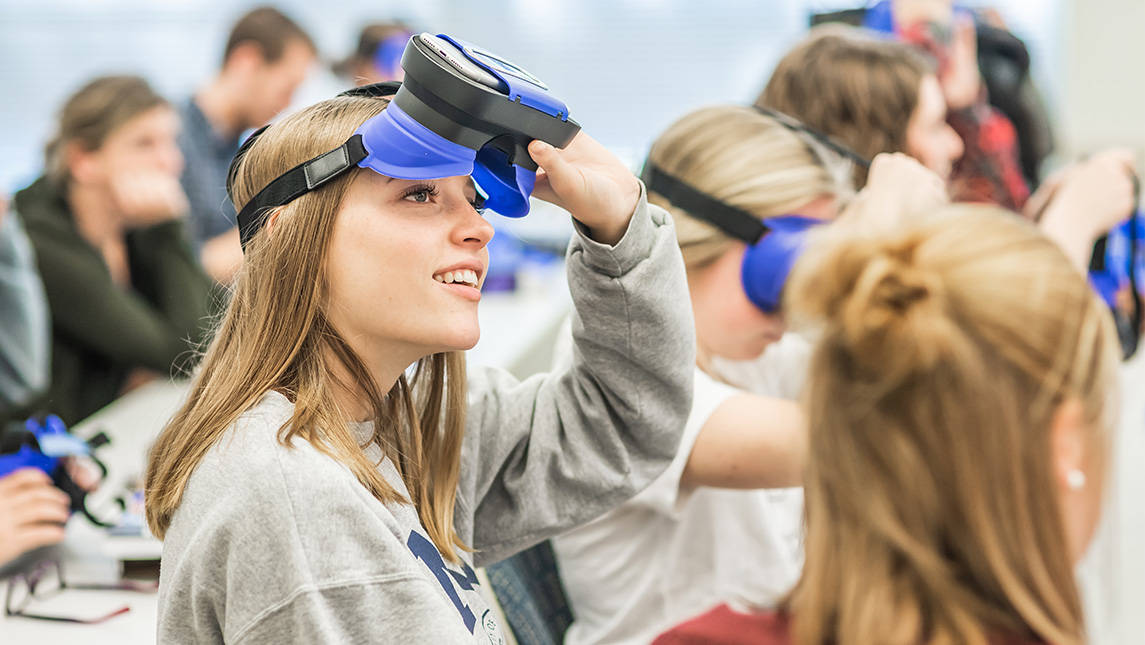
Category II Awardee: Revolutionizing creative scholarship to bring awareness to a problem Threading Innovation: An Interdisciplinary Evidence-Based Research Initiative Empowering Workforce Development through VR/AI in Cybersecurity and Apparel Supply Chain. Dr. Lakshmi Iyer, Information Systems and Supply Chain Management; Dr. Melanie Carrico, Consumer, Apparel, and Retail Studies; Dr. Motahareh Pourbehzadi, Information Systems and Supply Chain Management; Dr. Jin Su, Consumer, Apparel, and Retail Studies
This interdisciplinary initiative will leverage VR and AI to create immersive, evidence-based training tools that prepare students and professionals for the evolving cybersecurity and apparel supply chain workforce. Award amount: $71,909.
Category III Awardee: Responding to critical and urgent health and wellness needs Production and Modification of an Anti-Cancer Drug Lead. Dr. Jonathan Chekan and Dr. Nicholas Oberlies, Chemistry and Biochemistry
This research will develop scalable and sustainable methods to produce a promising and novel anti-cancer compound, Verticillin D, enabling the discovery of new therapeutic analogues with potential clinical impact. Award amount: $75,000.
Category IV Awardee: Advancing critical technologies Toward Trustworthy and Privacy-Preserving AI for Next-Generation Medication Assistance: A Multimodal Learning Copilot. Dr. Yingcheng Sun, Dr. Minjeong Kim, and Dr. Qianqian Tong, Computer Science
This program is directed towards the creation of a privacy-preserving, multimodal AI copilot that supports clinicians with medication guidance, clinical trial matching, and patient care while safeguarding sensitive health data. Award amount: $75,000.
The selected projects, which launch in September 2025, exemplify growth in research and the CITR goals of fostering innovative, interdisciplinary work; cultivating strategic partnerships; and generating outcomes that have measurable and lasting impact. Each demonstrates a clear plan to build external partnerships, engage students in research, and lay the foundation for future grant opportunities.
Study Smarter, Not Harder! Three Starter Skills from UNCG Peer Coaches
Posted on August 22, 2025
UNCG peer coaches peer around corners with the Academic Achievement Center's assistant director Erin Mason (center).
Even with renovations ongoing at Jackson Library for the next two years, the Academic Achievement Center (AAC) remains open. Its staff invites students to keep visiting the AAC on the ground floor through the College Avenue entrance. The staff and students who work there all share a commitment to helping UNC Greensboro students thrive.
Peer coaches are popular because they understand the stress that students face first-hand. They’ve juggled classes, clubs, new friends, and figuring out where the best pizza on campus is. They understand what it’s like to be launched into college life at full speed. That’s why they’re here to help you stay on track (and maybe even ahead).
Whether it’s time management or just trying to survive your first semester, a visit to the AAC could be the smartest move you make.
Favorite food on the go: Pepperoni pizza Favorite hang-out spot: The Library or the EUC’s third floor Favorite campus event: The Homecoming Bonfire A class that you enjoyed the most: CED 274 Stress Management Music or no music when studying: Music! I listen to Boyish, NewDad, Sasha Alex Sloan, Flower Face, and Mree.
Favorite food on the go: Protein shakes and applesauce Favorite hang-out spot: Taylor Garden Favorite campus event: Tennis matches and soccer games A class you enjoyed the most: PSC 260 Introduction to Comparative Politics Music or no music when studying: No music
Favorite food on the go: A quick Spartan Meal or fast food lunch Favorite hang-out spot: Taylor Garden Favorite campus event: The men’s first basketball game of the semester A class that you enjoyed the most: ADS 260 Understanding Race Music or no music when studying: I prefer a quiet space, but sometimes, listening to Lofi-radio helps me focus.
Who are the coaches? Meet your academic allies
It’s important to know that peer coaches are not the same as tutors, and they are not the ones to ask for answers to a specific assignment. Wilson admits she gets mistaken for a tutor at times. “The classes that I help students with are not classes I’ve taken,” she explains. “So, I can’t teach them the specific material of that class. That’s what a tutor is for.”
Coaches are there to work on long-term skills that can be applied to current and future courses. “We’re focused more on things like procrastination, time management, things that affect your study habits,” says Nwauwa.
Lee agrees, “You’re not going to find some ‘cheat codes’ for you to pass your test. We’re not ChatGPT. You still need to put in the work to get the results you want.”
The coaches apply for the job and are selected after an interview process. They get oversight and guidance from staff in the Division of Student Success, including Assistant Director for Campus Outreach and Coaching Erin Mason. Nwauwa says her own coach in academic counseling suggested she apply. “I needed two recommendation letters,” she says. “I got one from my counselor and another from a professor. Then I got an interview with Erin. We have to take some lessons on Canvas. Erin also taught us in person.”
They can also refer students to other units on campus for extra help. Wilson says a greater knowledge of the University-side services is one of the benefits of her job. “Before I became a peer coach,” she says, “I just remembered hearing about these services at orientation. Now, as a coach, I recommend those resources to fellow students.”
Peyton’s Key Skill to Learn in Your First Year
Definitely notetaking. I talk to a lot of students about college being different from high school. In high school, the teachers can be much more engaged because of smaller classes. But here, in the big lecture halls, the professor spouts off the information and then you leave. It’s up to you to take good notes that you understand. Also, I don’t think I’ve ever had a session where we did not talk about prioritizing goals. That’s one, too.
What’s in it for me?
Even students who got top marks in high school may find the college curriculum daunting. The fast pace, stringent course requirements, and large lecture halls may be such a dramatic change that they struggle to keep up.
In many ways, Lee says college can feel like a reset. “All the resources and support systems I had grown over the past four years of high school was pretty much out of my reach. I had to build up a new system, learn about campus, restructure how I take notes and do homework. I had to recalibrate how I do my extracurricular activities and academics, while also trying to maintain my social life.”
The AAC provides help in many ways: peer-to-peer tutoring for specific courses, workshops, and coaching to develop successful academic habits. Students may ask for peer coaching so they can sit down with a fellow student to discuss topics like motivation, time management, concentration and more. Or, if they get a referral, they can join executive coaching and join a cohort of students across majors who meet regularly and develop strategies over time.
Before becoming a coach, Lee went to the AAC for help with Spanish and formed a great relationship with her tutor. “It’s very interactive, very hands-on, and you get to know your tutor or coach on a personal level.”
When it comes to asking for help, Nwauwa says not to feel ashamed. “It is hard adjusting to putting yourself out there,” she acknowledges, “But you miss a lot of opportunities if you don’t.”
Ugochi’s Key Skill to Learn in Your First Year
I would say time management and figuring out your schedule. I always have a specific day where I do homework, so that for the rest of the week, I have time to do other things. If you don’t have that time management, you can end up putting too much stuff on yourself and then feeling burnt out. It’s definitely a skill to learn your first year.
How will it help me succeed?
Because they are all students, AAC coaches respect the need for school-life balance. “A lot of people think they have to hit the books hard all the time,” says Wilson. “And I say, you can get burnt out very easily. You should definitely be attending club meetings, hanging out with friends, or taking breaks to prevent that.”
The coaches say it’s fulfilling to know that they are passing along long-term skills that they learned when they first came to UNCG. And, like those who come to them for help, they are still getting better. “I always take each lesson and say, ‘Okay, maybe next time when I talk to a student, I can do this better,'” says Nwauwa. “It brings me a lot of comfort and joy helping people with things I struggled with myself.”
“If there’s something you could change, something to switch about your normal routine, I would say try the center,” says Lee. “The resource is there for you.”
Jazlyn’s Key Skill to Learn in Your First Year
Being a mental health minor, I’ll say taking care of yourself is always the number one priority. You’re not a robot. You can’t function on two hours of sleep. Taking care of yourself means finding a good balance in your school, work life, and personal life. It definitely took me many months and semesters to find a good balance. Prioritize yourself first, and everything else can come later.
Story by Janet Imrick, University Communications Photography by Sean Norona and Chase Cofield, University Communications
The policy revisions which have been approved and taken effect as of Aug. 18 were to add statements to the Acceptable Use Policy and Data Integrity Policy to support and safeguard the use of artificial intelligence-enabled tools and services with University data.
UNCG is First Campus Host for Career Launch Bootcamp
Posted on August 15, 2025
At UNCG, success isn’t just measured in grade point averages and graduation rates. Faculty and staff do everything they can to make sure our students are ready for the workforce.
TWC is a renowned organization that has been preparing college students for their careers since 1975. Students from all over the country travel to Washington, D.C. for its professional development seminars, immersive internship connections, and career preparation. This year, TWC will take their expertise on the road. And thanks to a strong relationship with UNCG’s CPD, Greensboro will be their first stop.
“As an inaugural regional program partner, UNCG embraced the opportunity to offer tailored content designed specifically for the North Carolina job market,” said Brandy Holoman, executive director of TWC’s Workforce & Programs. “Together, TWC and UNCG share a commitment to preparing students — while they are still in college — for the realities of tomorrow’s workplace.”
The three-day bootcamp combines the professional development expertise of TWC with UNCG’s alumni and corporate partners to deliver a networking and recruitment skill-sharpening event designed to give students a competitive advantage as they enter the workforce.
Opportunity Knocks
Participants will attend workshops to build competencies in areas such as artificial intelligence in the workplace, workplace resilience, and negotiation. They’ll mingle with employers and make important contacts. Meals will be provided, and all sessions will conveniently take place at the EUC.
A similar experience at TWC in Washington would cost those students around $1,200. UNCG’s partnerships allow Spartans to invest in their future careers with their tenacity and skills, instead of using their limited finances.
“The Career Launch Bootcamp is a strong example of UNCG’s commitment to preparing Spartans for career success,” said Vice Chancellor of Student Affairs Cathy Akens. “We are excited to offer this opportunity in partnership with TWC, knowing the lasting impact it will have. Participants will leave ready to excel in their first job and thrive in an ever-changing world of work.”
Race to Register
With participation limited to 75 students, CPD is gearing up for a selective application process. Interested third- and fourth-year students should sign up for more information on the event webpage. Students sharing their information will be first to hear about information sessions planned for the weeks ahead and registration deadline reminders.
Save the date for Oct. 24-26, as selected applicants must commit to attending all sessions of the event.
Submit your application for the Career Launch Bootcamp by the Sept. 19 deadline.
UNCG is committed to selecting students from across Schools and departments to represent the diverse degrees we offer and give regional employers such as Cone Health and Reynolds American access to our highly-skilled students.
“Deans and department heads from across our campus share our excitement about this opportunity and will help us recruit student participants,” said CPD’s Director Megan Walters. “We welcome nominations for the experience and look forward to identifying motivated Juniors and Seniors from UNCG’s diverse fields of study for this amazing opportunity.”
Story by Becky Deakins, University Communications. Photography by Sean Norona, University Communications.
Last week, Greensboro lost a passionate and stalwart leader in Jim Melvin.
As the city mourns his passing, UNC Greensboro remembers how Melvin supported our University mission and students, grew the workforce our graduates aspire to join, and helped to build the vibrant community around us.
“Jim Melvin has roots on our campus that date all the way back to his father’s grocery store on Tate Street,” said Chancellor Frank Gilliam. “His life mirrored UNCG’s motto of service and his legacy will live on in the Spartan scholars his work supported and the local industry he brought to the area, which will employ our graduates for years to come.”
A Servant’s Calling
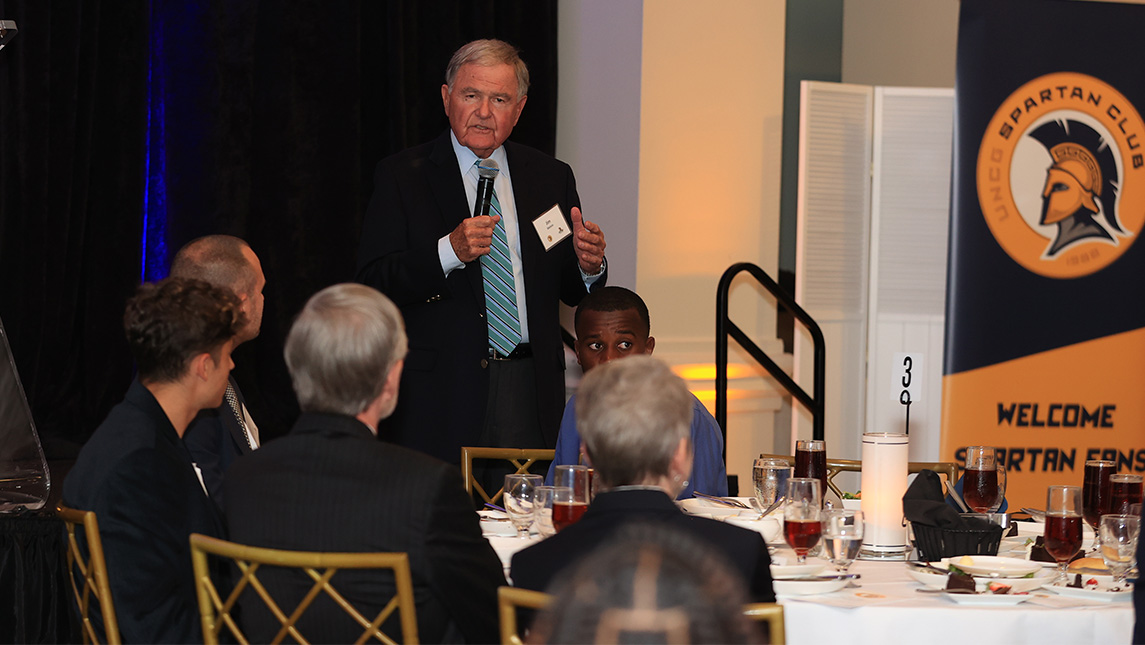
Melvin at a Bryan School dinner in 1989. Photo courtesy of Special Collections and University Archives.
Known around the state as “Mr. Greensboro,” Melvin gave a lifetime of unwavering support for the city where he was born and raised. In addition to a career in banking that spanned four decades, he held Greensboro’s longest term as mayor, serving ten years from 1971 to 1981. After Melvin retired, Joseph M. Bryan tapped him as a founder and early leader of his foundation, which not only supported the growth in the Greensboro area, but also contributed to educational funding at UNCG. To date, 370 students have benefitted from Joseph M. Bryan Foundation scholarships, primarily in the Bryan School of Business and Economics (Bryan School).
Melvin’s contributions to the University extended beyond his leadership as CEO and president of the Bryan Foundation. He also chaired the UNCG Board of Trustees and served on many other University boards and committees. He was awarded an honorary degree in 2007, received the UNCG Charles Duncan McIver Medal in 2005, and joined the UNCG Athletics Hall of Fame in 2000.
Always in the Game
Melvin’s passion for sports and recreation in Greensboro led him to spearhead projects like Bryan Park and the First Horizon Bank Park (home of the Grasshoppers), developing Greensboro’s “Tournament Town” moniker.
It also made him a big supporter of UNCG athletics. Melvin’s obituary noted that “you could always find him in the stands at Spartan basketball games.”
As one of the Greensboro business leaders known as the “Big Five,” he was important in establishing UNCG’s NCAA Division I athletic program, and he also funded his own scholarship. Since 1999, the Jim Melvin Athletic Scholarship has supported 18 scholar athletes at UNCG.
“Jim Melvin was a friend to UNCG athletics and was instrumental in our move from Division III to Division I in 1991,” said Athletic Director Brian Mackin. “UNCG athletics has seen record fundraising numbers in the last three years with Jim cochairing the scholarship and operating initiative. He will be missed by the UNCG Athletic Department, as well as the University and Greensboro communities.”
What’s Good for Greensboro Is Good for Spartans
Melvin speaks at the press conference for Toyota’s battery manufacturing facility.
Perhaps Melvin’s most enduring legacy is his recruitment of industry in and around the city of Greensboro, which in turn uplifts UNCG and its graduates.
Melvin understood that empowering communities meant not only funding education but also building industry to drive employment. He always kept his eye on emerging businesses to support the next generation of college graduates. In recent years, he was a primary supporter of Piedmont Triad International as an aviation hub, helping to attract HondaJet, the Boom Supersonic plant, and Toyota’s battery manufacturing plant.
“After Joseph M. Bryan, it would be difficult to name a greater champion of Greensboro than Jim Melvin,” said Dean Joy Bhadury of the Bryan School.
Bhadury further praised Melvin’s impact on UNCG students’ success and noted that being a champion of industry and urban growth didn’t keep him from making time to get to know the people who would benefit from his work at the yearly Bryan Scholars and Fellows dinner.
“In all my years at UNCG, I have never known Jim Melvin to have missed one of those events,” said Bhadury. “And at every event, including the most recent one in February 2025, he made a point to speak to students, find out more about them and their career aspirations, and encourage them onwards.”
“In his passing, a true giant of our city is gone and will be irreplaceably missed,” Bhadury continued. “UNCG joins the rest of our city in mourning his loss, but this also strengthens our resolution to ensure that we continue to work to bring to fruition the dreams of Mr. Melvin.”
Story by Becky Deakins, University Communications.