Quick Jump to:
Semester Hours
Course Loads
Policy on Continuous Enrollment
Leaves of Absence
Readmission
Grades
Grade Points Awarded per Hour of Credit
Withdrawl
Incomplete
S-U Grades
Appeal of Grades
Academic Eligibility to Continue in Graduate School
Degree Programs
Certificate Programs
Visions Program
Readmission after Academic Dismissal
Denial of Enrollment
Appeal of Regulations
Apply for Graduation
Commencement Participation Policy
Continual Learning
Independent Study
Summer Session
Student Responsibiliy
University Policies
Conflict of Interest
Student-Instructor Relationship
Faculty as Student
The unit of academic work is the semester hour, defined as one 50-minute lecture period (or at least two such periods of laboratory or field work) per week throughout one semester.
Graduate students are considered full time if they are enrolled in at least 6 semester hours per semester. Graduate students holding service appointments are restricted in course load depending upon the extent of their service.
Policy on Continuous Enrollment
Pursuit of a graduate degree should be continuous. Students pursuing a graduate degree program should normally be enrolled each Fall and Spring Semester, or one semester during the academic year in combination with Summer Session, for course work that is approved for their program of study and selected in consultation with the departmental Director of Graduate Study.
The policy on continuous enrollment normally requires that a student be enrolled continuously, as defined above, from the time of entry into a graduate degree program through the completion of all required course work, including the required hours of 699 and 799. Students who have already enrolled in the maximum number of 699/799 hours but who have not yet completed the requirements for thesis/dissertation are required to enroll in additional course work as described below.
Students completing their thesis or dissertation must enroll in and pay tuition and fees for not less than one nor more than three hours of thesis/dissertation extension credit each semester, after consultation with and approval by their faculty advisor. These hours will not count toward the degree. Students required to enroll in additional hours to complete their master’s thesis will enroll in departmental 801 (example: ART 801-Thesis Extension), and doctoral students completing their dissertation will enroll in departmental 802 (example: ENG 802-Dissertation Extension). All thesis and dissertation students must be enrolled in thesis/dissertation preparation (699/799) or the thesis/dissertation extension courses (801/802) for credit during the semester in which they complete their graduate work and are scheduled to receive their degrees.
A graduate student who has been admitted with full graduate standing to a graduate degree program but has not completed any 500-level or above courses at the University for two consecutive semesters (or a semester and Summer Session) is considered to have withdrawn from the curriculum. The student will be required to file an application for readmission to The Graduate School to resume the course of study. A student who withdraws will be required to comply with regulations and requirements in effect at the time of readmission to The Graduate School.
Students in planned summer-only programs of study should maintain annual summer session patterns of enrollment and course completion throughout the program of study for the degree.
Leaves of absence may be granted for a variety of reasons including extracurricular educational activities, illness, and other personal circumstances. Students should submit requests for a leave of absence in writing to their departmental Director of Graduate Study, who will forward the request to The Graduate School with the department’s recommendation. All requests for leaves of absence will be considered on a case-by-case basis in The Graduate School. Under normal circumstances, time devoted to a leave of absence will count toward the authorized time limit for completion of degree requirements. Students with special circumstances should consult with the departmental Director of Graduate Study to discuss options available for revising the time frame needed to complete their plan of study.
A student who fails to enroll in courses for more than one semester without an official leave of absence must file an application for readmission and pay the $55.00 application fee.
Beginning with courses taken in Fall 2004, plus/minus grades are incorporated into the GPA for all graduate level courses according to the following scale:
| Grade | Grade Points Awarded Per Hour of Credit |
| A | 4.0 |
| A- | 3.7 |
| B+ | 3.3 |
| B | 3.0 |
| B- | 2.7 |
| C+ | 2.3 |
| C | 2.0 |
| F/WF | 0.0 |
Grades of S, satisfactory, or U, unsatisfactory, are reported on all workshops and institutes, and certain seminars, field projects, internships, practica, music groups, and others.
The grade point average is determined by dividing the accumulated number of grade points earned by the accumulated number of semester hours undertaken. Hours attempted but not passed must be included in this calculation. Courses graded S/U and courses transferred from another institution (except those course taken through cross registration) may not be used in determining the UNCG grade point average.
For the completion of graduate programs, the overall GPA for graduate courses taken at UNCG must be at least 3.0. Additionally, the overall GPA for all courses included on the student’s final Plan of Study must be at least 3.0. A GPA of 3.0 or better may be required in the major field at the option of the major department. For certificate students, no more than three semester hours of credit evaluated as C+ (2.3) and/or C (2.0) may be applied toward the minimum hours required for the certificate. For master's and specialist students, no more than six semester hours of credit evaluated as C+ (2.3) and/or C (2.0) may be applied toward the minimum hours required for the degree. For doctoral students, grades in all courses applied toward the degree must be B (3.0) or better, and additional hours must be taken for any hours earned with a grade of B- (2.7) or less.
If a student receives a course grade other than Incomplete (I) and later submits additional work (whether that work is specified in the syllabus or not) after grades are posted, this work cannot be used as a basis for changing the assigned grade. Except for independent study or where specific provision is made in the course description, no student may repeat for credit a course for which he/she has earned credit. If a student repeats such a course, the grade will be recorded on the transcript, but no additional credit will be allowed toward graduation or toward the grade point average. A failing grade remains on the student/s academic record permanently.
Graduate students who must withdraw from the University may do so by dropping all courses via the Web through UNCGenie until the last day to drop without academic penalty. Students whose registration for all courses is cancelled must seek reactivation or readmission through The Graduate School to return to school in subsequent terms. After the deadline to withdraw without penalty, and no later than the last day of classes, a W may be granted only with the permission of the Dean of The Graduate School and if status in the course at the time of withdrawal is satisfactory. If the student is in failing status at the time of withdrawal, a grade of WF is given. A course abandoned with insufficient reason for withdrawal is assigned the grade of F. In certain cases, faculty may initiate the withdrawal procedure for cause.
The symbol I indicates inability, for reasons beyond the student’s control, to complete course requirements by the end of the term in which the course was offered. The I may be removed by completion of the deferred requirements within six months from the last day of examinations in the term in which the course was taken. An I not so removed within this time limit automatically becomes an F. A grade of I on any course, including work not required for the student’s program, must be removed before graduation. A grade of I cannot be removed with a grade of W.
In the case of a thesis, master’s production, or dissertation in progress, a grade of IP (in progress) will be recorded each semester of registration for credit until completion of the thesis, master’s production, or dissertation, when a final grade of S (satisfactory) will be assigned. Extension of thesis, research extension, and extension of dissertation courses also may be graded with IP on a limited basis, but faculty advisors may be required to provide documentation of the student’s satisfactory progress toward completion of the program.
Grades for the following courses are reported as S, satisfactory, or U, unsatisfactory:
A currently enrolled student may appeal a grade within one year of the date the grade was posted. The process of appeal must adhere to the following prescribed chain of command. The complaint is initiated with the instructor assigning the grade, then with the head of the department/program, and finally with the academic dean. If, at any level, the appeal is endorsed, endorsement at the next level is not required, but the endorsement is sent to The Graduate School for final decision. If the appeal is not endorsed at previous levels, a final appeal may be made in writing to the Graduate Studies Committee through the Dean of The Graduate School. Authority to change any grade, other than I, rests with the Dean of The Graduate School, subject only to the authority of the Chancellor.
Academic Eligibility to Continue in Graduate School
Persons enrolled in The Graduate School are regarded as members of the student body of The University of North Carolina at Greensboro and are held responsible for conducting themselves in conformity with the moral and legal restraints found in any law-abiding community. Continued enrollment in The Graduate School is at all times subject to review of the student’s academic record and of the student’s actions with regard to observance of University rules and regulations.
Fully admitted students will become academically ineligible to continue in The Graduate School under any of the following circumstances:
Fully admitted students in Post-Baccalaureate and Post-Master’s Certificate programs will become academically ineligible to continue in an approved certificate program under any of the following circumstances:
VISIONS students will become academically ineligible to continue in The Graduate School under any of the following circumstances:
Readmission after Academic Dismissal
A student who is dismissed for academic reasons will be eligible to submit a new application after two semesters or the equivalent and may be admitted only upon the recommendation of the major department head or Director of Graduate Study and with the approval of the Dean of The Graduate School. While on academic dismissal, students are not eligible to take courses through the Visions program. The policy on Academic Eligibility to Continue in Graduate School does not apply to provisionally admitted students. (See Provisional Admission)
For a fully admitted degree or certificate student who is dismissed for academic reasons and who has not yet attempted the minimum number of semester hours required for the degree or certificate, an appeal to the regulation on academic ineligibility will be considered under either of the following circumstances:
UNCG reserves the right to deny enrollment of any student, even though the student has met the minimum grade point average required, if it is apparent from the student's academic record that the student will not be able to meet the graduation requirements.
An appeal of the application of a rule or regulation must be made within one year as determined by the date of the letter from The Graduate School informing the student of the decision in question. The process of appeal must adhere to the following prescribed chain of command. The appeal is first made in writing to the head of the department/program, then to the academic dean. If, at either level, the appeal is endorsed, endorsement at the next level is not required, but the endorsement is sent to The Graduate School for final decision. If the appeal is not endorsed at previous levels, a final appeal may be made in writing to the Graduate Studies Committee through the Dean of The Graduate School. The decision of the Committee is final, subject only to the authority of the Chancellor.
Students must formally apply for graduation to The Graduate School by the end of the first week of classes during the term in which they plan to graduate. Degrees are awarded at the end of each semester and the second summer session (i.e., in December, May, and August). August and December degree recipients may participate in formal commencement exercises held in December. May degree recipients may participate in formal commencement exercises held in May. Diplomas and transcripts of students owing money to the university will be withheld until the account is cleared. Students may not be admitted to and graduate from the same degree or certificate program in the same academic term.
Commencement Participation Policy
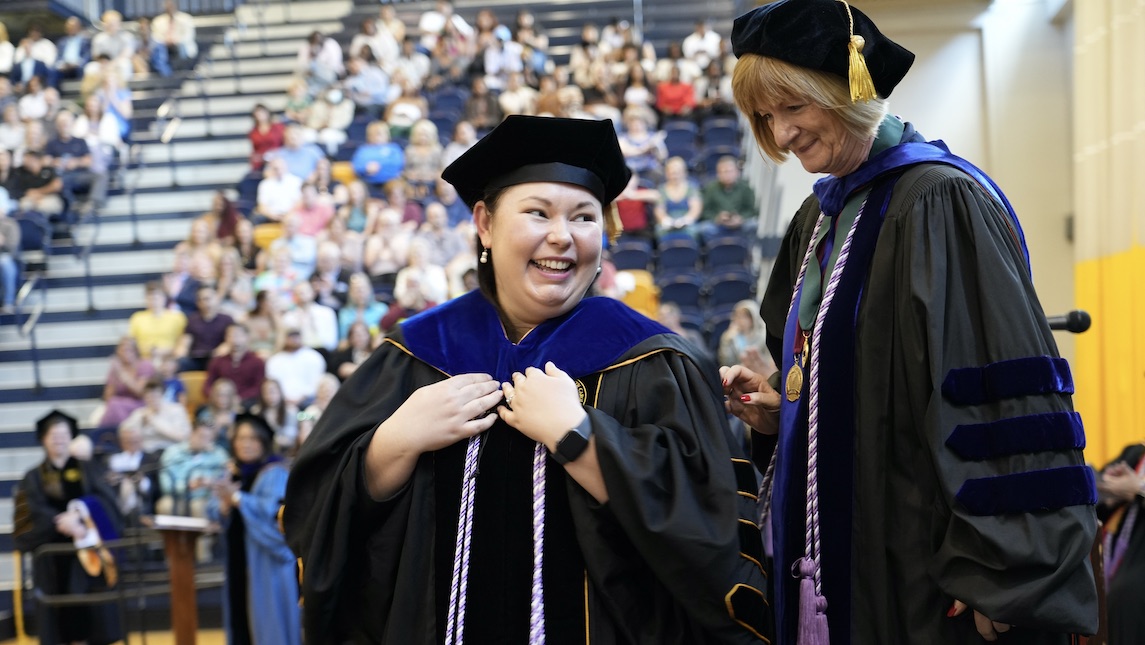
Students completing all degree requirements by the end of the spring semester are encouraged to participate in the May Commencement ceremony. Students completing all degree requirements by the end of the fall semester are encouraged to participate in the December Commencement ceremony. Students completing all degree requirements by the end of the Summer Session may participate in either the May or December Commencement ceremony by applying to graduate, paying the graduation fee, and notifying The Graduate School. Master’s regalia may be purchased and doctoral regalia may be purchased or rented from the University Bookstore. Degree candidates will not earn degrees nor be graduated from the University until they have completed all degree requirements. Participation in a commencement ceremony does not presume graduation from the University.
Only those doctoral candidates whose degree requirements are completed by the established deadlines (see the Calendar of Events) are authorized to participate in the formal December or May Commencement ceremony.
Students who do not apply for graduation before the published deadline for any semester may apply for graduation during the next semester. Students who have applied for graduation but fail to meet the requirements must reapply for graduation by the published deadline for the semester in which they will fulfill the requirements.
Degrees are conferred only after all requirements are completed and the Board of Trustees has taken official action.
Through the Division of Continual Learning, UNCG offers graduate credit as well as a variety of special programs that extend its academic resources to meet professional and personal learning needs of individuals. These programs may be offered on or off campus and include regular University academic credit and non-credit courses in formats such as shortened courses, workshops, institutes, conferences, teleconferences, and distance learning.
The State requires that non-credit programs and selected credit courses such as Study Abroad be self-supporting; therefore, fees are assessed for the cost of such programs. Other academic credit courses or programs are assessed according to a tuition and fee schedule established by General Administration of The University of North Carolina.
Graduate credit for academic courses completed through UNCG Division of Continual Learning (distance learning) can be applied to a degree at UNCG only if the student has been admitted to The Graduate School before the completion of 9 cumulative semester hours of credit. Students wishing to include distance learning work in their program should consult their advisors
Independent study is reserved for certificate or degree seeking students. VISIONS students are not eligible to register for independent study. To be eligible for independent study, a student must have completed several regular courses of graduate work and attained at least a 3.0 average. Students may not register for independent study as a substitute for existing courses. Registration for independent study must have the approval of the instructor, the department head or dean, and the Dean of The Graduate School.
Post-Baccalaureate and Post-Master's Certificate students may count no more than 3 semester hours of independent study toward certificate requirements.
Master's candidates may register for no more than 3 semester hours of independent study per semester and may count no more than 6 semester hours of independent study toward satisfying the minimum requirements for the master’s degree. At the discretion of the department, M.F.A. students may earn up to a maximum of 20% of their required hours as independent study credits.
Doctoral candidates may count not more than 15 semester hours of independent study toward degree requirements.
The University operates a Summer Session with classes beginning on a schedule of varying dates throughout the summer, thus enabling students to pursue a program of study best suited to their needs. Courses are open to graduate students desiring credit towards their advanced degree, certificate, or renewal of their teaching licensure. Special workshops and conferences enrich the opportunities for Summer Session study. A normal course load is six credit hours per five week session.
Students whose programs require that specific faculty members be available to them should determine that these faculty members will be on campus during the summer.
Each graduate student’s program is planned with an advisor who is a graduate faculty member appointed by the department head or dean. The advisor interprets departmental requirements and arranges an orderly sequence of activities for the student’s progress toward the anticipated degree. The student is responsible for continuing in satisfactory academic standing and for meeting all the degree requirements and deadlines for graduation or licensure. Therefore, students are advised to consult with their advisors frequently and to request their advisors to develop a tentative written plan of study. This plan is to be placed on file in The Graduate School.
The Academic Integrity Policy (see Appendix A) states the precepts, violations, and obligations of academic integrity. In addition, graduate students are expected to comply with the social regulations of the University as set forth in the Policies for Students handbook.

All students at UNCG, graduate and undergraduate, are responsible for observing all federal, state, and local laws as well as the regulations of The University. The University has developed policies relating to certain

kinds of behavior and circumstances, some of which are of particular interest or significance to graduate students. Judicial policies related to student conduct and full statements of the following policies may be found at deanofstudents.uncg.edu.
Student-Instructor Relationship
It is essential to the promotion of high academic standards and maintenance of sound professional practice that the student-instructor relationship be free of real or apparent conflicts of interest based on familiar relationships. To this end, a member of the faculty shall not serve in any capacity that will involve evaluating the academic performance of a graduate student when there exists between them a relationship in the first or second degree of affinity or consanguinity or when they otherwise are so closely identified with one another as to suggest a possible conflict of interest.
Members of the voting and non-voting faculty (as identified in sections 2.1 and 2.2 of the Constitution of the Faculty: The University of North Carolina at Greensboro) may not pursue a graduate degree or certificate in their home department or degree-offering unit. For exceptions, the Dean of the unit/program may petition the Dean of The Graduate School.